General, Organic & Biological Chemistry, 5e (Timberlake)
Chapter 6 Ionic and Molecular Compounds
6.1 Multiple-Choice Questions
1) The number of valence electrons found in an atom of a Group A element is equal to
A) its atomic number.
B) its mass number.
C) its group number.
D) eight.
E) eight minus the group number.
2) Valence electrons are electrons located
A) in the outermost energy level of an atom.
B) in the nucleus of an atom.
C) in the innermost energy level of an atom.
D) throughout the atom.
E) in the first three shells of an atom.
3) In an electron-dot structure of an element, the dots are used to represent
A) all of the electrons in the atom.
B) the valence electrons.
C) the electron arrangement.
D) only the electrons that will participate in bond formation.
E) the electrons that the element will gain when it forms a compound.
4) How many valence electrons are in the electron-dot structures for the elements in group 3A(13)?
A) 1
B) 2
C) 3
D) 4
E) 6
2
5) How many valence electrons does nitrogen have?
A) one
B) two
C) three
D) four
E) five
6) How many valence electrons does carbon have?
A) one
B) two
C) three
D) four
E) five
7) The octet rule indicates that
A) all of the noble gases have eight total electrons.
B) all of the shells in an atom hold a maximum of 8 electrons.
C) all of the Group A elements have 8 valence electrons.
D) atoms lose, gain, or share valence electrons to have 8 valence electrons.
E) the noble gases react with other compounds to get 8 valence electrons.
8) In ionic compounds, ________ lose their valence electrons to form positively charged ________. (5,2)
A) metals; anions
B) nonmetals; cations
C) metals; polyatomic ions
D) nonmetals; anions
E) metals; cations
9) How many electrons will aluminum gain or lose when it forms an ion?
A) lose 1
B) gain 5
C) lose 2
D) lose 3
E) gain 1
10) What is the symbol for the ion with 19 protons and 18 electrons?
A) F+
B) F–
C) Ar+
D) K–
E) K+
11) To form an ion, a sodium atom
A) gains one electron.
B) gains two electrons.
C) loses seven electrons.
D) loses one electron.
E) loses two electrons.
12) An anion always
A) has a positive charge.
B) contains a group of two or more atoms with a positive charge.
C) contains a metal and a nonmetal.
D) forms covalent bonds.
E) has a negative charge.
13) What is the ionic charge of an ion with 13 protons and 10 electrons?
A) 1+
B) 2+
C) 3+
D) 2–
E) 3–
14) The number of electrons in an ion with 20 protons and an ionic charge of 2+ is
A) 24.
B) 22.
C) 20.
D) 18.
E) 16.
15) Elements in group 2A(2) of the periodic table form ions with a charge of
A) 1+.
B) 1–.
C) 2+.
D) 3+.
E) 0.
16) The ion of aluminum is
A) Al+.
B) Al2+.
C) Al3+.
D) Al3-.
E) Al2-.
17) How many electrons will chlorine gain or lose when it forms an ion?
A) lose 1
B) gain 1
C) lose 7
D) gain 2
E) lose 3
18) What is the correct formula for the oxide ion?
A) O2-
B) O–
C) O+
D) O2+
E) O3+
19) What is the formula of the nitride ion?
A) N3-
B) NO2–
C) NO33-
D) NO32-
E) NO3–
20) How many electrons will lithium gain or lose when it forms an ion?
A) lose 1
B) gain 5
C) lose 2
D) lose 3
E) gain 1
21) How many electrons will iodine gain or lose when it forms an ion?
A) lose 1
B) gain 5
C) lose 2
D) lose 3
E) gain 1
6
22) An ionic compound
A) has a net positive charge.
B) has a net negative charge.
C) contains only cations.
D) contains only anions.
E) has a net charge of zero.
23) The correct formula for a compound formed from the elements Al and O is
A) AlO.
B) Al2O.
C) Al3O2.
D) AlO3.
E) Al2O3.
24) The correct formula for the compound formed from Mg and S is
A) MgS.
B) MgS2.
C) Mg2S.
D) Mg2S2.
E) Mg2S3.
25) Which one of the following compounds contains an ion with a 3+ charge?
A) KCl
B) Na2O
C) FeCl3
D) CuCl
E) MgCl2
7
26) The compound MgCl2
is named
A) magnesium chlorine.
B) magnesium dichloride.
C) magnesium(II) chloride.
D) magnesium chloride.
E) dimagnesium chloride.
27) Which one of the following elements forms two or more ions with different ionic charges?
A) K
B) F
C) Ca
D) O
E) Fe
28) What is the correct formula for the iron(II) ion?
A) Fe+
B) Fe2+
C) Fe3+
D) Fe2-
E) Fe3-
29) The name of the Cu+ ion is
A) copper(II).
B) copper(I).
C) cobalt.
D) copper.
E) cuprum.
30) What is the correct formula for iron(III) sulfide?
A) Fe2S2
B) Fe2S
C) FeS
D) FeS2
E) Fe2S3
31) The name of Al2(SO4)3 is
A) aluminum(III) sulfate.
B) dialuminum trisulfate.
C) dialuminum sulfate.
D) dialuminum trisulfide.
E) aluminum sulfate.
32) The name of PbO2
is
A) lead dioxide.
B) lead(II) oxide.
C) lead(IV) oxide.
D) plumbum oxide.
E) lead oxygen.
33) The formula of copper(I) sulfide is
A) CuS.
B) Cu2S.
C) Cu2(SO4)3.
D) CuSO4.
E) CuS2.
9
34) A group of covalently bonded atoms that has an overall electrical charge is called a(n)
A) ionic compound.
B) anion.
C) polyatomic ion.
D) cation.
E) molecule.
35) Which of the following polyatomic ions has a positive charge?
A) hydroxide
B) sulfate
C) hydrogen carbonate
D) ammonium
E) nitrate
36) The name of the HSO4– ion is
A) sulfate.
B) hydrogen sulfate.
C) sulfite.
D) hydrogen sulfite.
E) sulfide.
37) What is the formula of a compound that contains Na+ and PO43- ions?
A) Na3PO4
B) NaPO4
C) Na2PO3
D) Na3PO3
E) Na3P
38) Fe2(SO4)3 is called
A) iron sulfate.
B) iron(II) sulfate.
C) iron(III) sulfate.
D) diiron trisulfate.
E) iron trisulfate.
39) What is the formula for aluminum nitrite?
A) Al2NO2
B) AlNO3
C) Al(NO2)3
D) Al2(NO3)3
E) Al2(NO2)2
40) Which of the following polyatomic ions has a 3– ionic charge?
A) hydroxide
B) nitrate
C) sulfate
D) phosphate
E) bicarbonate
41) A(n) ________ is the smallest neutral unit of two or more atoms held together by a covalent bond.
A) ionic compound
B) nucleus
C) molecule
D) formula
E) unit
42) In a molecule with covalent bonding
A) oppositely charged ions are held together by strong electrical attractions.
B) atoms of metals form bonds to atoms of nonmetals.
C) atoms of different metals form bonds.
D) atoms are held together by sharing electrons.
E) atoms of noble gases are held together by attractions between oppositely charged ions.
43) The correct name of the compound is
A) nitrogen chloride.
B) trinitrogen chloride.
C) nitrogen(III) chloride.
D) nickel chloride.
E) nitrogen trichloride.
44) The formula for a molecule formed from N and Cl would be
A) NCl.
B) NCl2.
C) NCl3.
D) N3Cl.
E) NCl5.
45) The types of compounds that use prefixes in their names are
A) ionic compounds.
B) ionic compounds involving transition metals.
C) polyatomic ions.
D) covalent compounds.
E) compounds that contain polyatomic ions.
46) The correct name for the compound N2O3 is
A) nitrogen oxide.
B) nitrogen trioxide.
C) dinitride trioxide.
D) dinitrogen oxide.
E) dinitrogen trioxide.
47) What is the formula of carbon tetraiodide?
A) CI
B) CI4
C) C4I
D) CI3
E) C2I4
48) Which of the following elements does NOT exist as a diatomic molecule?
A) hydrogen
B) nitrogen
C) chlorine
D) oxygen
E) carbon
49) In a covalently bonded molecule, the number of electrons that an atom shares with others is usually
equal to the number of electrons
A) in the atom.
B) in its nucleus.
C) in all the atoms.
D) in its ion.
E) needed to give it a stable electron configuration.
50) Double and triple bonds form because
A) the atoms involved have high electronegativities.
B) single covalent bonds do not give all of the atoms in the molecule eight valence electrons.
C) one of the atoms in the molecule has more than eight valence electrons.
D) the ions involved have charges larger than one.
E) there is at least one hydrogen atom involved in the bond.
51) How many valence electrons are in the electron-dot structure of H2O?
A) 2
B) 4
C) 6
D) 8
E) 10
52) How many lone pairs of electrons are in the electron-dot structure of H2O?
A) 0
B) 1
C) 2
D) 3
E) 4
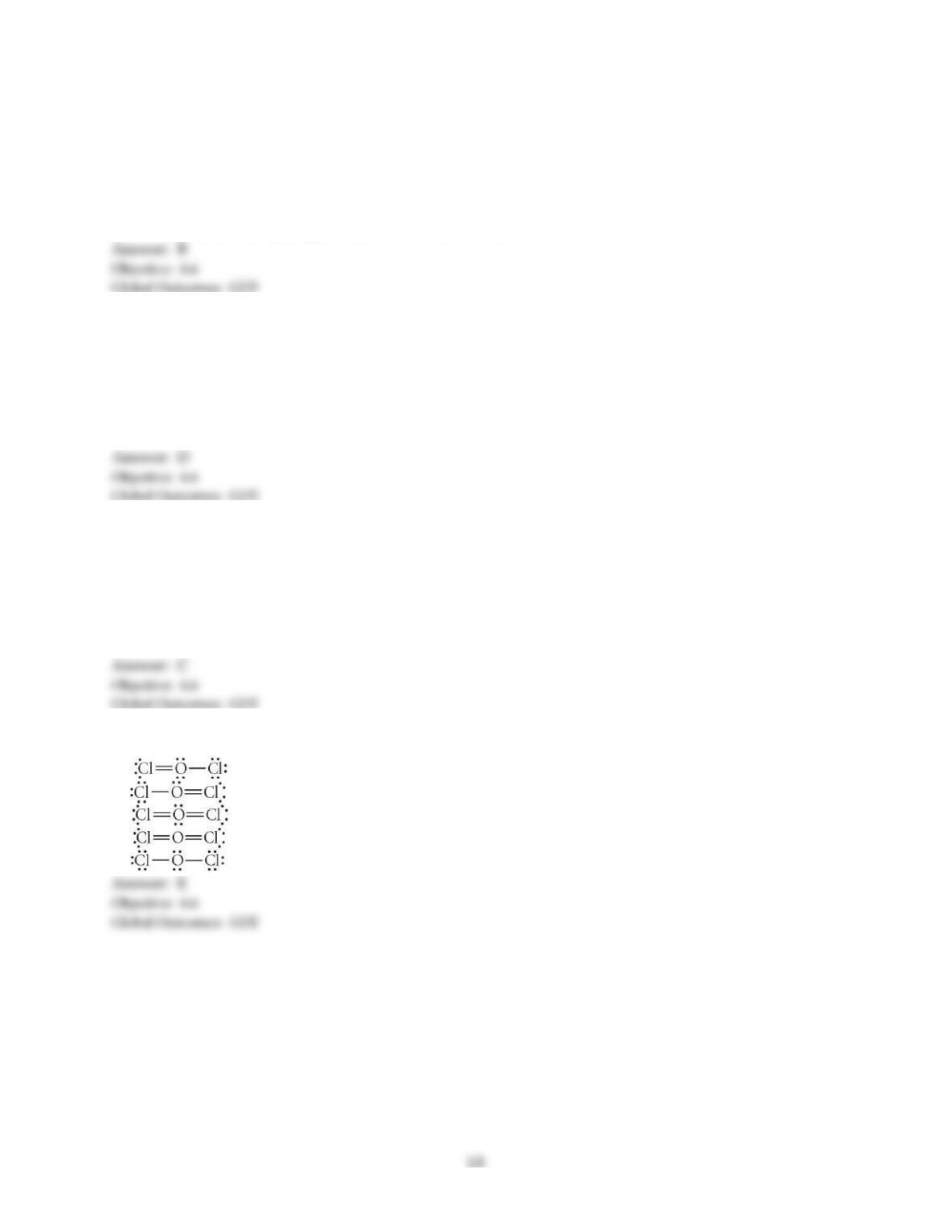
53) Choose the best electron-dot structure for OCl2.
A)
B)
C)
D)
E)
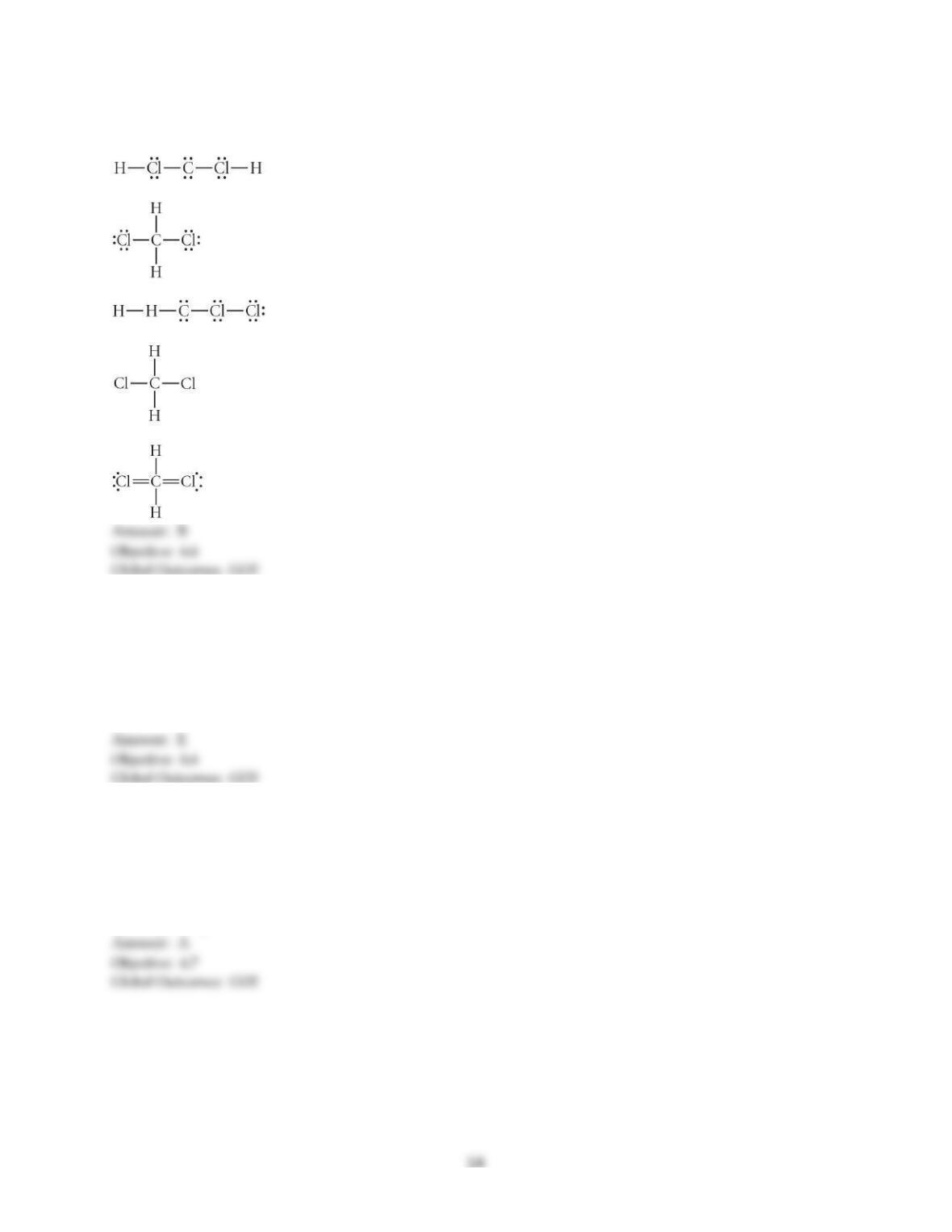
54) Choose the best electron-dot structure for CH2Cl2.
A)
B)
C)
D)
E)
55) How many valence electrons are in the electron-dot structure of CCl4?
A) 0
B) 82
C) 6
D) 8
E) 32
56) The ability of an atom to attract the shared electrons in a covalent bond is its
A) electronegativity.
B) bonding ability.
C) polarity.
D) ionic character.
E) nonpolarity.