For the question(s) that follow, consider the following balanced equation.
Mg3N2(s) + 6H2O(l) → 3Mg (OH)2(s) + 2NH3(g)
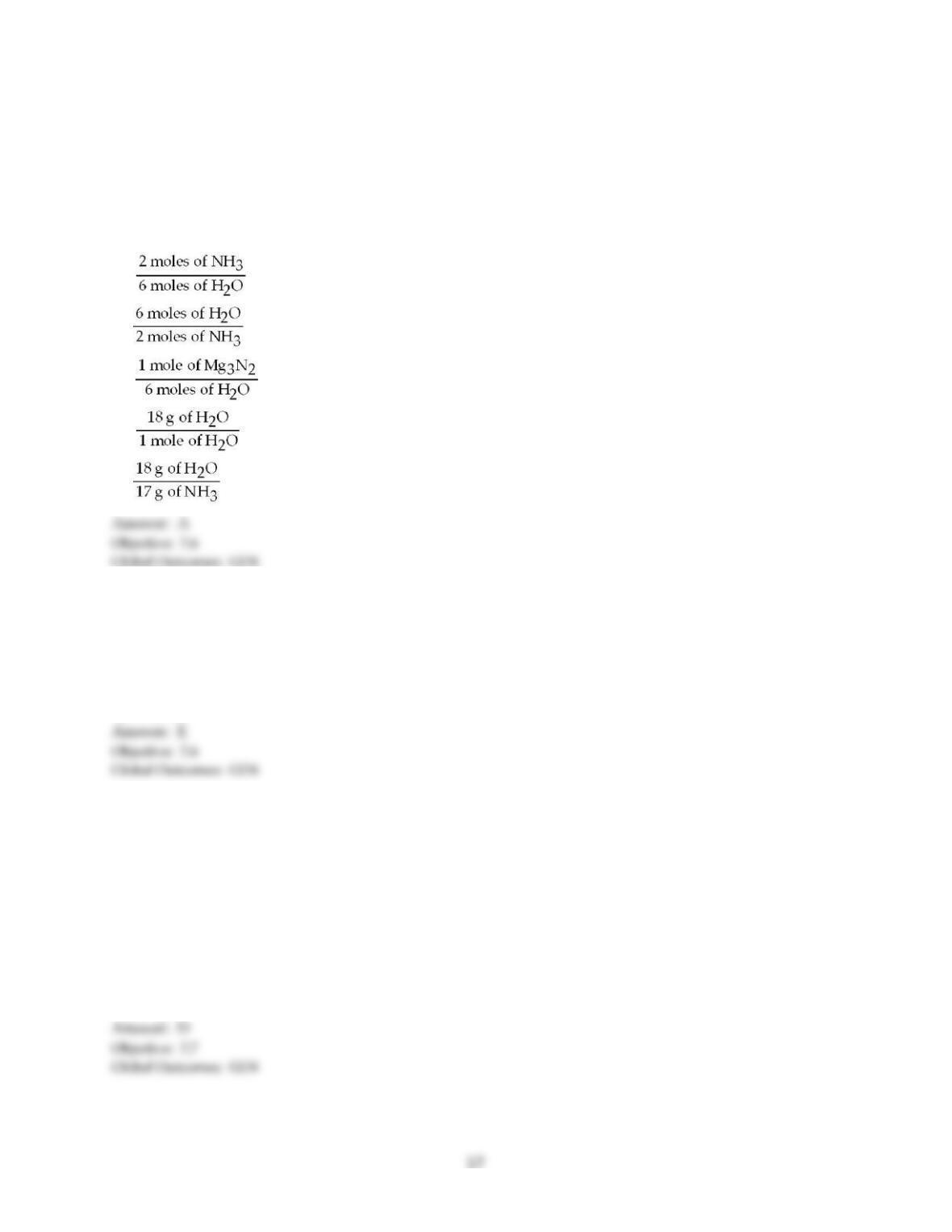
58) What is the correct form of the conversion factor needed to convert the number of moles of H2O to the
number of moles of NH3
produced?
A)
B)
C)
D)
E)
59) When 2 moles of Mg3N2 are allowed to react, how many moles of H2O also react?
A) 1 mole
B) 4 moles
C) 6 moles
D) 8 moles
E) 12 moles
For the question(s) that follow, consider the following equation.
2Mg + O2 → 2MgO
60) How many grams of MgO are produced when 40.0 grams of O2 react completely with Mg?
A) 30.4 g
B) 50.4 g
C) 60.8 g
D) 101 g
E) 201 g
For the question(s) that follow, consider the following balanced equation.
Mg3N2(s) + 6H2O(l) → 3Mg (OH)2(s) + 2NH3(g)
61) How many grams of H2O are needed to produce 150 g of Mg(OH)2?
A) 46 g
B) 18 g
C) 130 g
D) 93 g
E) 23 g
62) When 36.0 g of H2O react, how many grams of NH3 are produced?
A) 34.0 g
B) 10.0 g
C) 5.67 g
D) 11.3 g
E) 102 g
63) How many grams of hydrogen are needed to produce 1.80 g of water according to this equation?
2H2 + O2 → 2H2O
A) 0.100 g
B) 0.180 g
C) 0.200 g
D) 2.00 g
E) 4.00 g
64) In the reaction of silver nitrate with sodium chloride, how many grams of silver chloride will be
produced from 100. g of silver nitrate when it is mixed with an excess of sodium chloride? The equation
for the reaction is below.
AgNO3(aq) + NaCl(aq) → AgCl(s) + NaNO3(aq)
A) 107.9 g
B) 169.9 g
C) 84.4 g
D) 0.589 g
E) 58.9 g
65) Find the mass of AlCl3 that is produced when 25.0 grams of Al2O3 react with excess HCl according to
the following equation.
Al2O3(s) + 6HCl(aq) → 2AlCl3(aq) + 3H2O(l)
A) 155 g
B) 72.9 g
C) 65.4 g
D) 32.6 g
E) 16.3 g
66) How many grams of NO are required to produce 145 g of N2 in the following reaction?
4NH3(g) + 6NO(g) → 5N2(g) + 6H2O(l)
A) 186 g
B) 155 g
C) 125 g
D) 129 g
E) 145 g
67) How many grams of N2 are produced from 100. g of NH3 in the following reaction?
4NH3(g) + 6NO(g) → 5N2(g) + 6H2O(l)
A) 165 g
B) 132 g
C) 125 g
D) 206 g
E) 7.35 g
68) How many grams of CO2 are produced from 125 g of O2 and excess CH4?
CH4 + 2O2 → CO2 + 2H2O
A) 125 g of CO2
B) 62.5 g of CO2
C) 172 g of CO2
D) 85.9 g of CO2
E) 250. g of CO2
69) When 3.05 moles of CH4 are mixed with 5.03 moles of O2 the limiting reactant is
CH4 + 2O2 → CO2 + 2H2O
A) CH4.
B) O2.
C) CO2.
D) H2O.
70) When 85.0 g of CH4 are mixed with 160. g of O2 the limiting reactant is
CH4 + 2O2 → CO2 + 2H2O
A) CH4.
B) O2.
C) CO2.
D) H2O.
71) When 10.0 g of NH3 reacts, the actual yield of N2 is 8.50 g. What is the percent yield?
4NH3(g) + 6NO(g) → 5N2(g) + 6H2O(l)
A) 85.0%
B) 51.5%
C) 20.6%
D) 41.3%
E) 8.5%
72) When 85.0 g of CH4 are mixed with 160. g of O2 what is the maximum amount of CO2 that can be
produced?
CH4 + 2O2 → CO2 + 2H2O
A) 2.50 moles
B) 5.00 moles
C) 5.31 moles
D) 7.81 moles
73) When 60.0 g of CH4 reacts with excess O2, the actual yield of CO2 is 112 g. What is the percent yield?
CH4 + 2O2 → CO2 + 2H2O
A) 53.6 %
B) 187 %
C) 67.9 %
D) 46.4 %
74) Find the mass of AlCl3 that is produced when 10.0 grams of Al2O3 react with 10.0 g of HCl according
to the following equation.
Al2O3(s) + 6HCl(aq) → 2AlCl3(aq) + 3H2O(aq)
A) 16.2 g
B) 20.0 g
C) 12.2 g
D) 10.0 g
E) 6.10 g
75) What type of reaction is: CH4 + 2O2 → CO2 + 2H2O + 218 kcal?
A) an endothermic reaction
B) an exothermic reaction
C) a single replacement reaction
D) a combination reaction
E) a decomposition reaction
76) How many kcal are produced when 32.0 g of CH4 react?
CH4 + 2O2 → CO2 + 2H2O + 218 kcal
A) 218 kcal
B) 109 kcal
C) 436 kcal
D) 6.81 kcal
E) 698 kcal
77) For the reaction: 2H2O(l) + 137 kcal → 2H2 (g) + O2 (g), how many kcal are needed to form 2.00 moles
O2 (g)?
A) 68.5 kcal
B) 137 kcal
C) 274 kcal
D) 190. kcal
E) 548 kcal
78) For the reaction: 2H2O(l) + 137 kcal → 2H2 (g) + O2 (g), how many kcal are needed to react 50.0 g
H2O(l)?
A) 380. kcal
B) 137 kcal
C) 274 kcal
D) 190. kcal
E) 760. kcal
79) If the reaction shown below is exothermic, the energy level of the reactants is
H2 + O2 → 2H2O
A) lower than that of the products.
B) higher than that of the products.
C) the same as that of the products.
D) possibly lower, possibly higher than that of the products.
E) higher than the activation energy of the reaction.
80) In an endothermic reaction
A) heat flows out of the system.
B) energy is absorbed by the system.
C) the temperature of the system increases.
D) the products have less energy that the reactants.
E) the products have the same energy that the reactants.
81) Any reaction that absorbs 150 kcal of energy can be classified as
A) endothermic.
B) exothermic.
C) activated.
D) reduction.
E) oxidation.
82) The ________ is the energy difference between reactants and products in a chemical reaction.
A) transition energy
B) activation energy
C) product energy
D) overall energy
E) heat of reaction
83) The ________ is the minimum energy needed for a chemical reaction to begin.
A) reaction energy
B) activation energy
C) energy of reactants
D) energy of products
E) heat of reaction
84) A reaction that releases energy as it occurs is classified as a(n)
A) endothermic reaction.
B) exothermic reaction.
C) oxidation-reduction reaction.
D) catalyzed reaction.
E) decomposition reaction.
7.2 Bimodal Questions
1) In this reaction, what is the correct coefficient for hydrogen gas?
? H2 + ? O2 → ? H2O
A) 1
B) 2
C) 3
D) 4
E) 5
Barium chloride and sodium sulfate react according to the following equation.
BaCl2 + Na2SO4 → BaSO4 + 2NaCl
Answer the question(s) that follow about this reaction.
2) How many moles of barium sulfate are produced from 0.100 mole of barium chloride?
A) 0.0100 mole
B) 0.100 mole
C) 0.200 mole
D) 1.00 mole
E) 2.00 moles
3) How many grams of barium sulfate can be produced from 20.8 g of barium chloride?
A) 1.37 g
B) 2.33 g
C) 23.3 g
D) 137 g
E) 233 g
4) How many grams of barium chloride are needed to make 100. grams of barium sulfate?
A) 44.9 g
B) 89.2 g
C) 208.3 g
D) 233.3 g
E) 46.6 g
Answer the question(s) that follow about the following reaction.
2H2O2 → 2H2O + O2
5) How many moles of oxygen gas can 0.88 mole of hydrogen peroxide (H2O2) produce, if decomposition
is complete?
A) 0.50 mole
B) 0.88 mole
C) 1.8 moles
D) 2.0 moles
E) 0.44 mole
6) How many grams of water will 100. grams of hydrogen peroxide (H2O2) produce?
A) 3600 g
B) 360. g
C) 5.88 g
D) 52.9 g
E) 106 g
7) How many grams of hydrogen peroxide (H2O2) are needed to produce 25.0 g of oxygen?
A) 106 g
B) 26.6 g
C) 5.88 g
D) 25.0 g
E) 53.1 g
8) How many moles of hydrogen peroxide (H2O2) are needed to produce 5.0 moles of water?
A) 1.0 mole
B) 2.0 moles
C) 4.0 moles
D) 5.0 moles
E) 8.0 moles
7.3 Short Answer Questions
1) What type of reaction is the following?
2KClO3 → 2KCl + 3O2
2) What type of reaction is the following?
Zn + 2HCl → ZnCl2 + H2
3) What type of reaction is the following?
2KClO3 → 2KCl + 3O2
4) What type of reaction is the following?
Zn + 2HCl → ZnCl2 + H2
5) The number of particles in 1 mole of hydrogen gas is ________.
28
6) The molar mass of copper(II) nitrate, Cu(NO3)2 is ________.
7) What is the mass of 1 mole of argon gas?
8) What is the mass of 1 mole of helium gas?
9) Acetylene gas, C2H2, reacts with oxygen according to the following equation. If 1.00 mole of acetylene
reacts completely with sufficient oxygen, how many moles of carbon dioxide are produced?
2C2H2 + 5O2 → 4CO2 + 2H2O
7.4 True/False Questions
1) The following reaction is balanced.
KClO3 → KCl + O2
2) The following is a decomposition reaction.
2KClO3 → 2KCl + 3O2
3) Loss of electrons is an oxidation.
4) Avogadro’s number is the number of grams in a mole.
5) The molar mass of silver is 47 g.
6) The molar mass of magnesium is 24.3 g.
7) The mass of one mole of water is 18.0 g.
8) The molar mass of chlorine gas is 35.5 g.
9) The molar mass of copper(II) chloride is 134.5 g.
10) In the reaction of hydrogen gas with oxygen gas to produce water, 1 mole of oxygen gas can produce
2 moles of water, given sufficient hydrogen available.
11) In the reaction of hydrogen gas with oxygen gas to produce water, 16.0 g of oxygen gas can produce
9.00 g of water, given sufficient hydrogen available.
2H2 + O2 → 2H2O
12) The % yield is the ratio of the theoretical yield to the actual yield multiplied by 100.
13) In an exothermic reaction, heat is a product.
7.5 Matching Questions
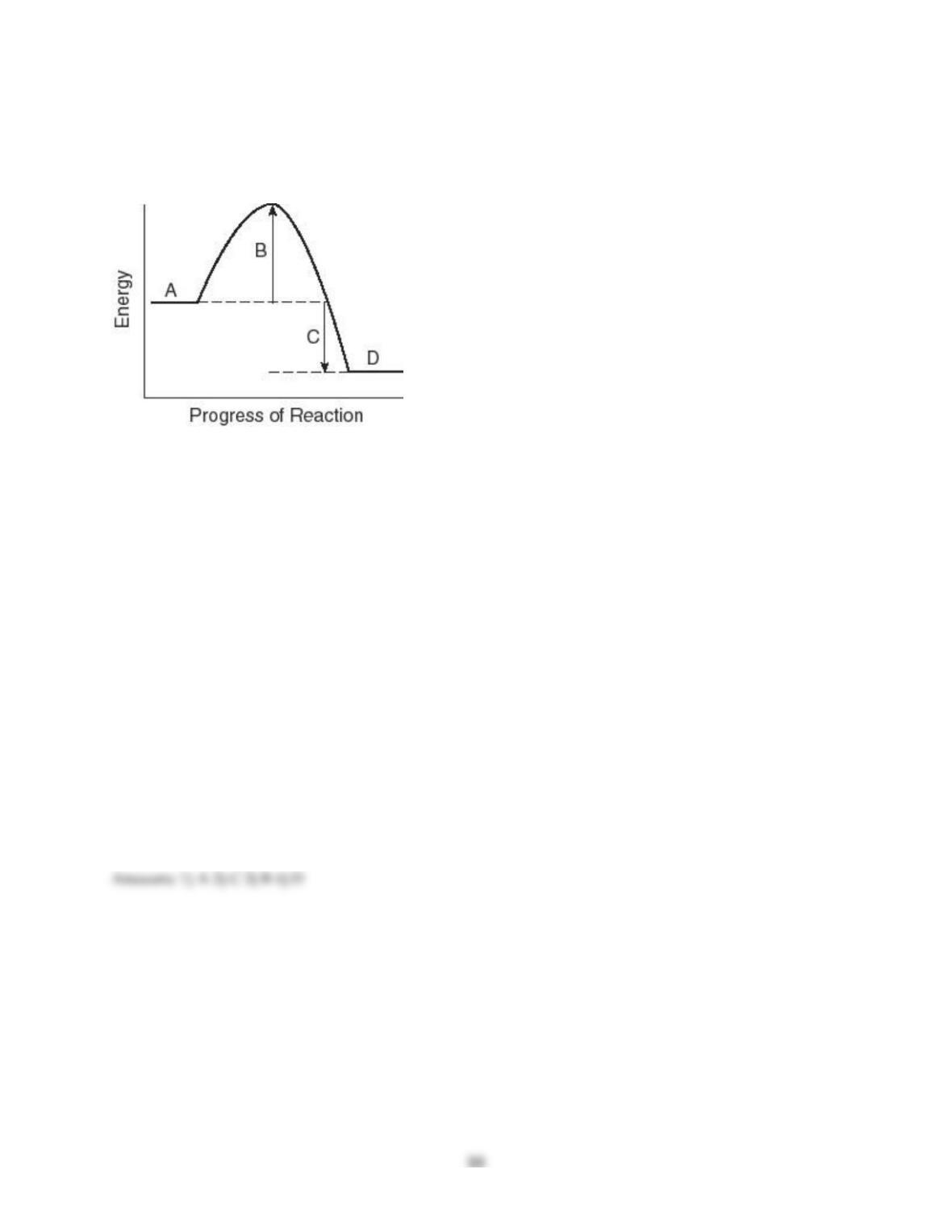
Identify the energy associated with each of the labeled parts of the following diagram.
A) energy of reactants
B) heat of reaction
C) activation energy
D) energy of products
1) Region A
Objective: 7.9
Global Outcomes: GO3
2) Region B
Objective: 7.9
Global Outcomes: GO3
3) Region C
Objective: 7.9
Global Outcomes: GO3
4) Region D
Objective: 7.9
Global Outcomes: GO3
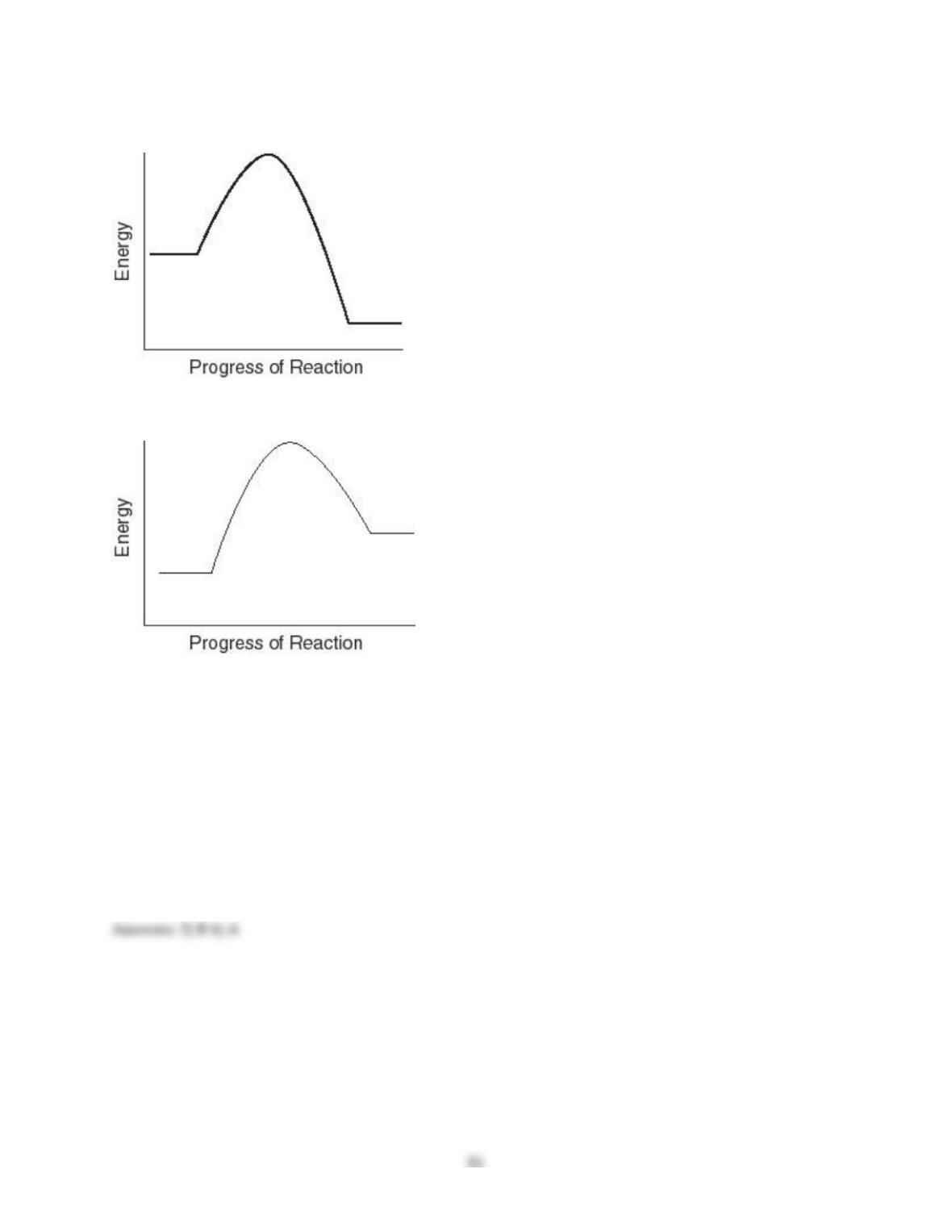
Identify the letter of the diagram corresponding to the given type of reaction.
A
B
A) Diagram A
B) Diagram B
5) endothermic reaction
Objective: 7.9
Global Outcomes: GO3
6) exothermic reaction
Objective: 7.9
Global Outcomes: GO3