46) The water-soluble B and C vitamins supply
A) essential amino acids.
B) substrates necessary for most of the reactions in the body.
C) essential fatty acids.
D) coenzymes required by some enzymes.
E) competitive inhibitors needed to regulate enzyme activity.
47) Metal ions such as Zn2+ and Fe3+ are often needed by enzymes as
A) isozymes.
B) allosteres.
C) inhibitors.
D) cofactors.
E) substrates.
48) When a cofactor is a small organic molecule, it is known as a(n)
A) isoenzyme.
B) vitamin.
C) zymogen.
D) coenzyme.
E) regulator.
49) Iron(II) and iron(III) ions are used in the functioning of
A) urease.
B) alcohol dehydrogenase.
C) creatine kinase.
D) the cytochrome oxidase system.
E) pepsin.
50) The B vitamins are examples of
A) water-soluble vitamins.
B) essential amino acids.
C) essential minerals.
D) oil soluble vitamins.
E) vitamins that are stored in the liver.
51) Coenzymes such as water-soluble vitamins are needed in only small amounts because
A) only small amounts of enzymes are present in each cell.
B) only small amounts of substrates are available at any one time.
C) they can be eliminated in the urine.
D) each vitamin molecule can be reused many times as a cofactor.
E) they can be stored in the liver for future use.
20.2 Bimodal Questions
1) A biological catalyst is called a(n) ________.
A) lipid
B) enzyme
C) cofactor
D) coenzyme
E) substrate
2) The names of many enzymes can be recognized by the suffix ________.
A) -ate
B) -ite
C) -ose
D) -ine
E) -ase
3) An enzyme that converts a cis double bond to a trans double bond is classified as a(n) ________.
A) oxidoreductase
B) transferase
C) hydrolase
D) lyase
E) isomerase
14
4) The full name of the enzyme LDH is ________.
A) lactate dehydrogenase
B) liver decompensation hexase
C) lactate dehydrase
D) liver dihydrogen kinase
E) lipase dehydrogenase
5) Enzymes that catalyze the same reactions but have slightly different structures are called ________.
A) coenzymes
B) cofactors
C) isoenzymes
D) competitive
E) noncompetitive
6) An enzyme that removes H from a substrate is classified as a(n) ________.
A) oxidoreductase
B) transferase
C) hydrolase
D) lyase
E) isomerase
7) The optimum pH for the activity of pepsin is about ________.
A) 2.0
B) 4.0
C) 6.5
D) 7.4
E) 7.6
8) The optimum pH for the activity of trypsin is about ________.
A) 2.0
B) 4.0
C) 6.5
D) 7.4
E) 8.0
9) Another name for a zymogen is a(n) ________.
A) cofactor
B) coenzyme
C) prosthetic group
D) isozyme
E) proenzyme
10) One deficiency disease that can be traced to insufficient intake of vitamin D is ________.
A) scurvy
B) rickets
C) beriberi
D) pellagra
E) pernicious anemia
11) A diet very low in vitamin C can lead over time to the condition ________.
A) rickets
B) scurvy
C) cancer
D) carpal tunnel syndrome
E) anorexia nervosa
20.3 Short Answer Questions
Indicate whether each of the following is fat soluble or water soluble.
1) vitamin B6
2) vitamin A
3) pantothenic acid
4) ascorbic acid
5) vitamin E
6) vitamin K
7) niacin
8) folic acid
9) vitamin D
10) riboflavin
20.4 True/False Questions
1) The active site is a large part of an enzyme.
2) In the induced fit model of enzyme activity, both the enzyme and the substrate change shape.
3) Alanine transaminase is an example of a transferase enzyme.
4) Pyruvate carboxylase is an example of a ligase enzyme.
5) Urease is an example of an oxidoreductase enzyme.
6) The optimum pH of most cellular enzymes is about 7.4.
7) Phosphorylation is a common form of covalent modification.
8) Insulin and digestive enzymes are produced as inactive forms called zymogens.
9) Enzymes always require a cofactor.
10) Enzyme cofactors are always metal ions, such as Zn2+ and Fe3+.
11) Vitamins are often cofactors.
20.5 Matching Questions
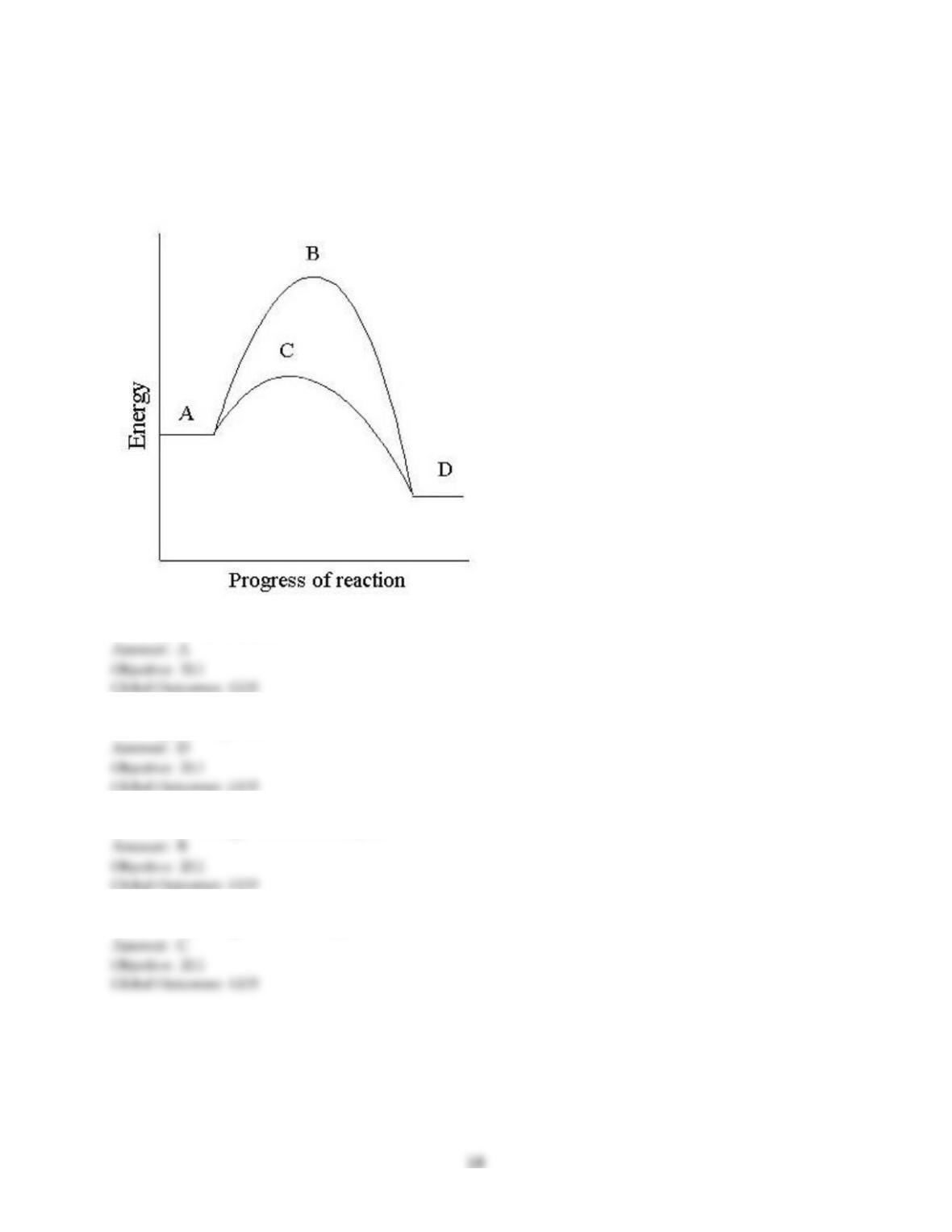
Identify each of the designated regions on the energy diagram for the conversion of a substrate to product with and
without an enzyme.
1) energy of the substrate
2) energy of the product
3) activation energy without the enzyme
4) activation energy with the enzyme

Match the correct term in enzyme action with each description.
A) coenzyme
B) lock-and-key theory
C) cofactor
D) active site
E) enzyme-substrate complex
5) the temporary combination of an enzyme with the compound on which it acts
Objective: 20.1, 20.6
Global Outcomes: GO2
6) an organic compound that is sometimes needed to complete an enzyme
Objective: 20.1, 20.6
Global Outcomes: GO2
7) the portion of an enzyme molecule where catalytic activity occurs
Objective: 20.1, 20.6
Global Outcomes: GO2
8) an inorganic substance such as Mg2+ required by some enzymes for activity
Objective: 20.1, 20.6
Global Outcomes: GO2
9) one theory that accounts for the unusual specificity of an enzyme
Objective: 20.1, 20.6
Global Outcomes: GO2

Identify the effect of the following on the activity of maltase, an enzyme that hydrolyzes maltose.
A) decreases
B) increases
C) has no effect
10) decreasing the concentration of maltose
Objective: 20.3
Global Outcomes: GO2
11) adjusting the temperature to the optimum temperature
Objective: 20.3
Global Outcomes: GO2
12) raising the pH to 11.0
Objective: 20.3
Global Outcomes: GO2
13) increasing the concentration of maltase (enzyme) when the enzyme is saturated with substrate
Objective: 20.3
Global Outcomes: GO2
14) lowering the pH to 1.0
Objective: 20.3
Global Outcomes: GO2

Identify the type of inhibition in each description.
A) competitive
B) noncompetitive
15) an inhibitor that resembles the structure of the substrate
Objective: 20.4
Global Outcomes: GO2
16) an inhibitor that forms a covalent bond with a side chain in the active site
Objective: 20.4
Global Outcomes: GO2
17) Adding more substrate does not reverse the effect of this inhibitor.
Objective: 20.4
Global Outcomes: GO2
18) The inhibition can be reversed by increasing the concentration of substrate.
Objective: 20.4
Global Outcomes: GO2
19) The inhibitor does not resemble the substrate.
Objective: 20.4
Global Outcomes: GO2

Match the vitamin name with its corresponding chemical name.
A) thiamine
B) cobalamin
C) niacin
D) cholecalciferol
E) ascorbic acid
F) riboflavin
G) pyridoxine
20) vitamin B3
Objective: 20.6
Global Outcomes: GO2
21) vitamin B2
Objective: 20.6
Global Outcomes: GO2
22) vitamin B1
Objective: 20.6
Global Outcomes: GO2
23) vitamin C
Objective: 20.6
Global Outcomes: GO2
24) vitamin B12
Objective: 20.6
Global Outcomes: GO2
25) vitamin B6
Objective: 20.6
Global Outcomes: GO2