40) The reactants that will form an ester in the presence of an acid catalyst are
A) two carboxylic acids.
B) two alcohols.
C) a carboxylic acid and an alcohol.
D) an aldehyde and an alcohol.
E) two aldehydes.
41) Which of these compounds is the ester formed from the reaction of acetic acid and 1–propanol?
A) O
CH3 – CH2 – C – O – CH2– CH3
B) OH
|
CH3 – C – OH
|
O – CH2 – CH2 – CH3
C) OH
|
CH3 – CH2 – C – OH
|
O – CH2 – CH3
D) O
CH3 – C – O – CH2 – CH2
– CH3
E) O
CH3 – CH2 – CH2
– O – CH2– C – OH
42) The alcohol and carboxylic acid required to form propyl ethanoate are
A) methanol and propionic acid.
B) ethanol and propionic acid.
C) propanol and propanoic acid.
D) 1-propanol and ethanoic acid.
E) 2-propanol and ethanoic acid.
43) What is the product of the reaction of an alcohol and a carboxylic acid when reacted together under
acidic conditions?
A) an ether
B) an ester
C) a salt
D) a ketone
E) an aldehyde
44) Derivatives of which aromatic carboxylic acid have been used as analgesics, antipyretics, and anti–
inflammatory agents?
A) benzoic acid
B) anthranilic acid
C) naphthenic acid
D) p-toluenesulfonic acid
E) salicylic acid
45) Many of the fragrances of flowers and the flavors of fruits are due to
A) ethers.
B) carboxylic acids.
C) esters.
D) amines.
E) amides.
46) What is the common name of this compound?
O
CH3 – C – O – CH2 – CH3
A) ethyl methyl ester
B) diethyl ester
C) ethyl methanoate
D) 2-ether-2-butanone
E) ethyl acetate
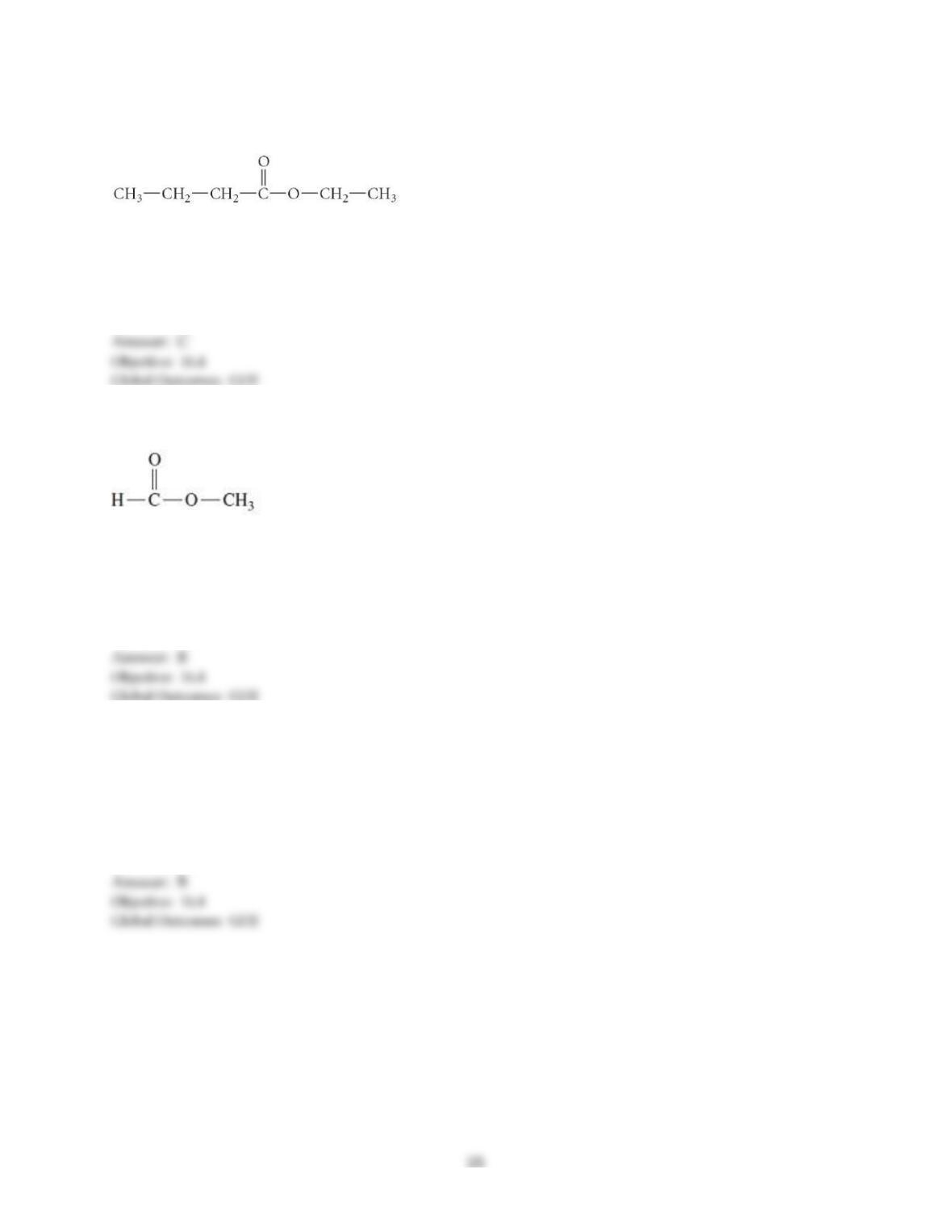
47) Give the IUPAC name for the following compound.
A) ethyl propyl ether
B) ethyl propanoate
C) ethyl butanoate
D) hexanoic acid
E) 4-hexanal
48) Give the IUPAC name for the following compound.
A) methyl formyl ether
B) methyl methanoate
C) methyl ethanoate
D) methyl formate
E) ethanoate
49) From what component is the first part of the IUPAC name of an ester (such as methyl acetate)
derived?
A) the carboxylic acid
B) the alcohol
C) the ether
D) the ester
E) the amide
50) The splitting apart of an ester in the presence of a strong acid and water is called
A) hydrolysis.
B) saponification.
C) neutralization.
D) esterification.
E) reduction.
51) Which of the following is the reaction for the acid hydrolysis of ethyl formate?
A) O O
CH3 – C – O – CH3 + NaOH → CH3 – C – O– Na+ + CH3
– OH
B) O O
CH3 – C – O – CH3 + H2O → CH3 – C – OH
+ CH3
– OH
C) O O
H – C – O – CH3 + H2O → H – C – OH
+ CH3
– OH
D) O O
H – C – O – CH2
–
CH3 + H2O → H – C – OH
+ CH3
– CH2
– OH
E) O OH
|
H – C – O – CH2
–
CH3 + H2O → H – C – O
– CH2
–
CH3
|
OH
52) Which of the following is the reaction for the saponification of methyl acetate?
A) O O
CH3 – C – O – CH3 + NaOH → CH3 – C – OH + CH3
– O– Na+
B) O O
CH3 – C – O – CH3 + NaOH → CH3 – C – O– Na+ + CH3
– OH
C) O O
H – C – O – CH3 + H2O → H – C – O–
+ CH3
– OH
D) O O
H – C – O – CH3 + NaOH → H – C – O– Na+ + CH3
– OH
E) O O
CH3 – C – O – CH3 + H2O → CH3 – C – O–
+ CH3
– OH
53) The reaction of an ester with NaOH is known as
A) esterification.
B) neutralization.
C) saponification.
D) reduction.
E) oxidation.
54) What chemical process is responsible for the smell of vinegar in an old bottle of aspirin?
A) reduction
B) hydration
C) hydrolysis
D) esterification
E) dissolution
55) Which part of a soap is responsible for its ability to dissolve fats and oily dirt?
A) the hydrophilic end
B) the hydrophobic end
C) the carboxylate
D) the ionized oxygen
E) the carbonyl group
56) What is the name of the structure formed when a soap coats an oily particle to make it water soluble?
A) micelle
B) cluster
C) liposome
D) dimer
E) lipid
16.2 True-False Questions
1) Carboxylic acids are responsible for the sweet taste of fruits and vegetables.
2) The major acidic component of vinegar is formic acid.
3) Alpha-hydroxy acids should be used at concentrations under 10% in skin care products.
4) It is always safe to use any commercial skin care product without doing a test patch first.
5) Benzoic acid is an aromatic carboxylic acid.
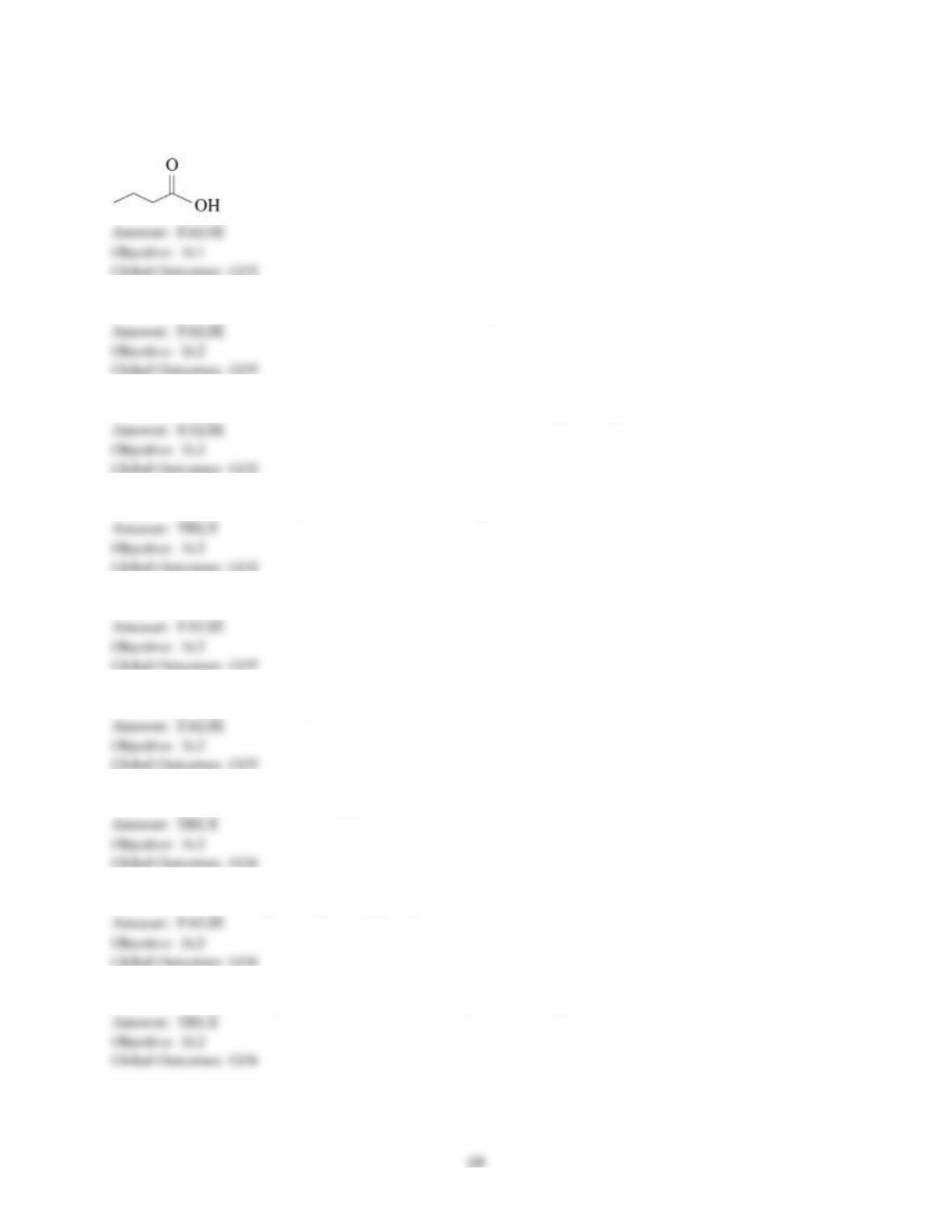
6) The IUPAC name of this compound is propanoic acid.
7) Carboxylic acids with more than five carbons are very water soluble.
8) The boiling points of carboxylic acids are lower than the corresponding alcohols.
9) Carboxylic acids with four or fewer carbons are very water soluble.
10) Sodium propionate is a common disinfectant.
11) When in solution, carboxylic acids are mostly in their ionized forms.
12) Sodium benzoate is a common preservative.
13) Citric acid is an important part of glycolysis.
14) The Krebs cycle is a process that the cell uses to produce energy.
15) The Krebs cycle and the citric acid cycle are different processes.
16) Carboxylic acids are strong acids.
17) When benzoic acid is neutralized by sodium hydroxide, sodium benzoate is formed.
18) Esters are formed from the reaction of an ether with a carboxylic acid.
19) An ester is derived from an alcohol and a carboxylic acid.
20) Methyl salicylate (oil of wintergreen) is used therapeutically as a counter-irritant.
21) Polyesters are plastics that are used to make fabrics, bottles, and medical devices such as heart valves.
22) Butyl alcohol is one of the reactants used to make methyl butyrate.
23) The ester formed from butyl alcohol and acetic acid is called butyl acetate.
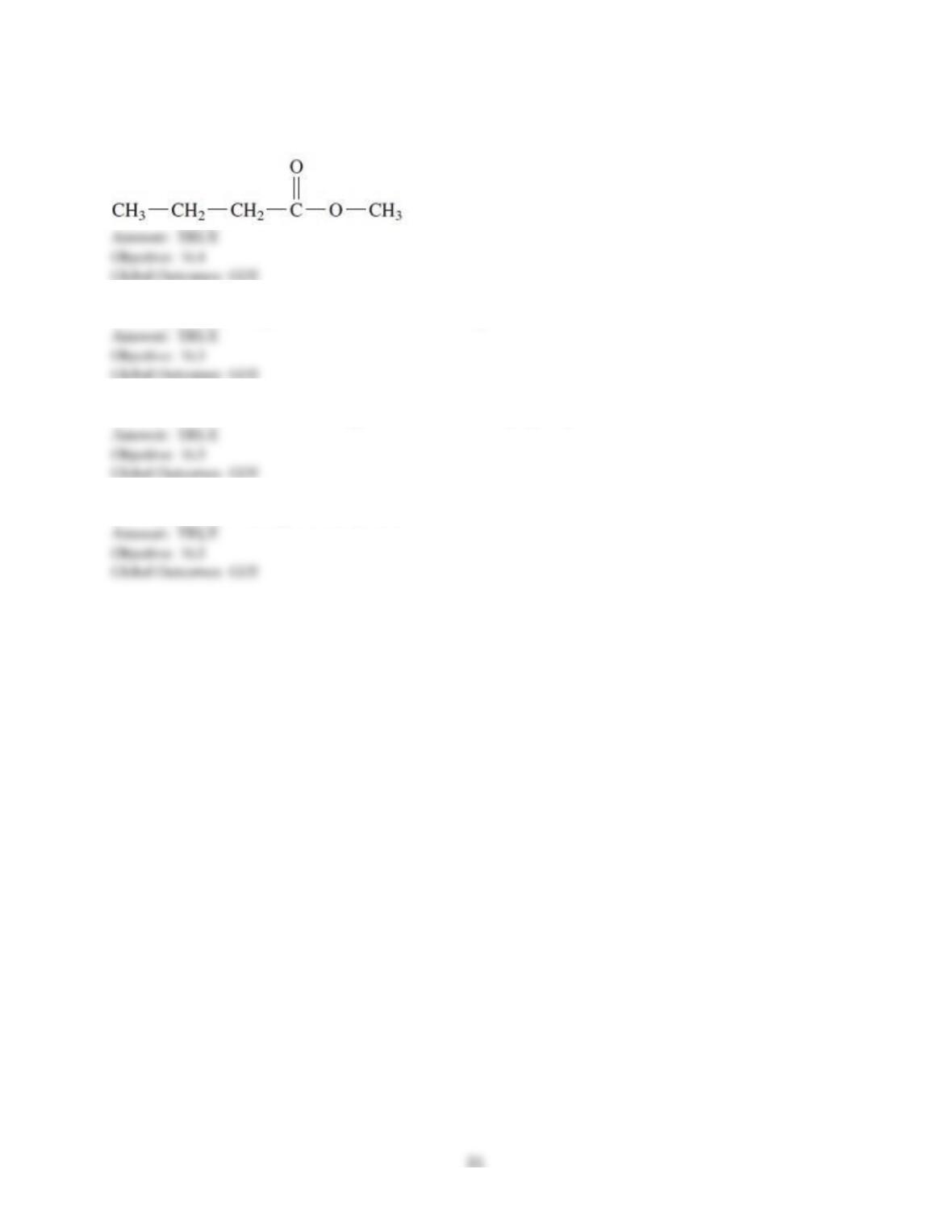
24) The IUPAC name of this compound is methyl butanoate.
25) Long chain carboxylic acids are also known as fatty acids.
26) Aspirin that has a smell of vinegar has broken down by hydrolysis.
27) Soaps are salts of long chain fatty acids.

16.3 Matching Questions
Identify the family for each of the following compounds.
A) ketone
B) carboxylic acid
C) ester
1) O
CH3 – C – CH3
Objective: 16.1, 16.3
Global Outcomes: GO2
2) O
CH3 – CH2 – C – OH
Objective: 16.1, 16.3
Global Outcomes: GO2
3) O
CH3 – CH2 – C – O – CH3
Objective: 16.1, 16.3
Global Outcomes: GO2

Select the correct name for the following.
A) ethyl formate
B) sodium formate
C) formic acid
4) O
H – C – OH
Objective: 16.1, 16.4
Global Outcomes: GO2
5) O
H – C – O – CH2 – CH3
Objective: 16.1, 16.4
Global Outcomes: GO2
6) O
H – C – O– Na+
Objective: 16.1, 16.4
Global Outcomes: GO2