General, Organic & Biological Chemistry, 5e (Timberlake)
Chapter 3 Energy and Matter
3.1 Multiple-Choice Questions
1) Helium is a(n)
A) compound.
B) heterogeneous mixture.
C) element.
D) homogeneous mixture.
E) electron.
2) Air is a(n)
A) compound.
B) heterogeneous mixture.
C) element.
D) homogeneous mixture.
E) None of the above.
3) Coins in a piggy bank is a(n)
A) compound.
B) heterogeneous mixture.
C) element.
D) homogeneous mixture.
E) None of the above.
4) Gold in a wedding ring is a(n)
A) compound.
B) heterogeneous mixture.
C) element.
D) homogeneous mixture.
E) None of the above.
2
5) The primary substances of which all other things are composed are
A) molecules.
B) compounds.
C) elements.
D) electrons.
E) protons.
6) Which of the following is a property of a solid?
A) It takes the shape of the container.
B) It fills the volume of the container.
C) The particles move at a rapid rate.
D) The interactions between its particles are very weak.
E) The particles have fixed positions and are very close together.
7) Which of the following is a physical property of both liquids and gases?
A) has its own shape
B) has a definite volume
C) has strong interactions between its particles
D) has randomly arranged particles
E) has large spaces between molecules
8) Which one of the following properties describes a liquid?
A) has its own shape
B) particles are close together and move randomly
C) particles move very rapidly
D) fills the entire volume of the container
E) There is essentially no interaction between the particles.
9) In a gas, the distance between the particles is
A) very close relative to the size of the molecules.
B) close relative to the size of the molecules.
C) fixed relative to the size of the molecules.
D) small relative to the size of the molecules.
E) very large relative to the size of the molecules.
10) Which of the following is an example of a physical change?
3
A) grinding coffee beans
B) baking a cake
C) converting water to hydrogen and oxygen
D) digesting a cheeseburger
E) burning coal
11) Which of the following would NOT be a physical change?
A) freezing water to make ice cubes
B) tearing a piece of aluminum foil
C) boiling water for soup
D) burning gasoline in a lawnmower
E) melting gold to make jewelry
12) Which of the following is a chemical change?
A) cutting a rope
B) bending a steel rod
C) making a snowman
D) burning sugar
E) melting gold
13) Which of the following is a physical change?
A) baking a cake
B) dry ice subliming
C) fermenting grapes to produce wine
D) digesting a meal
E) a tomato ripening
14) A temperature of 41 °F is the same as
A) 5 °C.
B) 310 °C.
C) -9 °C.
D) 16 °C.
E) 42 °C.
15) If the temperature is 20 °C, what is the corresponding temperature on the Fahrenheit scale?
A) -22 °F

4
B) 68 °F
C) 43 °F
D) 239 °F
E) 94 °F
16) If the temperature is – 55 °C, what is the corresponding temperature on the Kelvin scale?
A) 225 K
B) 218 K
C) 55 K
D) 273 K
E) 328 K
17) A patient has a temperature of 38.5 °C. What is the temperature in degrees Fahrenheit?
A) 70.5 °F
B) 311 °F
C) 126.9 °F
D) 101.3 °F
E) 11.7 °F
18) The temperature of liquid nitrogen is – 196 °C. What is the corresponding reading on the Kelvin scale?
A) 77 K
B) -127 K
C) -91 K
D) 48 K
E) 146 K
19) On a hot day, the thermometer read 95 °F. What is the temperature in degrees Celsius?
A) 77 °C
B) 113 °C
C) 35 °C
D) 63 °C
E) 178 °C
20) Absolute zero is
A) the freezing point of water using the Celsius scale.
B) the boiling point of liquid nitrogen.

5
C) the temperature on the Kelvin scale corresponding to 32 °F.
D) the coldest temperature possible.
E) the freezing point of liquid nitrogen.
21) 650. J is the same amount of energy as
A) 155 cal.
B) 2720 cal.
C) 650 cal.
D) 1550 cal.
E) 2.72 cal.
22) The energy associated with the motion of particles in a substance is called
A) temperature.
B) electrical energy.
C) heat.
D) chemical energy.
E) potential energy.
23) An example of kinetic energy is
A) a coiled spring.
B) running water.
C) a tree.
D) natural gas.
E) chemical energy.
24) Which of the following is an example of potential energy?
A) chewing food
B) water stored in a reservoir
C) burning wood
D) a fan blade turning
E) riding an exercise bike
25) The phrase “ability to do work” is a definition of
A) specific heat.
B) energy.
C) calorie.
6
D) heating.
E) cooling.
26) The energy stored in the chemical bonds of a carbohydrate molecule is
A) specific heat.
B) kinetic energy.
C) potential energy.
D) work.
E) a calorie.
27) The energy of motion is referred to as
A) work.
B) freezing.
C) specific heat.
D) potential energy.
E) kinetic energy.
28) In which of the following would the particles move most rapidly?
A) ice at -20 °C
B) water at 20 °C
C) steam at 110 °C
D) boiling water
E) ice at 0 °C
29) 3.25 kcal is the same amount of energy as
A) 3.25 J.
B) 0.777 J.
C) 777 J.
D) 13600 J.
E) 13.6 J.
30) Global warming is believed to result from all of the following except
A) burning of fossil fuels.
B) increasing levels of carbon dioxide in the atmosphere.
C) deforestation.
D) movement of the Earth closer to the Sun.
E) carbon dioxide trapping the heat produced by the Sun.
31) A 2.5 g sample of french fries is placed in a calorimeter with 500.0 g of water at an initial temperature
of 21 °C. After combustion of the french fries, the water has a temperature of 48 °C. What is the caloric
value (kcal/g) of the french fries?
A) 14 kcal/g
B) 11 kcal/g
C) 0.14 kcal/g
D) 4.2 kcal/g
E) 5.4 kcal/g
32) A potato contains 20 g of carbohydrate. If carbohydrate has a caloric value of 4 kcal/g, how many kcal
are obtained from the carbohydrate in the potato?
A) 5 kcal
B) 20 kcal
C) 40 kcal
D) 60 kcal
E) 80 kcal
33) The dietary calorie (Cal) is equal to
A) 1000 kilocalories.
B) 1000 calories.
C) 100 calories.
D) 10 calories.
E) 1 calorie.
34) A cheeseburger from a fast food restaurant contains 19 g of fat, 20. g of carbohydrate, and 28 g of
protein. How many kcal of energy does the cheeseburger contain? (The accepted caloric values for foods
are 4.0 kcal/g for carbohydrate, 9.0 kcal/g for fat, and 4.0 kcal/g for protein.) Report the answer to 2
significant figures.
A) 70. kcal
B) 360 kcal
C) 17 kcal
D) 630 kcal
E) 280 kcal
35) A serving of fish contains 50.g of protein and 4.0 g of fat. If protein has a caloric value of 4.0 kcal/g and
fat has 9.0 kcal/g, how many kcal are in the serving? Report the answer to 2 significant figures.
A) 240 kcal
B) 54.0 kcal
C) 470 kcal
D) 220 kcal
E) 490 kcal
36) A slice of pizza contains 29 g of carbohydrate, 13 g of protein and an unknown amount of fat. If the
pizza contains 280 kcal, how many grams of fat are present? Report the answer to 2 significant figures.
A) 10. g
B) 12 g
C) 25 g
D) 55 g
E) 250 g
37) A diet has a total caloric intake of 1400 kcal. If the protein in the diet provides 35% of the kcal, the
number of kcal of protein in the diet is
A) 700 kcal.
B) 490 kcal.
C) 210 kcal.
D) 460 kcal.
E) 1200 kcal.
38) One cup of kidney beans contains 15 g of protein, 1.0 g of fat, and 42 g of carbohydrate. How many
kilocalories, to two significant figures, does this sample contain?
A) 60 kcal
B) 88 kcal
C) 230 kcal
D) 240 kcal
E) 520 kcal
39) The specific heat of a substance is the amount of heat needed to
A) change 1 g of the substance from the solid to the liquid state.
B) raise the temperature of 1 g of the substance by 1 °C.
C) change 1 g of the substance from the liquid to the solid state.
D) convert 1 g of a liquid to gas.
E) convert 1 g of a solid to a gas.
40) A kilocalorie of heat is required to raise the temperature of
A) 1 g of water from 14 °C to 15 °C.
B) 1 g of water by 10 °C.
C) 10 g of water by 10 °C.
D) 100 g of water by 10 °C.
E) 100 g of water by 100 °C.
41) How many calories are required to raise the temperature of a 35.0 g sample of iron from 25 °C to 35
°C? Iron has a specific heat of 0.108 cal/g °C.
A) 38 cal
B) 1.1 cal
C) 3.8 cal
D) 93 cal
E) 130 cal
42) How many calories are required to increase the temperature of 13 g of alcohol from 11 °C to 23 °C?
The specific heat of alcohol is 0.588 cal/g °C.
A) 83 cal
B) 0.63 cal
C) 92 cal
D) 0.54 cal
E) 170 cal
43) How many calories are required to raise the temperature of a 150. g sample of gold from 25 °C to 175
°C? The specific heat of gold is 0.0308 cal/g °C.
A) 4.62 cal
B) 116 cal
C) 22500 cal
D) 693 cal
E) 130 cal
44) Raising the temperature of 10.0 g of water from 10.0 °C to 20.0 °C requires 100.0 cal of energy, while
raising the temperature of 10.0 g of aluminum from 10.0 °C to 20.0 °C requires 22 cal. More calories are
required to heat the water because
A) water is a liquid and aluminum is a solid at 10.0 °C.
B) ten grams of water occupies a larger volume than 10.0 g of aluminum.
C) water has a greater potential energy than aluminum.
D) water has a larger specific heat than aluminum.
E) 10.0 °C is closer to the melting point of water than to the melting point of aluminum.
45) The number of calories needed to raise the temperature of 32 g of water from 12 °C to 54 °C is
A) 384 cal.
B) 1.3 cal.
C) 1300 cal.
D) 1700 cal.
E) 0.76 cal.
46) The specific heat of copper is 0.0920 cal/g °C, and the specific heat of silver is 0.0562 cal/g °C. If 100 cal
of heat is added to one g of each metal at 25 °C, what is the expected result?
A) The copper will reach a higher temperature.
B) The silver will reach a higher temperature.
C) The two samples will reach the same temperature.
D) The copper will reach a temperature lower than 25 °C.
E) The silver will soften.
47) A burn from steam at 100 °C is expected to be more severe than a burn from boiling water at 100 °C
because
A) the steam is hotter than the boiling water.
B) there is more steam than water.
C) the steam will give off a large amount of heat as it condenses.
D) you are more likely to come into contact with the steam than with the boiling water.
E) All of these answers are correct.
48) The physical state(s) present when a substance is melting is (are)
A) solid.
B) liquid.
C) gas.
D) solid + liquid.
E) liquid + gas.
49) The formation of a gas resulting from the escape of high-energy particles from the surface of a liquid
is known as
A) evaporation.
B) deposition.
C) boiling.
D) melting.
E) sublimation.
50) When a solid is converted directly to a gas, the change of state is called
A) freezing.
B) melting.
C) boiling.
D) condensation.
E) sublimation.
51) Which of the following does NOT involve a change of state?
A) melting ice
B) freezing water
C) vaporization of alcohol
D) sublimation of dry ice
E) pouring water into a vacuum-insulated bottle
52) A heating curve illustrates
A) what a substance looks like as it is heated.
B) what happens to the particles of a substance as it is heated.
C) what happens to the heat applied as the temperature is increased.
D) the changes in the temperature and physical state of a substance as it is heated.
E) the chemical changes that occur as the substance is heated.
53) Which of the following does NOT represent a step on the heating curve of water?
A) The temperature of steam cannot exceed 100 °C.
B) The temperature of ice remains at 0 °C as it melts.
C) The temperature of liquid water increases linearly as it is heated.
D) The temperature of liquid water remains at 100 °C as it boils.
E) Both liquid water and ice are present at 0 °C.
3.2 Short Answer Questions
1) The simplest type of pure substance is an ________.
2) A mixture which has uniform properties is a ________ mixture.
3) A color of a substance is an example of a ________ property.
4) A reaction of a substance with water is an example of a ________ property.
5) The lowest temperature on the Kelvin scale is ________ kelvin.
6) The boiling point of water on the Celsius scale is ________ °C.
7) The energy of motion is called ________ energy.
8) The nutritional calorie (Cal) is the same as ________ cal.
9) Will the caloric value of a 100. g hamburger be higher or lower than the caloric value of 100. g of sugar?
10) Will the caloric value of a 100.g hamburger be higher or lower than the caloric value of 100. g of
cooking oil?
11) The units of specific heat are ________.
12) The change of state from solid to gas is termed ________.
13) When a liquid boils, the process by which the molecules leave its surface is called ________.
Bromine ) has a freezing point of -7 °C, and a boiling point of 60 °C.
Indicate the state or change of state occurring at each temperature.
14) 30 °C
15) 60 °C
16) -7 °C
17) -15 °C
18) 70 °C
3.3 True/False Questions
1) Gold is an element.
2) Black coffee is a homogeneous mixture.
3) A solid has a constant shape and volume.
4) Molecules of a gas are very close together.
5) Water vapor is a gas.
6) Water freezes at 100 °C.
7) 32 °F is the same temperature as 100 °C.
8) The energy in chemical bonds is kinetic energy.
9) Carbohydrates and proteins have the same caloric value per gram.
10) The units of specific heat are cal g/°F.
11) Condensation occurs when a liquid is converted to a solid.
12) As heat is removed from a solid, its temperature decreases.
13) When a liquid is boiling, its temperature does not change.
14) Condensation occurs when a liquid is converted to a solid.
15) As a solid melts, its temperature does not change.
16) The temperature at which water melts and freezes is the same.
3.4 Matching Questions
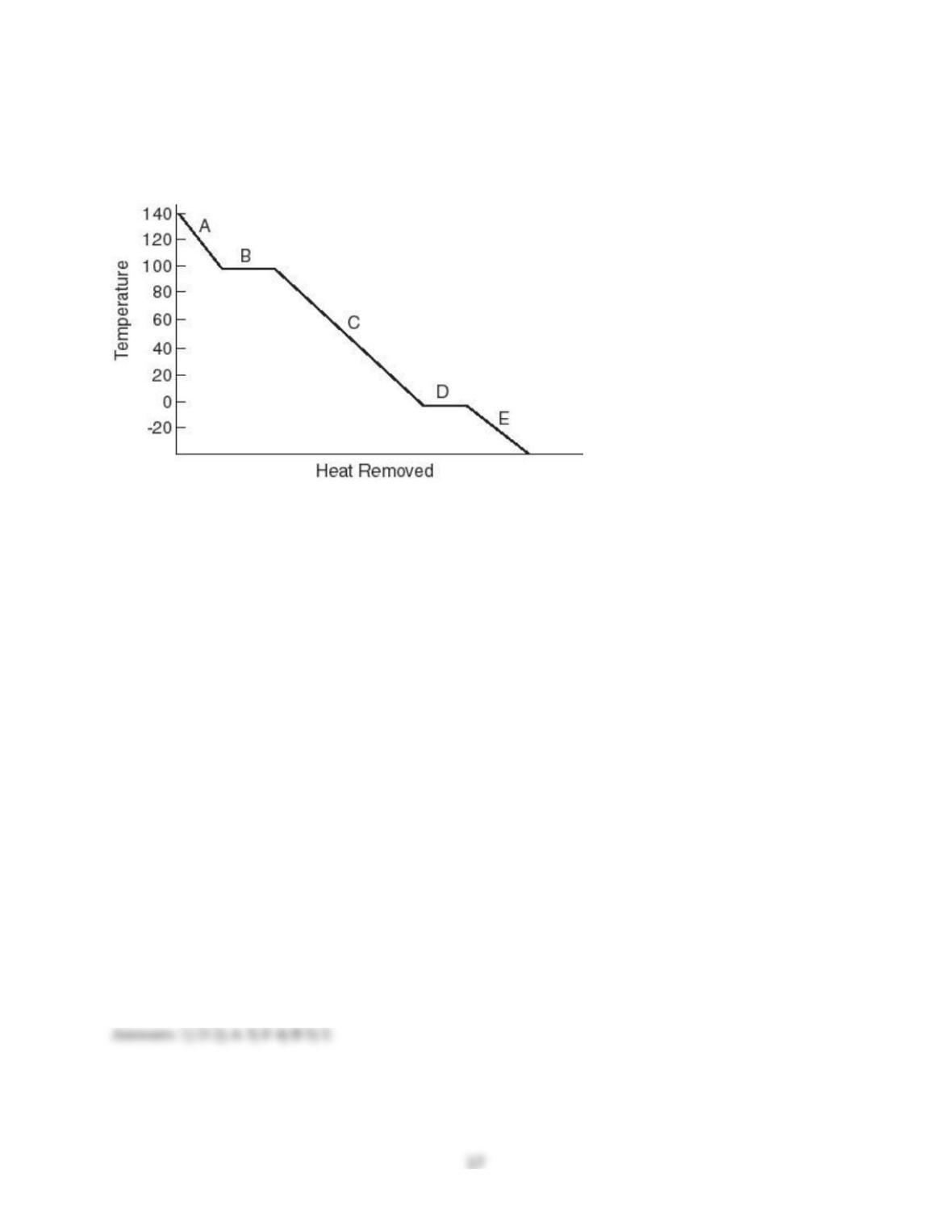
Identify the physical state(s) corresponding to the regions on the cooling curve below.
A) liquid and gas
B) liquid and solid
C) solid and gas
D) gas
E) solid
F) liquid
1) A
Objective: 3.7
Global Outcomes: GO3
2) B
Objective: 3.7
Global Outcomes: GO3
3) C
Objective: 3.7
Global Outcomes: GO3
4) D
Objective: 3.7
Global Outcomes: GO3
5) E
Objective: 3.7
Global Outcomes: GO3

Match the state of matter with each of the following descriptions of a substance.
A) liquid
B) solid
C) liquid + gas
D) gas
E) solid + liquid
6) Particles are held close together in a random pattern.
Objective: 3.2
Global Outcomes: GO2
7) Great distances exist between the particles.
Objective: 3.2
Global Outcomes: GO2
8) This substance is boiling.
Objective: 3.7
Global Outcomes: GO2
9) This material has a definite volume, and a definite shape.
Objective: 3.2
Global Outcomes: GO2
10) This substance is melting.
Objective: 3.7
Global Outcomes: GO2

Identify each of the following transformations as a chemical or physical change
A) physical
B) chemical
11) water evaporating
Objective: 3.2
Global Outcomes: GO2
12) a button falling off of a shirt
Objective: 3.2
Global Outcomes: GO2
13) silver tarnishing
Objective: 3.2
Global Outcomes: GO2
14) cutting the grass
Objective: 3.2
Global Outcomes: GO2
15) a nail rusting
Objective: 3.2
Global Outcomes: GO2
16) baking a cake
Objective: 3.2
Global Outcomes: GO2
17) placing photographs in a scrapbook
Objective: 3.2
Global Outcomes: GO2
18) formation of green leaves on a plant
Objective: 3.2
Global Outcomes: GO2
19) burning leaves
Objective: 3.2
Global Outcomes: GO2
20) melting ice
Objective: 3.2
Global Outcomes: GO2