General, Organic & Biological Chemistry, 5e (Timberlake)
Chapter 18 Amines and Amides
18.1 Multiple Choice Questions
1) The compound CH3 – CH2 – NH – CH3 is classified as a
A) primary amine.
B) secondary amine.
C) tertiary amine.
D) quaternary amine.
E) hydrated amine.
2) The compound CH3 – CH2 – NH2 is classified as a
A) primary amine.
B) secondary amine.
C) tertiary amine.
D) quaternary amine.
E) hydrated amine.
3) Which of the following compounds is an amine?
A) (CH3 – CH2)2NH
B) CH3 – CH2 – CH2 – CH2 – CO2 – CH3
C) CH3 – CH2 – CH2 – CH2 – O – CH2 – CH2 – CH3
D) CH3 – CH = O
E) CH3 – CO – CH3

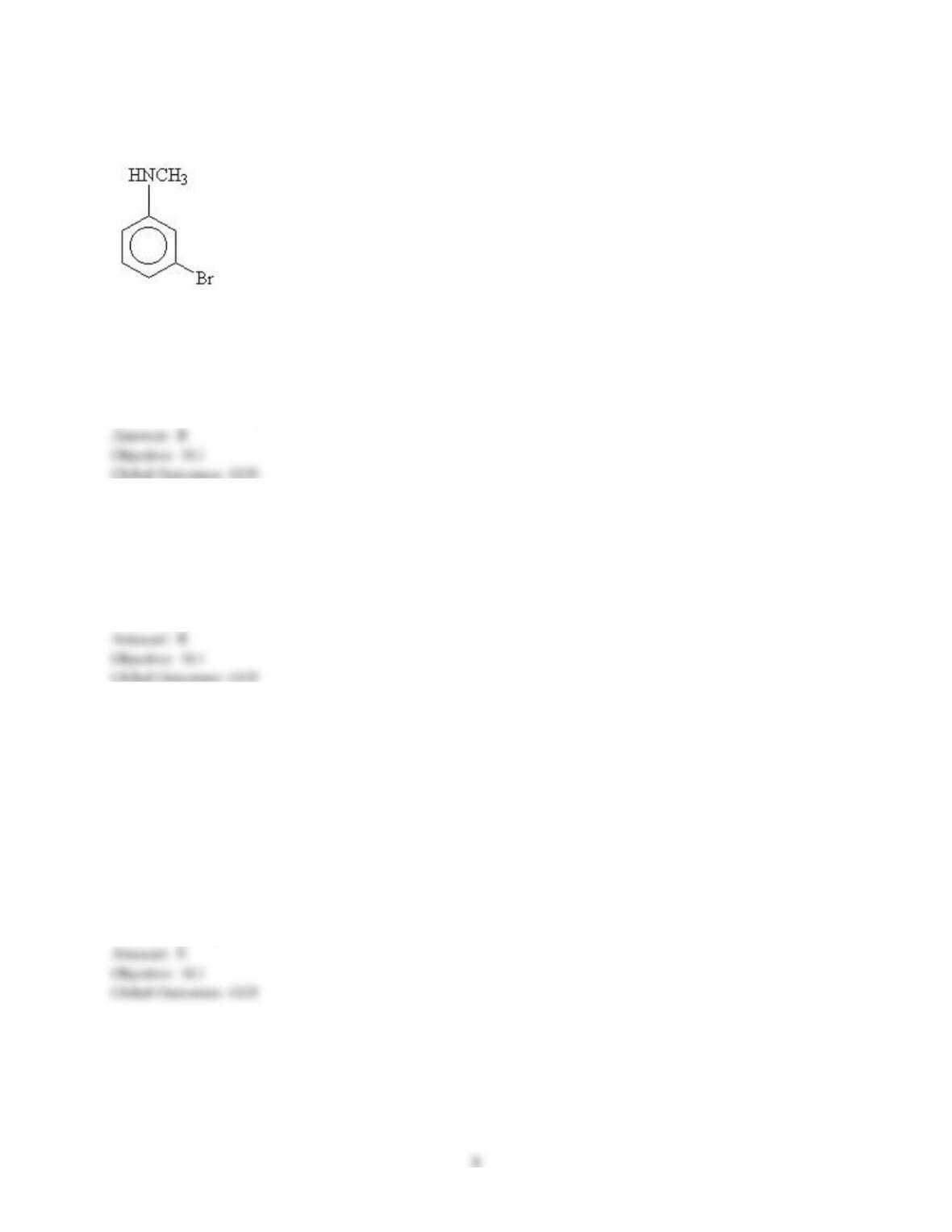
4) What is the name of this compound?
A) 1-methyl-5-bromoaniline
B) N-methyl-3-bromoaniline
C) N-methyl-p-bromoaniline
D) 1-bromo-3-N–methylamine benzene
E) 1-bromo-3-N-methyl aniline
5) Aminobenzene is properly known as
A) toluene.
B) aniline.
C) amidine.
D) histidine.
E) phenylamine.
6) What is the name of this compound?
CH3 – N – CH2 – CH3
|
CH3
A) trimethylamine
B) diethylamine
C) ethylmethylamine
D) ethylmethylnitride
E) ethyldimethylamine
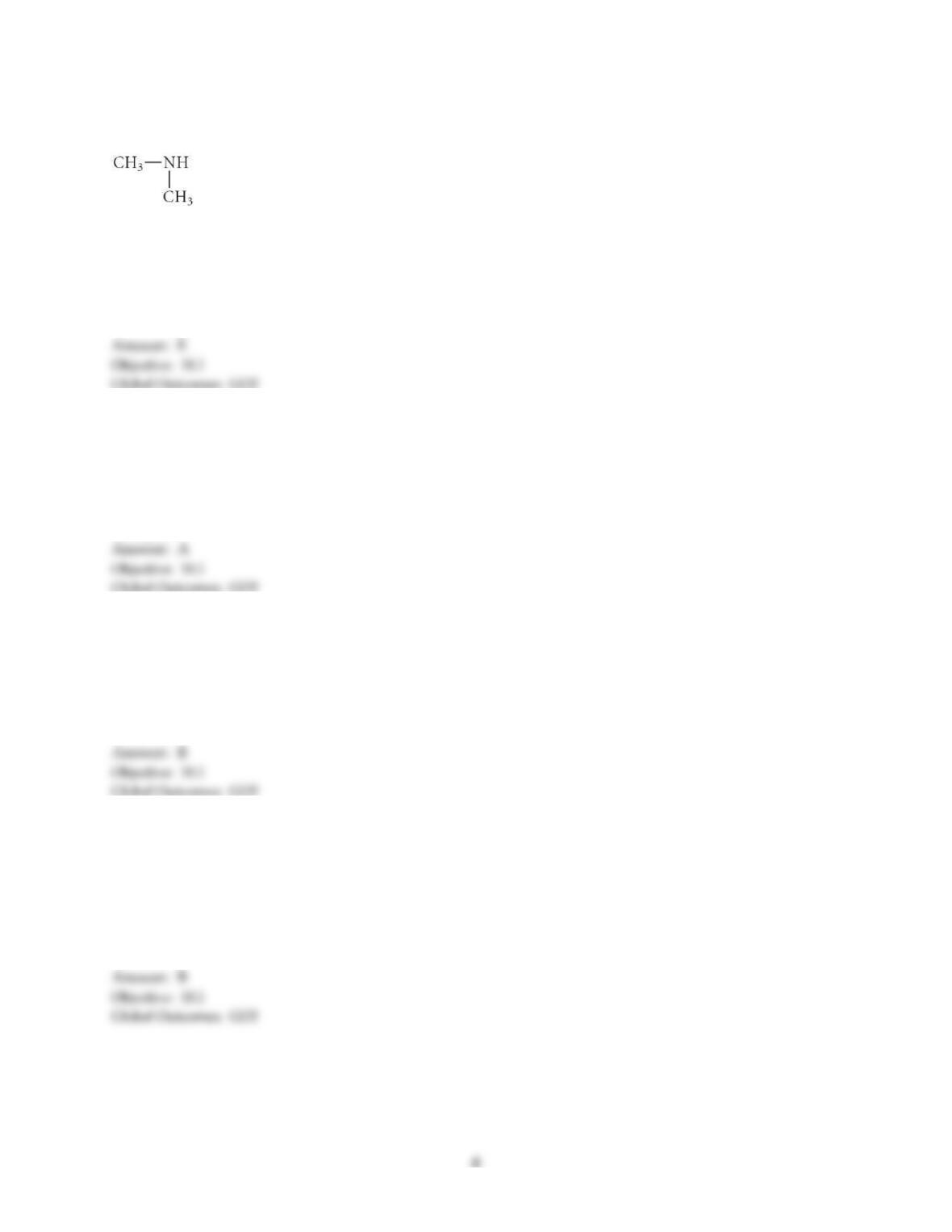
7) Name the following compound.
A) ethyl amine
B) dimethyl ether
C) methanal
D) 1-methanoate
E) dimethyl amine
8) Amines contain the element
A) nitrogen.
B) oxygen.
C) sulfur.
D) astatine.
E) arginine.
9) In what kind of amine is the nitrogen directly bonded to two carbon atoms?
A) primary
B) secondary
C) tertiary
D) quaternary
E) amide
10) When naming amines according to the IUPAC system, the -e in the corresponding alkane is replaced
with
A) -amide.
B) -amine.
C) -ine.
D) -ide.
E) -ane.
11) Aniline is a(n)
A) primary aromatic amine.
B) secondary aromatic amine.
C) heterocyclic amine.
D) aliphatic amine.
E) tertiary amine.
12) What prefix is used to show that a small alkyl group is attached to the nitrogen of aniline and not to
the aromatic ring?
A) N-
B) C-
C) Roman numerals
D) Greek letters
E) iso-
13) How many alkyl substituents does N-ethyl-N-methylaniline have?
A) one
B) two
C) three
D) eight
E) none
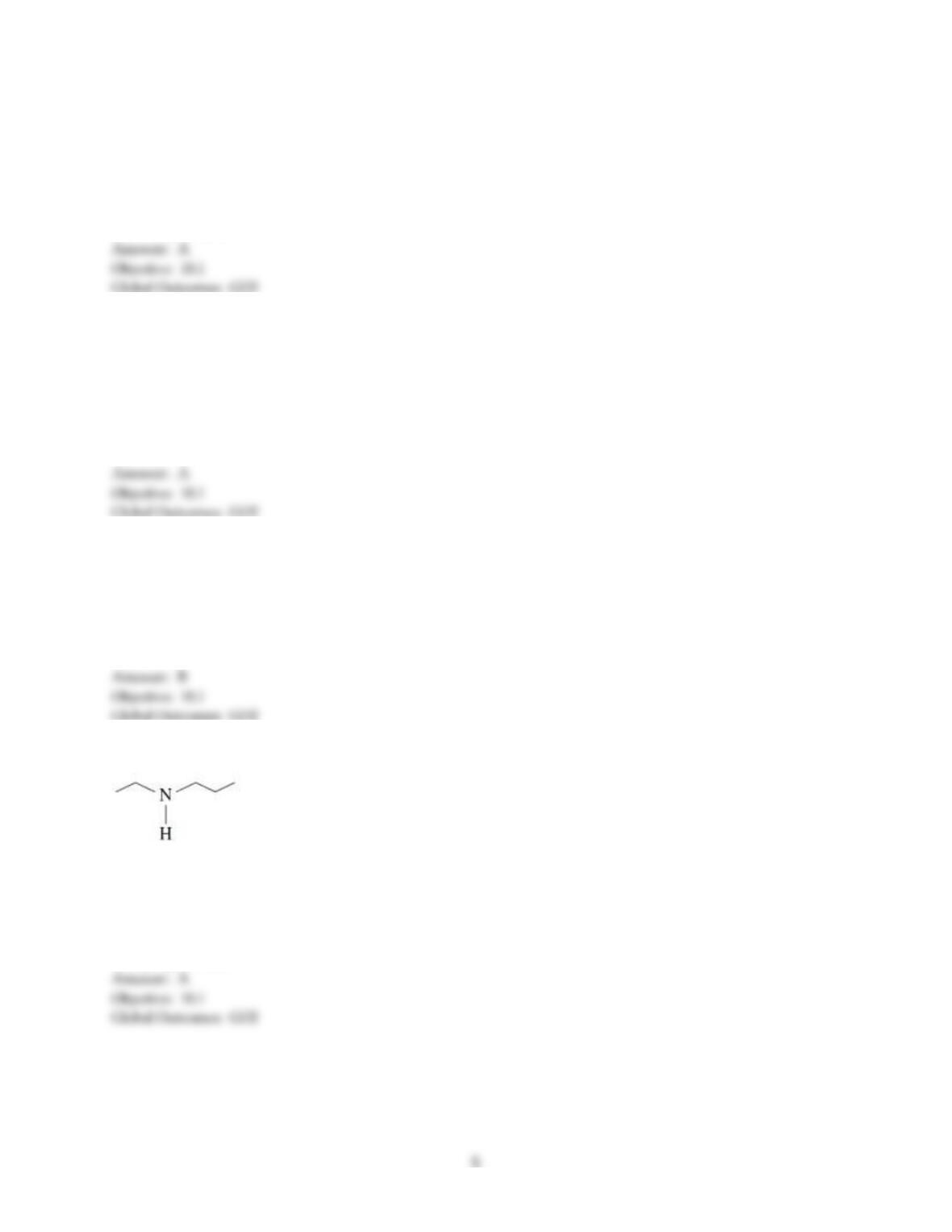
14) What is the common name of the following compound?
A) ethyl propyl amine
B) diethyl amine
C) trimethyl amine
D) propyl amino
E) dipropyl amine
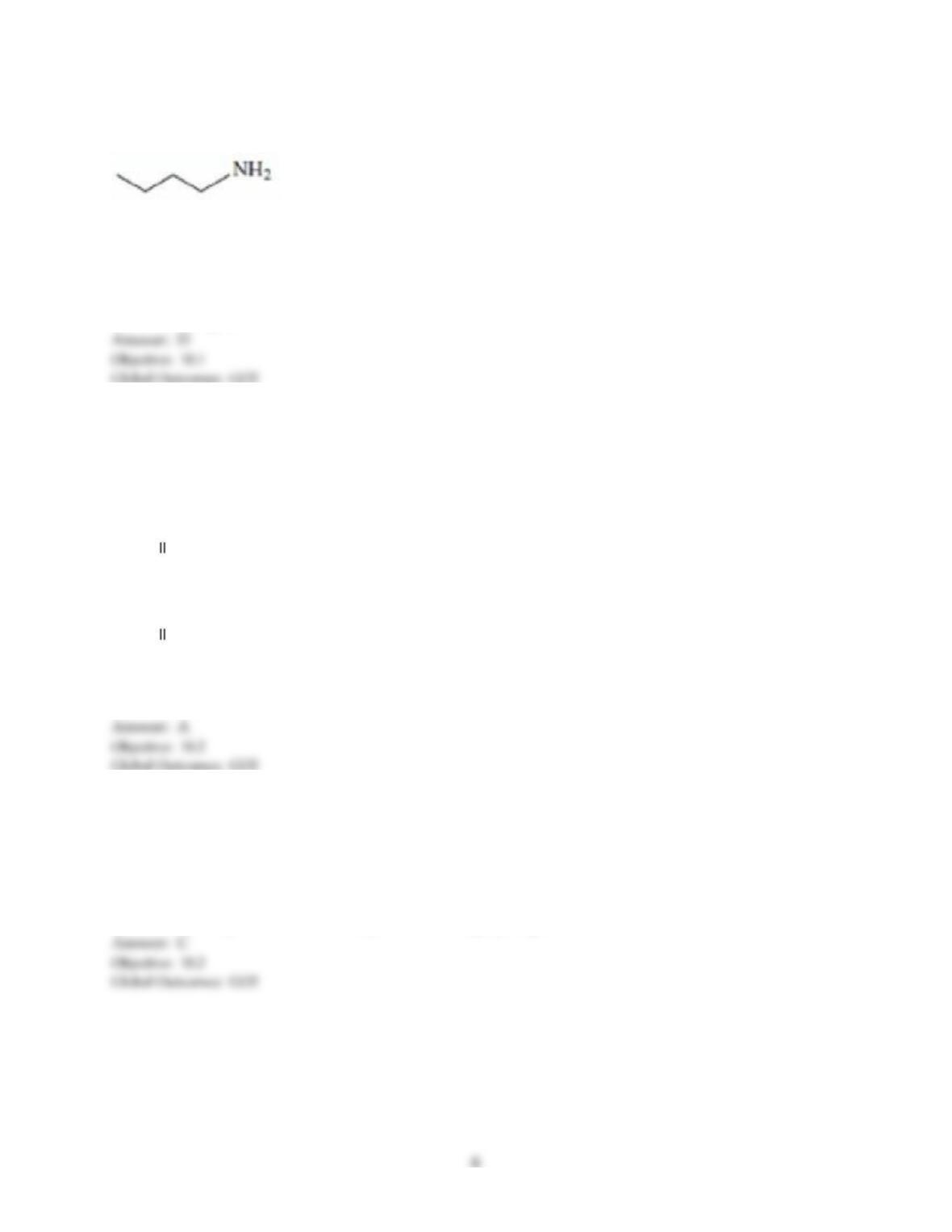
15) What is the IUPAC name of the following compound?
A) propyl amine
B) butyl amine
C) amine butane
D) 1-aminobutane
E) 1-aminopropane
16) Which of the following compounds CANNOT form hydrogen bonds with water?
A) CH3 – CH2 – CH3
B) CH3 – CH2 – OH
C) O
CH3 – C – OH
D) O
CH3 – C – O – CH3
E) CH3 – CH2 – NH2
17) Which of the following compounds CANNOT form hydrogen bonds with water?
A) (CH3 – CH2)2NH
B) CH3 – CH2 – OH
C) (CH3 – CH2)3N
D) CH3 – CH2 – NH2
E) All of the compounds above are capable of forming hydrogen bonds with water.
18) Which of the following represents the complete neutralization of N,N-dimethylamine?
A) CH3NH + H2O → CH3NH2+ + OH–
| |
CH3 CH3
B) CH3NH + NaOH → CH3N-Na+ + H2O
| |
CH3 CH3
C) CH3NH + HCl → CH3NH2 + CH3Cl
|
CH3
D) CH3NH + H2O → CH3OH + CH3NH2
|
CH3
E) CH3NH + HCl → CH3NH2+ + Cl–
| |
CH3 CH3
19) When ethylamine dissolves in water, a solution of ________ is produced.
A) ammonia
B) ethylammonium hydroxide
C) ethylamine
D) ethylhydroxide
E) ethylhydroxylate
20) Diethylamine and HCl react to produce
A) diethyl chloride.
B) diethylammonium chloride.
C) ethylammonium chloride.
D) ammonium chloride.
E) butylammonium chloride.
21) What relation does the boiling point of an amine have to a similar hydrocarbon?
A) higher
B) lower
C) very similar
22) Amines can form ________ bonds with other molecules.
A) oxygen
B) hydrogen
C) nonpolar
D) metallic
E) triple
23) What kind of amine can NOT form hydrogen bonds?
A) primary
B) secondary
C) tertiary
D) aromatic
E) substituted
24) Amines are
A) Bronsted-Lowry bases.
B) Bronsted-Lowry acids.
C) neutral in water solution.
D) unreactive.
25) The odor of an amine can be neutralized with
A) water.
B) acids.
C) bases.
D) detergents.
E) solvents.
9
26) Choline is a quaternary ammonium compound with a ________ charge on the nitrogen.
A) positive
B) negative
C) zero
D) neutral
E) double
27) In what form are amine-containing drugs often administered?
A) free base
B) sodium salt
C) ammonium salt
D) water solution
E) oil solution
28) What kind of pharmacologic activity is found in the amines Procaine and Lidocaine?
A) stimulant
B) anesthetic
C) local anesthetic
D) disinfectant
E) fungicide
29) What are alkaloids?
A) physiologically active nitrogen compounds derived from plants
B) anesthetics found in plants
C) flavoring agents found in fruits and vegetables
D) preservatives found in animal tissue
E) natural steroids
30) Identify the heterocyclic amine in the choices below.
A) diphenhydramine
B) pyrrolidine
C) adrenaline
D) methylamine
E) cholesterol
31) Among the choices below, identify the heterocyclic amine found in DNA.
10
A) piperidine
B) pyridine
C) pyrrole
D) purine
E) imidazole
32) Nicotine, coniine, quinine, atropine, and morphine are all examples of
A) ethers.
B) esters.
C) carboxylic acids.
D) alkaloids.
E) amides.
33) Procaine and Lidocaine were developed by modifying the structure of
A) cocaine.
B) nicotine.
C) harmaline.
D) meperidine.
E) caffeine.
34) Physiologically active nitrogen-containing compounds produced by plants are called
A) aromatics.
B) alkaloids.
C) esters.
D) polymers.
E) ethers.
35) Which of the following is NOT an alkaloid?
A) nicotine
B) caffeine
C) diethylamine
D) quinine
E) cocaine
36) What functional group is always found in alkaloids (such as caffeine, nicotine, and digitalis)?
A) amide
B) acid
C) ether
D) amine
E) ester
37) Cyclic compounds that contain a nitrogen atom are called
A) carbocyclic compounds.
B) aromatic compounds.
C) heterocyclic compounds.
D) homocyclic compounds.
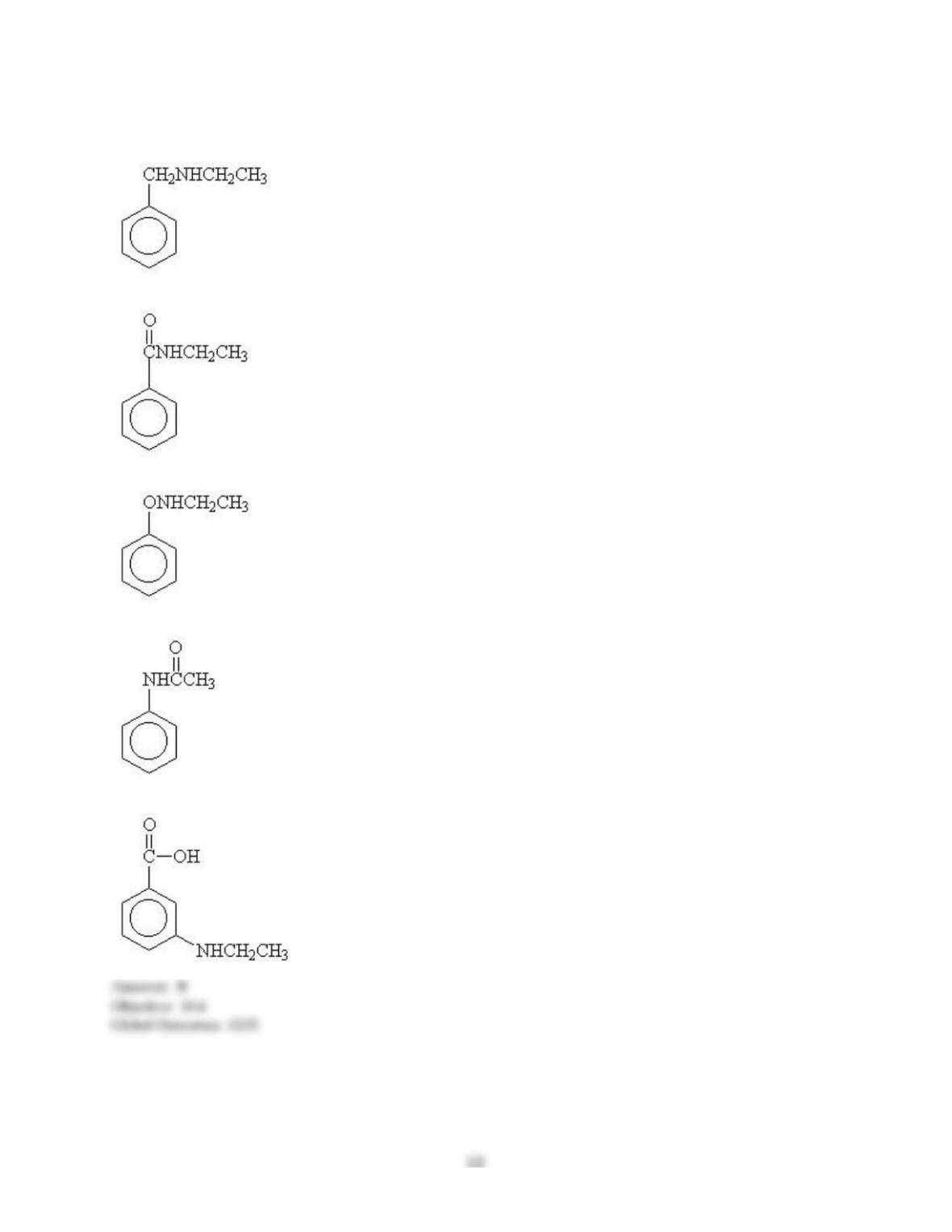
38) The amide formed in the reaction of benzoic acid and ethylamine is
A)
B)
C)
D)
E)