49) At STP conditions, 11 g of SO2 has a volume of
A) 250 L.
B) 3.8 L.
C) 22 L.
D) 0.0076 L.
E) 130 L.
50) At STP, what is the volume of 1.00 mole of carbon dioxide?
A) 1.00 L
B) 44.0 L
C) 273 L
D) 22.4 L
E) 12.2 L
51) The mathematical expression of the ideal gas law is
A) P1V1 = P2V2.
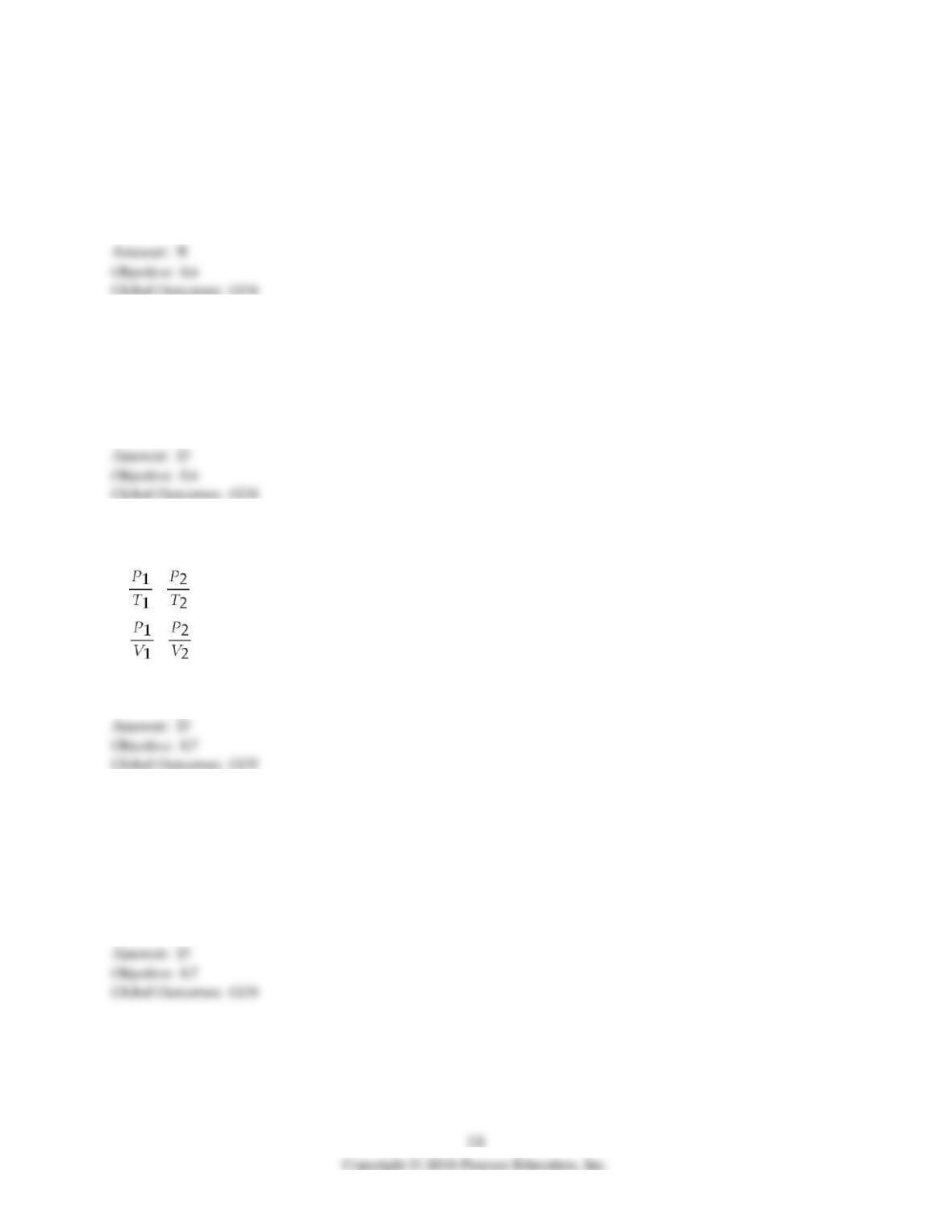
B) = .
C) = .
D) PV = nRT.
E) PT = P1 + P2 + P3.
52) What volume would a 0.250 mole sample of H2 gas occupy, if it had a which has a pressure of 1.70
atm, and a temperature of 35 °C?
A) 0.269 L
B) 0.423 L
C) 1.25 L
D) 3.72 L
E) 283 L

14
53) What is the mass of a sample of O2 gas, which has a pressure of 740.mmHg, at a temperature of 25 °C,
in a volume of 250. mL?
A) 0.318 g
B) 3.82 g
C) 201 g
D) 292 g
E) 320. g
54) What is the pressure, in mmHg, of a 4.00 g sample of O2 gas, which has a temperature of 30.0 °C, and
a volume of 3000 mL?
A) 0.788 mmHg
B) 1.04 mmHg
C) 78.0 mmHg
D) 7880 mmHg
E) 788 mmHg
55) What is the mass of neon that exerts a pressure of 720. mmHg,with a temperature of -15.0 °C , when
the volume of the container is 760. mL?
A) 0.0340 g
B) 0.686 g
C) 0.615 g
D) 517 g
E) 25.8 g
56) Zn(s) + 2HCl(aq) → H2(g) + ZnCl2(aq)
When 25.0 g of Zn reacts, how many L of H2 gas are formed at STP?
A) 4.28 L
B) 0.0171 L
C) 8.56 L
D) 22.4 L
E) 0.382 L
57) Zn(s) + 2 HCl(aq) → H2(g) + ZnCl2(aq)
When 25.0 g of Zn reacts, how many L of H2 gas are formed at 25 °C and a pressure of 854 mmHg?
A) 8.56 L
B) 0.120 L
C) 8.32 L
D) 22.4 L
E) 0.382 L
58) Which of the following is NOT a potential use for a hyperbaric chamber?
A) treatment for burns and infections
B) counteracting carbon monoxide poisoning
C) increasing the rate at which a broken bone heals
D) treating a diver with the bends
E) treating some cancers
59) The total pressure in a mixture of gases is equal to the partial pressure(s) of
A) the gas with the greatest number of moles.
B) the gas with the smallest number of moles.
C) the gas with the highest molecular weight.
D) the gas that occupies the largest volume.
E) all the gases added together.
60) A cyclopropane-oxygen mixture is used as an anesthetic. If the partial pressure of cyclopropane in the
mixture is 330 mmHg and the partial pressure of the oxygen is 1.0 atm, what is the total pressure of the
mixture in torr?
A) 330 torr
B) 430 torr
C) 760 torr
D) 1.4 torr
E) 1100 torr
61) A tank contains helium gas at 490 mmHg, nitrogen gas at 0.75 atm, and neon at 520 torr. What is the
total pressure in atm?
A) 2.1 atm
B) 0.55 atm
C) 1.0 × 10³ atm
D) 1.5 atm
E) 1600 atm
62) A tank contains a mixture of helium, neon, and argon gases. If the total pressure in the tank is
490. mmHg and the partial pressures of helium and argon are 215 mmHg and 102 mmHg, respectively,
what is the partial pressure of neon?
A) 0.228 mmHg
B) 603 mmHg
C) 377 mmHg
D) 807 mmHg
E) 173 mmHg
63) Which of the following correctly describes the partial pressures of gases in the body?
A) high O2, low CO2, oxygenated blood
B) high O2, low CO2, deoxygenated blood
C) high O2, high CO2, oxygenated blood
D) high O2, high CO2, tissue
E) low O2, low CO2, deoxygenated blood
64) If atmospheric pressure on a certain day is 749 mmHg, what is the partial pressure of nitrogen, given
that nitrogen is about 78% of the atmosphere?
A) 170 mmHg
B) 580 mmHg
C) 600 mmHg
D) 750 mmHg
E) 760 mmHg
65) A gas sample contains 4.0 g of CH4 and 2.0 g of He. What is the volume of the sample at STP?
A) 130 L
B) 11 L
C) 17 L
D) 30. L
E) 5.6 L
8.2 Bimodal Questions
1) In the kinetic molecular theory of gas behavior, the distance between gas molecules is assumed to be
________ the diameter of the gas molecules.
A) 22.4 times
B) small relative to
C) dependent on
D) approximately the same as
E) large relative to
2) A barometer is a device for measuring ________.
A) atmospheric pressure
B) blood pressure
C) gas pressure in a container
D) gas pressure in the lung
E) vapor pressure
3) The pressure exerted by the particles of vapor above a liquid is called the ________.
A) vapor pressure
B) barometric pressure
C) standard pressure
D) molar pressure
E) atmospheric pressure
4) The relationship P1V1 = P2V2 is called ________.
A) Boyle’s Law
B) Charles’s Law
C) Gay-Lussac’s Law
D) The Combined Gas Law
E) Avogadro’s Law
5) The relationship P1/T1 = P2/T2 is called ________.
A) Boyle’s Law
B) Charles’s Law
C) Gay-Lussac’s Law
D) The Combined Gas Law
E) Avogadro’s Law
6) The relationship V1/n1 = V2/n2 is called ________.
A) Boyle’s Law
B) Charles’s Law
C) Gay-Lussac’s Law
D) The Combined Gas Law
E) Avogadro’s Law
8.3 Short Answer Questions
1) A barometer is usually filled with ________.
2) One atmosphere is the same as ________ mmHg.
3) The pressure unit 1 mmHg is the same pressure unit as the pressure unit ________.
4) Nitrogen makes up about ________ percent of the atmosphere.
5) Oxygen makes up about ________ percent of the atmosphere.
6) Boyle’s Law is usually written as ________.
7) Gay-Lussac’s Law is usually written as ________.
8) Avogadro’s Law is usually written as ________.
9) At STP, the molar volume of a gas is ________.
10) The use of high-pressure chambers to control disease processes is known as ________.
11) The Ideal Gas Law is usually written as ________.
8.4 True/False Questions
1) The kinetic energy of a gas sample is directly proportional to the Kelvin temperature of the gas.
2) 1 mmHg is the same as 760 atm.
3) The air we breathe is about 21% oxygen.
4) According to Boyle‘s, when volume increases, pressure decreases.
5) Gas law calculations normally require the use of the Kelvin temperature scale.
6) The pressure exerted by a gas on its container is inversely related to its Kelvin temperature.
7) In the combined gas law, temperatures are given in °C.
8) STP stands for 25 °C and 760 mmHg.
9) STP stands for 0 °C and 760 mmHg.
10) The volume of 1 mole of an ideal gas at STP is 22.4 L.
11) Ideal Gas Law calculations require the pressure to be in units of atm.
12) Carbon dioxide and water vapor together account for about 5% of the air we breathe.
13) During inspiration, we actually make use of 100% of the oxygen in the air we breathe.
14) In deoxygenated blood, the partial pressure of carbon dioxide is greater than the partial pressure of
oxygen left.

8.5 Matching Questions
Indicate the effect on the pressure of the following change.
A) decreases
B) increases
C) no change
1) There is a decrease in volume (n, T constant).
Objective: 8.1
Global Outcomes: GO2
2) Some molecules of gas are removed (V, T constant).
Objective: 8.6
Global Outcomes: GO2
3) The temperature is doubled (V, n constant).
Objective: 8.4
Global Outcomes: GO2
4) The volume and the Kelvin temperature are reduced by one-half (n constant).
Objective: 8.5
Global Outcomes: GO2
5) A leak occurs and gas escapes (V, T constant).
Objective: 8.5
Global Outcomes: GO2

Match the correct formula with the gas law name given.
A) =
B) PT = P1 + P2 + P3 …
C) =
D) PV = nRT
E) mass/volume
F) =
G) P1V1 = P2V2
H) =
6) Boyle’s Law
Objective: 8.1
Global Outcomes: GO2
7) Combined Gas Law
Objective: 8.5
Global Outcomes: GO2
8) Charles’s Law
Objective: 8.3
Global Outcomes: GO2
9) Ideal Gas Law
Objective: 8.7
Global Outcomes: GO2
10) Avogadro’s Law
Objective: 8.6
Global Outcomes: GO2
11) Gay-Lussac’s Law
Objective: 8.4
Global Outcomes: GO2
12) Dalton’s Law
Objective: 8.8
Global Outcomes: GO2