General, Organic & Biological Chemistry, 5e (Timberlake)
Chapter 4 Atoms
4.1 Multiple-Choice Questions
1) The primary substances of which all other things are composed are
A) molecules.
B) compounds.
C) elements.
D) electrons.
E) protons.
2) Au is the symbol for
A) gold.
B) silver.
C) argon.
D) aluminum.
E) sodium.
3) aluminum
A) Al
B) Am
C) Au
D) Sn
E) Ag
4) iron
A) Ir
B) Fs
C) Fe
D) In
E) FE
5) sodium
A) So
B) Na
C) No
D) Sm
E) Au
6) potassium
A) P
B) Po
C) Pt
D) K
E) Ko
7) silver
A) S
B) Si
C) Ag
D) Au
E) AG
8) Ca is the symbol for
A) calcium.
B) carbon.
C) cobalt.
D) copper.
E) cadmium.
9) What elements are in hydroxyapatite, Ca5 (PO4)3OH, a major compound in human bones and teeth?
A) carbon, potassium, oxygen, hydrogen
B) calcium, phosphorus, oxygen, hydrogen
C) carbon, phosphorus, oxygen, helium
D) calcium, phosphorus, oxygen, helium
E) carbon, potassium, oxygen, helium

3
10) Which of the following is a characteristic of the modern periodic table?
A) A group is a horizontal row on the periodic table.
B) A period is a column on the periodic table.
C) The elements in each group have similar chemical properties.
D) The B groups contain the representative elements.
E) The A groups contain the transition elements.
11) Which of the following properties is NOT a characteristic of the Group 1A(1) elements (alkali metals)?
A) They are shiny.
B) They are good conductors of heat.
C) They react vigorously with water.
D) Most of them are liquids at room temperature.
E) They are good conductors of electricity.
12) The Group 8A(18) elements
A) are unreactive and are rarely found in combination with other elements.
B) are good conductors of electricity.
C) melt at high temperatures.
D) are liquids at room temperature.
E) react vigorously with water.
13) Which of the following elements is a metal?
A) nitrogen
B) fluorine
C) argon
D) strontium
E) phosphorus
14) Which of the following is a characteristic of nonmetals?
A) shiny
B) malleable
C) good conductors of heat
D) low melting points
E) good conductors of electricity
15) Which of the following elements is a nonmetal?

4
A) nitrogen
B) sodium
C) iron
D) silver
E) calcium
16) Which of the following elements is a noble gas?
A) oxygen
B) chlorine
C) bromine
D) argon
E) nitrogen
17) Which element would have physical and chemical properties similar to chlorine?
A) Ar
B) Br
C) S
D) O
E) P
18) What is the symbol of the element in Group 4A(14) and Period 2?
A) Be
B) Mg
C) Ca
D) C
E) Si
19) What is the symbol of the element in Period 4 and Group 2?
A) Be
B) Mg
C) Ca
D) C
E) Si
20) Identify the noble gas in the following list.
A) helium

5
B) nitrogen
C) oxygen
D) gold
E) chlorine
21) Identify the metalloid in the following list.
A) sulfur
B) fluorine
C) silver
D) copper
E) germanium
22) Semiconductors are located in the periodic table on (or in) the
A) left side of the table.
B) right side of the table.
C) line dividing metals from nonmetals in the table.
D) first period of the table.
E) last period of the table.
23) The element in this list with chemical properties similar to magnesium is
A) sodium.
B) boron.
C) carbon.
D) strontium.
E) chlorine.
24) The smallest particle of an element that retains the characteristics of the element is a(n)
A) electron.
B) neutron.
C) proton.
D) atom.
E) nucleus.
25) According to the Atomic Theory,
A) all atoms are different.
B) atoms are neither created nor destroyed during a chemical reaction.

6
C) atoms of the same element combine to form compounds.
D) all matter is made up of tiny particles called electrons.
E) a compound can contain different numbers of atoms as long as it has the same kinds of atoms.
26) Which of the following descriptions of a subatomic particle is correct?
A) A proton has a positive charge and a mass of approximately 1 amu.
B) An electron has a negative charge and a mass of approximately 1 amu.
C) A neutron has no charge and its mass is negligible.
D) A proton has a positive charge and a negligible mass.
E) A neutron has a positive charge and a mass of approximately 1 amu.
27) In an atom, the nucleus contains
A) an equal number of protons and electrons.
B) all the protons and neutrons.
C) all the protons and electrons.
D) only neutrons.
E) only protons.
28) The atomic number of an atom is equal to the number of
A) nuclei.
B) neutrons.
C) neutrons plus protons.
D) electrons plus protons.
E) protons.
29) The number of neutrons in an atom is equal to
A) the atomic number.
B) the mass number.
C) the mass number + the atomic number.
D) the mass number – the atomic number.
E) the number of protons.
30) The mass number of an atom can be calculated from
A) the number of electrons.
B) the number of protons plus neutrons.
C) the number of protons.

7
D) the number of electrons plus protons.
E) the number of neutrons.
31) What is the mass number of an atom of potassium that has 20 neutrons?
A) 15
B) 19
C) 35
D) 39
E) 59
32) Consider a neutral atom with 30 protons and 34 neutrons. The atomic number of the element is
A) 30.
B) 32.
C) 34.
D) 64.
E) 94.
33) Consider a neutral atom with 30 protons and 34 neutrons. The mass number for this atom is
A) 30.
B) 32.
C) 34.
D) 64.
E) 94.
34) Consider a neutral atom with 30 protons and 34 neutrons. The number of electrons in this atom is
A) 30.
B) 32.
C) 34.
D) 64.
E) 94.
35) How many protons are in an isotope of sodium with a mass number of 25?
A) 11
B) 14
C) 15
D) 25

E) 32
36) Consider an isotope of sodium with a mass number of 25. The number of neutrons in this isotope of
sodium is
A) 11.
B) 14.
C) 16.
D) 25.
E) 32.
37) Which of the following gives the correct numbers of protons, neutrons, and electrons in a neutral
atom of Sn?
A) 118 protons, 50 neutrons, 118 electrons
B) 118 protons, 118 neutrons, 50 electrons
C) 50 protons, 68 neutrons, 50 electrons
D) 68 protons, 68 neutrons, 50 electrons
E) 50 protons, 50 neutrons, 50 electrons
38) Isotopes are atoms of the same element that have
A) different atomic numbers.
B) the same atomic numbers but different numbers of protons.
C) the same atomic numbers but different numbers of electrons.
D) the same atomic number but different numbers of neutrons.
E) the same atomic mass but different numbers of protons.
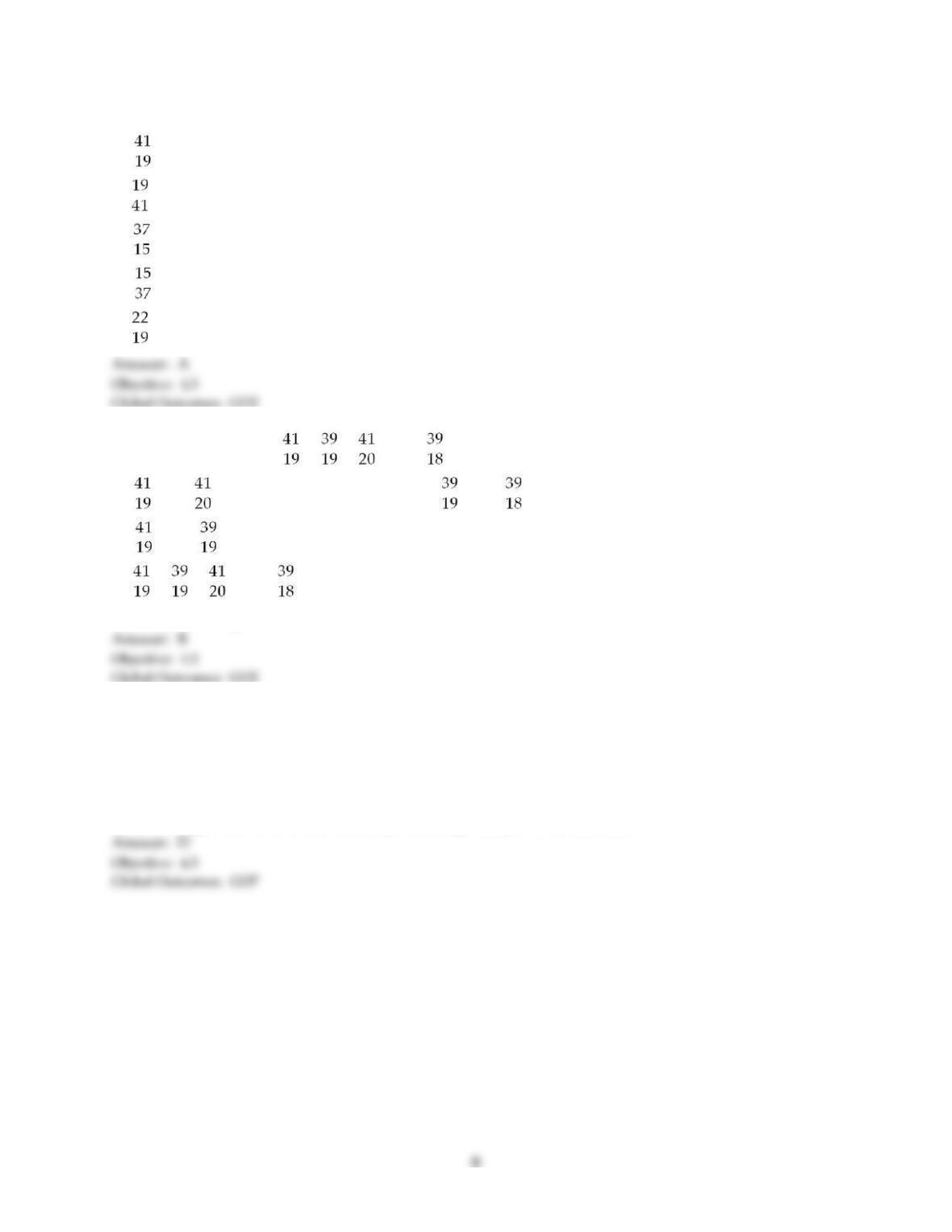
39) The correct symbol for the isotope of potassium with 22 neutrons is
A) K.
B) K.
C) P.
D) P.
E) K.
40) Given the following: X, X, X, and X. Which are isotopes of each other?
A) X and X are isotopes of each other; and X and X are isotopes of each other.
B) X and X are isotopes of each other.
C) X, X, X, and X are isotopes of each other.
D) None are isotopes of each other.
41) The atomic mass of an element is equal to
A) its mass number.
B) its atomic number.
C) one-twelfth of the mass of a carbon-12 atom.
D) a weighted average mass of all of the naturally occurring isotopes of the element.
E) the average mass of all of the naturally occurring isotopes of the element.

42) A sample of chlorine has two naturally occurring isotopes. The isotope Cl-35 (mass 35.0 amu) makes
up 75.8% of the sample, and the isotope Cl-37 (mass = 37.0 amu) makes up 24.3% of the sample. What is
the average atomic mass for chlorine?
A) 36.0 amu
B) 35 amu
C) 36.6 amu
D) 35.5 amu
E) 35.521 amu
43) A sample of silicon has three naturally occurring isotopes: Si-28 (mass 28.0 amu); Si-29 (mass 29.0
amu) and Si-30 (mass = 30.0 amu). If the average atomic mass of silicon is 28.1 amu, which isotope is the
most abundant?
A) Si-28
B) Si-29
C) Si-30
D) All isotopes have the same natural abundance.
44) Which of the following is NOT true for the atoms 13N, 14N, and 15N?
A) They all have the same mass number.
B) They are isotopes.
C) They all have the same atomic number.
D) They all have 7 protons.
E) They all have 7 electrons.
45) The elements lithium, sodium, and potassium
A) are isotopes of each other.
B) are in the same period of elements.
C) have the same number of neutrons.
D) are in the same group.
E) have the same mass number.

46) The elements sodium, magnesium, and silicon
A) are isotopes of each other.
B) are in the same period of elements.
C) have the same number of neutrons.
D) are in the same group.
E) have the same mass number.
47) The electron arrangement of any particular atom shows
A) the number of isotopes possible.
B) a description of the shape of each energy level.
C) the number of electrons in each energy level.
D) a diagram of an atomic nucleus.
E) the maximum number of electrons each energy level can hold.
48) The number of electron levels in a magnesium atom is
A) 1.
B) 2.
C) 3.
D) 4.
E) 5.
49) The maximum number of electrons that may occupy the third energy level is
A) 2.
B) 8.
C) 10.
D) 18.
E) 32.
50) What is the element with the electron configuration 1s22s22p63s23p5?
A) Be
B) Cl
C) F
D) S
E) Ar
51) What is the electron configuration for aluminum?
A) 1s22s22p63s23p1
B) 1s22s22p63s23p3
C) 1s22s22p63s23p5
D) 1s22s22p63s23p6
E) 1s22s22p63s23p8
52) Which of the following electron configurations is impossible?
A) 1s22s22p63s23p1
B) 1s22s42p63s23p3
C) 1s22s22p63s23p5
D) 1s22s22p63s23p6
E) 1s22s22p63s23p3
53) What is the electron configuration for potassium (atomic number 19)?
A) 1s22s22p63s23p7
B) 1s22s22p6 3s23p53d2
C) 1s22s22p83s23p5
D) 1s22s22p63s23p64s1
E) 1s22s22p63s23p54s1
54) What element has the electron configuration 1s22s22p63s23p2?
A) carbon
B) oxygen
C) sulfur
D) iron
E) silicon