55) The number of electrons in the outer energy level of a neutral atom of boron (atomic number 5) is
A) 2.
B) 3.
C) 5.
D) 8.
E) 10.
56) What is the correct electron configuration for the lithium atom?
A) 1s3
B) 2s1
C) 1s12s2
D) 1s22s1
E) 1s22s5
57) What is the abbreviated electron configuration for nickel (atomic number 28)?
A) [He]2s22p3
B) [Ar]4s23d8
C) [Kr]4s23d8
D) [Ar]4s24p4
E) [Ar]3d8
58) What is the element with the abbreviated electron configuration [Kr]5s24d8?
A) Ni
B) Pd
C) Pt
D) Kr
E) Xe
14
59) The number of valence electrons found in an atom of a Group A element is equal to
A) its atomic number.
B) its mass number.
C) its group number.
D) eight.
E) eight minus the group number.
60) Valence electrons are electrons located
A) in the outermost energy level of an atom.
B) in the nucleus of an atom.
C) in the innermost energy level of an atom.
D) throughout the atom.
E) in the first three shells of an atom.
61) In an electron-dot structure of an element, the dots are used to represent
A) all of the electrons in the atom.
B) the valence electrons.
C) the electron arrangement.
D) only the electrons that will participate in bond formation.
E) the electrons that the element will gain when it forms a compound.
62) How many valence electrons are in the electron-dot structures for the elements in group 3A(13)?
A) 1
B) 2
C) 3
D) 4
E) 6
63) The number of dots in the electron dot structure of nitrogen is
A) one.
B) two.
C) three.
D) four.
E) five.
64) The number of dots in the electron dot structure of carbon is
A) one.
B) two.
C) three.
D) four.
E) five.
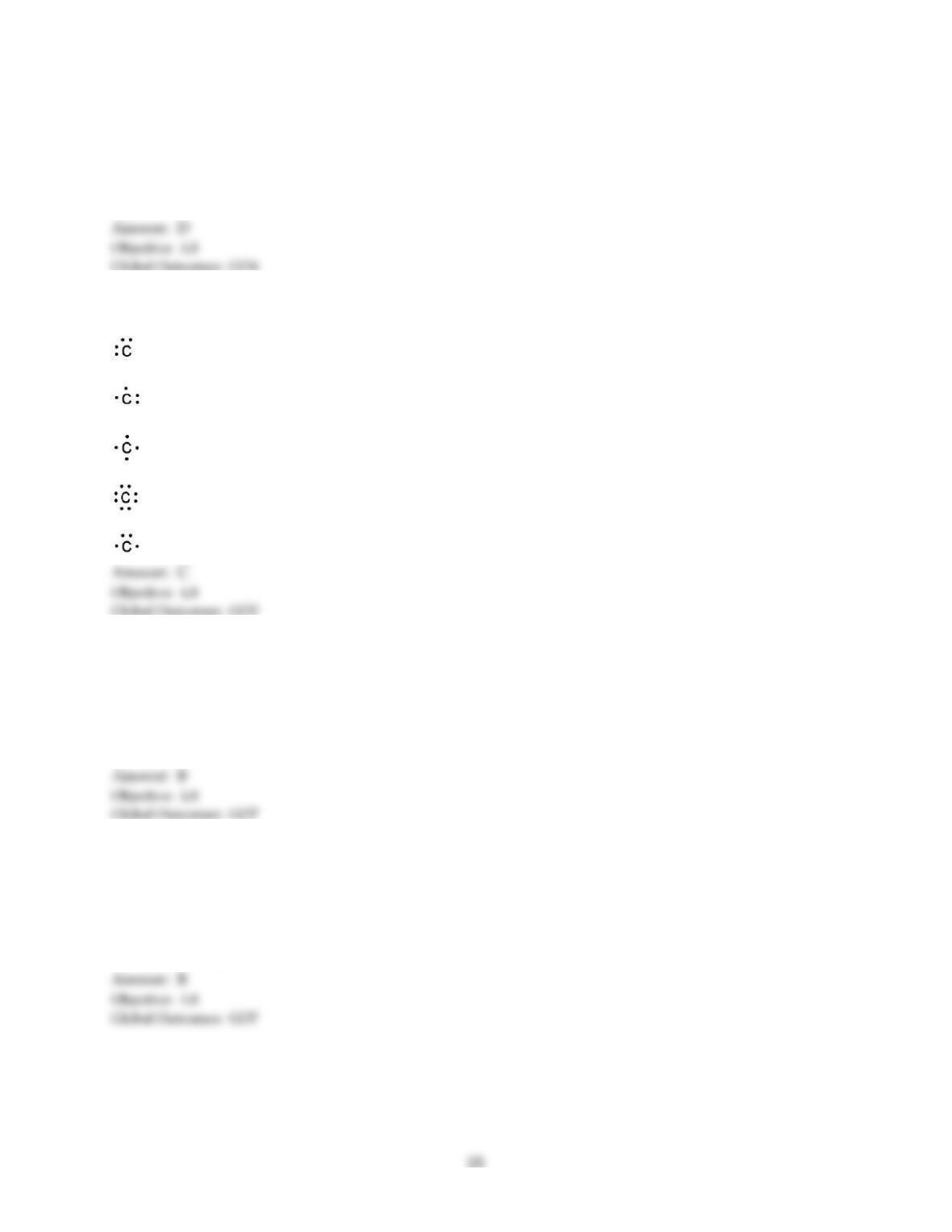
65) Which of the following is the correct electron-dot structure for carbon?
A)
B)
C)
D)
E)
66) The atomic size of atoms
A) increases going across a period.
B) decreases going across a period.
C) decreases going down within a group.
D) does not change going across a period.
E) None of the above.
67) The ionization energy of atoms
A) decreases going across a period.
B) decreases going down within a group.
C) increases going down within a group.
D) does not change going down within a group.
E) None of the above.
16
68) Of the elements: B, C, F, Li, and Na., the element with the largest atomic radius is
A) B.
B) C.
C) F.
D) Li.
E) Na.
69) Of the elements: B, C, F, Li, and Na, the element with the smallest atomic radius is
A) B.
B) C.
C) F.
D) Li.
E) Na.
70) Of the elements: B, C, F, Li, and Na. The element with the highest ionization energy is
A) B.
B) C.
C) F.
D) Li.
E) Na.
71) Ionization energy is
A) the energy an ion acquires from an electron.
B) the energy needed to remove the least tightly bound electron.
C) highest for metals in Group 1A (1).
D) higher for potassium than for lithium.
E) None of the above.
72) Of the elements: B, C, F, Li, and Na. The element with the smallest ionization energy is
A) B.
B) C.
C) F.
D) Li.
E) Na.
73) Of the elements: B, C, F, Li, and Na. The element with the most metallic character is
17
A) B.
B) C.
C) F.
D) Li.
E) Na.
74) Of the elements: B, C, F, Li, and Na. The element with the least metallic character is
A) B.
B) C.
C) F.
D) Li.
E) Na.
4.2 Short Answer Questions
Write in the electronic configuration for the atom shown.
1) Sodium
2) Chlorine
3) Argon
4) Sulfur
5) Magnesium
6) Phosphorus
4.3 True/False Questions
1) The symbol for potassium is P.
2) The symbol for gold is Au.
3) Sulfur is a nonmetal.
4) Chromium is a metal.
5) Radon is a metal.
6) Mercury is a metal.
7) Iodine is a metal.
8) An electron has a positive charge.
9) Protons and neutrons are located in the nucleus of an atom.
10) Sulfur has 16 valence electrons.
11) Isotopes have the same atomic number but different mass numbers.
12) Potassium has one valence electron.
13) The electron configuration of potassium is 1s22s22p63s1.
14) A lithium atom is larger than a potassium atom.
15) A sodium atom is larger than a silicon atom.
16) Chlorine has a higher ionization energy than aluminum.
17) Chlorine has a higher ionization energy than fluorine.
18) Ionization energy increases going down a group.
19) Atomic size decreases going from left to right within a period.
20) Chlorine has more metallic character than fluorine.
4.4 Matching Questions
Do the following represent elements in a group, a period, or neither?
A) period
B) group
C) neither
1) Li, C, F
Objective: 4.2
Global Outcomes: GO2
2) F, S, P
Objective: 4.2
Global Outcomes: GO2
3) O, S, Se
Objective: 4.2
Global Outcomes: GO2
4) He, H, I
Objective: 4.2
Global Outcomes: GO2

Match the correct symbols with the names of elements.
A) Co
B) Cl
C) C
D) Ca
E) Cu
5) calcium
Objective: 4.1
Global Outcomes: GO2
6) copper
Objective: 4.1
Global Outcomes: GO2
7) carbon
Objective: 4.1
Global Outcomes: GO2
8) chlorine
Objective: 4.1
Global Outcomes: GO2
9) cobalt
Objective: 4.1
Global Outcomes: GO2

Give the correct number of electrons.
A) seven
B) five
C) eight
D) one
E) two
10) in the second energy level of magnesium
Objective: 4.6
Global Outcomes: GO2
11) in the highest occupied energy level of chlorine
Objective: 4.6
Global Outcomes: GO2
12) in the outer energy level of nitrogen
Objective: 4.6
Global Outcomes: GO2
13) in the first energy level of chlorine
Objective: 4.6
Global Outcomes: GO2
14) in the third energy level of sodium
Objective: 4.6
Global Outcomes: GO2

Classify the following elements.
A) halogen
B) alkaline earth metal
C) alkali metal
D) noble gas
E) nonmetal
F) transition element
15) sodium
Objective: 4.2
Global Outcomes: GO2
16) argon
Objective: 4.2
Global Outcomes: GO2
17) bromine
Objective: 4.2
Global Outcomes: GO2
18) copper
Objective: 4.2
Global Outcomes: GO2
19) magnesium
Objective: 4.2
Global Outcomes: GO2
20) phosphorus
Objective: 4.2
Global Outcomes: GO2

Classify the following elements as metals, nonmetals or metalloids.
A) metalloid
B) nonmetal
C) metal
21) chlorine
Objective: 4.2
Global Outcomes: GO2
22) cobalt
Objective: 4.2
Global Outcomes: GO2
23) sulfur
Objective: 4.2
Global Outcomes: GO2
24) silicon
Objective: 4.2
Global Outcomes: GO2
25) nickel
Objective: 4.2
Global Outcomes: GO2