37) What phospholipid contains fatty acids but NOT glycerol?
A) lecithin
B) glycolipid
C) sphingolipid
D) cephalin
E) corticosteroid
38) Which of the following compounds is a glycerolphospholipid?
A) jojoba wax
B) estrogen
C) lecithin
D) triolein
E) cerebroside
39) Which of the following is NOT a function of glycerophospholipids?
A) transport of triacylglycerols
B) regulation of cellular permeability
C) protect nerve cells
D) aid in digestion
E) transport of cholesterol
40) A lecithin contains which of the following components?
A) glycerol and three fatty acids
B) glycerol, two fatty acids and choline
C) glycerol, two fatty acids, phosphate and an amino alcohol
D) sphingosine, two fatty acids, phosphate and an amino alcohol
E) sphingosine, one fatty acid, phosphate and an amino alcohol
41) The most common type of gallstones is composed of almost pure
A) cholesterol.
B) bile salts.
C) glycerophospholipids.
D) calcium salts of fatty acids.
E) anabolic steroids.
42) A lipoprotein particle functions to
A) dissolve polar lipids for excretion.
B) metabolize lipids into new substances.
C) dissolve polar lipids in urine.
D) transport nonpolar lipids to body cells.
E) store lipids in the tissues.
43) Synthesis of cholesterol and bile salts takes place in the
A) liver.
B) gall bladder.
C) small intestine.
D) large intestine.
E) pancreas.
44) Which of the following is NOT a lipoprotein that carries nonpolar lipids through the bloodstream?
A) sphingosine
B) LDL
C) HDL
D) VLDL
E) chylomicron
45) The steroid hormone that increases the blood glucose and glycogen levels from fatty acids and amino
acids is
A) aldosterone.
B) progesterone.
C) cortisone.
D) estrogen.
E) prednisone.
46) The steroid hormone present in birth control pills is
A) aldosterone.
B) progesterone.
C) cortisone.
D) estrogen.
E) norethindrone.
47) Which of the following is a lipid?
A) cholesterol
B) nicotine
C) aniline
D) lactose
E) collagen
48) The main lipid components in cellular membranes are
A) glycerolphospholipids.
B) terpenes.
C) steroids.
D) triacylglycerols.
E) waxes.
49) In the fluid-mosaic model that describes plasma membranes,
A) there are three layers of glycerophospholipid molecules.
B) two layers of glycerophospholipid molecules have their nonpolar sections oriented to the inside of the
membrane.
C) two layers of glycerophospholipid molecules have their nonpolar sections along the outer surface of
the membrane.
D) A single row of glycerophospholipid molecules forms a barrier between the inside and outside of the
cell.
E) two layers of proteins separate the contents inside a cell from the surrounding fluids.
50) Channel proteins in cell membranes serve what function?
A) They add strength and rigidity to the membrane.
B) They provide pathways for water and electrolytes to move through cell membranes.
C) They form the bilayer portion of the membrane.
D) They allow nonpolar substances to move through the membrane.
E) They prevent interactions between the nonpolar tails of the phospholipids which gives the membrane
its fluidity.
51) According to the fluid-mosaic model of a cell membrane, the main component of a membrane is
A) a lipid bilayer.
B) a membrane protein.
C) a glycoprotein.
D) a steroid.
E) a prostaglandin.
52) The type of lipid that gives a cell membrane its shape is a
A) triacylglycerol.
B) glycerophospholipid.
C) prostaglandin.
D) bile salt.
E) wax.
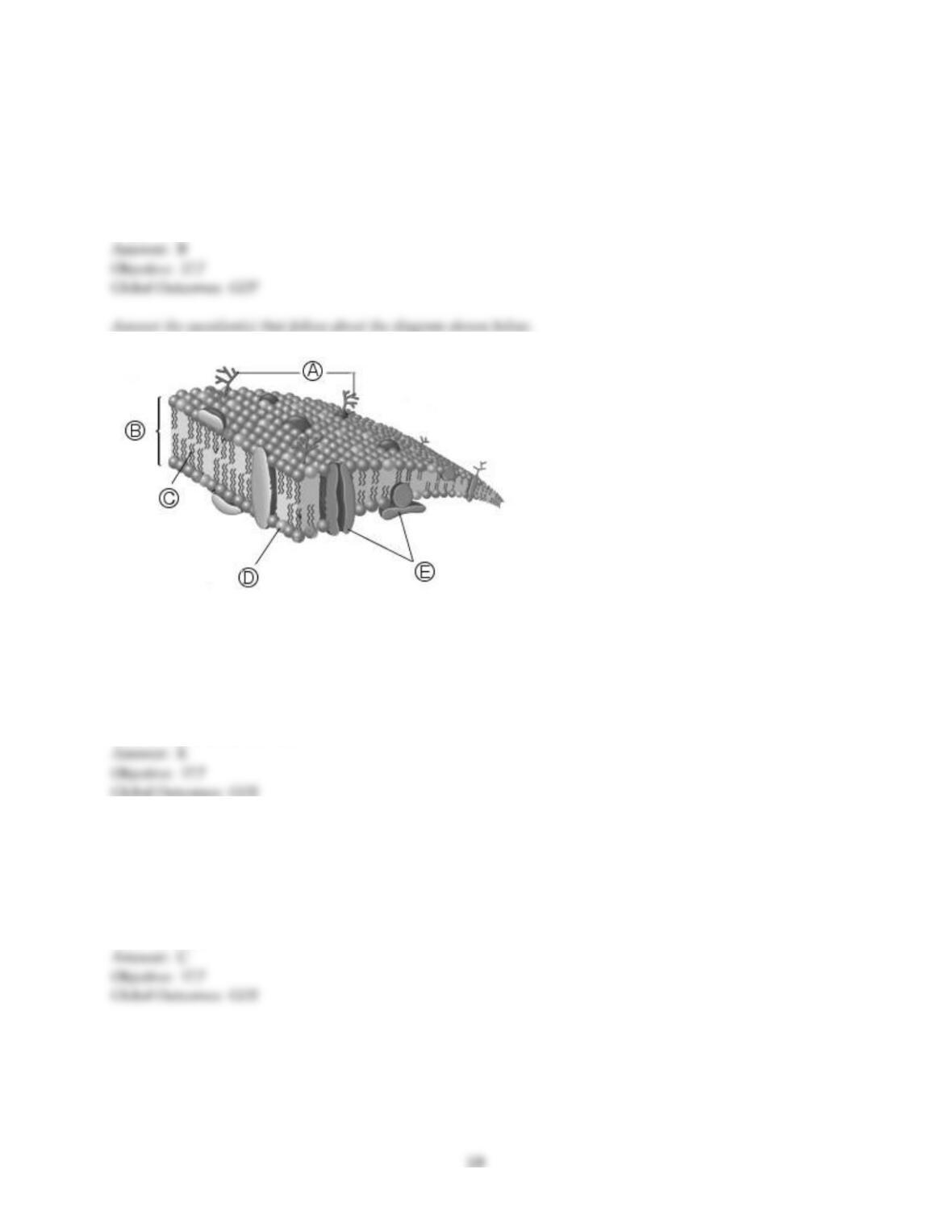
53) One inner component of a typical cell membrane is
A) glucose.
B) cholesterol.
C) glycine.
D) palmitic acid.
E) glycerol.
54) In this diagram of a cell membrane, the small branched object labeled (A) is part of a
A) steroid.
B) hydrophobic region.
C) membrane protein.
D) glycerophospholipid.
E) carbohydrate side chain.
55) In this diagram of a cell membrane, the objects labeled (E) are
A) steroids.
B) hydrophobic regions.
C) proteins.
D) phospholipids.
E) carbohydrate side chains.
56) In this diagram of a cell membrane, the object labeled (C) is a
A) steroid.
B) hydrophobic region.
C) phospholipid.
D) mitochondrion.
E) glycolipid.
57) In this diagram of a cell membrane, the object labeled (B) is a
A) steroid.
B) hydrophobic region.
C) membrane protein.
D) glycerophospholipid bilayer.
E) carbohydrate side chain.
58) In this diagram of a cell membrane, the object labeled (D) is part of a
A) steroid.
B) hydrophobic region.
C) cholesterol.
D) glycerophospholipid.
E) glycosphingolipid.
59) In the lipid bilayer of a cell membrane
A) the hydrophobic heads are on the inner and outer surface and the hydrophilic tails in the middle.
B) the hydrophilic heads are on the inner and outer surface and the hydrophobic tails in the middle.
C) there is a random arrangement of phospholipids.
D) the hydrophilic heads are on the inner and outer surface and cholesterol is in the middle.
E) cholesterol is on the inner and outer surface and phospholipids are in the middle.
17.2 Bimodal Questions
1) A precursor of prostaglandins is ________ acid.
A) oleic
B) linoleic
C) arachidonic
D) tauric
E) palmitic
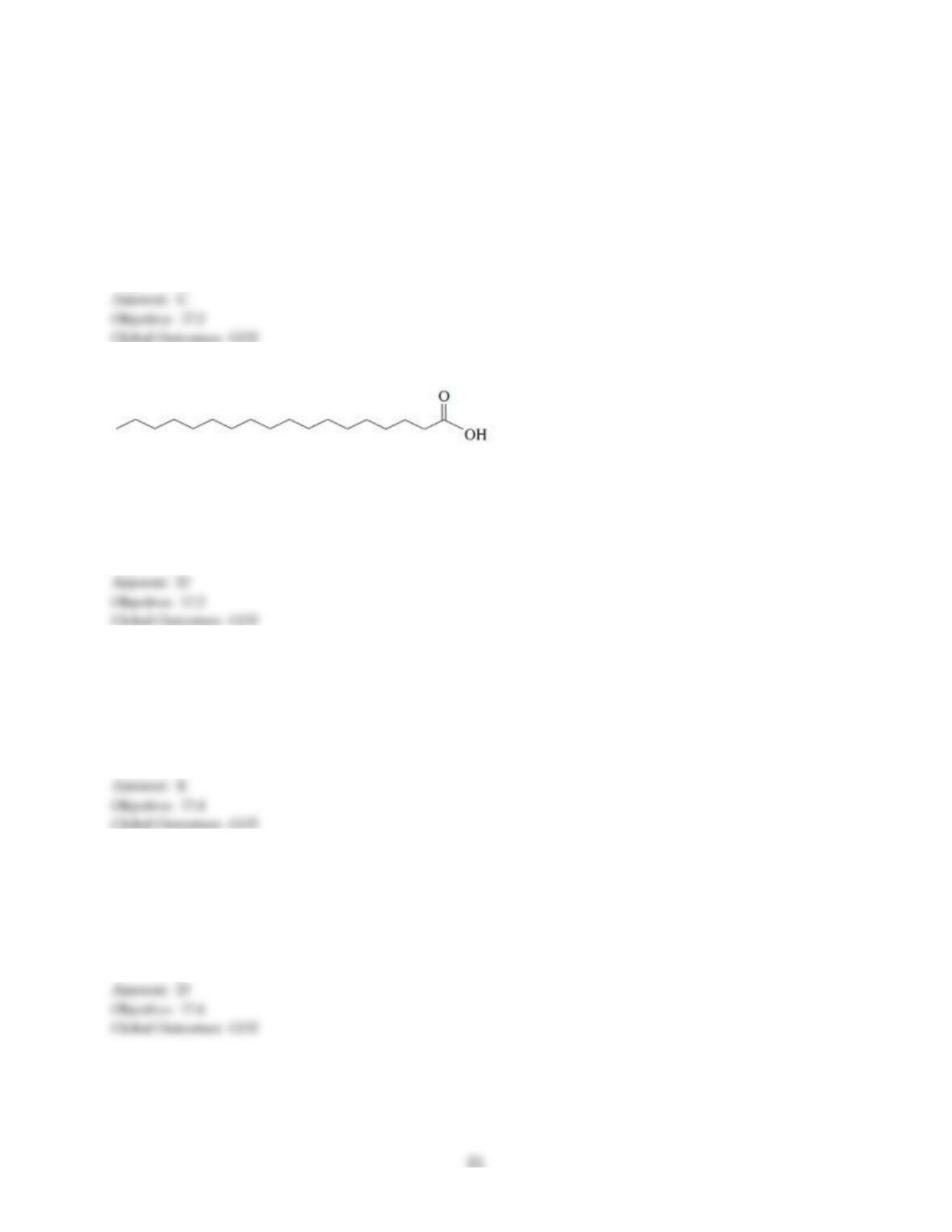
2) The structure is that of ________ acid.
A) oleic
B) linoleic
C) arachidonic
D) stearic
E) palmitic
3) The name of the reaction that occurs when a fat reacts with sodium hydroxide and water is ________.
A) hydrogenation
B) reduction
C) hydration
D) oxidation
E) saponification
4) Bile salts are synthesized from ________.
A) cephalin
B) triacylglycerols
C) pancreas
D) cholesterol
E) lecithin
5) Cholesterol belongs to the ________ group of lipids.
A) phospholipid
B) steroid
C) prostaglandin
D) triacylglycerol
E) wax
6) Bile salts are stored in the ________.
A) liver
B) pancreas
C) stomach
D) gall bladder
E) small intestine
7) Bile salts are among the lipid class known as ________.
A) sphingosides
B) prostaglandins
C) cerebrosides
D) triacylglycerols
E) steroids
8) In a simple model of atherosclerosis and heart disease, the compound that forms plaques that adhere to
the walls of the blood vessels is ________.
A) cholesterol
B) carnauba wax
C) stearic acid
D) glycerol
E) sphingosine
23
17.3 True/False Questions
1) DNA is a lipid.
2) Steroids do not contain fatty acids.
3) Most plant lipids are saturated lipids.
4) Palmitic acid is an unsaturated fatty acid.
5) Oleic acid is an unsaturated fatty acid.
6) Stearic acid is a polyunsaturated fatty acid.
7) The tail of a triacylglycerol is the nonpolar end.
8) Hydrogenation of the double bonds in unsaturated fats requires a catalyst.
9) The catalyst needed for saponification is H+ ion.
10) The saponification of a fat gives fatty acid salts and glycerol.
11) One function of phospholipids is to provide structure to biomembranes.
12) Sphingolipids contain fatty acids.
13) Many sex hormones are steroids.
14) Excess cholesterol in the blood can lead to a build up of plaque.
15) Bile salts help in the digestion of proteins.
16) In the fluid-mosaic model of cell membranes, the lipid molecules are oriented with their heads to the
outside of the membrane.
17) Glycoproteins are components of cell membranes.
18) The interior of a lipid bilayer is the hydrophilic region.
25
17.4 Matching Questions
Match the following.
A) sphingolipids
B) hydrogenation
C) higher
D) animals
E) insoluble in water
F) plants
G) fatty acids
H) hydrolysis
I) lower
J) glycerin
K) ester
L) unsaturated
M) soap
N) cholesterol
1) The second component of triacylglycerols beside glycerol.
Objective: 17.1
Global Outcomes: GO2
2) a lipid that cannot be hydrolyzed
Objective: 17.1
Global Outcomes: GO2
3) the functional group of triacylglycerols
Objective: 17.1
Global Outcomes: GO2
4) a fatty acid with at least one double bond
Objective: 17.1
Global Outcomes: GO2
5) phospholipids that do not contain glycerol
Objective: 17.1
Global Outcomes: GO2
6) the process of converting unsaturated fats into saturated fats
Objective: 17.1
Global Outcomes: GO2
7) the melting points of saturated fats compared to unsaturated fats
Objective: 17.1
Global Outcomes: GO2
8) a source of most saturated fats
Objective: 17.1
Global Outcomes: GO2
9) a characteristic common to most lipids
Objective: 17.1
Global Outcomes: GO2
10) the product of reacting a triacylglycerol with a strong base and water
Objective: 17.1
Global Outcomes: GO2
Select the type of lipid that matches the description.
A) glycerophospholipid
B) steroid
C) triacylglycerol
11) triolein
Objective: 17.1
Global Outcomes: GO2
12) aldosterone
Objective: 17.1
Global Outcomes: GO2
13) testosterone
Objective: 17.1
Global Outcomes: GO2
14) lecithin
Objective: 17.1
Global Outcomes: GO2
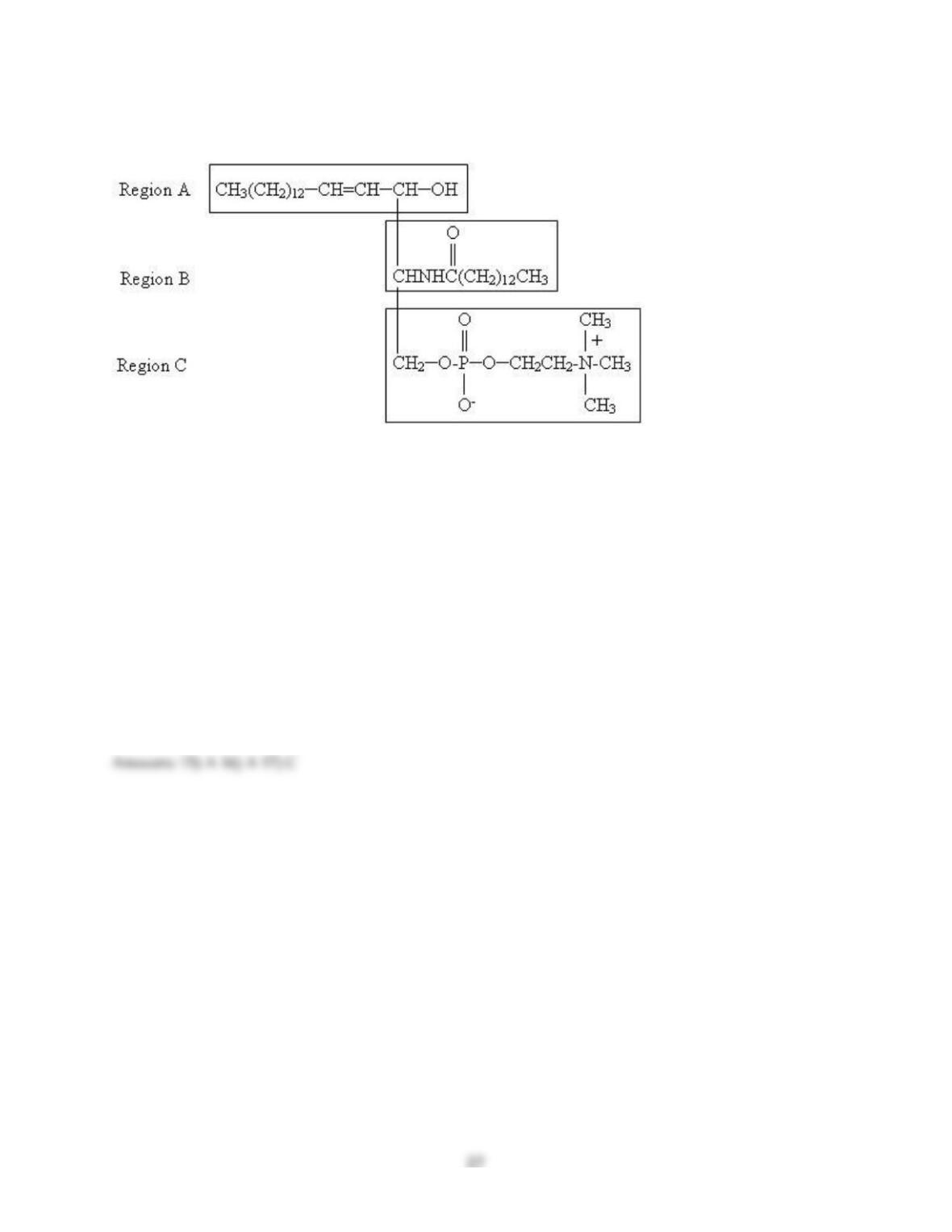
Identify each of the specified regions on this phospholipid as polar or nonpolar.
A) nonpolar
B) neither
C) polar
15) Region A
Objective: 17.5
Global Outcomes: GO2
16) Region B
Objective: 17.5
Global Outcomes: GO2
17) Region C
Objective: 17.5
Global Outcomes: GO2