General, Organic & Biological Chemistry, 5e (Timberlake)
Chapter 14 Aldehydes, Ketones, and Chiral Molecules
14.1 Multiple-Choice Questions
1) Which one of the following compounds is an aldehyde?
A) OH
|
CH3 – CH – CH3
B) O
CH3 – CH2 – CH
C) CH3 – CH = CH – CH2 – CH3
D) CH3 – CH2 – O – CH2 – CH3
E) CH3 – SH
2) What are the bond angles in a typical carbonyl group?
A) 45°
B) 90°
C) 109.5°
D) 120°
E) 135°
3) How many carbonyl-containing isomers does the formula C3H6O have?
A) two
B) three
C) five
D) seven
E) eight
4) The compound 2-propanone is also known as
A) acetone.
B) 2-propanone.
C) dimethyl ketone.
D) β-propanone.
E) propylone.
5) The common name for 2-butanone, a readily available solvent, is
A) methyl acetone.
B) methyl ethyl ketone.
C) β-butanone.
D) butyl ketone.
E) butyl ether.
6) Formaldehyde is used industrially to make
A) polymers.
B) insulating materials.
C) carpeting.
D) All of the above.
E) None of the above.
7) Acetone can be produced by the body when a person is
A) exercising.
B) dieting with high protein diets.
C) ill with a flu.
D) recovering from surgery.
E) sleeping.
8) Which of the following compounds contains a ketone functional group?
A) CH3
|
CH3 – C – OH
|
CH3
B) O
CH3 – CH
C) CH3 – CH2 – O – CH2 –CH3
D) O
CH3 – CH2 – C – CH3
E) CH3 – O – CH
|
CH3
9) What is the IUPAC name for this compound?
O
CH3 – CH
A) methyl aldehyde
B) 1-ethanaldehyde
C) 1-ethanone
D) ethanal
E) methanal
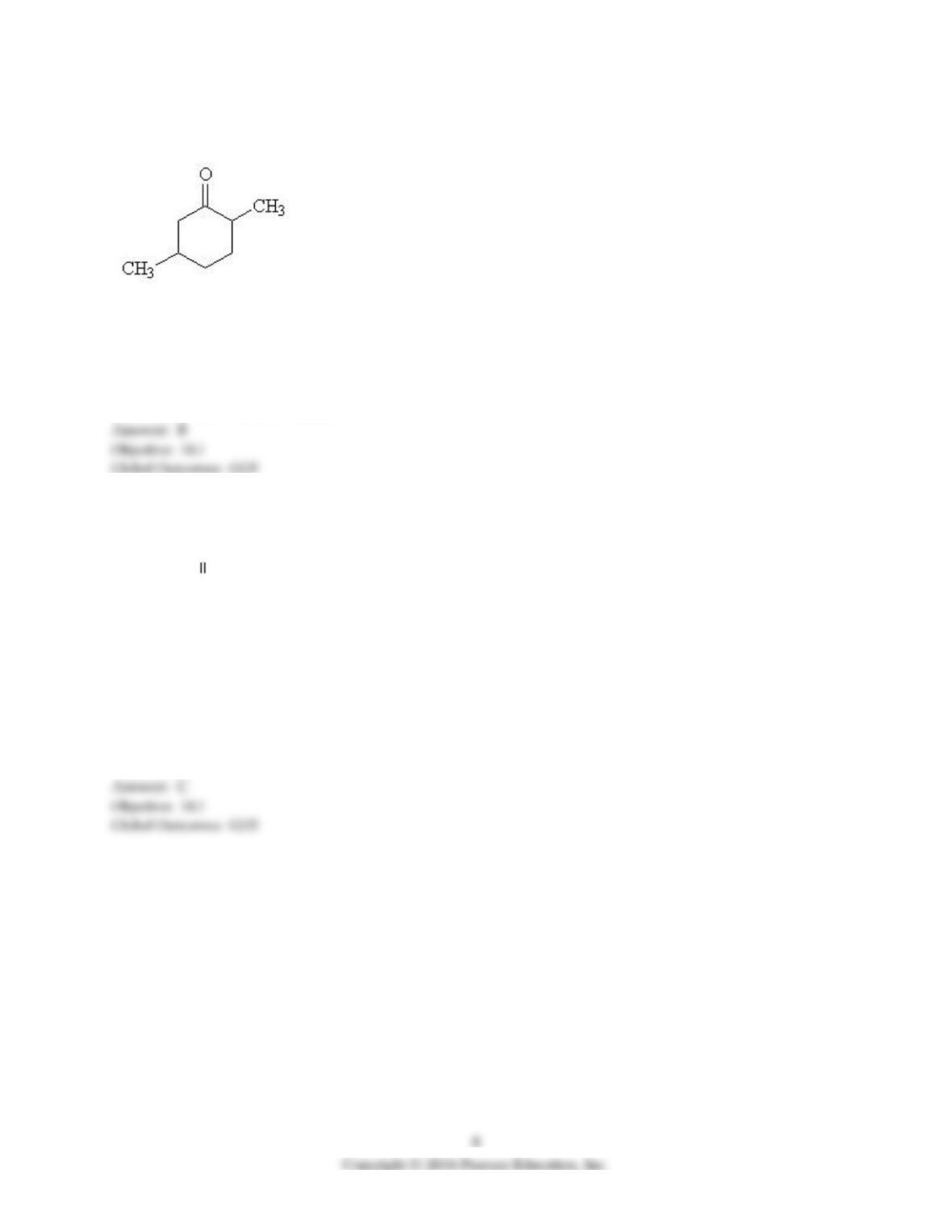
10) What is the IUPAC name for this compound?
A) methylcyclohexanone
B) 2,5-dimethylcyclohexanone
C) 1,4-dimethyl-2-cyclohexanone
D) cyclohexyl methyl ketone
E) 1,4-dimethyl-3-cyclohexanone
11) What is the name of this compound?
O
CH3 – C – CH – CH3
|
CH3
A) 2-pentanone
B) methyl propyl ketone
C) 3-methyl-2-butanone
D) 2-methyl-3-butanone
E) 2-methyl-3-ketone butane
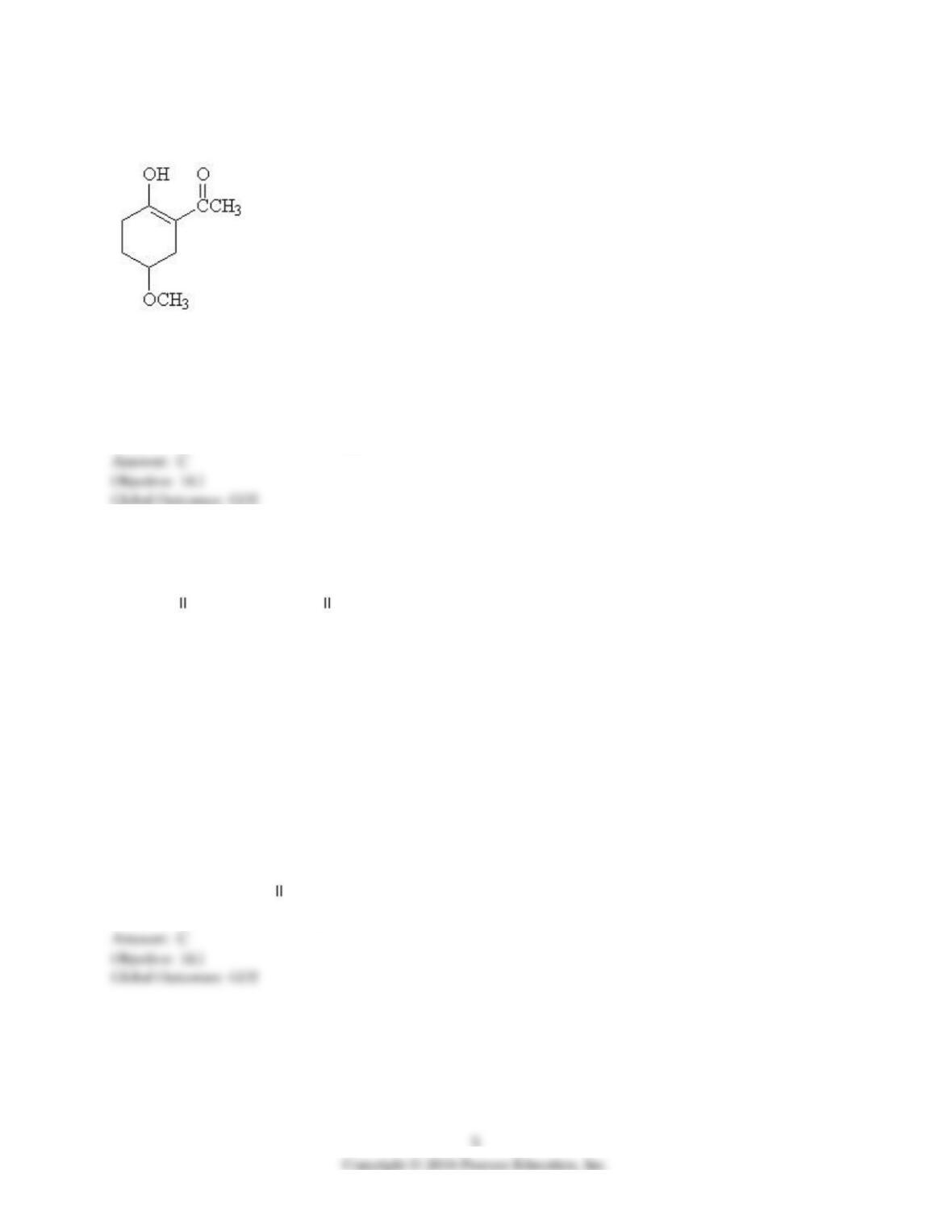
12) Three functional groups found in this compound are
A) alcohol, aromatic, and ether.
B) alcohol, aldehyde, and ether.
C) alcohol, ether, and ketone.
D) aldehyde, ether, and carboxylic acid.
E) cycloalkene, alcohol, and carboxylic acid.
13) Which of the following pairs of compounds are isomers?
A) CH3CH2CH2OH and CH3OCH3
B) O O
CH3CH2 C CH3 and CH3 C CH2CH3
C) OH
|
CH3CH2 OCH2CH3 and CH3 C CH3
|
CH3
D) OH
|
CH3CH2CHOH and CH3 C HCH2CH3
|
CH3
E) O
CH3CH2OH and H C CH3
14) In all aldehydes except formaldehyde, how many hydrogen atoms is the carbonyl group bonded to?
A) one
B) two
C) three
D) four
15) How many hydrogen atoms is the carbonyl group in a ketone bonded to?
A) none
B) one
C) two
D) three
E) four
16) The carbonyl group consists of
A) a carbon-oxygen-hydrogen structure.
B) a carbon-oxygen single bond.
C) a carbon-oxygen double bond.
D) a carbon-oxygen triple bond.
E) a carbon-oxygen-carbon structure.
17) The oxygen atom in a carbonyl group is ________ the carbon atom.
A) more electronegative than
B) less electronegative than
C) identical in electronegativity to
D) more electropositive than
E) more soluble than
18) How many lone pairs of electrons does the oxygen in a carbonyl group have?
A) None, they’re all bonded.
B) one
C) two
D) three
E) four
19) In the IUPAC naming system, a ketone is named by replacing the -e in the corresponding alkane
name with
A) yne.
B) ene.
C) al.
D) one.
E) ol.
20) In the IUPAC naming system, an aldehyde is named by replacing the -e of the name of the
corresponding alkane with
A) yne.
B) ene.
C) al.
D) one.
E) ol.
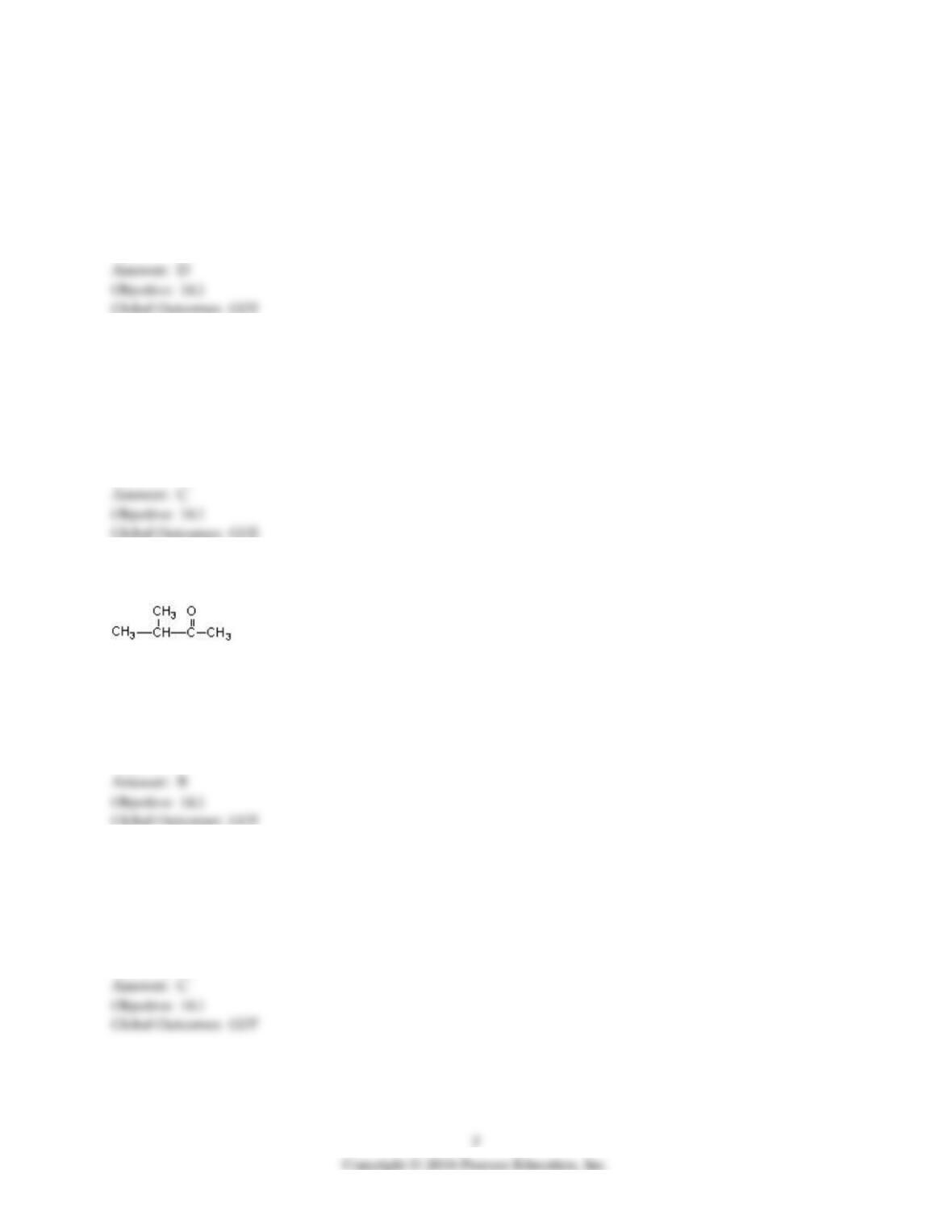
21) What is the name of this compound?
A) 2-methylbutanone
B) 3-methyl-2-butanone
C) 2-methyl-3-butanone
D) 3-methylbutanone
E) pentanone
22) Formalin is
A) another name for formaldehyde.
B) a plastic.
C) an aqueous solution of formaldehyde.
D) an excellent solvent.
E) a polymer.
23) Acetone is a ketone commonly used as a
A) preservative.
B) flavoring agent.
C) fuel.
D) solvent.
E) drain cleaner.
24) The flavoring agent found in vanilla is
A) an aldehyde.
B) a ketone.
C) a hydrocarbon.
D) an ester.
E) a thiol.
25) Aldehydes have higher boiling points than alkanes of similar mass because of
A) hydrogen bonding.
B) dipole-dipole interactions.
C) ionic bonding.
D) covalent bonding.
E) oxygen bonding.
26) The increased boiling point of ketones compared to alkanes and ethers of similar mass is due to
A) hydrogen bonding.
B) dipole-dipole interactions.
C) a bent chain structure.
D) resonance.
E) ionic interactions.
27) Low-molecular-weight ketones are soluble in water. What is the shortest length of the carbon chain
where insolubility becomes important?
A) one
B) two
C) four
D) five
E) eight
28) Which of the following would not be water soluble?
A) acetone
B) propanal
C) 3-heptanone
D) formaldehyde
E) 2-butanone
29) Which of the following ketones is the most soluble in water?
A) O
CH3 C CH3
B) O
CH3 – CH – C – CH3
|
CH3
C) O
CH3 – CH2 – C – CH2 – CH2 – CH3
D) O
CH3 – C – CH2 – CH2 – CH3
E) O
CH3 – CH2 – C – CH2 – CH3
30) The reduction of 3-pentanone with hydrogen in the presence of a nickel catalyst will yield
A) pentane.
B) 2-pentene.
C) diethyl alcohol.
D) 3-pentanol.
E) pentanaldehyde.
31) The addition of hydrogen to an organic compound or the loss of oxygen is called
A) reduction.
B) oxidation.
C) dehydration.
D) halogenation.
E) hydration.
32) The hydrogenation of 2-methylpropanal gives the product
A) 1-butanol.
B) 2-methylpropanoic acid.
C) 2-methyl-3-propanol.
D) 2-methyl-1-propanol.
E) 2-methyl-2-propanol.
33) The Tollens’ test may be used to distinguish
A) acids from amines.
B) esters from acids.
C) ketones from alcohols.
D) aldehydes from ketones.
E) alcohols from alkenes.
34) Benedict’s test requires an aldehyde and an adjacent
A) saturated carbon.
B) ketone.
C) alcohol.
D) phenyl ring.
E) acid.
35) Aldehydes and ketones may be reduced to
A) acids.
B) alkanes.
C) ethers.
D) alcohols.
E) esters.
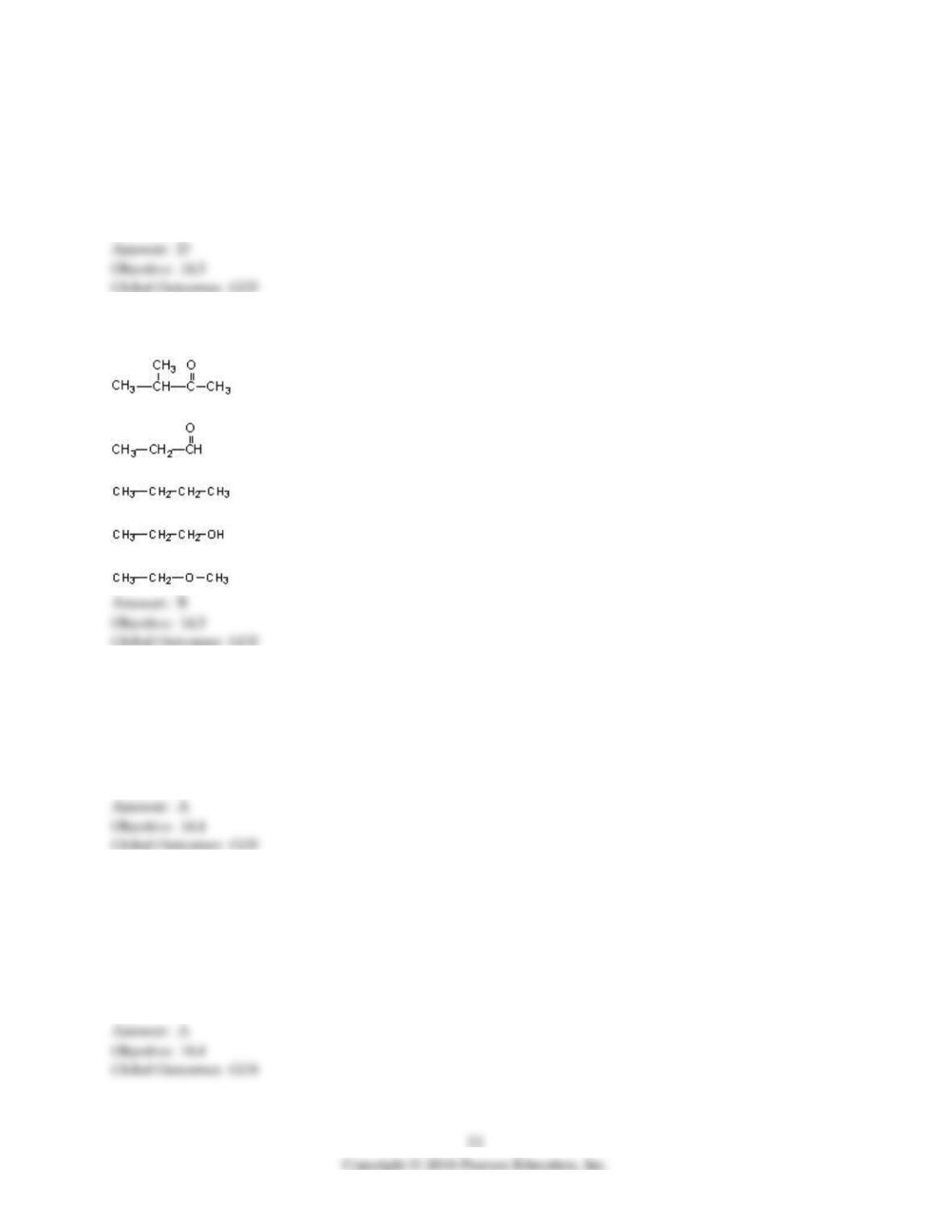
36) Which of the compounds would give a positive Tollens’ test?
A)
B)
C)
D)
E)
37) An acetal is formed from two molecules of an alcohol and a(n)
A) aldehyde.
B) ether.
C) carboxylic acid.
D) alkyl ether.
E) ester.
38) How many moles of an alcohol are needed to react with 1 mole of an aldehyde to
form a hemiacetal?
A) 1
B) 1.5
C) 2
D) 3
E) 3.5
39) How do sugars form cyclic hemiacetals?
A) Two molecules of a sugar react with one another.
B) A molecule of sugar reacts with an added alcohol.
C) A molecule of sugar reacts with itself.
D) A molecule of sugar reacts with an added aldehyde.
E) A sugar molecule decomposes.
40) The product of adding two molecules of an alcohol to an aldehyde in the presence of acid is a(n)
A) acetal.
B) ether.
C) hemiacetal.
D) hemiether.
E) hydroxyl group.