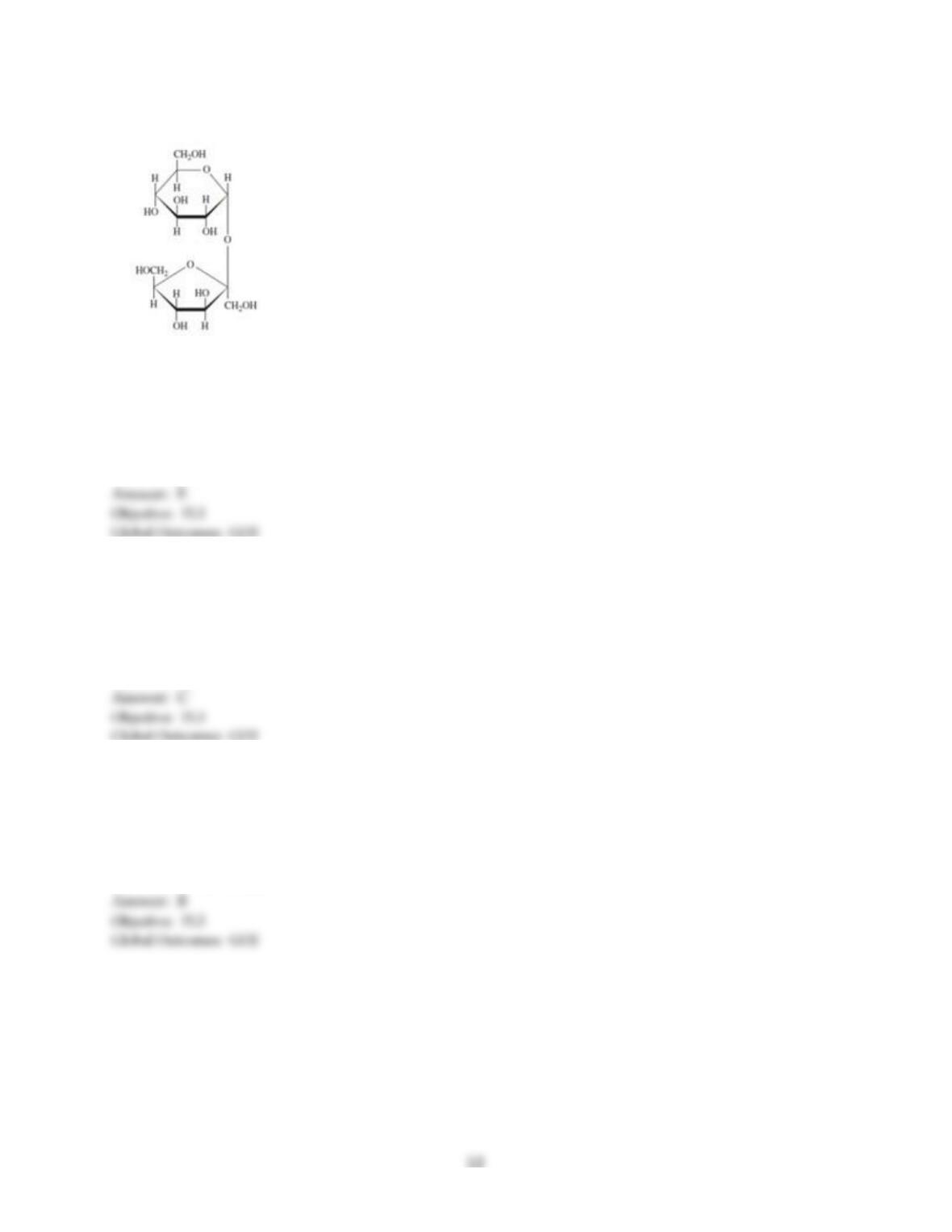
Refer to the disaccharides below to answer the question(s) that follow.
32) In the figure above, the monosaccharide unit at the top is a(n)
A) aldopentose.
B) ketopentose.
C) aldohexose.
D) aldoheptose.
E) ketohexose.
33) In the figure above, the monosaccharide unit on the bottom is a(n)
A) aldopentose.
B) ketopentose.
C) aldohexose.
D) aldoheptose.
E) ketohexose.
34) Hydrolysis of the disaccharide above gives the monosaccharides
A) fructose and ribose.
B) fructose and galactose.
C) ribose and glucose.
D) ribose and galactose.
E) fructose and lactose.

13
35) The disaccharide above contains a(n) ________-glycosidic linkage.
A) α-1,4
B) β-1,4
C) α-2,4
D) β-2,4
E) α-2,6
36) Maltose is a
A) monosaccharide.
B) disaccharide.
C) trisaccharide.
D) polysaccharide.
E) phosphosaccharide.
37) Galactose is a product of enzymatic hydrolysis of
A) lactose.
B) glucose.
C) maltose.
D) erythrose.
E) sucrose.
38) Maltose can be classified as a(n)
A) disaccharide.
B) polysaccharide.
C) ketose.
D) pentose.
E) oligosaccharide.
39) Which of the following contains α-1,6-branches?
A) amylose
B) glycogen
C) cellulose
D) sucrose
E) maltose
40) Cellulose is not digestible by humans because it contains glucose units linked by ________-glycosidic
bonds.
A) α-1,2
B) α-1,4
C) α-1,6
D) β-1,2
E) β-1,4
41) Amylose is a polysaccharide which has
A) only β-1,4-bonds between glucose units.
B) only α-1,4-links bonds glucose units.
C) both α-1,4-and β-1,4-bonds between glucose units.
D) hemiacetal links joining glucose units.
E) carbon-carbon bonds joining glucose units.
42) Humans cannot digest cellulose because they
A) lack the necessary enzymes to digest β-glycosides.
B) are allergic to β-glycosides.
C) are poisoned by β-glycosides.
D) have intestinal flora which use up β-glycosides.
E) cannot digest chlorophyll.
43) Under acid hydrolysis conditions, starch is converted to
A) glucose.
B) xylose.
C) maltose.
D) galactose.
E) fructose.
44) Amylopectin is a polysaccharide which has
A) only β-1,4-bonds between glucose units.
B) only α-1,4-links bonds glucose units.
C) both α-1,4-and β–1,4-bonds between glucose units.
D) both α-1,4-and α-1,6-bonds between glucose units.
E) carbon-carbon bonds joining glucose units.
45) Glycogen is a polysaccharide which has
A) only β-1,4-bonds between glucose units.
B) only α-1,4-links bonds glucose units.
C) both α-1,4-and β-1,4-bonds between glucose units.
D) both α-1,4-and α-1,6-bonds between glucose units.
E) carbon-carbon bonds joining glucose units.
1)
2)
3)
4)
5)
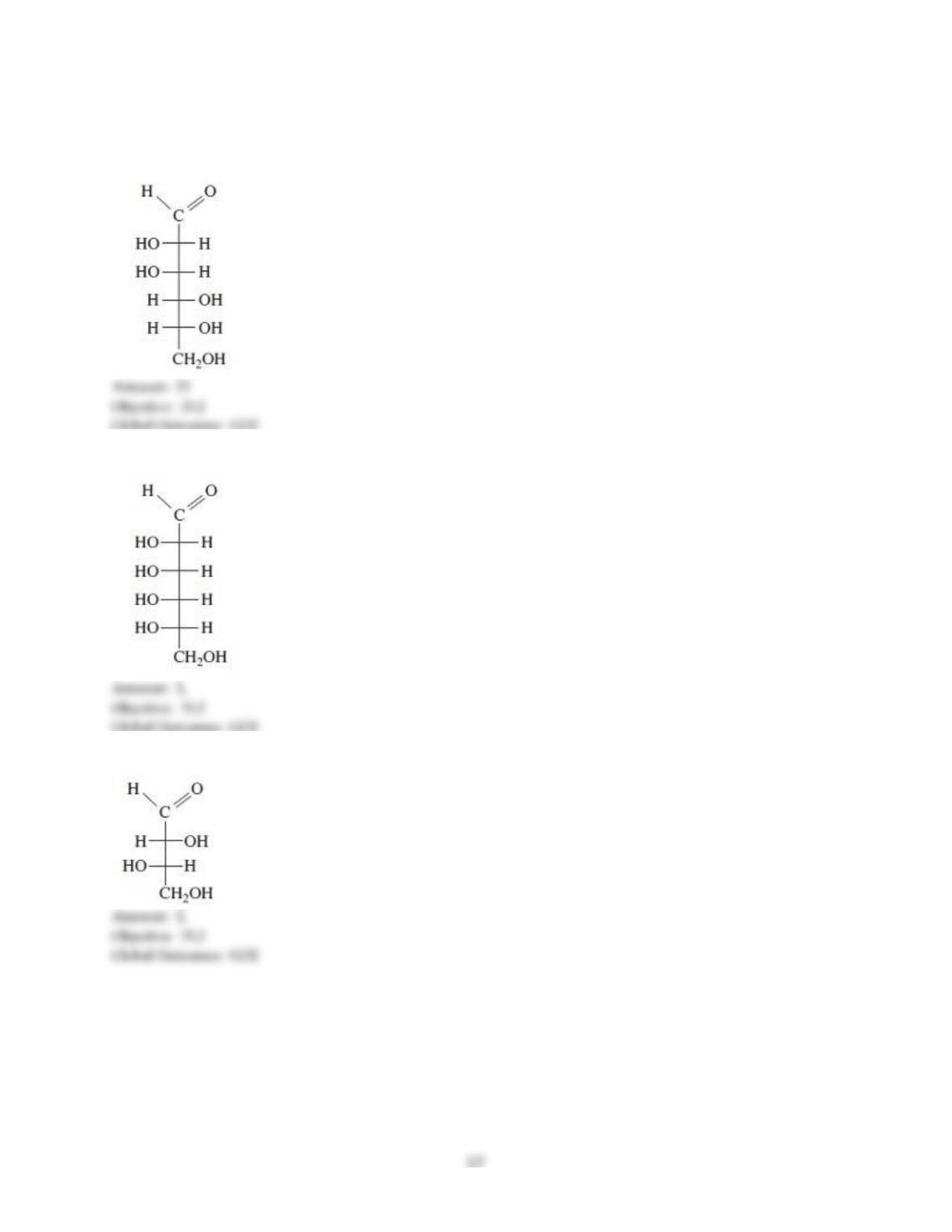
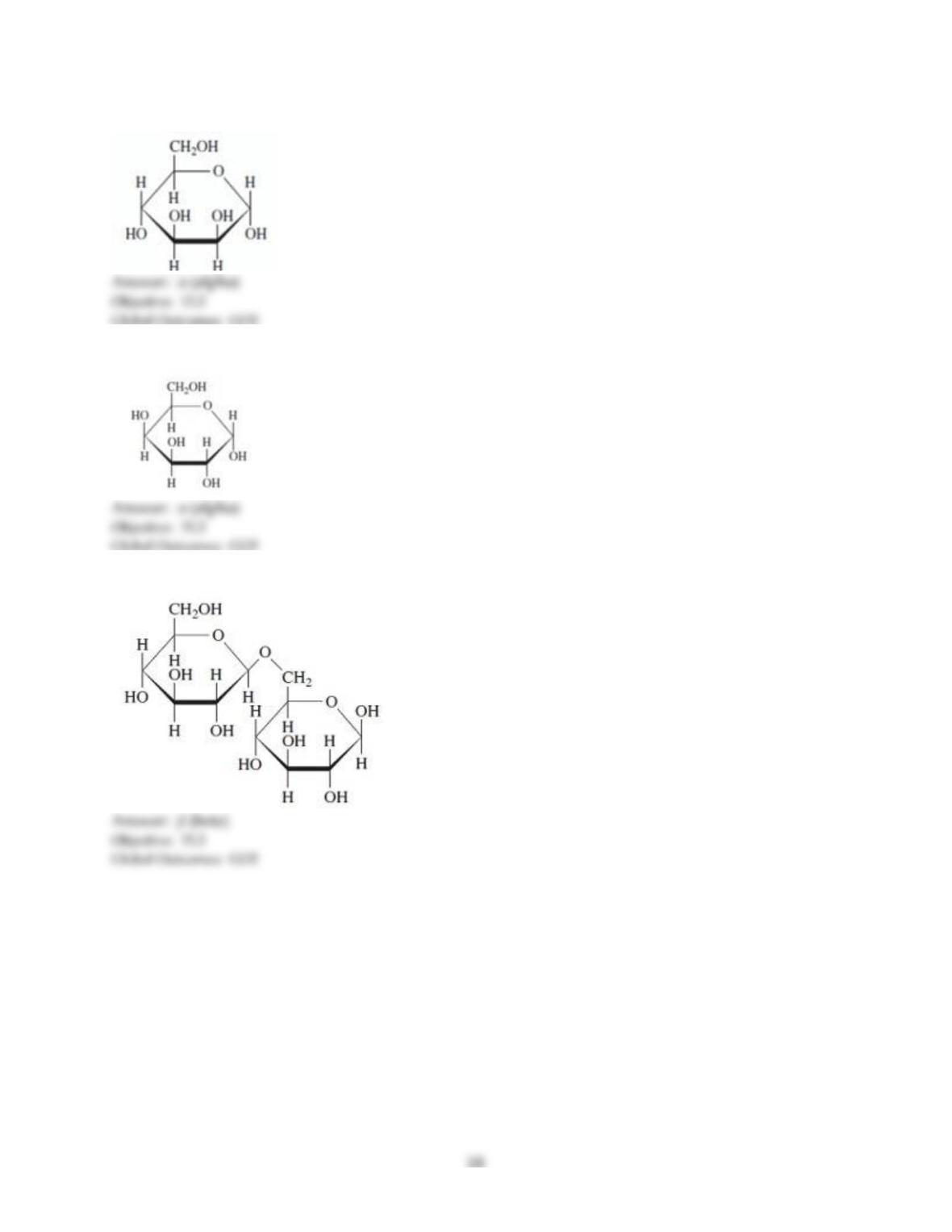
Identify each Fischer projection as the D– or L-isomer.
6)
7)
8)
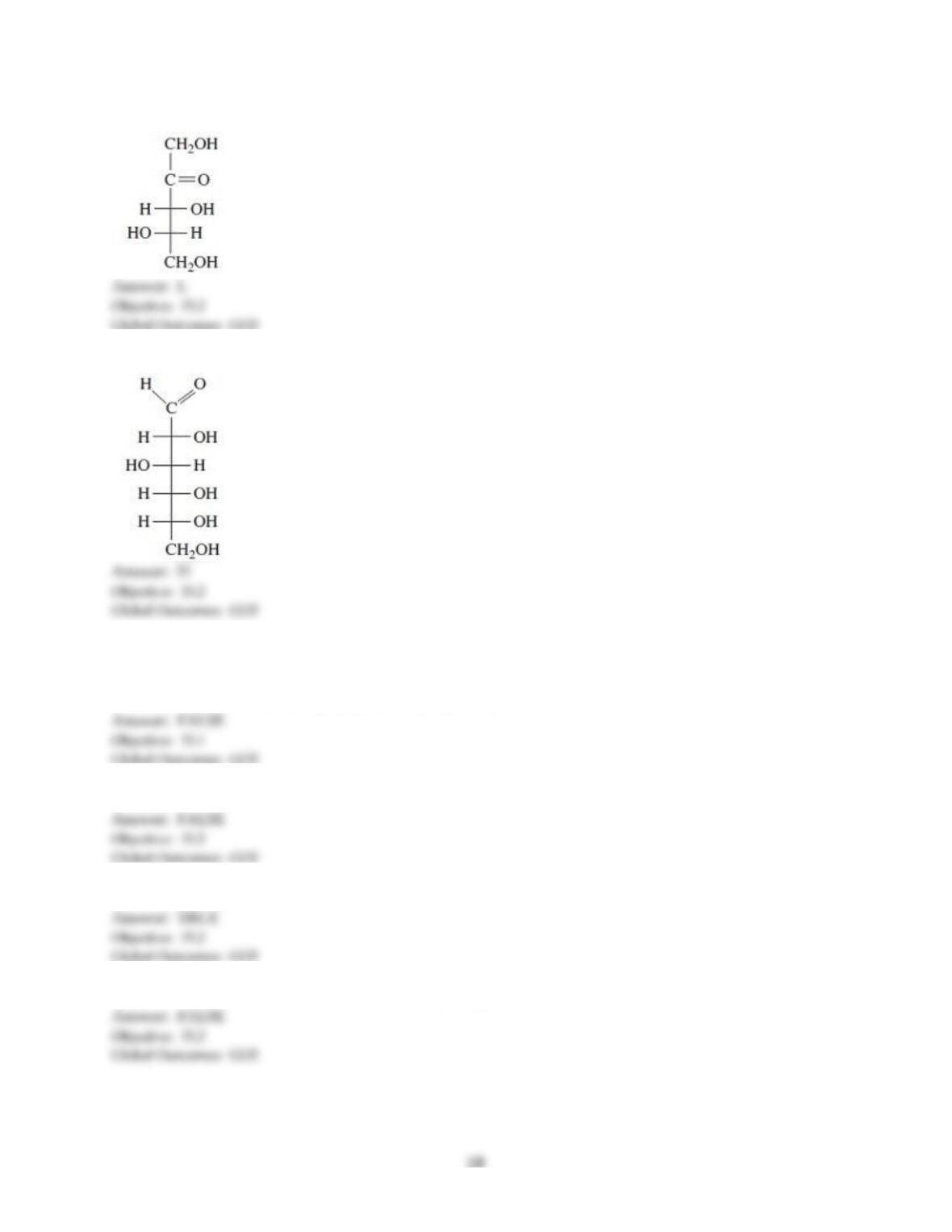
9)
10)
15.3 True/False Questions
1) A monosaccharide can be hydrolyzed to smaller units.
2) Fructose is also known as dextrose.
3) Fructose is a ketohexose.
4) In the D- isomer, the -OH farthest from the carbonyl is to the left.
19
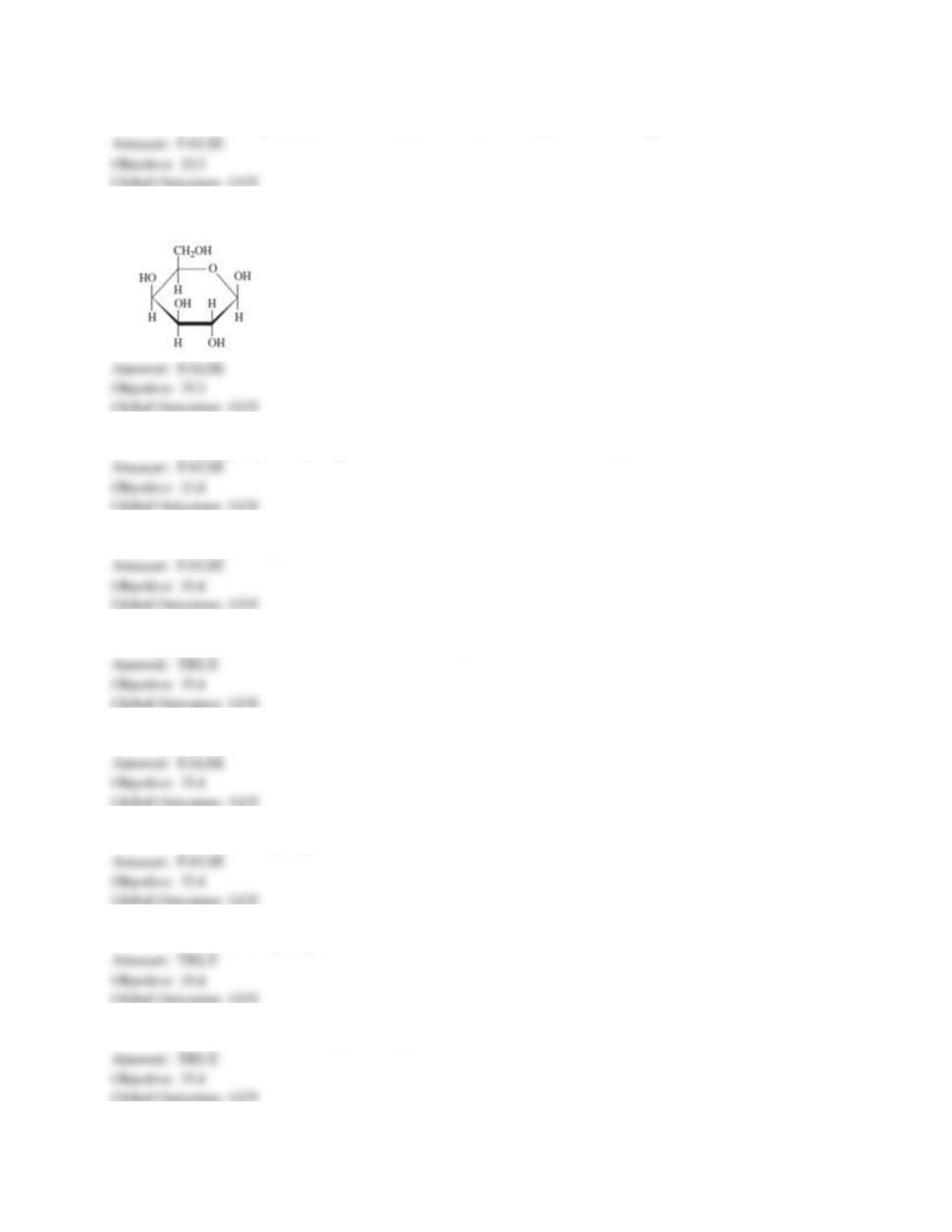
5) In the α anomer of glucose, the OH on carbon 1 is above the plane of the ring.
6) This anomer is the α anomer
7) A reducing sugar gives a precipitate of silver metal with Benedict’s reagent.
8) Cellulose will give a positive Benedict’s test.
9) The product of oxidation of an aldose is a carboxylic acid.
10) The product of reduction of mannose is mannic acid.
11) Sucrose is a reducing sugar.
12) Maltose is a reducing sugar.
13) The product of reduction of xylose is xylitol.
14) Sucrose is made up of glucose units only.
15) Galactose is a disaccharide.
16) Sucrose is a disaccharide.
17) The iodine test is used to detect the presence of a reducing sugar.
18) Glucose is stored in animals as glycogen.
19) Amylopectin is a straight-chain polysaccharide.
20) Cellulose is a polysaccharide with only β-1,4-bonds between glucose units.
21
15.4 Matching Questions
Select the correct carbohydrate for each description.
A) amylose
B) fructose
C) lactose
D) cellulose
E) galactose
F) glycogen
G) maltose
H) sucrose
1) a carbohydrate that cannot be digested by humans
Objective: 15.2, 15.5, 15.6
Global Outcomes: GO2
2) a disaccharide that occurs as a breakdown product of starch
Objective: 15.2, 15.5, 15.6
Global Outcomes: GO2
3) a carbohydrate that stores energy in the human body
Objective: 15.2, 15.5, 15.6
Global Outcomes: GO2
4) a carbohydrate that is used to build cell walls in plants
Objective: 15.2, 15.5, 15.6
Global Outcomes: GO2
5) a monosaccharide that combines with glucose to form lactose
Objective: 15.2, 15.5, 15.6
Global Outcomes: GO2
6) a disaccharide found in milk and milk products
Objective: 15.2, 15.5, 15.6
Global Outcomes: GO2
7) a disaccharide consisting of glucose and fructose
Objective: 15.2, 15.5, 15.6
Global Outcomes: GO2
8) a disaccharide consisting of two glucose molecules
Objective: 15.2, 15.5, 15.6
Global Outcomes: GO2
9) a monosaccharide found in fruit juices and honey, the sweetest carbohydrate
Objective: 15.2, 15.5, 15.6
Global Outcomes: GO2

10) an unbranched carbohydrate that stores glucose in plants
Objective: 15.2, 15.5, 15.6
Global Outcomes: GO2
Indicate the monosaccharide(s) produced upon hydrolysis of each carbohydrate.
A) glucose + fructose
B) glucose
C) glucose + galactose
11) amylopectin
Objective: 15.5, 15.6
Global Outcomes: GO2
12) lactose
Objective: 15.5, 15.6
Global Outcomes: GO2
13) glycogen
Objective: 15.5, 15.6
Global Outcomes: GO2
14) maltose
Objective: 15.5, 15.6
Global Outcomes: GO2
15) sucrose
Objective: 15.5, 15.6
Global Outcomes: GO2