39) When acetic acid reacts with ammonia, NH3, the reaction called amidation yields
A) acetamine.
B) ammonium acetate.
C) ethylammonium hydroxide.
D) amino acetate.
E) acetamide.
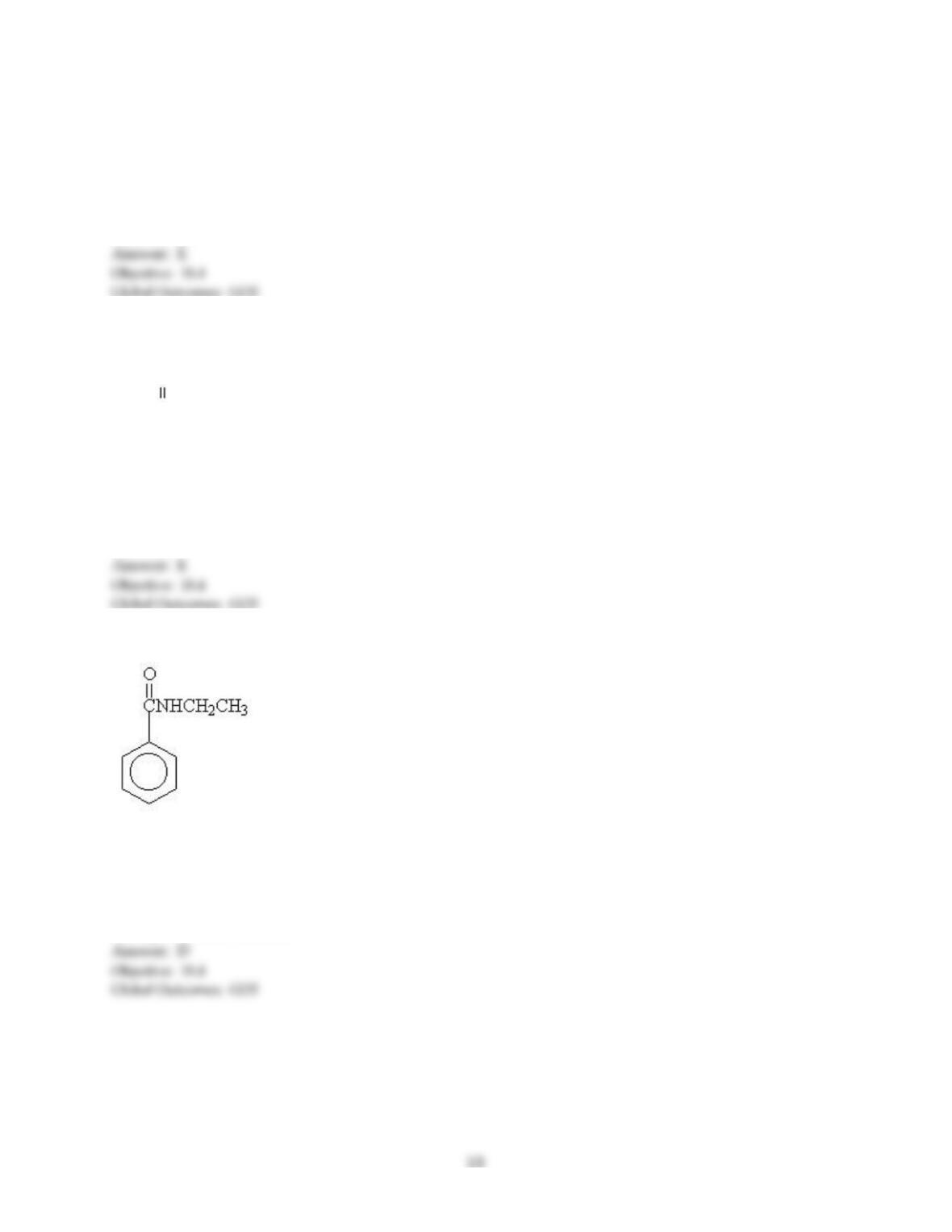
40) What is the major functional group in the following compound?
O
CH3 – C – NH – CH3
A) ketone
B) carboxylic acid
C) ester
D) amine
E) amide
41) What is the name of this compound?
A) 1-ethylbenzamide
B) N,N-dimethylbenzamide
C) 2-ethylbenzamide
D) N-ethylbenzamide
E) ethylaminobenzoic acid
42) One name for this compound is
O
CH3 – CH2 – C – NH – CH2 – CH3
A) N-ethylpropanamide.
B) N-ethylacetamide.
C) pentanamide.
D) N,N-diethylacetamide.
E) ethylpropionamide.
43) In the formation of N-ethylacetamide, the reactant(s) is(are)
A) acetic acid and dimethylamine.
B) diethylamine.
C) acetamide and ethanol.
D) acetic acid and ethylamine.
E) ethanol and ethylamine.
44) The reaction of butanoic acid and dimethylamine gives
A) N-methylbutanamide.
B) N-ethylbutanamide.
C) N,N–dimethylbutanamide.
D) N,N-methylbutanamine.
E) N-methylbutanamine.
45) Which chemical class does phenobarbital belong to?
A) ester
B) amine
C) amide
D) alkane
E) ether
46) Amides are derivatives of ________ and ________.
A) amines; esters
B) amines; carboxylic acids
C) alkanes; amines
D) carboxylic acids; alcohols
E) alcohols; carboxylic acids
47) What kind of compound is urea?
A) ester
B) acid
C) amide
D) ketone
E) amine
48) What is the chemical classification of the barbiturate sedatives?
A) cyclic amides
B) cyclic ethers
C) cyclic amines
D) cyclic esters
E) cyclic acids
49) Amides having fewer than ________ carbons are generally water soluble.
A) five
B) six
C) ten
D) eleven
E) twelve
50) Which of the following is the reaction for the acid hydrolysis of N-methylacetamide?
A) O O
CH3 – C – NH – CH3 + H2O → CH3 – C – NH2 + CH3OH
B) O O
H C – NH – CH3 + H2O → H C – NH2 + CH3OH
C) O O
CH3 – C – NH – CH3 + H2O + HCl → CH3 – C – NH3+Cl– + CH3OH
D)O O
H C – NH – CH3 + H2O + HCl → H C – NH3+Cl– + CH3OH
E) O O
CH3 – C – NH – CH3 + H2O + HCl → CH3 – C OH + CH3NH3+Cl–
51) Which of the following is the reaction for the base hydrolysis of N-ethylformamide?
A)O O
H C – NH – CH2CH3 + NaOH → H C OH + CH3CH2 – NH2–Na+
B) O O
H C – NH – CH2CH3 + NaOH → H C O–Na+ + CH3CH2 – NH2
C) O O
H C – NH – CH2CH3 + NaOH → H C O–Na+ + NH3 + CH3CH3
D)O O
H C – NH – CH2CH3 + NaOH → H C O–Na+ + CH3 – NH – CH3
E) O
H C – NH – CH2CH3 + NaOH → CH3CH2 – NH2 + NaHCO2
52) With the correct choice of acid, acid hydrolysis of acetamide could produce
A) acetic acid and ammonium chloride.
B) acetic acid and methylamine.
C) ethanol and ammonia.
D) acetaldehyde and ammonium hydroxide.
E) formic acid and ethylamine.
53) With the correct choice of acid, the product(s) of the acid hydrolysis of N-methylbenzamide could be
A) formic acid and aniline.
B) methanol and benzoic acid.
C) benzoic acid and ethylamine.
D) benzoic acid and methylammonium chloride.
E) formic acid, phenol, and ammonia.
54) What pharmacologically active amine is responsible for the signs and symptoms encountered in an
allergic reaction?
A) histamine
B) epinephrine
C) diphenhydramine
D) phenylephrine
E) dopamine
55) Which of the following is NOT a neurotransmitter?
A) histamine
B) epinephrine
C) glutamate
D) pyridine
E) serotonin
56) A neurotransmitter
A) transmits neurons.
B) transmits neutrons.
C) transmits a nerve impulse.
D) signals loss of appetite.
E) transmits ideas from person to person.
57) A deficiency of which amine is responsible for the signs and symptoms of Parkinson’s disease?
A) histamine
B) dopamine
C) epinephrine
D) diphenhydramine
E) methedrine
58) In response to allergic reactions or injury to cells, the body increases the production of
A) diphenhydramine.
B) antihistamine.
C) histamine.
D) epinephrine.
E) dopamine.
18.2 True/False Questions
1) Aniline is the IUPAC approved name for aminobenzene.
2) Aniline is a primary amine.
3) Ethylmethylamine is a tertiary amine.
4) The amine functional group is rarely found in pharmacologically active compounds.
5) Primary amines contain two carbon-containing groups bonded to the nitrogen atom.
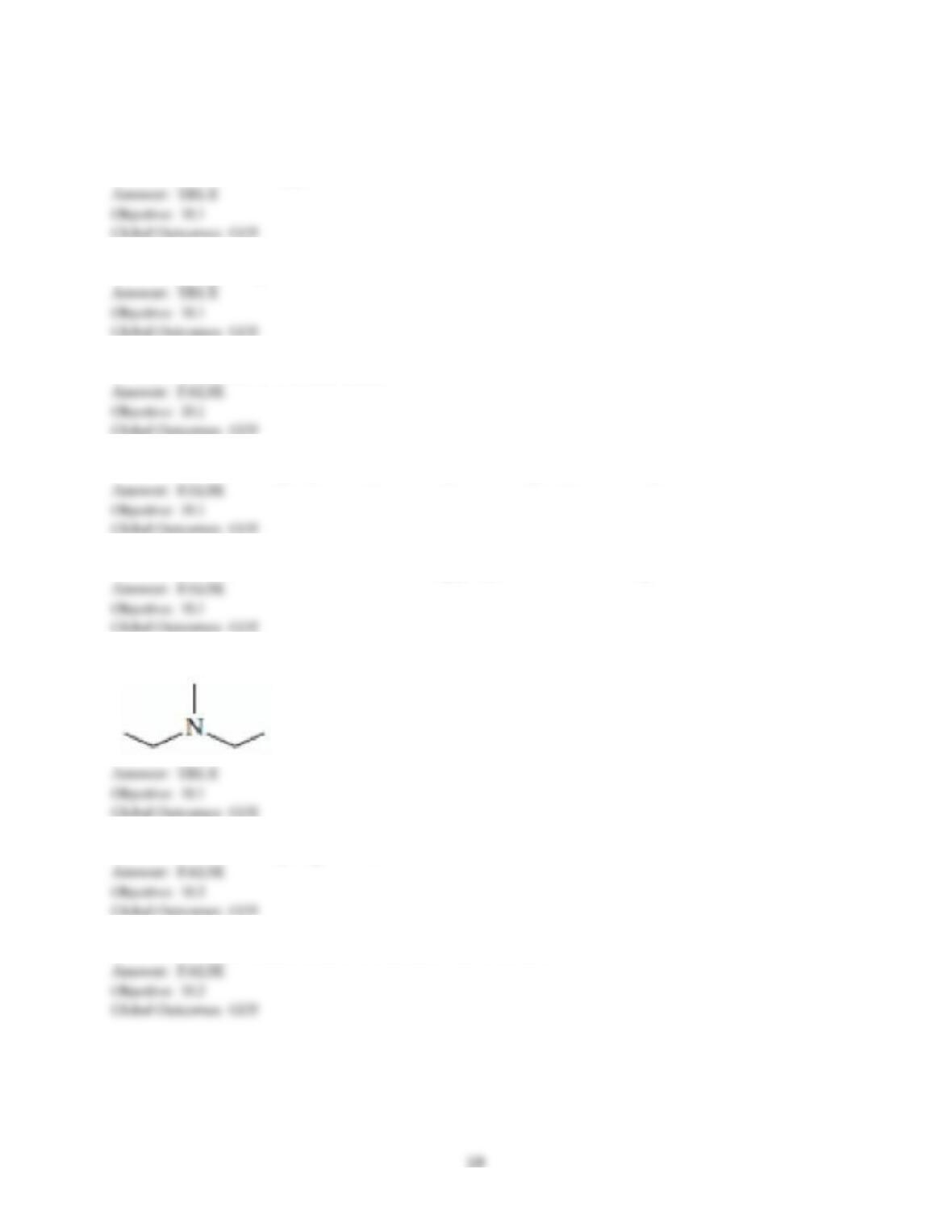
6) The compound shown is a tertiary amine.
7) Amines do not form hydrogen bonds.
8) Amines with more that six carbon atoms are soluble in water.
9) Hydrogen bonds in amines are weaker than those in alcohols.
10) Amines do not ionize in water.
11) Amines act as weak acids by accepting protons from water.
12) Amines are mostly ionized in water.
13) Ammonium salts are usually liquid at room temperature.
14) Ammonium salts are odorless and usually highly water soluble.
15) Crack cocaine is produced by the neutralization and extraction of cocaine from its hydrochloride salt.
16) Quinine is an alkaloid used for treatment of malaria.
17) Heterocyclic amines contain a nitrogen atom in a ring.
18) Caffeine is not an alkaloid.
21
19) Atropine and cocaine are used in the diagnosis of eye diseases.
20) Pyrimidine derivatives are found in DNA.
21) Nicotine is a pharmacologically active aromatic amide.
22) Meperidine is a synthetic compound developed from morphine.
23) Urea is one end product of protein metabolism in humans.
24) Aspartame is a sweetener made from corn.
25) The amide group is often found in pharmacologically active substances.
26) Aspirin substitutes may contain amide rather than ester functional groups.
27) When amides are hydrolyzed in basic solution, the products are an ammonium salt and a carboxylic
acid.
28) When amides are hydrolyzed in acidic solution, the products are an amine and a carboxylic acid.
29) Amphetamines are arylalkylamines with stimulant activity.
30) GABA is not a neurotransmitter.
31) Many important antidepressant drugs are SSRIs.
32) Neurotransmitters are chemicals that transmit a nerve impulse.
33) Nerve poisons bind to acetylcholine esterase enzyme and inhibit its action.

18.3 Matching Questions
Identify the family for each of the following compounds.
A) amine
B) amide
1) CH3 – CH2 – NH – CH3
Objective: 18.1, 18.4
Global Outcomes: GO2
2) O
CH3 – CH2 – C – NH – CH3
Objective: 18.1, 18.4
Global Outcomes: GO2
Select the correct name for the following.
A) N-ethyl formamide
B) dimethylethylamine
C) ethylamide
D) ethyldimethylamine
3) O
H – C – NH – CH2 – CH3
Objective: 18.1, 18.4
Global Outcomes: GO2
4) CH3
|
CH3 – CH2 – N – CH3
Objective: 18.1, 18.4
Global Outcomes: GO2
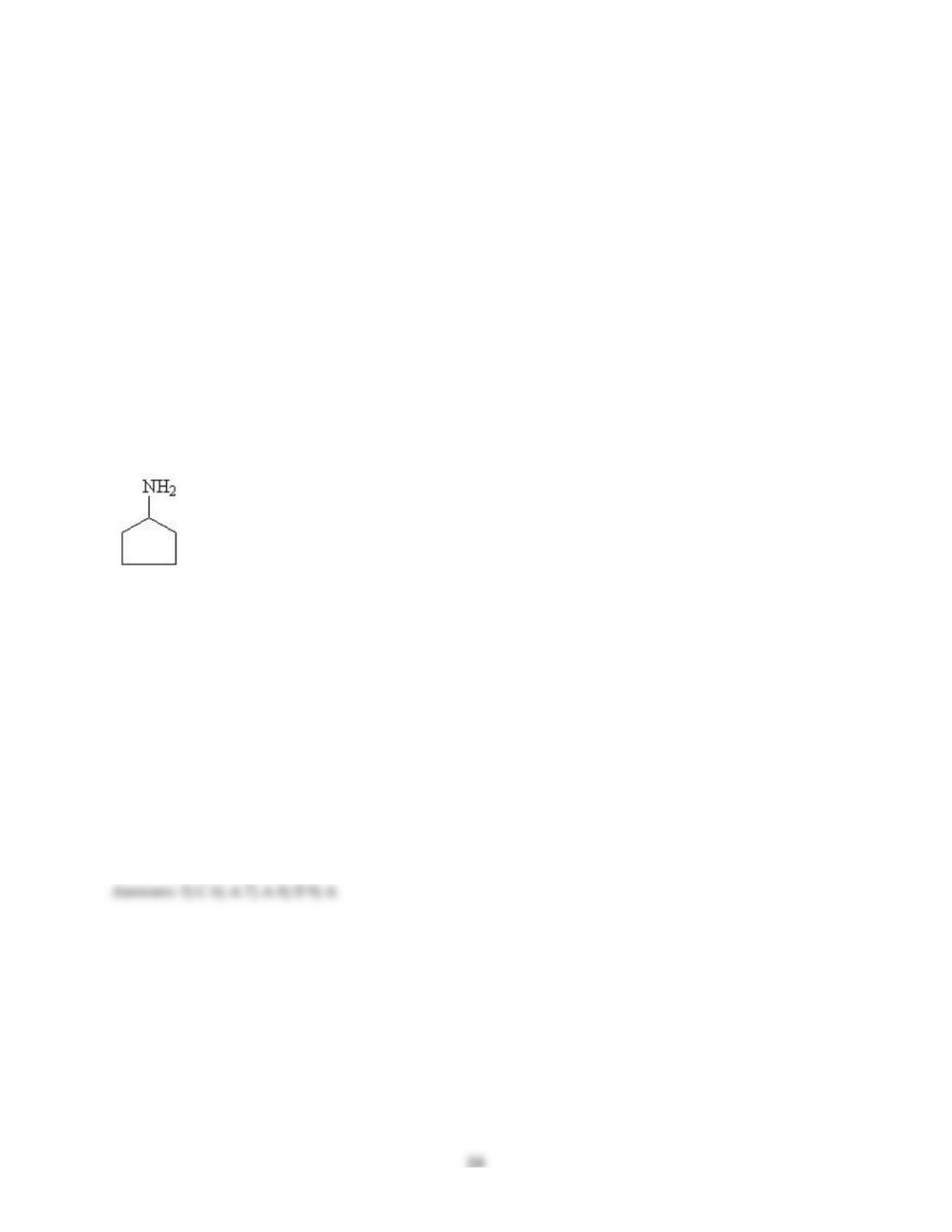
Classify the amines shown in column 1 as primary, secondary, or tertiary.
A) primary
B) secondary
C) tertiary
5) CH3
|
CH3 – N – CH3
Objective: 18.1
Global Outcomes: GO2
6) CH3 – CH2 – CH2 – NH2
Objective: 18.1
Global Outcomes: GO2
7)
Objective: 18.1
Global Outcomes: GO2
8) H
|
CH3 – N – CH2 – CH3
Objective: 18.1
Global Outcomes: GO2
9) CH3
|
CH3 – CH – CH2 – NH2
Objective: 18.1
Global Outcomes: GO2