Archives: Quiz
978-0132751261 Problem Part 9
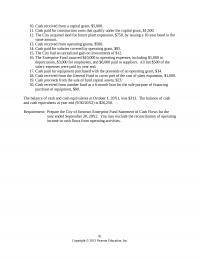
10. Cash received from a capital grant, $5,000. 11. Cash paid for construction costs that qualify under the capital grant, $1,500. 12. The City acquired land for future plant expansion, $750, by issuing a 10-year bond in the same amount. […]
978-0132751261 Problem Part 8
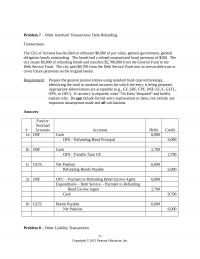
Problem 7 – Other Interfund Transactions: Debt Refunding Transactions: The City of Armona has decided to refinance $8,000 of par value, general government, general obligation bonds outstanding. The bonds had a related unamortized bond premium of $200. The city issues […]
978-0132751261 Problem Part 7
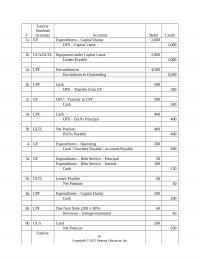
# Fund or Nonfund Accounts Accounts Debit Credit 1a GF Expenditures – Capital Outlay 2,000 Fund or 61 Copyright © 2013 Pearson Education, Inc. OFS – Capital Lease 2,000 1b GCA/GLTL Equipment under Capital Lease 2,000 Leases Payable 2,000 2a […]
978-0132751261 Problem Part 6
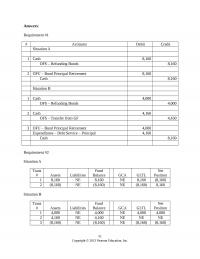
Answers: Requirement #1 # Accounts Debit Credit Situation A Requirement #2 Situation A Trans # Assets Liabilities Fund Balance GCA GLTL Net Position 1 8,160 NE 8,160 NE 8,160 (8,160) 2 (8,160) NE (8,160) NE (8,160) 8,160 Situation B Trans […]

978-0132751261 Problem Part 5
(2) Indicate the effects of each transaction on the accounting equation of the Capital Projects Fund and on the General Capital Assets and General Long-Term Liabilities accounts. If an element is not affected, put “NE” in the appropriate box. 41 […]
978-0132751261 Problem Part 4
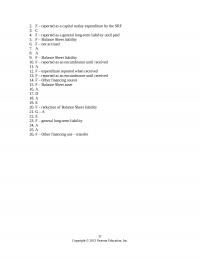
31 Copyright © 2013 Pearson Education, Inc. 2. F – reported as a capital outlay expenditure by the SRF 3. C 4. F – reported as a general long-term liability until paid 5. F – Balance Sheet liability 6. F […]
978-0132751261 Problem Part 3
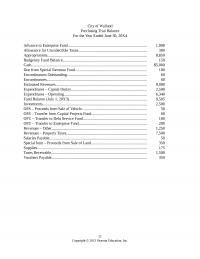
City of Walland Preclosing Trial Balance For the Year Ended June 30, 20X4 Advance to Enterprise Fund……………………………………………………………………… 1,000 Allowance for Uncollectible Taxes……………………………………………………….…… 300 Appropriations……………………………………………………………………..….…….…….… 8,850 Budgetary Fund Balance………………………………………………………………………..… 150 Cash………………………………………………………………………………………………………. $5,000 Due from Special Revenue Fund………………………………………………………….…… 100 Encumbrances Outstanding………………………………………………….…….…….……… 60 […]
978-0132751261 Problem Part 2
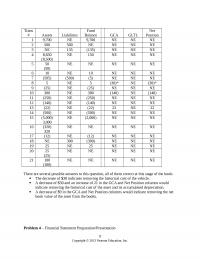
Trans # Assets Liabilities Fund Balance GCA GLTL Net Position 1 9,700 NE 9,700 NE NE NE There are several possible answers to this question, all of them correct at this stage of the book: The decrease of $30 indicates […]
978-0132751261 Problem Part 1
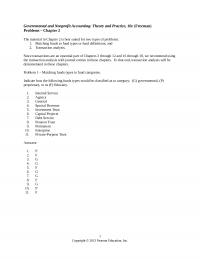
Governmental and Nonprofit Accounting: Theory and Practice, 10e (Freeman) Problems – Chapter 2 The material in Chapter 2 is best suited for two types of problems: 1. Matching funds to fund types or fund definitions; and 2. Transaction analysis. Since […]
978-0132729840 Chapter 08
Chapter 8 – Going Green MULTIPLE CHOICE 1. Voluntary action taken by organizations designed to meet the needs of the present generation without compromising the needs of future generations is called: a. ecology b. environmental management c. sustainability d. maintenance […]
978-0132729840 Chapter 07 Part 2
39. Autonomy places decision‐making authority in the hands of employees who are best able to respond, and respond quickly, to a dynamic environment. 40. Knowledge possessed by employees at lower hierarchical levels puts them in an excellent position to understand […]
978-0132729840 Chapter 07 Part 1
Chapter 7 – Leading Change MULTIPLE CHOICE 1. According to Spector, leadership’s primary role in change management is: a. providing strategic direction b. determining which employees must be laid off c. mobilizing adaptive behavior in the organization d. being the […]
978-0132729840 Chapter 06 Part 2
36. Organizational structures are a way to focus the activities of employees. 37. Leaders call on functional structures to focus both individuals and units on their contribution to the organization’s tasks. (True: Moderate; p. 128) 38. Functional structures facilitate integration […]
978-0132729840 Chapter 06 Part 1
Chapter 6 – Reinforcing New Behaviors MULTIPLE CHOICE 1. _______________ is designed to surface any misalignment that may exist between patterns of internal behavior and a desired new strategy. a. People alignment b. Diagnosis c. Structural design d. Technology change […]
978-0132729840 Chapter 05 Part 2
33. In succession planning, focusing on fast track managers is a good approach because: a. fast trackers are known to have skills associated with future performance b. fast trackers have passed all of the written and behavioral tests c. fast […]
978-0132729840 Chapter 05 Part 1
Chapter 5 – People Alignment MULTIPLE CHOICE 1. ____________ involves assuring that the skills and behaviors of employees within the organization will enable the effective implementation of the organization’s strategy a. Business dynamics b. Human development planning c. People alignment […]
978-0132729840 Chapter 04 Part 2
34. Reporting structures are components of informal design elements. 35. Effective change implementation separates the two aspects of design, targeting formal design before seeking to alter informal design. (False: Difficult; p. 77) 36. The most effective way to change organizational […]
978-0132729840 Chapter 04 Part 1
Chapter 4 – Organizational Redesign MULTIPLE CHOICE 1. Organizational design refers to: a. formal arrangements that an organization calls upon to help shape employee behavior. b. informal arrangements that an individual or an organization calls upon to help shape employee […]
978-0132729840 Chapter 03
Chapter 3 – Mutual Engagement and Shared Diagnosis MULTIPLE CHOICE 1. ____________ is/are the process of learning about the dynamics of an organization’s functioning. a. Consulting b. Operational reviews c. Diagnosis d. Cultural learning e. Behavior change 2. ____________ is […]
978-0132729840 Chapter 02 Part 2
Copyright © 2013 Pearson Education, Inc. publishing as Prentice Hall 22 41. The organization’s external environment refers to the culture and climate of the organization. 42. Because organizational employees get paid, they are not considered to be a part of […]
978-0132729840 Chapter 02 Part 1
Copyright © 2013 Pearson Education, Inc. publishing as Prentice Hall 15 Chapter 2 – Theories of Effective Change Implementation MULTIPLE CHOICE 1. Effective change involves: a. content b. process c. what is being changed d. how are the changes being […]
978-0132729840 Chapter 01
TEST BANK Chapter 1 – Organizational Change MULTIPLE CHOICE 1. Nokia’s loss of market share of U.S. cell phone business as a result of: a. lack of technological skills b. too much focus on the growing emerging markets c. conscious […]
978-0132729048 Chapter 11 Part 2
Difficulty: Easy Page Ref: 421-422 28. Management development programs focus on developing all of the following EXCEPT A) Conceptual knowledge and skills. B) Technical knowledge and skills. C) Interpersonal knowledge and skills. D) Personal traits conducive to effective leadership. E) […]
978-0132729048 Chapter 11 Part 1
CHAPTER ELEVEN: EMPLOYEE AND MANAGEMENT DEVELOPMENT MULTIPLE-CHOICE QUESTIONS 1. The reason(s) companies are willing to invest more in employee development today compared to the past include which of the following? A) Employees are willing to change employers to advance their […]
978-0132729048 Chapter 10 Part 2
B) To deal with failure rates, organizations have started hiring foreign nationals for overseas positions. C) In general both Japan and the USA have similar failure rates for their expatriates. D) Virtual expatriates are expatriates that move to the overseas […]
978-0132729048 Chapter 10 Part 1
CHAPTER TEN: KEY AREAS OF ORGANIZATIONAL TRAINING MULTIPLE-CHOICE QUESTIONS 1. The SBI case at the beginning of Chapter 10, where the women were treated so differently than the men, took place in the A) 1950’s. B) 1960’s. C) 1990’s. D) […]
978-0132729048 Chapter 09 Part 2
C) Internal validity. D) General validity. E) History validity. Answer: C Difficulty: Moderate Page Ref: 347 26. Which of the following is NOT listed as a threat to internal validity? A) Maturation B) Testing C) Instrumentation D) Statistical regression E) […]
978-0132729048 Chapter 09 Part 1
CHAPTER NINE: EVALUATION OF TRAINING MULTIPLE-CHOICE QUESTIONS 1. What are the inputs into the evaluation phase of training? A) Evaluation strategy and design B Evaluation objectives and design issues C) Organizational constraints D) B & C E) A & C […]
978-0132729048 Chapter 08
CHAPTER EIGHT: DEVELOPMENT AND IMPLEMENTATION OF TRAINING MULTIPLE-CHOICE QUESTIONS 1. The “process” for the developmental phase of the training model is A) Instructional strategy. B) Instructional methods. C) Instructional equipment and material. D) All of the above. Page Ref: 275 […]
978-0132729048 Chapter 07
CHAPTER SEVEN: ELECTRONIC TRAINING METHODS MULTIPLE-CHOICE QUESTIONS 1. Which of the following is NOT a potential benefit for Electronic Training? A) Reduces the cost of training B) Allows the trainee to master learning C) Reduces the company ability to track […]
978-0132729048 Chapter 06 Part 2
Answer: A Difficulty: Easy Page Ref: 220-221 28. Which of the following is true about games and simulations? A) A major problem for them is attracting trainee attention. B) They are quite useful in developing trainee skill in applying or […]
978-0132729048 Chapter 06 Part 1
CHAPTER SIX: TRADITIONAL TRAINING METHODS MULTIPLE-CHOICE QUESTIONS 1. Training methods can be divided into _____ and _____ approaches. A) Cognitive; behavioral B) Strategic; skill C) Procedural; strategic D) KSA; lecture E) None of the above Page Ref: 200 2. Which […]
978-0132729048 Chapter 05 Part 2
33. In the elaboration theory, the process of identifying the simplest version of a complex task which is still representative of the total task is called A) Epitomizing. B) Elaborating. C) Extrapolating. D) Cognitive simplification. Page Ref: 175 34. In […]
978-0132729048 Chapter 05 Part 1
CHAPTER FIVE: TRAINING DESIGN MULTIPLE-CHOICE QUESTIONS 1. If a major constraint is “short lead time” (therefore there is not much time to prepare training), one viable option is use of A) Programmed instruction. B) Modularization. C) External consultants. D) Massed […]
978-0132729048 Chapter 04 Part 2
30. A good HRIS should provide information on A) Previous positions individuals have held. B) Training that individuals have received. C) Performance levels. D) All of the above. Page Ref: 111 31. Performance appraisals are almost always completed by A) […]
978-0132729048 Chapter 04 Part 1
CHAPTER FOUR: NEEDS ANALYSIS MULTIPLE-CHOICE QUESTIONS 1. A triggering event A) Is a comparison of a reactive and proactive TNA. B) Occurs when actual organizational performance is greater than expected organizational performance. C) Occurs when actual organizational performance is less […]
978-0132729048 Chapter 03 Part 2
26. Which of the following best describes the cognitive approach to training? A) Subject-oriented B) Formal, authority-oriented, judgmental, and competitive C) Interactive, group, project-oriented, and experiential D) Relaxed, mutually trustful, respectful, and collaborative E) Both C & D Page Ref: […]
978-0132729048 Chapter 03 Part 1
CHAPTER THREE: LEARNING, MOTIVATION, AND PERFORMANCE MULTIPLE-CHOICE QUESTIONS 1. Theories are A) Useful for model building but impractical for practitioners. B) Generally developed by all of us to help us understand how things work in our world. C) Concrete steps […]
978-0132729048 Chapter 02
CHAPTER TWO: ALIGNING TRAINING WITH STRATEGY MULTIPLE-CHOICE QUESTIONS 1. Strategic planning is best defined as A) The development of a relatively long-term mission consistent with internal tactics. B) The development of relatively short-term objectives that meet the executive committee objectives. […]
978-0132729048 Chapter 01
TEST BANK FOR EFFECTIVE TRAINING: SYSTEMS, STRATEGIES, AND PRACTICES CHAPTER ONE: TRAINING IN ORGANIZATIONS MULTIPLE-CHOICE QUESTIONS 1. Which of the following is evidence supporting the assertion that companies are investing in more training? A) Higher net sales per employee B) […]
978-0132574952 Chapter 27 Part 4
Global Rationale: Cognitive Level: Understanding Client Need: Safe Effective Care Environment Client Need Sub: Safety and Infection Control Nursing/Integrated Concepts: Nursing Process: Assessment Learning Outcome: Question 29 Type: MCSA Which of the following technologies does collaborative computing not use to […]
978-0132574952 Chapter 27 Part 3
2. Nurses are the only health care provider capable of understanding best practice models. 3. There is not as much demand for translational research today as there was five years ago. 4. Translational research is a new concept in health […]
978-0132574952 Chapter 27 Part 2
Rationale 2: From a health information technology perspective, health care research has been impeded by all of these except a rapid adoption of data exchange standards. Slow adoption of data exchange standards and uniform languages, a failure to realize a […]
978-0132574952 Chapter 27 Part 1
Hebda, Handbook of Informatics, 5/e Test Bank Chapter 27 Question 1 Type: MCSA A qualitative researcher studying lived experiences of congestive heart failure clients wishes to analyze data obtained from client interviews. Which of the following software programs are best […]
978-0132574952 Chapter 26 Part 2
Correct Answer: 1,2,3,4,5 Rationale 1: The National Academies has prepared, in cooperation with the Department, fact sheets on five types of terrorist attacks including fact sheets on Chemical, Biological, Radiological, Nuclear, and IED attacks (Homeland Security, 2011). These fact sheets […]
978-0132574952 Chapter 26 Part 1
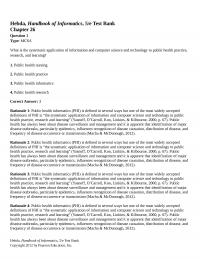
Hebda, Handbook of Informatics, 5/e Test Bank Chapter 26 Question 1 Type: MCSA What is the systematic application of information and computer science and technology to public health practice, research, and learning? 1. Public health nursing 2. Public health practice […]
978-0132574952 Chapter 25 Part 3
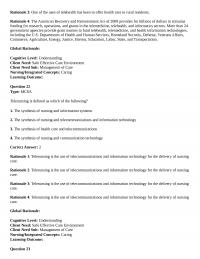
Rationale 3: One of the uses of telehealth has been to offer health care to rural residents. Rationale 4: The American Recovery and Reinvestment Act of 2009 provides for billions of dollars in stimulus funding for research, operations, and grants […]
978-0132574952 Chapter 25 Part 2
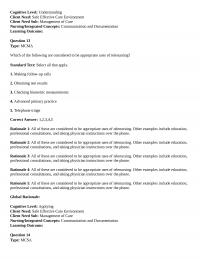
Cognitive Level: Understanding Client Need: Safe Effective Care Environment Client Need Sub: Management of Care Nursing/Integrated Concepts: Communication and Documentation Learning Outcome: Question 13 Type: MCMA Which of the following are considered to be appropriate uses of telenursing? Standard Text: […]
978-0132574952 Chapter 25 Part 1
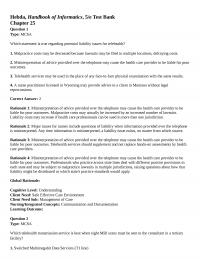
Hebda, Handbook of Informatics, 5/e Test Bank Chapter 25 Question 1 Type: MCSA Which statement is true regarding potential liability issues for telehealth? 1. Malpractice costs may be decreased because lawsuits may be filed in multiple locations, defraying costs. 2. […]
978-0132574952 Chapter 24 Part 2
4. A process is established for easily sending the message (practitioner) and receiving the message (consumer) in a way that is clear to each individual. 5. A set of decision-making rules created from the information collected from the consumer is […]