
Copyright © 2013 Pearson Education, Inc. publishing as Prentice Hall 22
41. The organization’s external environment refers to the culture and climate of the
organization.
42. Because organizational employees get paid, they are not considered to be a part
of the stakeholders of the organization.
43. The multiple stakeholder perspective represents in part an ethical view of the role
of business organizations in the community.
44. Content-driven change creates an organizational climate in which employees will
be motivated to adopt new behaviors consistent with the strategic direction of the
organization.
45. Content-driven change is both tangible and measurable.
46. A task-aligned approach to change implementation motivates people to change
their behaviors by focusing on the big picture and feelings of connectedness.
47. Kicking off change implementation with shared diagnosis builds dissatisfaction with
the status quo.
48. Asking employees to enact new behaviors can be supported by organizational help
in learning new skills.
49. Effective change implementation does not require new skills and competencies on
the part of the organization’s employees.
50. Mutual engagement occurs at the shared diagnosis stage but not during people
alignment stage.
Copyright © 2013 Pearson Education, Inc. publishing as Prentice Hall 23
ESSAY QUESTIONS
51. What are the two key concepts proposed by Lewin?
52. Discuss Lewin’s approach to behavior (including the formula).
53. Explain the concept of unfreezing, moving and refreezing.
54. Explain the field of organizational development.
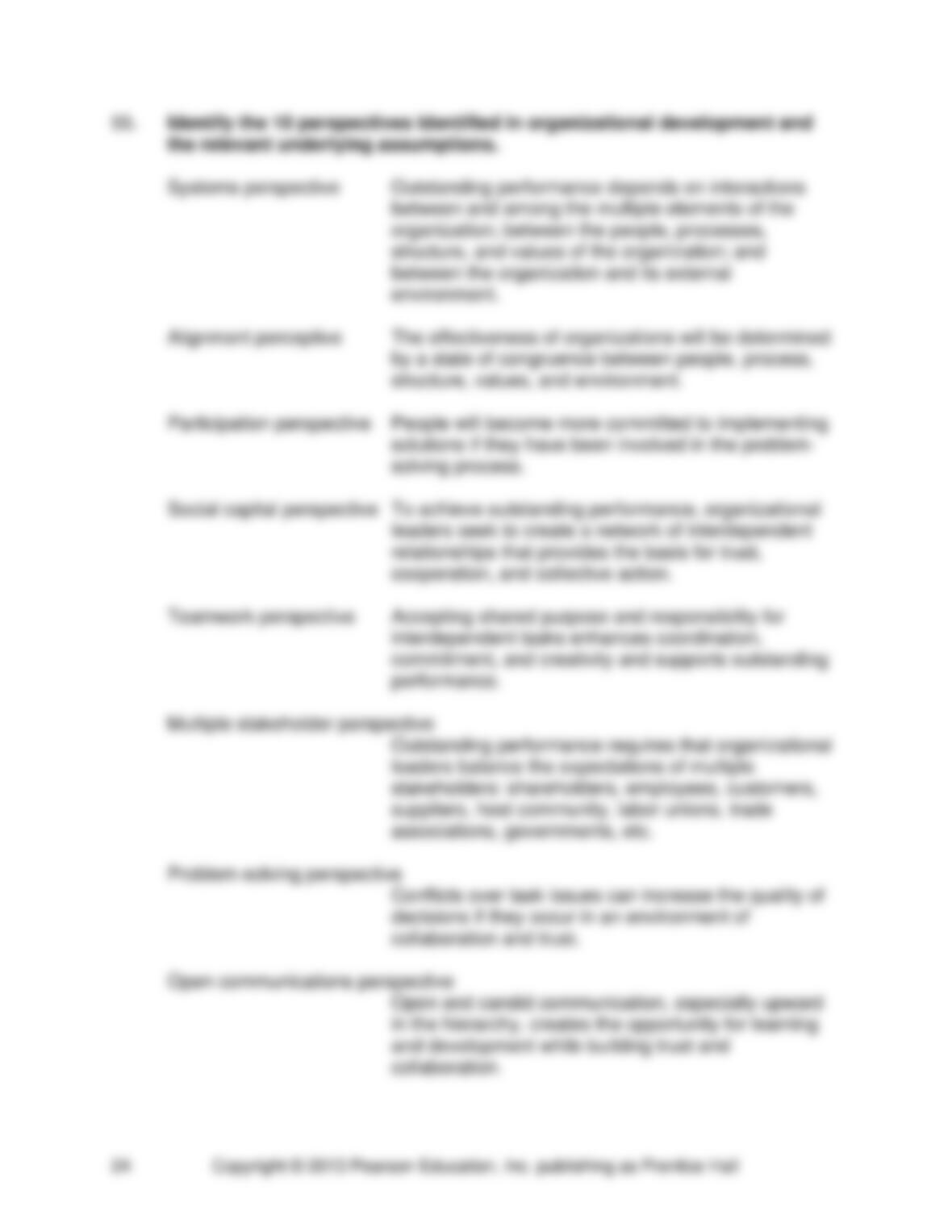
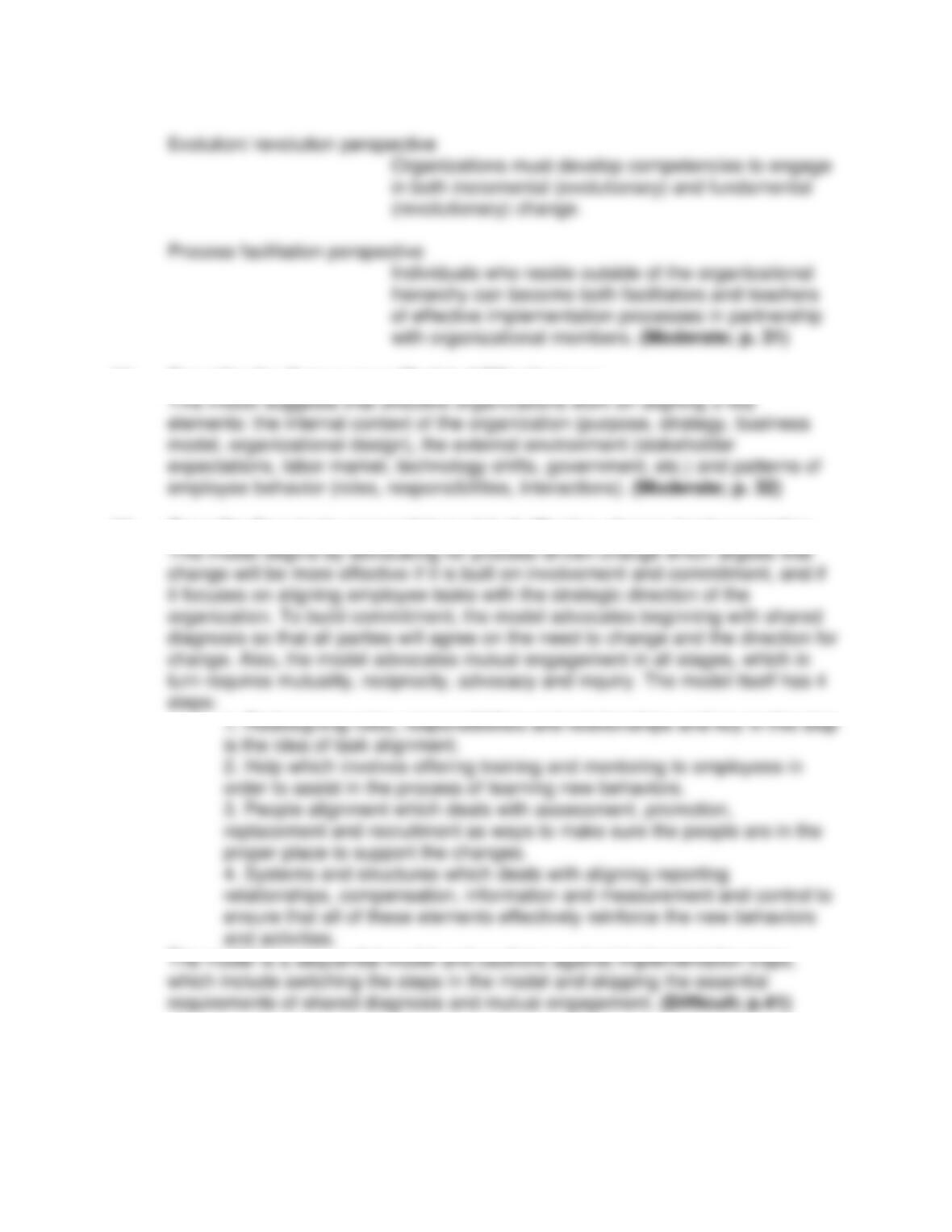
55. Identify the 10 perspectives identified in organizational development and
the relevant underlying assumptions.
Copyright © 2013 Pearson Education, Inc. publishing as Prentice Hall 25
Evolution/ revolution perspective
Organizations must develop competencies to engage
in both incremental (evolutionary) and fundamental
(revolutionary) change.
Process facilitation perspective
Individuals who reside outside of the organizational
hierarchy can become both facilitators and teachers
of effective implementation processes in partnership
with organizational members. (Moderate; p. 31)
56. Describe the Congruence Model of Effectiveness.
57. Describe Spector’s sequential model of effective change implementation.

Copyright © 2013 Pearson Education, Inc. publishing as Prentice Hall 26
Scenario-Based Questions
You are the CEO in a large and trendy interior design firm, servicing both corporate and
wealthy individual clients. Your organization’s excellent reputation is built on the edgy
design offered by your talented and creative designers. Recently, however, you have
started to lose clients due to complaints about customer service. It seems that the
designers of late have become more interested in their own individual reputation and
fame than in the clients’ needs. Also, your firm has received negative press for its
unwillingness to embrace green and sustainable design standards. Your top executive
team has decided to make client service the new corporate priority and it has called a
meeting to announce this new strategy.
58. Using Spector’s model, this meeting should focus on:
a. clearly outlining the new strategy and its implications for people and
structures.
b. developing a step-by-step process for measuring client service.
c. aligning the internal, external and employee environment.
d. involving everybody in shared diagnosis first.
59. Your employees are not happy with your announcement about the new strategy.
While they realize that there are issues with customer service, they question the
top executives’ decision to make service the new priority, arguing that a focus on
service will hurt the quality of their design. Your response is:
a. to explain way their actions created the problem
b. to engage in discussion and dialogue
c. to observe the most vocal opponents and plan a firing strategy
d. to move along as planned, keeping focused on the end goal
e. none of the above
60. One of the options for your new strategy is a program in customer service training.
You have seen this program in action at one of your competitors and it worked
beautifully there. You should decide:
a. to purchase this program because it is ready to go and it will give you some
focus and structure in the change process.
b. to purchase this program because it worked well for your competitor and you
must keep up with changes in the environment.
c. to work within the company to develop your own program for customer
service recognizing that there are no ready-made solutions.
d. none of the above

Copyright © 2013 Pearson Education, Inc. publishing as Prentice Hall 27