
Chapter 8 – Going Green
MULTIPLE CHOICE
1. Voluntary action taken by organizations designed to meet the needs of the present
generation without compromising the needs of future generations is called:
a. ecology
b. environmental management
c. sustainability
d. maintenance
e. none of the above
2. ___________ is an organizational approach to defining performance that takes into
account social, economic, and ecological dimensions and assumes that the three
are mutually reinforcing.
a. Going green
b. Ecological accounting
c. Triple accountability
d. Triple bottom line
e. none of the above
3. ___________ is a public relations effort which claims environmental virtue
without making any substantive organizational change.
a. Ecological fraud
b. Sustainability leverage
c. Green messaging
d. Greenwashing
e. None of the above
4. Which of the following is NOT a driver for companies’ sustainability efforts?
a. employee interest
b. government regulations
c. consumer preferences
d. all of the above
e. none of the above

5. Which of following is NOT one of the five stages of responsiveness to issues of
sustainability typically followed by companies?
a. defensive
b. civil
c. compliance
d. visionary
e. strategic
6. Which is NOT an advantage of going green?
a. lowered cost of operating
b. elimination of waste
c. positioned for an IPO
d. reduced exposure to risk
e. inoculating against future law suits
7. Once a trigger event motivates a reevaluation of values, goals, and strategy,
the transformation typically follows which set of sequential interventions?
a. set the vision, diagnose the status quo, alter informal and then formal design
elements.
b. set the vision, diagnose the status quo, alter formal and then informal design
elements.
c. diagnose the status quo, set the vision, alter formal and then informal design
elements.
d. diagnose the status quo, set the vision, alter informal and then formal design
8. Effective “green visions” have three characteristics in common:
a. they articulate some specific territory in which the organization can
contribute to sustainable development.
b. they state a belief that going green and performing well is mutually
reinforcing rather than mutually exclusive.
c. they vow a commitment to a long‐term social responsibility that transcends
the performance of the company.
d. all of the above
e. none of the above

9. _________ is a tool for measuring multiple outcomes; financial
performance, customer satisfaction, internal process excellence, and employee
learning and growth and the connection of those outcomes to the vision and
strategy of the organization.
a. Multiple bottom line
b. Balance score card
c. Multiple bottom line score card
d. Green score card
e. none of above
10. __________ are objective measurements of a firm’s social and environmental
impact.
a. Triple bottom line metrics
b. Eco-metrics
c. Sustainability score card metrics
d. Green metrics
e. none of the above
11. The balanced scorecard balances financial measures with three additional metrics:
a. customer satisfaction, employee satisfaction, green metrics
b. internal process excellence customer satisfaction, employee learning and
growth
c. employee learning and growth, employee satisfaction, internal process
excellence
d. employee satisfaction, green metrics, internal process excellence
e. none of the above
12. ___________ are the values called upon by individuals to explain or justify their
course of action or pattern of behavior.
a. Green values
b. Enacted values
c. Espoused values
d. Terminal values
e. none of the above

13. ___________ are the set of values that are implicit in actions or patterns of
behavior.
a. Terminal values
b. Enacted values
c. Espoused values
d. Displayed values
e. none of the above
14. ____________ are actions of an organization designed to meet requirements
imposed by law.
a. Sustainability
b. Regulatory abatement
c. Compliance
d. Legal abatement
e. none of the above
15. Companies should kick-off sustainability efforts with diagnosis because?
a. diagnosis is easier to understand than other aspects of change
b. it helps focus employees on what needs to change
c. sustainability requires employees to be compliant and that requires
diagnosis
d. all of the above
e. none of the above
16. Sustainability and going green is the same thing.
17. Corporate sustainability does NOT necessarily involve voluntary efforts on the part
of organizations.
18. “Greenwashing” is a public relations effort that does not involve organizational
transformation.
19. Government regulations are the main motivation for going green in the United
States and Europe.

20. When it comes to going green, most organizations follow a predictable path,
starting with vision and compliance before becoming managerial, strategic,
and civil.
21. One of the most frequently mentioned performance advantages of going
green is the impetus it provides for innovation.
22. Going green starts with a visionary statement from top leadership.
23. There is still much that is controversial about going green.
24. A sustainability balanced scorecard can help an organization measure its
performance on the triple bottom line.
25. Organizational culture does little to help embed a green mindset and shape
employee behaviors.
26. Early diagnostic efforts will need to include not just the company itself, but
also its supply chain partners.
27. Informal design changes associated with going green start with building high
levels of collaboration.
28. Sustainability becomes fully integrated into a company’s business strategy in the
managerial stage of responsiveness to issues of sustainability.
29. When company representatives promote wider efforts on behalf of sustainability
they are said to be in the strategic stage of responsiveness to issues of
sustainability.
30. By treating the challenge of going green as a transactional challenge, organizations
will be better positioned to meet the goals of the triple bottom line.
31. To be effective, green visions embed and connect the firm’s commitment to
sustainability with its business mission; that way, going green is seen as tactical
and NOT strategic.
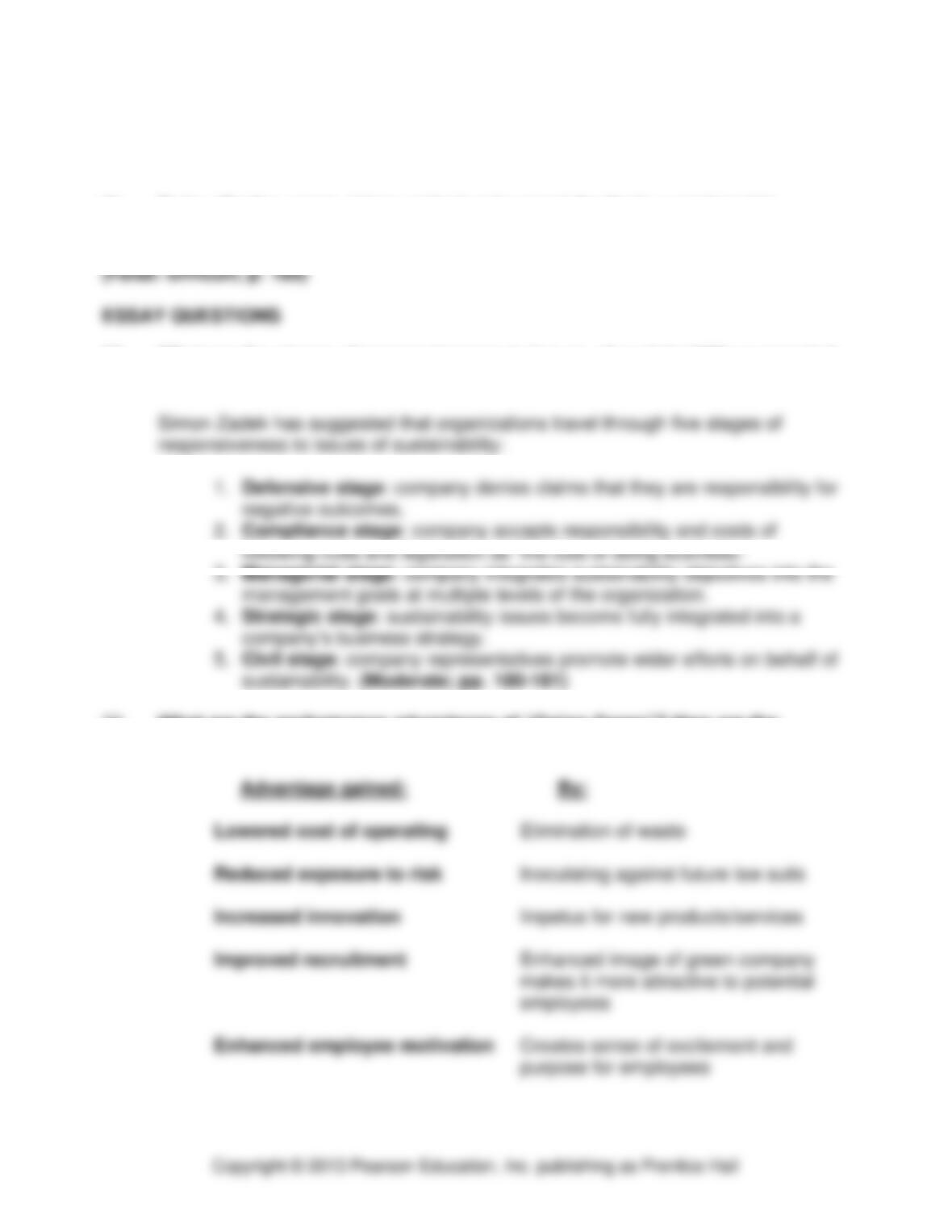
32. What are the stages of responsiveness to issues of sustainability suggested
by Simon Zadek? Briefly describe each.
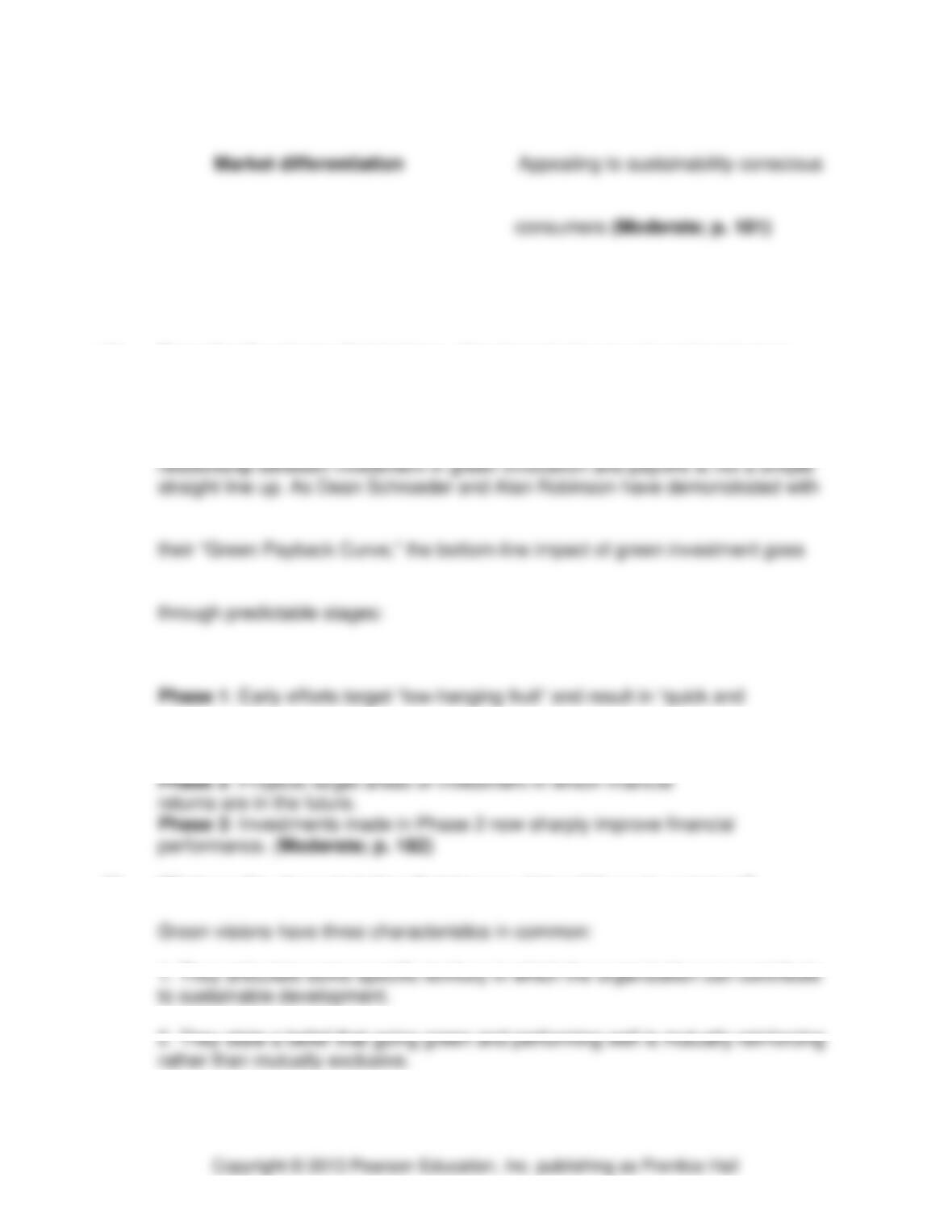
33. What are the performance advantages of “Going Green”? How are the
advantages realized?
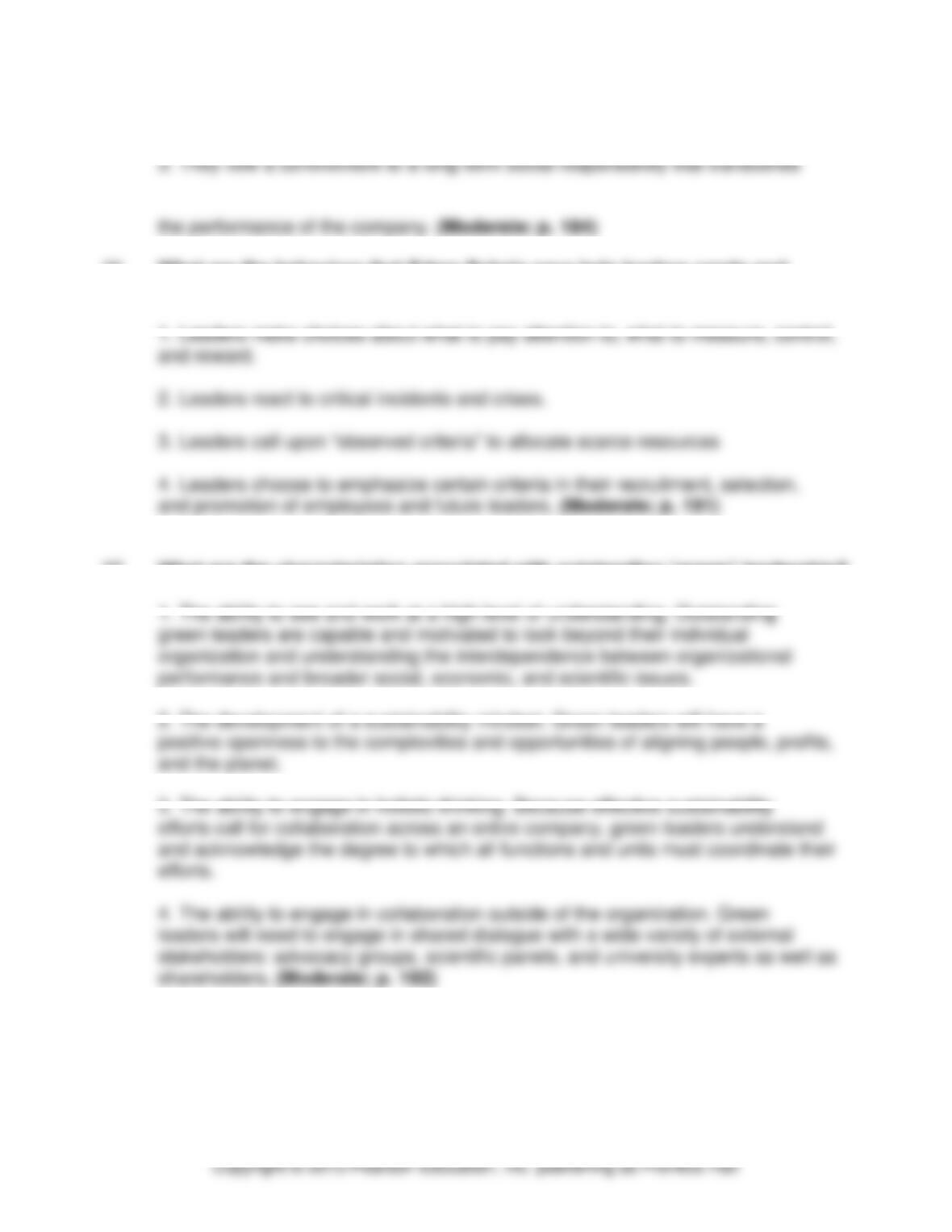
34. Describe the stages that bottom‐line impact of green investment goes
through, as Dean Schroeder and Alan Robinson demonstrated in
their “Green Payback Curve.”
Although sustainability can and does result in improved performance, the
certain” financial payback.
35. What are the characteristics that “green visions” have in common?
36. What are the behaviors that Edgar Schein says help leaders create and
embed culture in an organization?
2. Leaders react to critical incidents and crises.
3. Leaders call upon “observed criteria” to allocate scarce resources
4. Leaders choose to emphasize certain criteria in their recruitment, selection,
37. What are the characteristics associated with outstanding “green” leadership?
4. The ability to engage in collaboration outside of the organization. Green
leaders will need to engage in shared dialogue with a wide variety of external
stakeholders: advocacy groups, scientific panels, and university experts as well as
Scenario-Based Questions
You are a CEO of a well-established company in the retail industry. You and the Board of
Directors intend to “go green.” You believe that your biggest challenge is implementing
change in a manner that pleases all the stakeholders and attains sustainability.

38. You, like most CEOs, believe that the biggest benefit from going green is:
a. innovation
b. improved company/brand image
c. cost savings
d. competitive advantage
e. employee satisfaction
39. For existing organizations, going green represents a new direction. It is not just a
new strategy but a new way of thinking about strategy. In that regard, you should
start going green with:
a. hiring the right people, experienced in “being green”
b. creating an effective method of measuring progress
c. setting a vision
d. altering informal design elements
e. diagnosis
40. Your company has reached the point where it accepts responsibility and costs of
following rules and legislation as “the cost of doing business.” You are at the
_________ stage of responsiveness to issues of sustainability:
a. defensive
b. managerial
c. civil
d. strategic stage
e. none of the above
41. Your change efforts are going well. However you know that sustainability involves a
larger commitment to the community in which the organization exists, therefore
your diagnostic efforts will need to focus not just on the company but also on:
a. the entire retail industry
b. local governments
c. other businesses in your supply chain
d. regulatory agencies
e. all of the above
42. Asking the question “How will going green affect my personal reputation and that of
the firm?” is an indication that your company has which type of sustainability
culture?
a. ambivalent
b. commitment
c. espoused
d. compliance
Copyright © 2013 Pearson Education, Inc. publishing as Prentice Hall

Copyright © 2013 Pearson Education, Inc. publishing as Prentice Hall
e. none of the