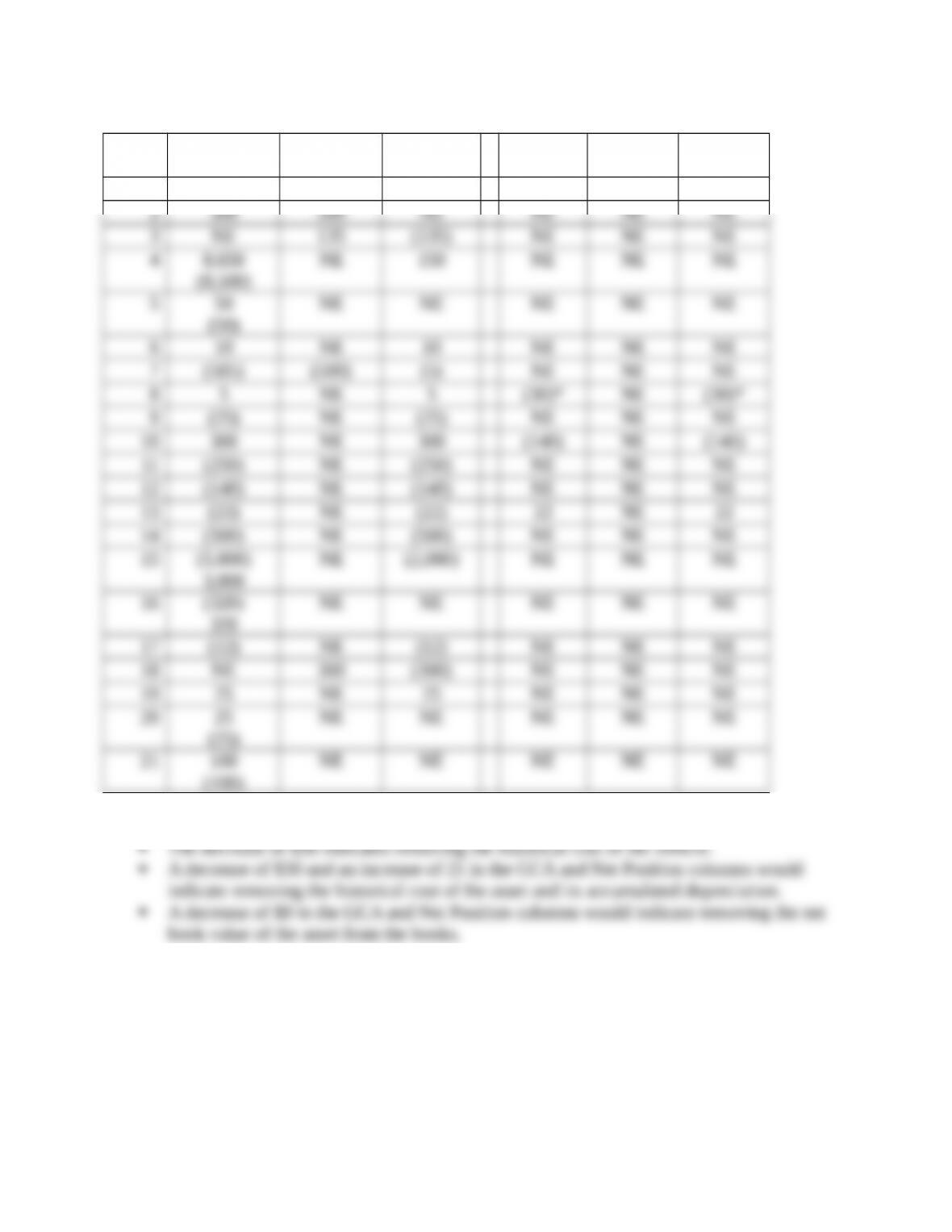
Trans
# Assets Liabilities
Fund
Balance GCA GLTL
Net
Position
1 9,700 NE 9,700 NE NE NE
There are several possible answers to this question, all of them correct at this stage of the book:
Problem 4 – Financial Statement Preparation/Presentation
11
Copyright © 2013 Pearson Education, Inc.
(A) Prepare, using good form, a skeleton Statement of Revenues, Expenditures, and Changes in
Fund Balances.
(B) Next, insert the number representing each of the following items in the appropriate location
in the statement. If any item is not reported in the statement, explain why not.
1. Property taxes levied for and collected in the current year
2. Estimated cost of goods ordered but not received by year end
3. Transfer to another fund
4. Salary costs incurred during the year
5. Payment to retire long-term note principal
6. Payment of interest on long-term note
7. Accrued interest on long-term note
8. Receipt of proceeds of short-term note
9. Payment of interest on short-term note
10. Accrued interest on short-term note
11. Payment to retire principal of short-term note
12. Payment to establish an Enterprise Fund activity; no repayment expected
13. Long-term loan from the General Fund to an Internal Service Fund
14. Short-term loan from the General Fund to a Capital Projects Fund
15. Purchase of equipment
16. Purchase of temporary investment in securities
17. Receipt of proceeds from sale of fixed asset
18. Property taxes collected in advance on next year’s tax levy
19. Depreciation of equipment
20. Purchase of electricity from the Electric Enterprise Fund
12
Copyright © 2013 Pearson Education, Inc.
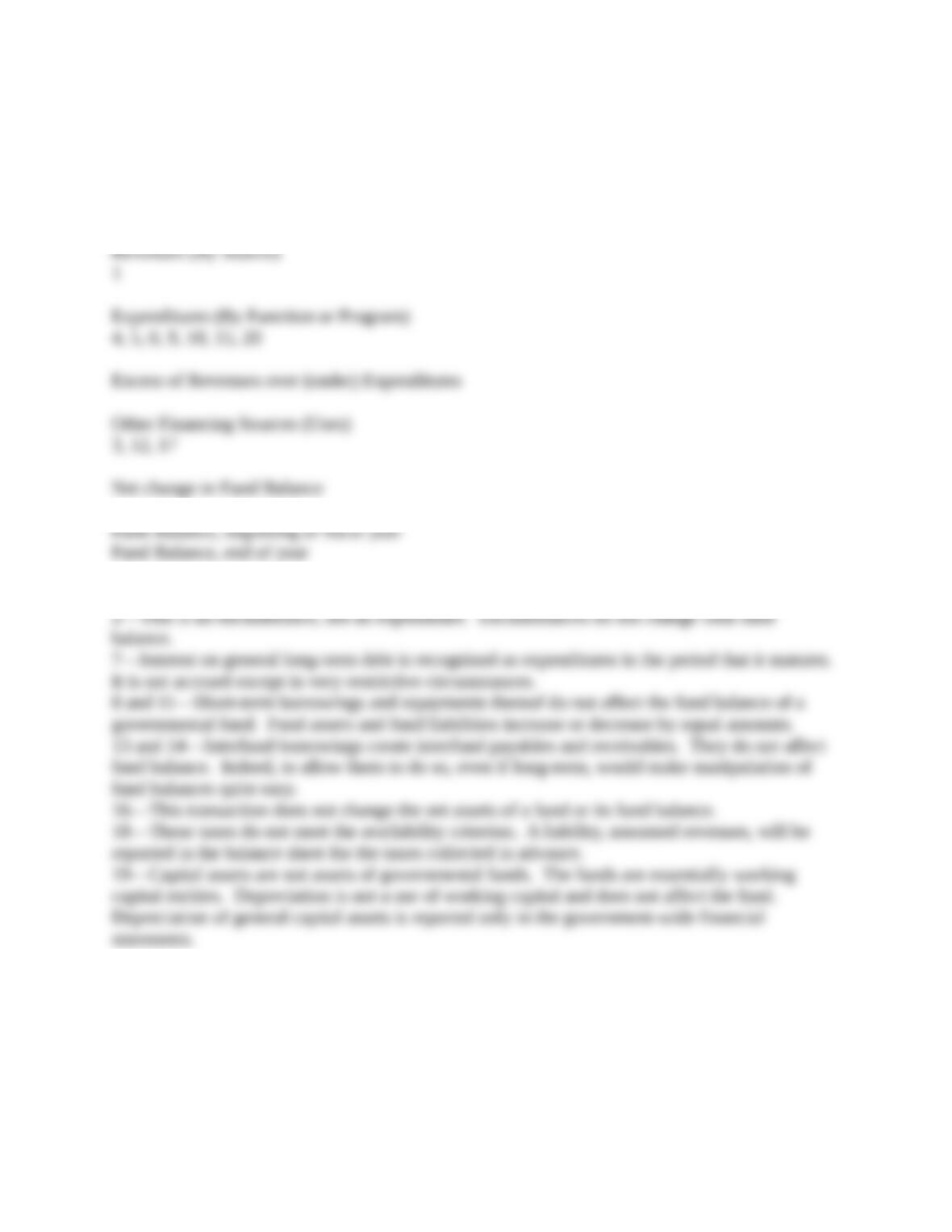
Answers:
Name of Government
Name of Fund
Statement of Revenues, Expenditures, and Changes in Fund Balance
For the Year Ended …
Not reported:
Problem 5 – Property Tax Entries
13
Copyright © 2013 Pearson Education, Inc.
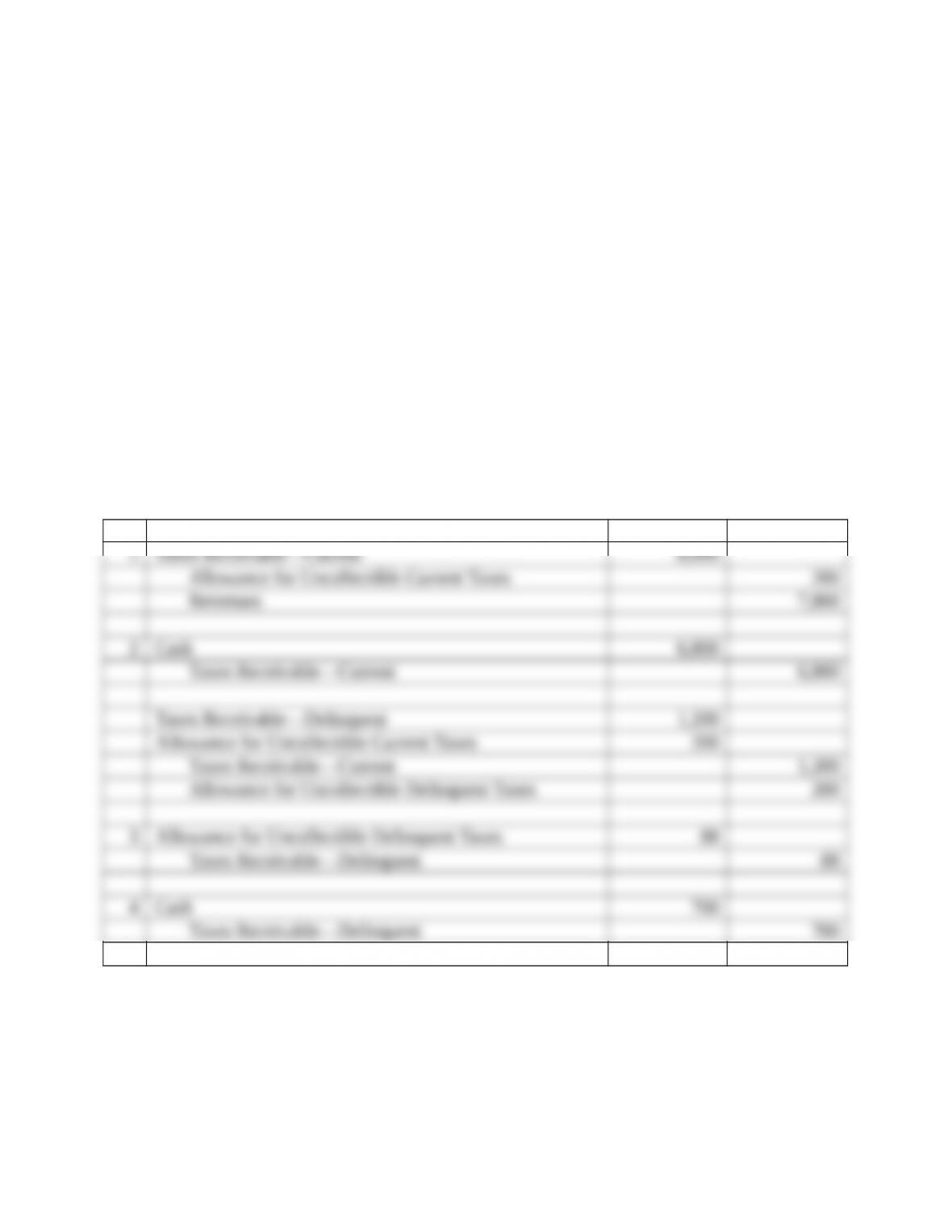
Selected transactions for the Jackson Independent School District are presented below. All
amounts are in thousands of dollars.
1. On January 1 the school district levied property taxes of $8,000.The due date for the
taxes is March 31.The school district expects to collect all except $200 either by the end
of the fiscal year or within 60 days thereafter. The other $200 is expected to be
uncollectible.
2. During the first quarter (ending March 31) the school district collected $6,800 of its
current year’s property taxes. The rest of the taxes are past due.
3. On June 12 the school district wrote off $88 of property taxes as uncollectible.
4. From March 31 to December 31 the school district collected $700 of the property taxes
that were levied on January 1. The school district expects to collect an additional $300 of
these taxes during the first two months of the next fiscal year.
Instructions: Prepare the necessary journal entries. Dates and explanations may be omitted. If a
transaction requires no entry, do not leave it blank: state “No Entry Required” and explain why.
Answers:
# Accounts Debit Credit
Problem 6 – Fund Balance Calculations
14
Copyright © 2013 Pearson Education, Inc.

The City of Armona had the following assets and liabilities at June 30, 20X3, the end of its fiscal
year (all amounts are in thousands):
Assets
Cash
Investments
Taxes Receivable
Allowance for Uncollecible Taxes
Due from Special Revenue Fund
Inventory
Advance to Enterprise Fund
Total Assets
5,250
250
1,300
(200)
150
200
150
7,100
Liabiliies
Vouchers Payable
Short-Term Note Payable
Accrued Wages Payable
Due to Internal Service Fund
Total Liabiliies
750
1,000
200
50
2,000
Additional information:
1. The city received a state grant of $300 stipulating that it could be spent at any time on
equipment. To date, none of the money has been spent.
2. The city council, in a formal vote, decided to set aside another $500 for equipment
purchases.
Requirement: Calculate the five components of Fund Balance.
Answer:
Governmental and Nonprofit Accounting: Theory and Practice, 10e (Freeman)
Problems – Chapter 4
15
Copyright © 2013 Pearson Education, Inc.

Problem 1 –Journal Entries, Subsidiary Ledger Effects, Transaction Analysis
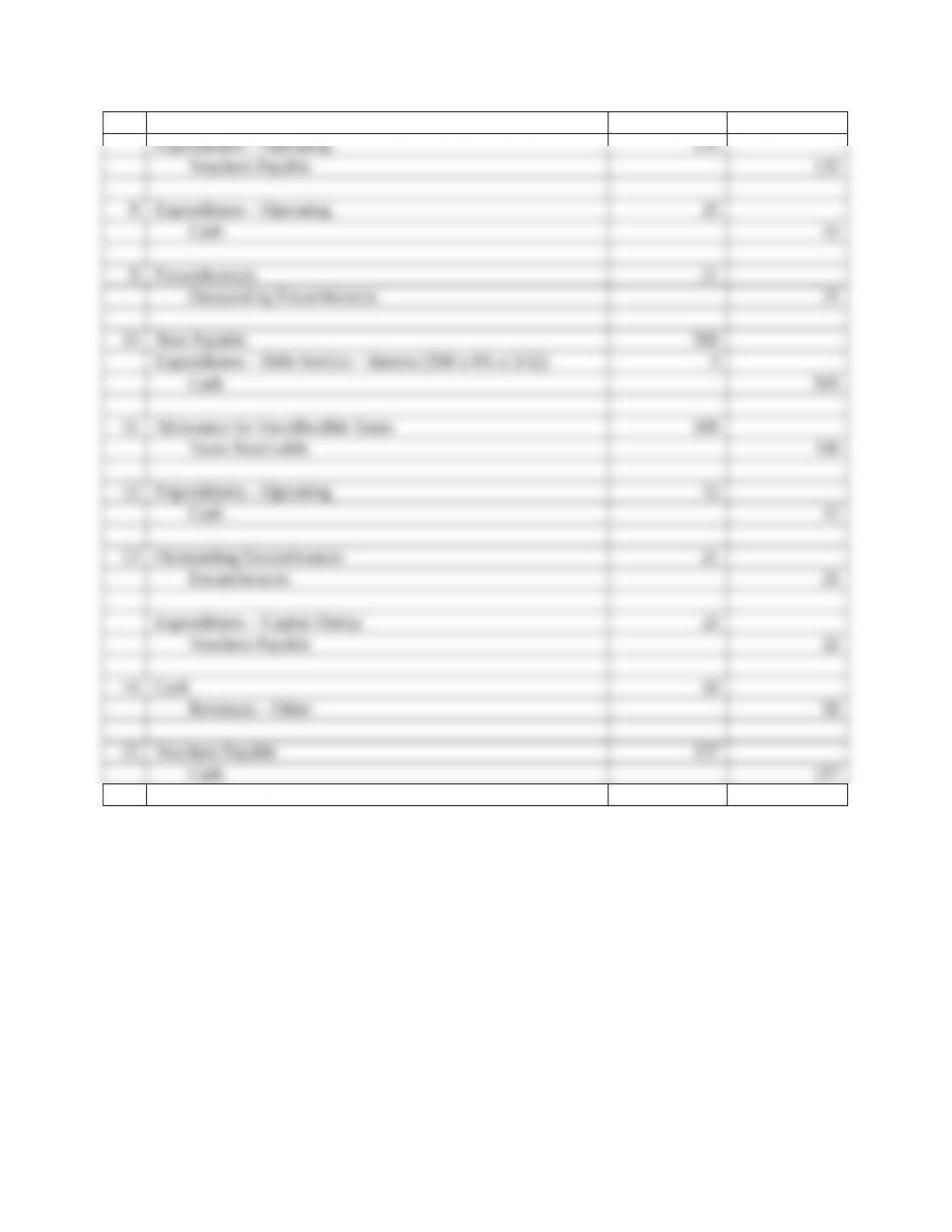
5Selected transactions of the City of Miser Station General Fund for the 20X1 fiscal year are
presented on the following page. All amounts are in thousands of dollars.
General instructions:
f. Dates and formal explanations may be omitted, but number your entries appropriately.
g. All interest rates are annual percentage rates (APRs).
h. Record your entries on the lined paper provided with your answer pages. Sufficient space has
been provided to allow you to skip lines between entries.
i. When recording Revenues, classify them as Revenues–Property Taxes or Revenues–Other. When
recording expenditures, classify them as Expenditures–Operating, Expenditures–Debt Service, or
Expenditures–Capital Outlay. Additional detail for budgetary entries is not required.
j. Show all work for any amount required in an entry that is not given in the exam (except when
recording the amount necessary to balance the journal entry).
Requirements:
3. Prepare the general ledger journal entries for the transactions. If no entry is required, do not leave
it blank. State “No Entry Required” and briefly explain why.
4. Indicate the effects of the transaction on the accounting equations for the General Fund and the
General Capital Assets and General Long-Term Liabilities accounts. Do not leave a cell blank. If
a transaction has no effect on a particular element, use “NE”.
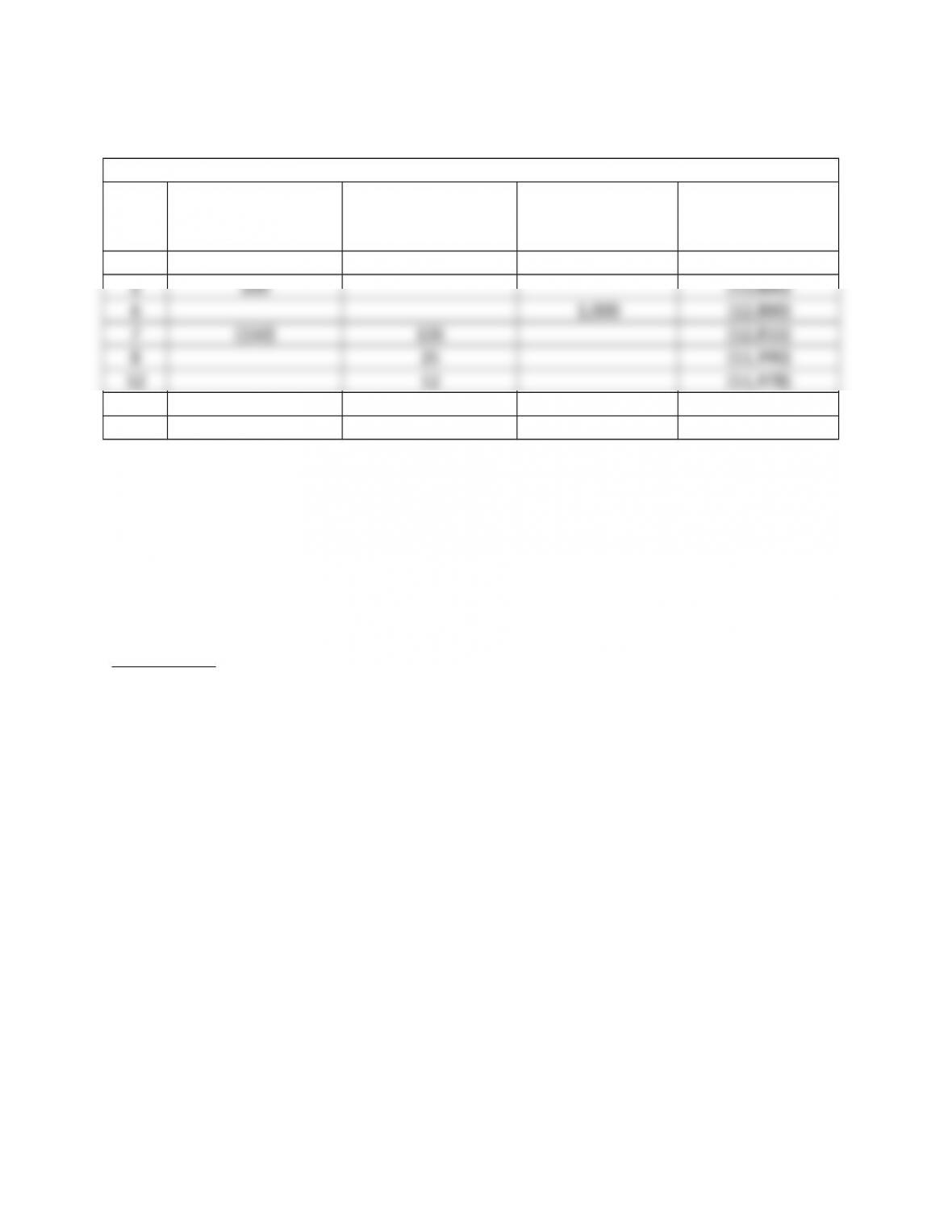
5. Maintain the subsidiary ledgers for Revenues – Property Taxes and Expenditures – Operating for
all appropriate entries.
Transactions:
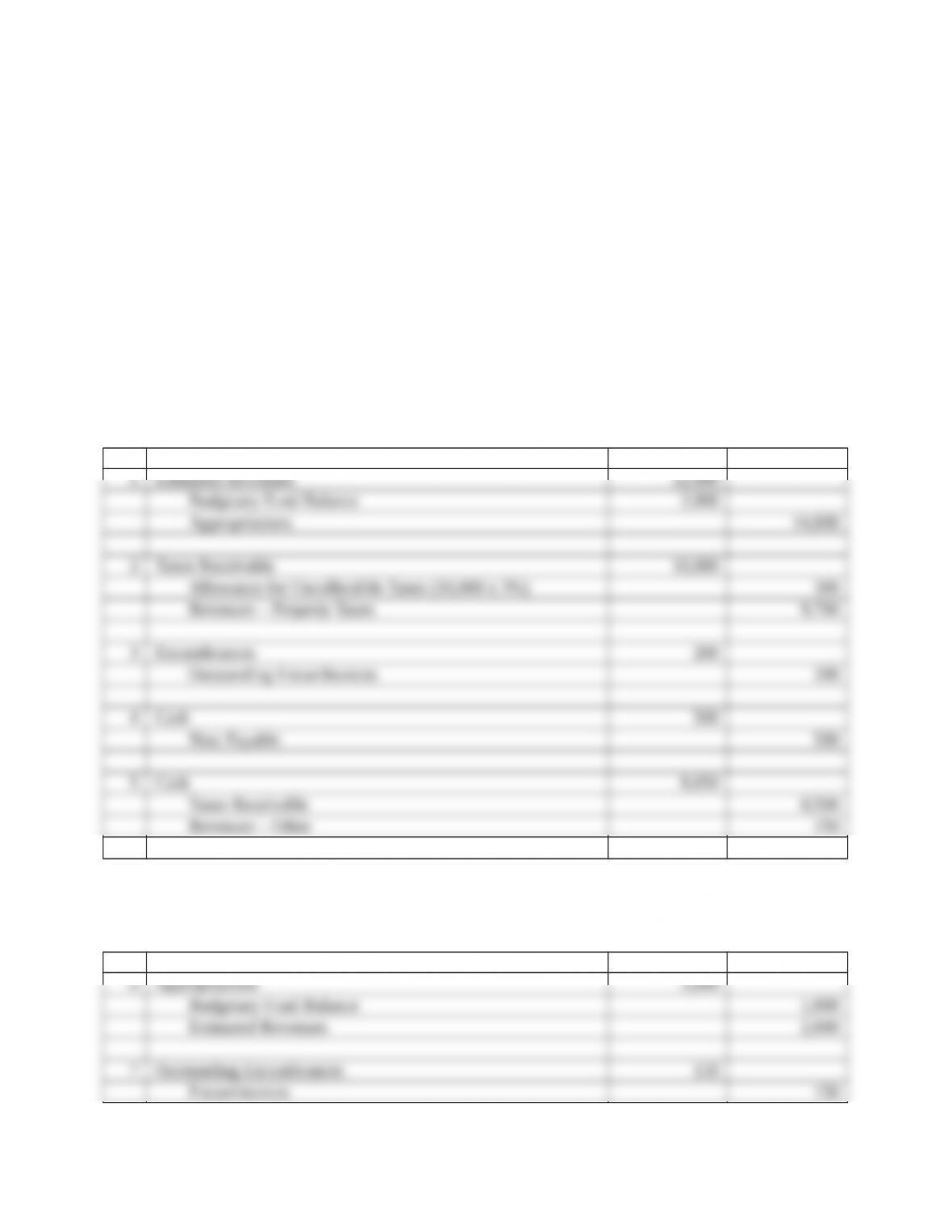
22. The City Council approved the following budget for the fiscal year:
Appropriations…………………………………………………………..………………… 14,000
Estimated Revenues…………………………………………………………….……….. 12,000
Of these amounts, $8,000 is for operating expenditures and $10,000 is for property tax
revenues.
23. The property tax levy was recorded, $10,000, of which 3% will probably prove uncollectible.
24. The city ordered $200 in supplies.
25. The City borrowed $500 from the Blount National Bank on a two-month, 6% note.
26. Cash receipts were (see entry #2):
Property Taxes………………………………………………………………………..…..…..….. 8,500
License and Permits………………………………………………………………………….….. 150
Total Receipts……………………………………………………………………………..…. 8,650
27. The City Council revised the budget (see entry #1). Appropriations were reduced $3,000 and
Estimated Revenues were reduced $2,000 (Appropriations for Expenditures – Operating were
reduced $1,000; property tax revenues were not affected).
28. Of the previous supplies order (Entry #3), 75% of the order was received. The actual cost of the
goods received was $135. The amount due the vendor will be paid at a later date.
16
Copyright © 2013 Pearson Education, Inc.
29. City employees were paid, $25.
30. The city ordered a new police car. The estimated cost is $21.
31. The City repaid the short-term note (see entry #4) when due.
32. Wrote off $100 of taxes receivable as uncollectible (see entry #2).
33. Paid $12 to the Special Revenue Fund to repay it for General Fund employee salaries that were
inadvertently recorded as expenditures of that fund.
34. The city received the police car (see entry #9). The actual cost was $22. The vendor will be paid
at a later date.
35. The city collected $50 for licenses.
36. The city paid $157 on account.
Answers:
Requirement #1
# Accounts Debit Credit
Requirement #1 (continued)
# Accounts Debit Credit
17
Copyright © 2013 Pearson Education, Inc.
18
Copyright © 2013 Pearson Education, Inc.
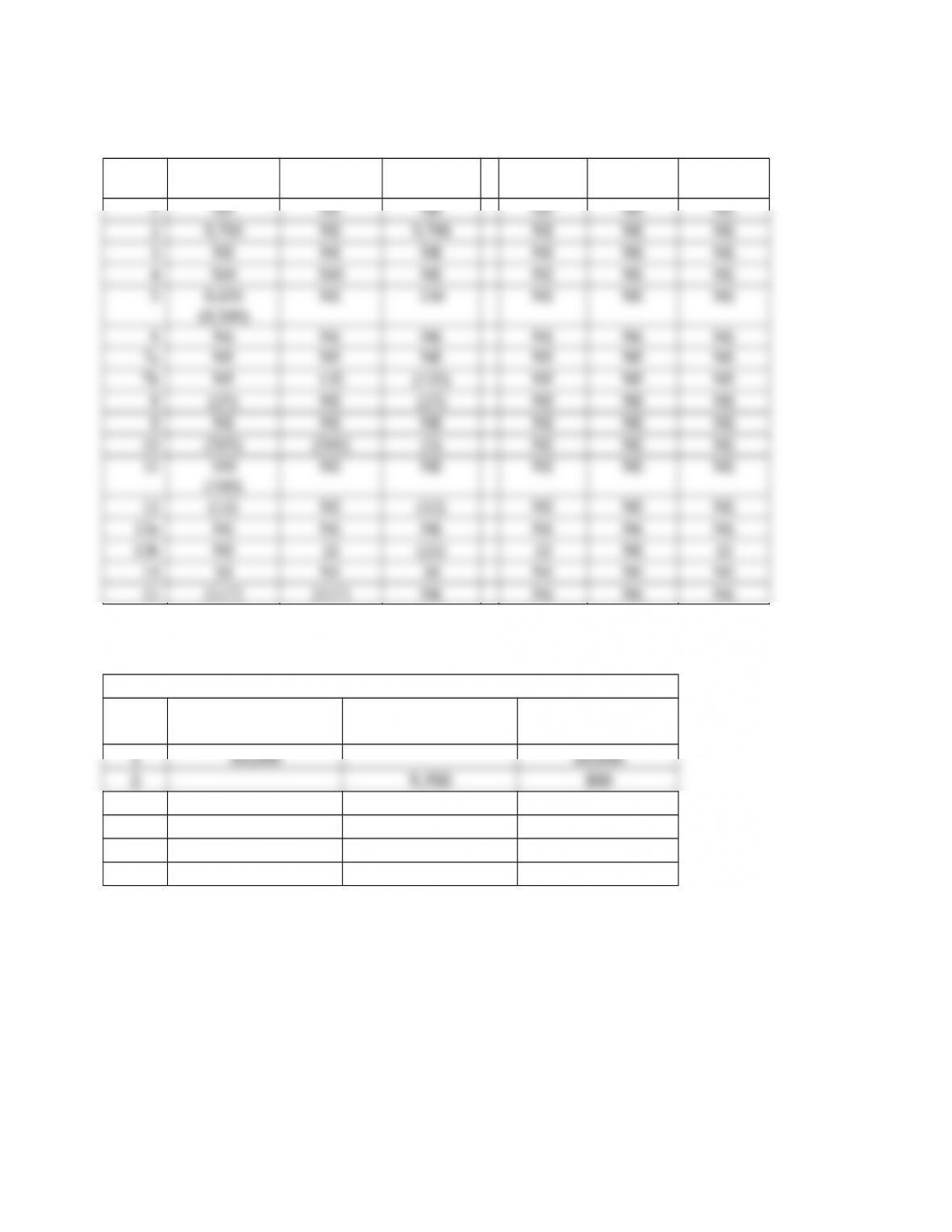
Requirement #2
Trans
# Assets Liabilities
Fund
Balance GCA GLTL
Net
Position
Requirement #3a
Revenues – Property Taxes
Trans
#
Dr.
Esimated Revenues
(Cr.)
Revenues
Dr. (Cr.)
Balance
19
Copyright © 2013 Pearson Education, Inc.
Requirement #3b
Expenditures – Operaing
Trans
#
Dr. (Cr.)
Encumbrances
Dr.
Expenditures
(Cr.)
Appropriaions
Dr. (Cr.)
Unencumbered
Balance
1 (14,000) (14,000)
Problem 2 – Closing Entries
Listed below (in alphabetical order) are the general ledger and budgetary accounts for the City of
Walland. All balances are year end, unless otherwise noted. All accounts have a normal balance.
At the end of the year, the City Council passed an ordinance that all outstanding orders would be
honored in the following fiscal year. Also, the Finance Officer set aside $40 for equipment
replacement.
Requirements:
1. Prepare the Statement of Revenues, Expenditures, and Changes in Fund Balance for the year
ended June 30, 20X4.
2. Prepare the Balance Sheet for the year ended June 30, 20X4.
3. Prepare all necessary closing entries.
20
Copyright © 2013 Pearson Education, Inc.