Archives
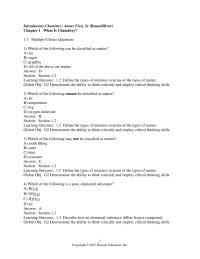
Chemistry Chapter 1 Which of the following cannot be classified as matter
Answer: B Section: Section 1.2 Learning Outcome: 1.2 Define the types of mixtures in terms of the types of matter. Global Obj: G2 Demonstrate the ability to think critically and employ critical thinking skills. Answer: C Section: Section 1.2 Learning […]
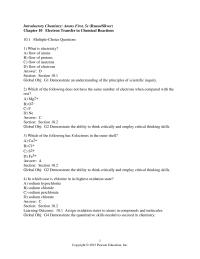
Chemistry Chapter 10 In which case is chlorine in its highest oxidation state
Copyright © 2015 Pearson Education, Inc. Introductory Chemistry: Atoms First, 5e (Russo/Silver) Chapter 10 Electron Transfer in Chemical Reactions 10.1 Multiple-Choice Questions 1) What is electricity? A) flow of atoms B) flow of protons C) flow of neutrons D) flow […]
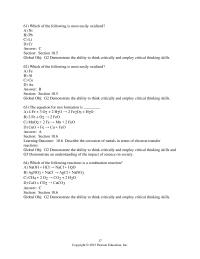
Chemistry Chapter 10 The overall charge of calcium sulfate is
Copyright © 2015 Pearson Education, Inc. 61) Which of the following is most easily oxidized? A) Ni B) Pb C) Li D) Cr Answer: C Section: Section 10.5 Global Obj: G2 Demonstrate the ability to think critically and employ critical […]
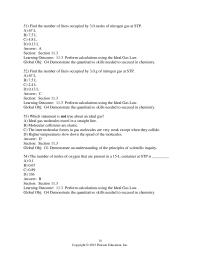
Chemistry Chapter 11 Ideal Gas Law global Obj Demonstrate Understanding The
Copyright © 2015 Pearson Education, Inc. 51) Find the number of liters occupied by 3.0 moles of nitrogen gas at STP. A) 67 L B) 7.5 L C) 4.8 L D) 0.13 L Answer: A Section: Section 11.3 Learning Outcome: […]
Chemistry Chapter 11 The value of the gas constant R is equal to
Copyright © 2015 Pearson Education, Inc. Introductory Chemistry: Atoms First, 5e (Russo/Silver) Chapter 11 What If There Were No Intermolecular Forces? – The Ideal Gas 11.1 Multiple Choice Questions 1) Pressure is defined as ________. A) the amount of force […]
Chemistry Chapter 12 Situations of great disorder are said to have
Copyright © 2015 Pearson Education, Inc. 11) is expected to have a greater energy of hydration than . Answer: TRUE Section: Section 12.2 Learning Outcome: 12.2 Describe the energetics and intermolecular attractions associated with creating a solution. Global Obj: G2 […]
Chemistry Chapter 12 Which of the following has the highest hydration
Copyright © 2015 Pearson Education, Inc. Introductory Chemistry: Atoms First, 5e (Russo/Silver) Chapter 12 Solutions 12.1 Multiple Choice Questions 1) Solutions are considered to be which general type of matter? A) homogeneous mixtures B) heterogeneous mixtures C) pure substances D) […]
Chemistry Chapter 13 If the concentration of B is doubled while the
Copyright © 2015 Pearson Education, Inc. 42) If the concentration of B is doubled while the concentration of A is unchanged, the rate will ________. A (g) + 3B (g) → C (g) + 2D (g) Rate = k[A][B]3 A) […]
Chemistry Chapter 13 Which of the following is an exothermic reaction
Copyright © 2015 Pearson Education, Inc. Introductory Chemistry: Atoms First, 5e (Russo/Silver) Chapter 13 When Reactants Turn into Products 13.1 Multiple Choice Questions 1) Which of the following is an exothermic reaction? A) burning propane gas in a barbecue B) […]
Chemistry Chapter 14 A reaction is close to equilibrium when a rapid
Copyright © 2015 Pearson Education, Inc. 58) If the solubility of calcium fluoride is 2.0 × 10⁻⁴ M, the solubility product value is ________. A) 1.6 × 10⁻¹² B) 3.2 × 10⁻¹¹ C) 4.0 × 10⁻⁸ D) 8.0 × 10⁻¹² […]
Chemistry Chapter 14 The following chemical reaction has reached equilibrium
Copyright © 2015 Pearson Education, Inc. Introductory Chemistry: Atoms First, 5e (Russo/Silver) Chapter 14 Chemical Equilibrium 14.1 Multiple Choice Questions 1) When a reaction shows one arrow pointing from left to right, this means ________. A) the reaction has reached […]
Chemistry Chapter 15 Solid sodium chloride is a strong electrolyte
Copyright © 2015 Pearson Education, Inc. 61) The conjugate base of ammonia is ________. A) NH2– B) NH– C) N3- D) NH4+ Answer: A Section: Section 15.9 Global Obj: G2 Demonstrate the ability to think critically and employ critical thinking […]
Chemistry Chapter 15 Which of the following acids is a triprotic acid
Copyright © 2015 Pearson Education, Inc. Introductory Chemistry: Atoms First, 5e (Russo/Silver) Chapter 15 Electrolytes, Acids, and Bases 15.1 Multiple Choice Questions 1) Which of the following compounds is an electrolyte when dissolved in distilled water? A) ethyl alcohol B) […]
Chemistry Chapter 16 The half-life of an isotope decreases as the initial
Copyright © 2015 Pearson Education, Inc. 6) A nuclear reaction involves much higher energies than a chemical reaction. Answer: TRUE Section: Section 16.2 Learning Outcome: 16.8 Understand nuclear fission, nuclear fusion, and their impact on society. Global Obj: G1 Demonstrate […]
Chemistry Chapter 16 When a neutron is transformed into a proton
Copyright © 2015 Pearson Education, Inc. Introductory Chemistry: Atoms First, 5e (Russo/Silver) Chapter 16 Nuclear Chemistry 16.1 Multiple Choice Questions 1) Isotopes have ________. A) the same number of protons but different number of neutrons B) the same number of […]
Chemistry Chapter 17 Given this hydrocarbon line drawing
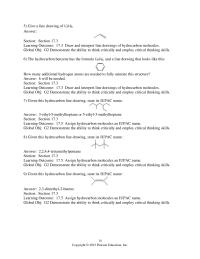
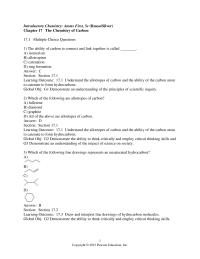
Copyright © 2015 Pearson Education, Inc. 5) Give a line drawing of . Answer: Section: Section 17.3 Learning Outcome: 17.3 Draw and interpret line drawings of hydrocarbon molecules. Global Obj: G2 Demonstrate the ability to think critically and employ critical […]
Chemistry Chapter 17 Which of the following are allotropes of carbon
Copyright © 2015 Pearson Education, Inc. Introductory Chemistry: Atoms First, 5e (Russo/Silver) Chapter 17 The Chemistry of Carbon 17.1 Multiple Choice Questions 1) The ability of carbon to connect and link together is called ________. A) isomerism B) allotropism C) […]
Chemistry Chapter 18 What two functional groups are found at the ends of
Answer: D Section: Section 18.2 Learning Outcome: 18.1 Understand what a polymer and a monomer are. Global Obj: G2 Demonstrate the ability to think critically and employ critical thinking skills. Answer: B Section: Section 18.2 Learning Outcome: 18.1 Understand what […]
Chemistry Chapter 2 How many Joules of heat are required to raise
Copyright © 2015 Pearson Education, Inc. 80) 100. cal of heat are added to 10 g of ethanol (0.581 cal/g °C) originally at 15 °C. The final temperature is ________. A) 17 °C B) 27 °C C) 32 °C D) […]
Chemistry Chapter 2 Match The Correct Scientific Notation From Column
Copyright © 2015 Pearson Education, Inc. Match the correct scientific notation from column 2 with the standard notation provided in column 1. A) 1.570 x 100 B) 1.570 x 101 C) 1.570 x 10⁻³ D) 1.570 x 10⁻² 13) 15.70 […]
Chemistry Chapter 2 Which one of the following numbers does not have four
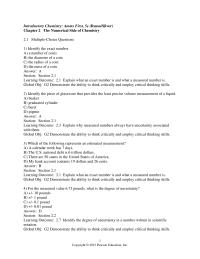
Copyright © 2015 Pearson Education, Inc. Introductory Chemistry: Atoms First, 5e (Russo/Silver) Chapter 2 The Numerical Side of Chemistry 2.1 Multiple-Choice Questions 1) Identify the exact number. A) a number of coins B) the diameter of a coin C) the […]
Chemistry Chapter 3 Identify Groups Periods Metals And Nonmetals The
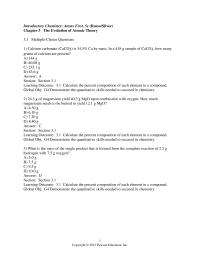
Copyright © 2015 Pearson Education, Inc. Introductory Chemistry: Atoms First, 5e (Russo/Silver) Chapter 3 The Evolution of Atomic Theory 3.1 Multiple-Choice Questions 1) Calcium carbonate (CaCO3) is 34.5% Ca by mass. In a 418 g sample of CaCO3, how many […]
Chemistry Chapter 3 Platinum is used in the catalytic converters of the cars
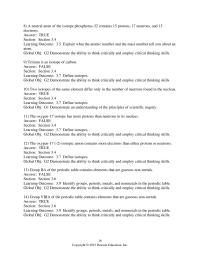
Copyright © 2015 Pearson Education, Inc. 8) A neutral atom of the isotope phosphorus-32 contains 15 protons, 17 neutrons, and 15 electrons. Answer: TRUE Section: Section 3.4 Learning Outcome: 3.5 Explain what the atomic number and the mass number tell […]
Chemistry Chapter 4 Match The Following Species The First
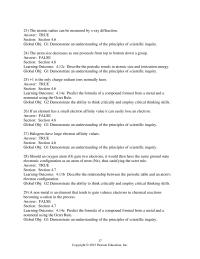
Copyright © 2015 Pearson Education, Inc. 23) The atomic radius can be measured by x-ray diffraction. Answer: TRUE Section: Section 4.6 Global Obj: G1 Demonstrate an understanding of the principles of scientific inquiry. 24) The atom size decreases as one […]
Chemistry Chapter 4 Which The Following Ions Does Not Include
Copyright © 2015 Pearson Education, Inc. Introductory Chemistry: Atoms First, 5e (Russo/Silver) Chapter 4 The Modern Model of the Atom 4.1 Multiple-Choice Questions 1) The units of h (Planck’s constant) are ________. A) J.s B) J/s C) m/s D) J/nm […]
Chemistry Chapter 5 Draw Covalent Bond And Count The Valence
Copyright © 2015 Pearson Education, Inc. Introductory Chemistry: Atoms First, 5e (Russo/Silver) Chapter 5 Chemical Bonding and Nomenclature 5.1 Multiple-Choice Questions 1) Which of the following statements best describes an ionic bond? A) a strong lattice of positively and negatively […]
Chemistry Chapter 5 fulfill its octet which appears on the right column
60 54) fluorine Section: Section 5.4 Learning Outcome: 5.7 Draw dot diagrams for atoms. Global Obj: G2 Demonstrate the ability to think critically and employ critical thinking skills. 55) lithium Section: Section 5.4 Learning Outcome: 5.7 Draw dot diagrams for […]
Chemistry Chapter 5 Sulfur tetrafluoride is the only compound that forms
Copyright © 2015 Pearson Education, Inc. 26) Carbon monoxide is the only compound that forms between carbon and oxygen. Answer: FALSE Section: Section 5.5 Learning Outcome: 5.8 Draw dot diagrams for molecules. Global Obj: G2 Demonstrate the ability to think […]
Chemistry Chapter 5 What is the chemical name of the compound whose
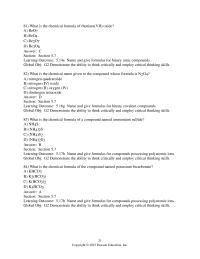
Copyright © 2015 Pearson Education, Inc. 81) What is the chemical formula of rhenium(VII) oxide? A) ReO7 B) ReO4 C) Re2O7 D) Re3O6 Answer: C Section: Section 5.7 Learning Outcome: 5.14e Name and give formulas for binary ionic compounds. Global […]
Chemistry Chapter 6 Demonstrate the ability to think critically
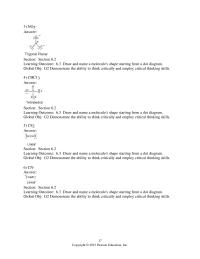
Copyright © 2015 Pearson Education, Inc. 3) NO3– Answer: Section: Section 6.2 Learning Outcome: 6.3 Draw and name a molecule’s shape starting from a dot diagram. Global Obj: G2 Demonstrate the ability to think critically and employ critical thinking skills. […]
Chemistry Chapter 6 In a molecule having four pairs of electrons around
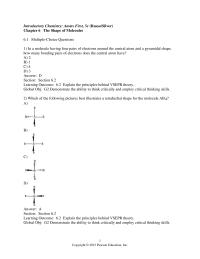
Copyright © 2015 Pearson Education, Inc. Introductory Chemistry: Atoms First, 5e (Russo/Silver) Chapter 6 The Shape of Molecules 6.1 Multiple-Choice Questions 1) In a molecule having four pairs of electrons around the central atom and a pyramidal shape, how many […]
Chemistry Chapter 7 A change of state from a gas to a liquid is called
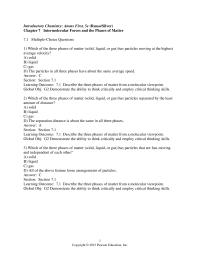
Copyright © 2015 Pearson Education, Inc. Introductory Chemistry: Atoms First, 5e (Russo/Silver) Chapter 7 Intermolecular Forces and the Phases of Matter 7.1 Multiple-Choice Questions 1) Which of the three phases of matter (solid, liquid, or gas) has particles moving at […]
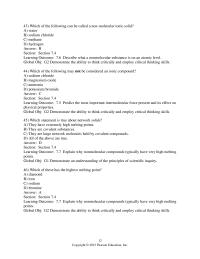
Chemistry Chapter 7 The acetone molecule has a large dipole because of
Copyright © 2015 Pearson Education, Inc. 43) Which of the following can be called a non-molecular ionic solid? A) water B) sodium chloride C) methane D) hydrogen Answer: B Section: Section 7.4 Learning Outcome: 7.6 Describe what a nonmolecular substance […]
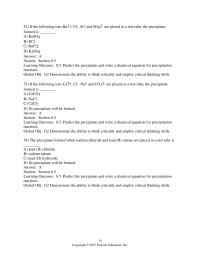
Chemistry Chapter 8 Demonstrate The Ability Think Critically And Employ
Copyright © 2015 Pearson Education, Inc. 52) If the following ions Ba2+, Cl–, K+ and SO42- are placed in a test tube, the precipitate formed is ________. A) BaSO4 B) KCl C) BaCl2 D) K2SO4 Answer: A Section: Section 8.5 […]
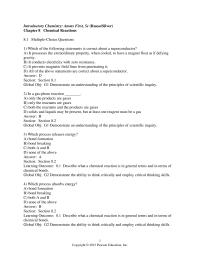
Chemistry Chapter 8 What is the coefficient for iron after the following
Copyright © 2015 Pearson Education, Inc. Introductory Chemistry: Atoms First, 5e (Russo/Silver) Chapter 8 Chemical Reactions 8.1 Multiple-Choice Questions 1) Which of the following statements is correct about a superconductor? A) It possesses the extraordinary property, when cooled, to have […]
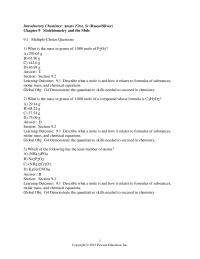
Chemistry Chapter 9 The molar mass rounded to the nearest
Copyright © 2015 Pearson Education, Inc. Introductory Chemistry: Atoms First, 5e (Russo/Silver) Chapter 9 Stoichiometry and the Mole 9.1 Multiple-Choice Questions 1) What is the mass in grams of 1.000 mole of P2O5? A) 239.03 g B) 61.96 g C) […]
Chemistry Chapter 9 The theoretical mass of sulfur dioxide produced
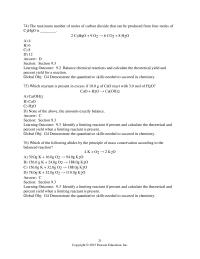
Copyright © 2015 Pearson Education, Inc. 74) The maximum number of moles of carbon dioxide that can be produced from four moles of C3H8O is ________. 2 C3H8O + 9 O2 → 6 CO2 + 8 H2O A) 4 B) […]
Chemistry Chapter 9 what a mole is and how it relates to formula
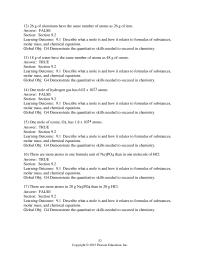
Copyright © 2015 Pearson Education, Inc. 12) 26 g of aluminum have the same number of atoms as 26 g of iron. Answer: FALSE Section: Section 9.2 Learning Outcome: 9.1 Describe what a mole is and how it relates to […]
Chemistry Chapter 9 Which The Following Compounds Has Its Nitrogen
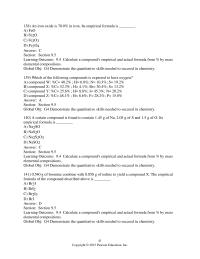
Copyright © 2015 Pearson Education, Inc. 138) An iron oxide is 70.0% in iron. Its empirical formula is ________. A) FeO B) Fe2O C) Fe2O3 D) Fe3O4 Answer: C Section: Section 9.5 Learning Outcome: 9.4 Calculate a compound’s empirical and […]