Introductory Chemistry: Atoms First, 5e (Russo/Silver)
Chapter 15 Electrolytes, Acids, and Bases
15.1 Multiple Choice Questions
1) Which of the following compounds is an electrolyte when dissolved in distilled water?
A) ethyl alcohol
B) sucrose
C) sodium sulfate
D) oxygen
2) Which of the following acids can produce only one H3O+ ion per molecule of acid when
dissolved in water, although itself has other non-ionizable hydrogens?
A) hydrobromic acid
B) sulfurous acid
C) hypochlorous acid
D) acetic acid
3) What are the ions formed in glucose, C6H12O6?
A) C6H11O6– + H+
B) C6H11O5+ + OH–
C) CO2 + H2O
D) No ions are formed.
4) Which of the following solutions would you expect not to conduct electricity?
A) NaCl in water
B) CO in water
C) HCl in water
D) in water
5) Which of the following compounds is a strong electrolyte when dissolved in distilled water?
A) sodium chloride
B) sucrose
C) acetone (nail polish remover)
D) ethyl alcohol
6) Which of the following acids is a triprotic acid when dissolved in water?
A) hydrobromic acid
B) sulfuric acid
C) hypochlorous acid
D) phosphoric acid
7) Which of the following acids is a diprotic acid when dissolved in water?
A) hydrobromic acid
B) sulfuric acid
C) hypochlorous acid
D) phosphoric acid
8) Which of the following acids produces more than one H3O+ ion per molecule of acid when
dissociated in water?
A) hydrobromic acid
B) carbonic acid
C) hypochlorous acid
D) acetic acid
9) Which of the following acids does not produce more than one H3O+ ion per molecule of acid
when dissociated in water?
A) carbonic acid
B) sulfurous acid
C) phosphoric acid
D) acetic acid
10) Which of the following acids does not produce two H3O+ ion per molecule of acid when
dissociated in water?
A) hydriodic acid
B) sulfurous acid
C) sulfuric acid
D) carbonic acid
11) Which of the following compounds is a weak electrolyte when dissolved in distilled water?
A) phosphoric acid
B) nitric acid
C) potassium chloride
D) glucose
12) Which of the following acids is a strong acid?
A) acetic acid
B) hydrofluoric acid
C) phosphoric acid
D) hydrochloric acid
13) Which of the following acids is a weak acid?
A) sulfuric acid
B) hydrochloric acid
C) nitric acid
D) carbonic acid
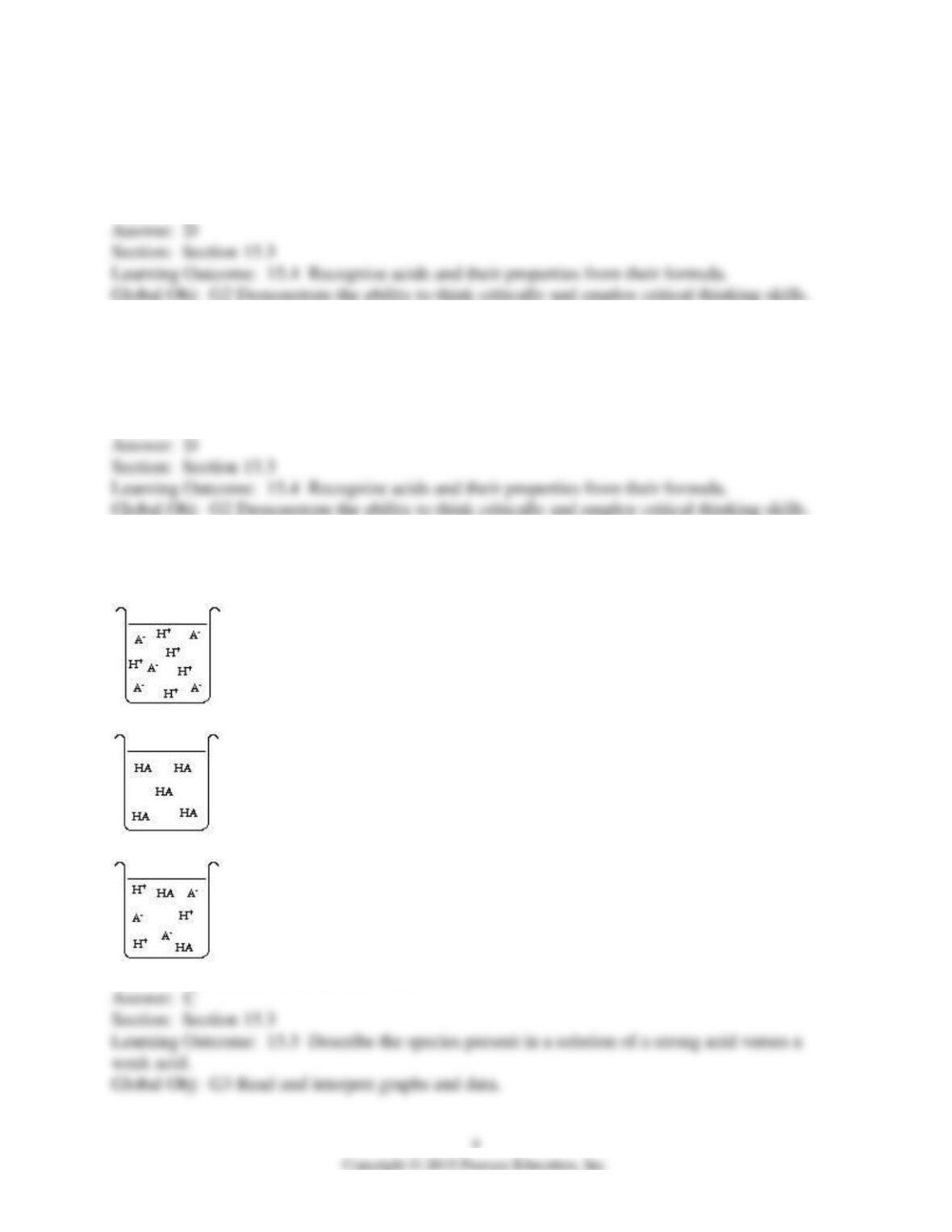
14) The compound HA is an acid that is soluble in water. Which of the “beakers” below shows
HA behaving as a weak acid in water?
A)
B)
C)
D) Both A and C are weak acids in water.
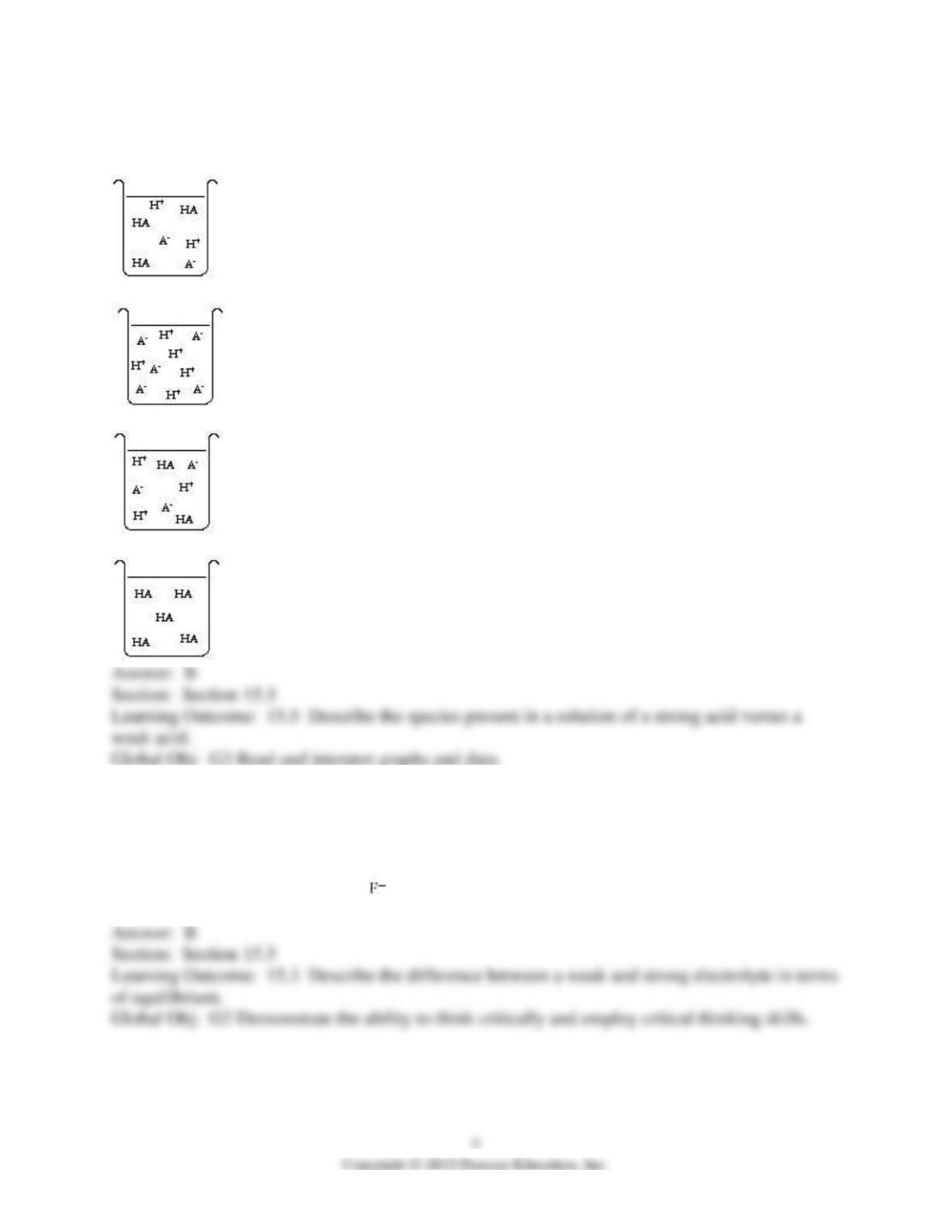
15) The compound HA is an acid that is soluble in water. Which of the “beakers” below shows
HA behaving as a strong acid in water?
A)
B)
C)
D)
16) Why is HF in water considered a weakly acidic solution, while HCl and HBr in water are
considered strongly acidic solutions?
A) HF does not dissolve in water.
B) HF only partially dissociates into ions in water.
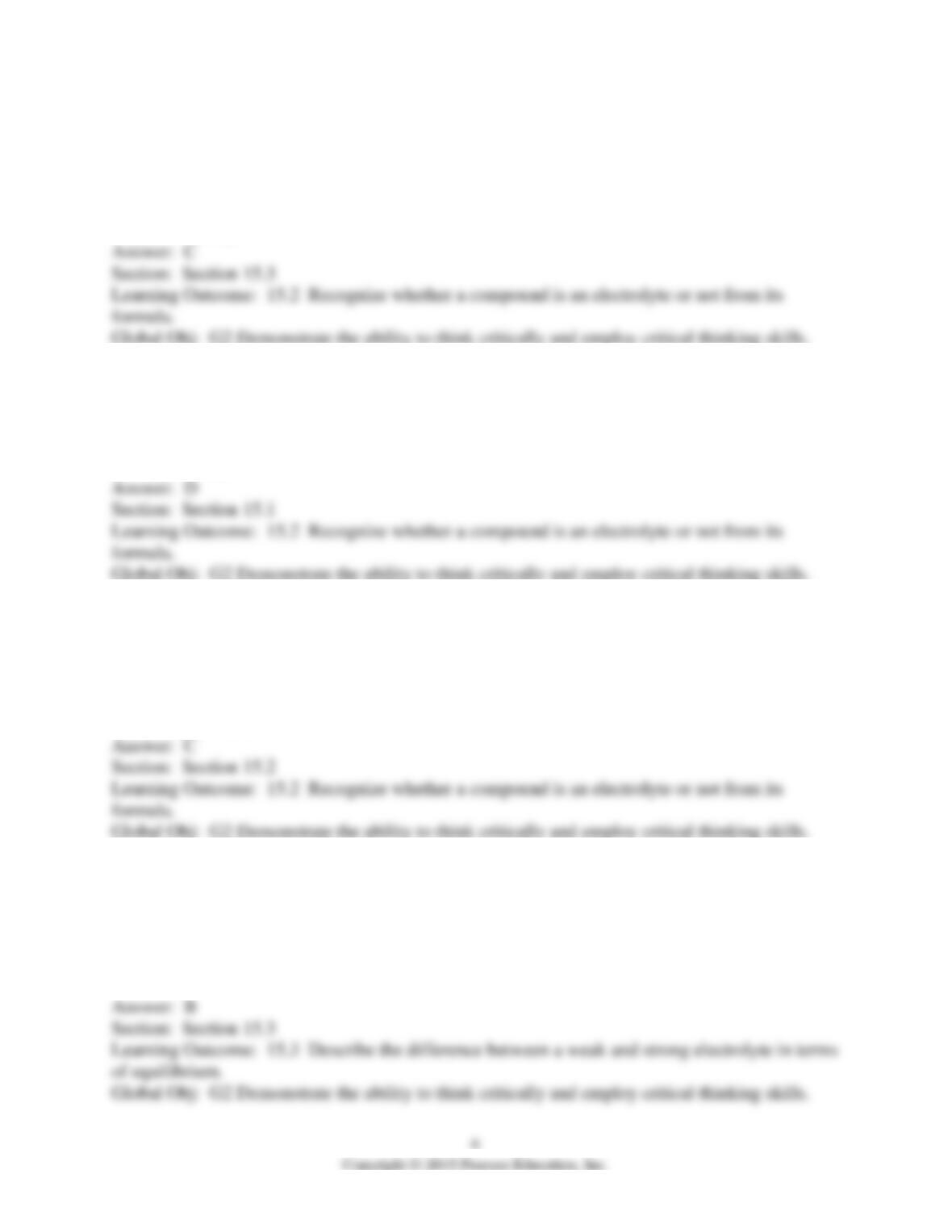
C) HF has a weak conjugate base, .
D) Both B and C are correct.
17) Which of the following compounds is not a strong electrolyte when dissolved in distilled
water?
A) potassium chloride
B) sulfuric acid
C) acetic acid
D) potassium hydroxide
18) Which of the following compounds is a non-electrolyte when dissolved in distilled water?
A) sodium chloride
B) hydrochloric acid
C) sodium hydroxide
D) ethyl alcohol
19) Which of the following compounds is not a weak electrolyte when dissolved in distilled
water?
A) ammonia
B) acetic acid (vinegar)
C) potassium chloride
D) hydrogen fluoride
20) Which of the following acids is the strongest acid?
A) acetic acid, Ka = 1.8 × 10⁻⁵
B) nitrous acid, Ka = 4.5 × 10⁻⁴
C) hydrogen peroxide, Ka = 2.4 × 10⁻¹²
D) hypochlorous acid, Ka = 3.5 × 10⁻⁸
21) Which of the following compounds is the weakest acid?
A) acetic acid, Ka = 1.8 × 10⁻⁵
B) nitrous acid, Ka = 4.5 × 10⁻⁴
C) hydrogen peroxide, Ka = 2.4 × 10⁻¹²
D) hypochlorous acid, Ka = 3.5 × 10⁻⁸
22) When hydrofluoric acid is dissolved in water, the ionized species are ________.
A) H3O+ and OH–
B) H2F– and H3O+
C) H3O+ and F–
D) H2F+ and OH–
23) Which of the following bases produces two OH– ions per formula unit of base when
dissolved in water?
A) potassium hydroxide
B) calcium hydroxide
C) aluminum hydroxide
D) ammonia
24) Which of the following bases produces only one OH– ion per molecule of formula unit when
dissolved in water?
A) potassium hydroxide
B) calcium hydroxide
C) aluminum hydroxide
D) barium hydroxide
25) Which of the following acids could be considered an Arrhenius acid?
A) HCl
B) COOH
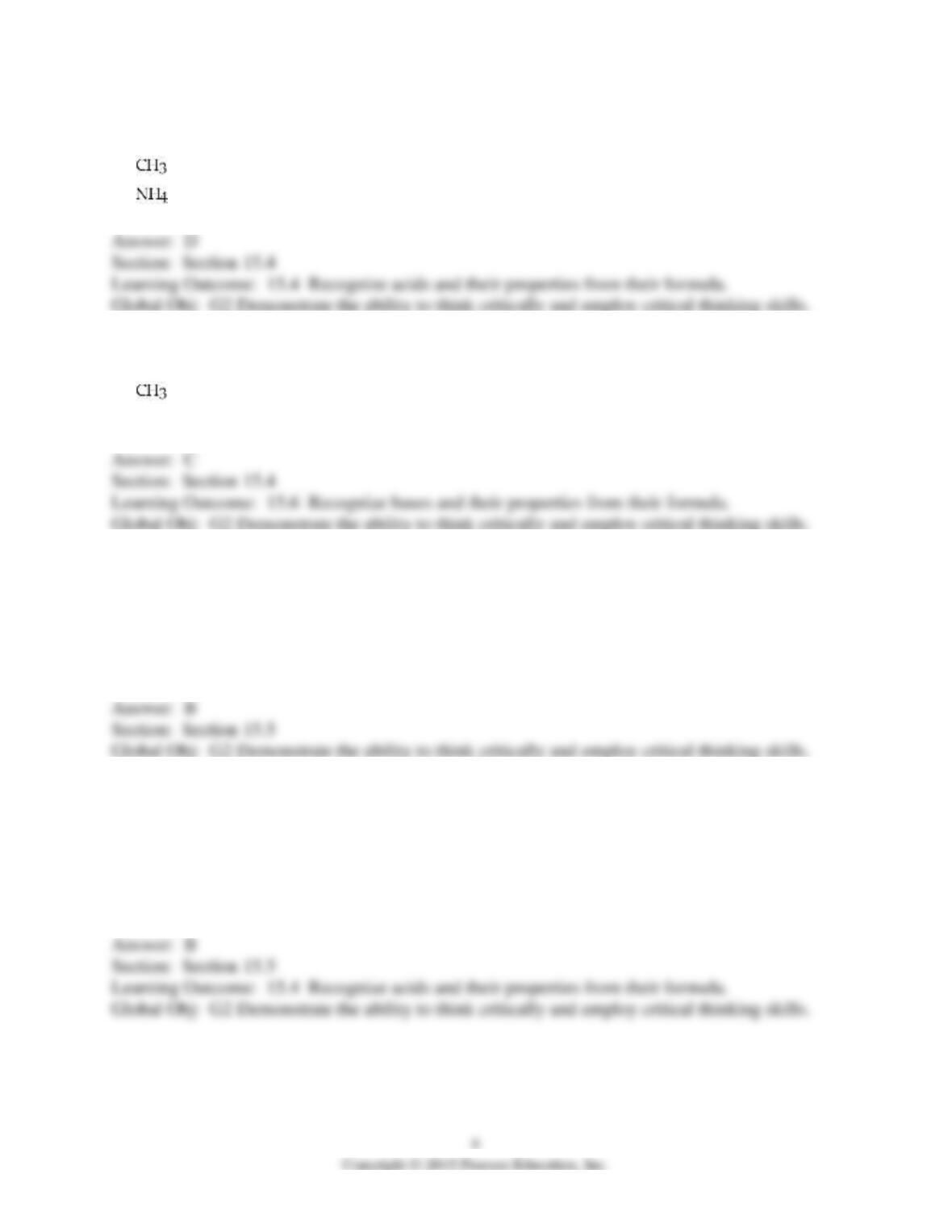
C) +
D) All of the above are Arrhenius acids.
26) Which of the following compounds could be considered an Arrhenius base?
A) HCl
B) COOH
C) KOH
D) HF
27) Which of the following compounds can behave both as a Bronsted-Lowry acid and a
Bronsted-Lowry base?
A) CH4
B) H2O
C) SiH4
D) H2
28) The acid in the forward reaction is ________.
HCO3– + H2O → H2CO3 + OH–
A) HCO3–
B) H2O
C) H2CO3
D) OH–
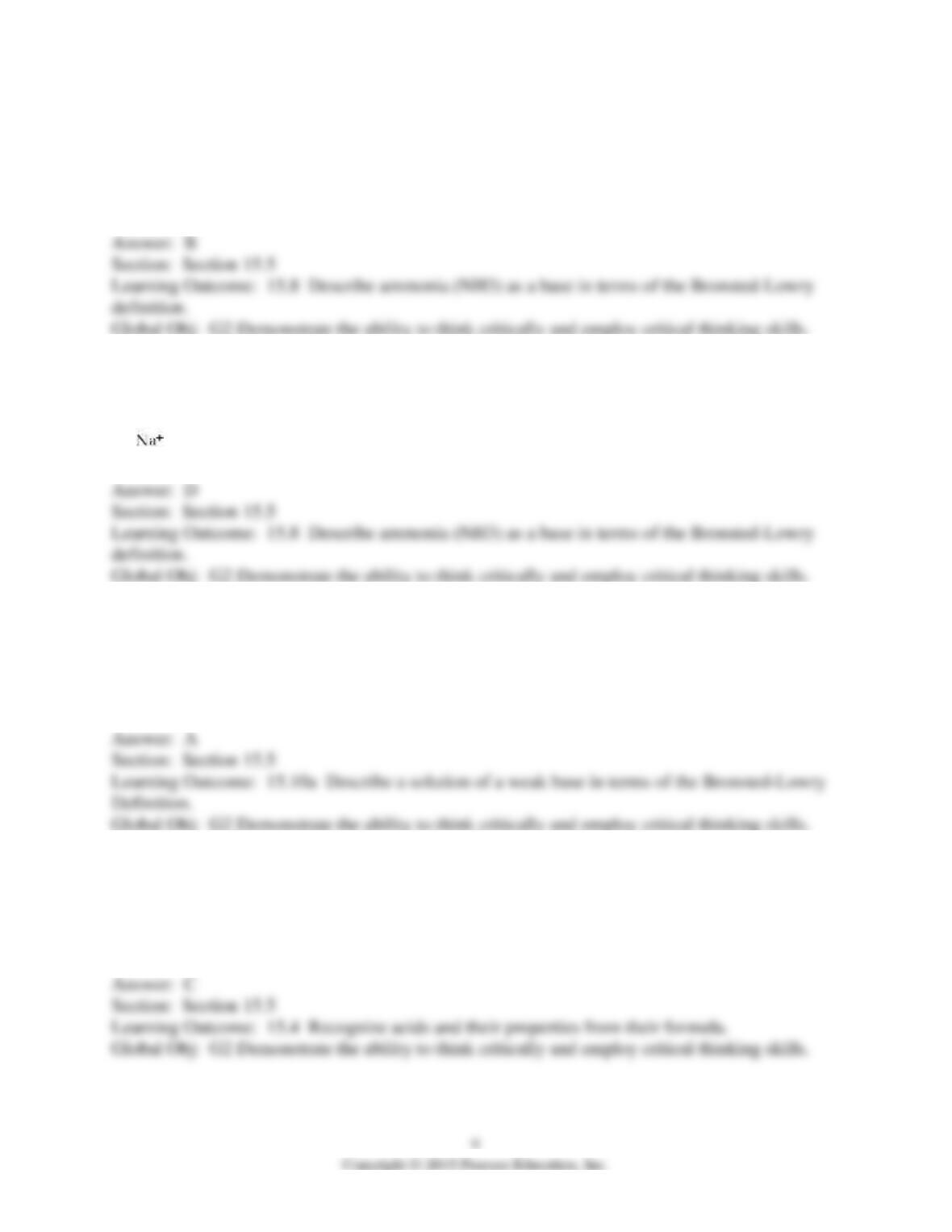
29) Which of the following compounds qualifies as a Bronsted-Lowry base?
A) CH4
B) NH3
C) SiH4
D) H2
30) Which of the following compounds or ions qualifies as a Bronsted-Lowry acid?
A) KOH
B) NH3
C)
D) NH4+
31) Which of the following compounds does not qualify as a Bronsted-Lowry base?
A) CH4
B) NH3
C) PH3
D) H2O
32) Which of the following compounds does not qualify as a Bronsted-Lowry acid?
A) HF
B) H2CO3
C) H2
D) H2O
33) Which of the following bases is a weak base?
A) sodium hydroxide
B) ammonium hydroxide
C) lithium hydroxide
D) potassium hydroxide
34) Which of the following bases is a strong base?
A) potassium hydroxide
B) ammonium hydroxide
C) aluminum hydroxide
D) fluoride ion
35) Which of the following bases is the weakest base?
A) ammonia, Kb = 1.7 × 10⁻⁵
B) aniline, Kb = 4.2 × 10⁻¹⁰
C) trimethylamine, Kb = 7.4 × 10⁻⁵
D) methylamine, Kb = 4.4 × 10⁻⁴
36) Which of the following bases is the strongest base?
A) ammonia, Kb = 1.7 × 10⁻⁵
B) aniline, Kb = 4.2 × 10⁻¹⁰
C) trimethylamine, Kb = 7.4 × 10⁻⁵
D) methylamine, Kb = 4.4 × 10⁻⁴
37) The base in the forward reaction is ________.
NH3 + H2O → N + + OH–
A) N +
B) H2O
C) NH3
D) OH–
38) When ammonia is dissolved in water, the ionized species are ________.
A) NH4+ and OH–
B) NH2– and H+
C) NH4+ and H–
D) NH2+ and H–
39) Acidic solutions ________.
A) have a higher concentration of hydronium ions than hydroxide ions
B) have a lower concentration of hydronium ions than hydroxide ions
C) turn red litmus paper to blue
D) colorize phenolphthalein solutions
40) Basic solutions ________.
A) have a higher concentration of hydronium ions than hydroxide ions
B) have a lower concentration of hydronium ions than hydroxide ions
C) turn blue litmus paper to pink
D) decolorize phenolphthalein solutions
41) What is the hydroxide-ion concentration of an aqueous solution having a hydrogen-ion
concentration of 4.75 × mol/L?
A) 2.10 × mol/L
B) 5.25 × mol/L
C) 4.75 × mol/L
D) -4.75 × mol/L
42) Which substance is the most acidic?
A) coffee
B) milk
C) oven cleaner
D) baking soda
43) Which substance is the most basic?
A) blood
B) milk
C) household ammonia
D) milk of magnesia
44) Which solution is the most basic solution?
A) a solution whose [H+] = 100
B) a solution whose [OH–] = 10-14
C) a solution whose pH = 0
D) All of the above have the same degree of basicity.
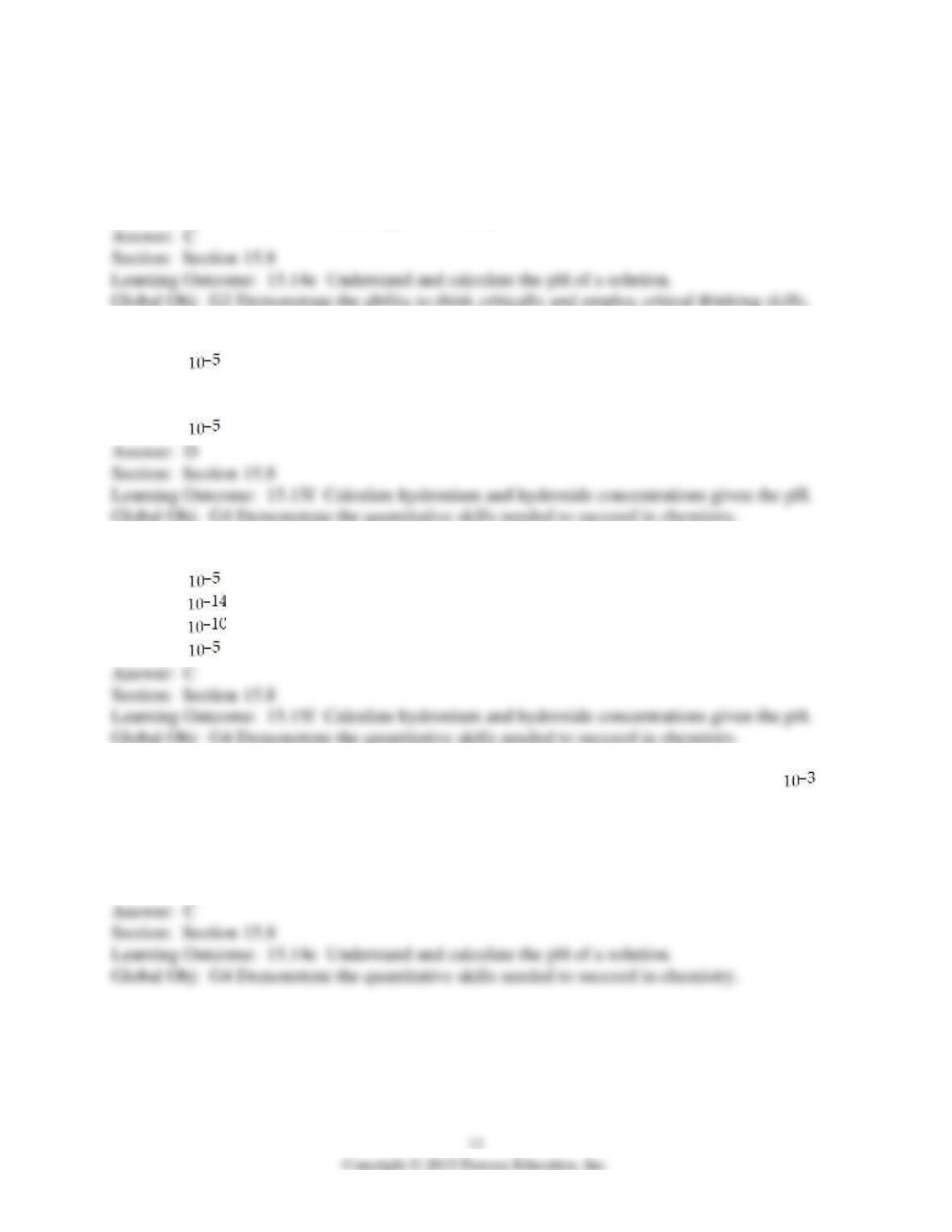
45) Which solution is the most acidic solution?
A) a solution whose [H+] = 10-1
B) a solution whose [OH–] = 10-10
C) a solution whose pH = 0
D) All of the above have the same degree of acidity.
46) What is the hydrogen-ion concentration of an aqueous solution having a pH of 4.72?
A) 4.72 × mol/L
B) 4.72 mol/L
C) 0.67 mol/L
D) 1.91 × mol/L
47) What is the hydroxide-ion concentration of an aqueous solution having a pH of 4.72?
A) 4.72 × mol/L
B) 1.91 × mol/L
C) 5.25 × mol/L
D) 1.91 × mol/L
48) What is the pH of an aqueous solution having a hydrogen-ion concentration of 6.83 ×
mol/L?
A) 6.83
B) 0.83
C) 2.17
D) 1.03
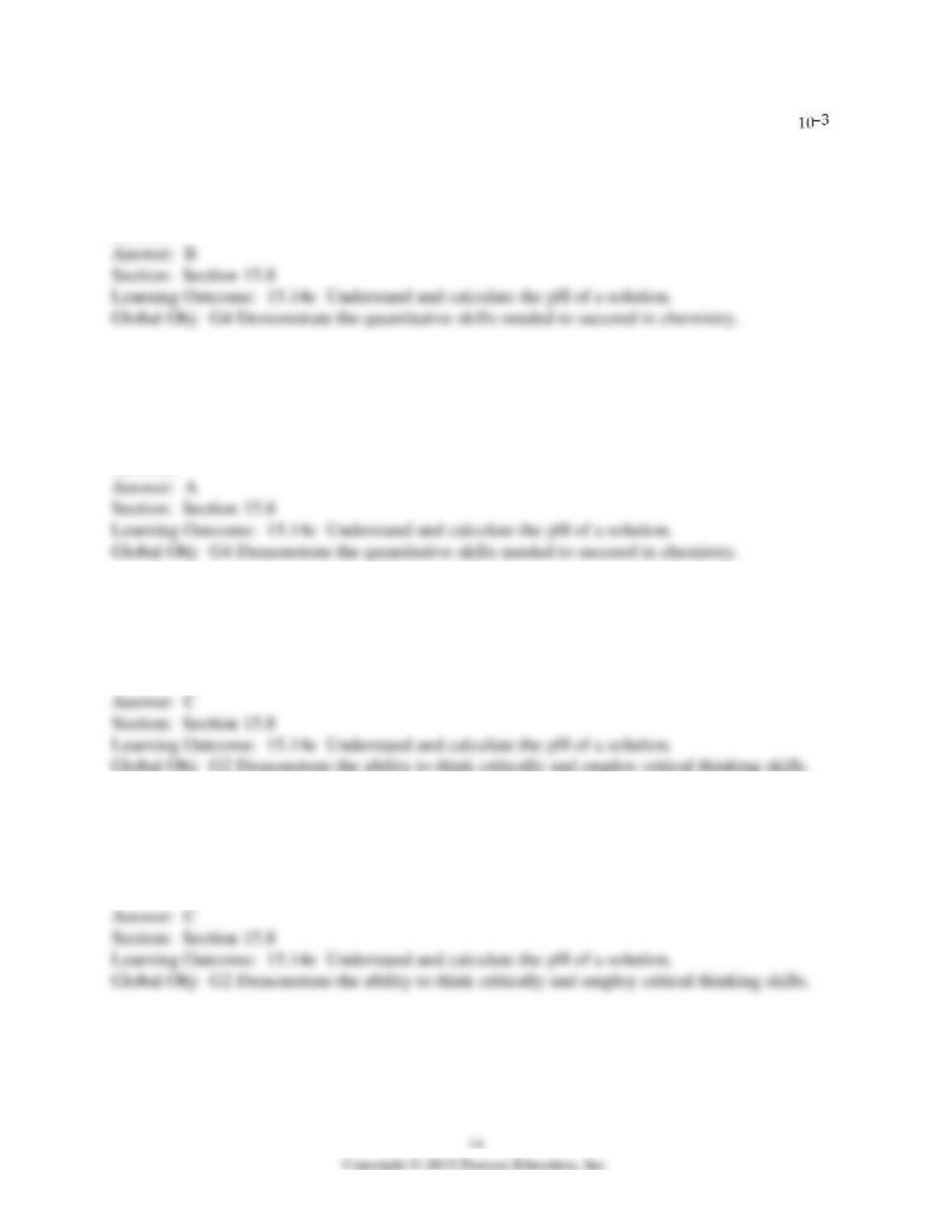
49) What is the pOH of an aqueous solution having a hydrogen-ion concentration of 6.83 ×
mol/L?
A) 16.17
B) 11.83
C) 2.17
D) 1.03
50) The pH of an aqueous solution is 9.35. What is the pOH? (pH + pOH = 14 for aqueous
acid/base systems).
A) 4.65
B) 0.971
C) -4.65
D) 0.668
51) The pH of blood is approximately ________.
A) 5.2
B) 7.0
C) 7.4
D) 9.1
52) The pH of diabetic patients can be as low as ________.
A) 3.2
B) 5.8
C) 6.8
D) 7.0
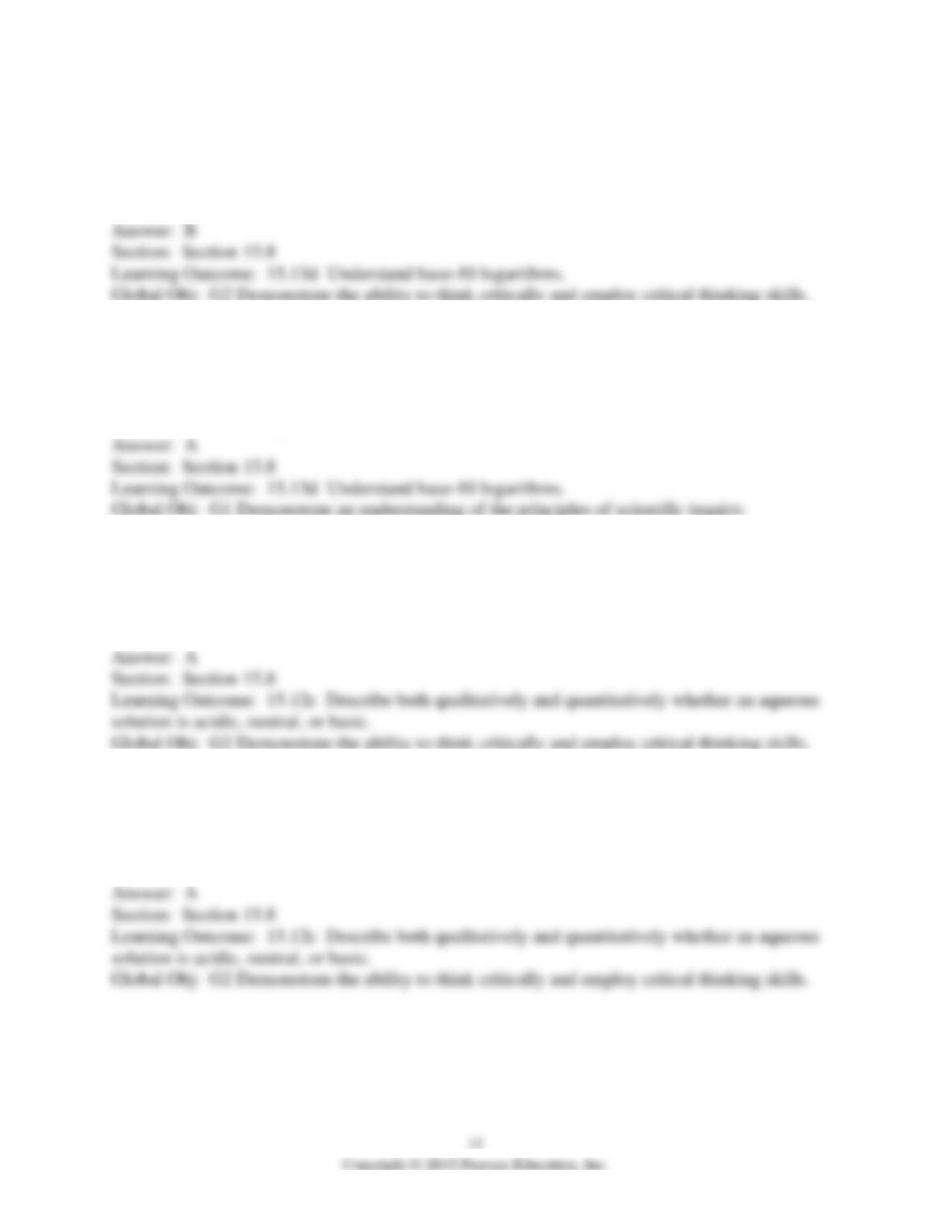
53) A drop of a full unit in the pH scale ________.
A) reduces the acidity 10×
B) increases the acidity 10×
C) reduces the acidity 2×
D) increases the acidity 2×
54) A change in pH from 10 to 7 ________.
A) increases the acidity 1000×
B) reduces the acidity 3000×
C) increases the acidity 3×
D) increases the acidity 3000×
55) The pH of natural rainwater is close to ________.
A) 5.6
B) 6.3
C) 7.0
D) 8.2
56) Stomach juices have a pH close to ________.
A) 1.5
B) 2.8
C) 4.5
D) 7.0
57) The conjugate acid of H2PO4– is ________.
A) H3PO4
B) HPO42-
C) PO43-
D) H4PO4+
58) The conjugate base of H2PO4– is ________.
A) H3PO4
B) HPO42-
C) PO43-
D) H4PO4+
59) The conjugate acid of HCO3– is ________.
A) H2CO3
B) CO32-
C) CO22-
D) H3CO3–
60) The conjugate base of HCO3– is ________.
A) H2CO3
B) CO32-
C) CO22-
D) H3CO3+