52) If the following ions Ba2+, Cl–, K+ and SO42- are placed in a test tube, the precipitate
formed is ________.
A) BaSO4
B) KCl
C) BaCl2
D) K2SO4
53) If the following ions Ca2+, Cl–, Na+ and CO32- are placed in a test tube, the precipitate
formed is ________.
A) CaCO3
B) NaCl
C) CaCl2
D) No precipitate will be formed.
54) The precipitate formed when sodium chloride and lead (II) nitrate are placed in a test tube is
________.
A) lead (II) chloride
B) sodium nitrate
C) lead (II) hydroxide
D) No precipitate will be formed.
55) The precipitate formed when barium nitrate and potassium chromate are placed in a test tube
is ________.
A) barium nitrate
B) barium chromate
C) potassium nitrate
D) potassium chromate
56) The precipitate formed when hydrochloric acid and sodium hydroxide are placed in a test
tube is ________.
A) sodium hydroxide
B) sodium chloride
C) hydrochloric acid
D) No precipitate will be formed.
57) The net ionic equation for the following reaction is ________.
H2SO4 + KOH → K2SO4 + H2O
A) K+ (aq) + SO42- (aq) → K2SO4
B) H+ (aq) + OH– (aq) → H2O
C) K+ (aq) + OH–(aq) → KOH
D) H+ (aq) + SO42- (aq) → H2SO4
58) It takes ________ mole(s) of potassium hydroxide to neutralize ________ moles of sulfuric
acid.
A) 1; 1
B) 1; 2
C) 2; 1
D) 3; 1
59) It takes ________ mole(s)of calcium hydroxide to neutralize ________ moles of sulfuric
acid.
A) 1; 1
B) 1; 2
C) 2; 1
D) 1; 3
60) It takes ________ mole(s) of sulfuric acid to neutralize ________ moles of aluminum
hydroxide.
A) 2; 3
B) 3; 2
C) 1; 2
D) 1; 1
61) The number of moles of sodium hydroxide needed to neutralize one mole of nitric acid is
________.
A) 1
B) 2
C) 3
D) 0.5
8.2 True/False Questions
1) Bond breaking releases energy.
2) Bond formation releases energy.
3) The coefficients in the balanced equation are 1: 6: 2: 3.
Au2S3 + H2 → Au + H2S
4) The coefficients in the balanced equation are 2: 2: 3.
KClO3 → KCl + O2
5) The coefficients in the balanced equation are 1: 19: 8: 3.
C8H6 + O2 → CO2 + H2O
6) Another term for the combination reaction is a synthesis reaction.
7) In a combustion reaction, oxygen is typically one of the reactants.
8) In a decomposition reaction, one compound breaks down into two or more simpler
compounds or elements.
9) In a combination reaction two or more compounds yield two or more compounds.
10) A combustion reaction always involves carbon dioxide formation.
11) One needs to balance a chemical reaction before identifying the type of reaction.
12) In a precipitation reaction, all ions and compounds are soluble in water.
13) All nitrates are soluble in water.
14) All hydroxides are insoluble in water.
19
15) Silver (I) chloride is insoluble in water, while silver (I) acetate is soluble in water.
16) Only the halides of lead (II) and silver (I) are insoluble in water.
17) Ammonium phosphate is soluble in water, but ammonium carbonate is insoluble in water.
18) When the following ions barium, chloride, sodium and sulfate are placed together in a test
tube, barium sulfate precipitates out.
19) It takes two moles of sulfuric acid to neutralize one mole of sodium hydroxide.
20) An alternative name for hydrochloric acid is muriatic acid.
21) An alternative name for lye is potassium hydroxide.

8.3 Matching Questions
Match each of the equations in the left column with the correct relative coefficient ratio when the
equation is balanced that appears in the right column.
A) 2: 3: 2: 4
B) 1: 1: 1: 1
C) 1: 3: 2: 2
D) 1: 2: 2: 1
E) 1: 2: 1: 1
F) 1: 3: 3: 4
1) CH4 + Br2 → CH3Br + HBr
Section: Section 8.3
Learning Outcome: 8.3 Write and balance chemical equations.
Global Obj: G4 Demonstrate the quantitative skills needed to succeed in chemistry.
2) CH4 + O2 → CO + H2O
Section: Section 8.3
Learning Outcome: 8.3 Write and balance chemical equations.
Global Obj: G4 Demonstrate the quantitative skills needed to succeed in chemistry.
3) Mg + HBr → MgBr2 + H2
Section: Section 8.3
Learning Outcome: 8.3 Write and balance chemical equations.
Global Obj: G4 Demonstrate the quantitative skills needed to succeed in chemistry.
4) CaCl2 +AgNO3 →
Section: Section 8.3
Learning Outcome: 8.3 Write and balance chemical equations.
Global Obj: G4 Demonstrate the quantitative skills needed to succeed in chemistry.
5) C3H8O + O2 → CO + H2O
Section: Section 8.3
Learning Outcome: 8.3 Write and balance chemical equations.
Global Obj: G4 Demonstrate the quantitative skills needed to succeed in chemistry.
6) C2H4 + O2 → CO2 + H2O
Section: Section 8.3
Learning Outcome: 8.3 Write and balance chemical equations.
Global Obj: G4 Demonstrate the quantitative skills needed to succeed in chemistry.

21
Match every equation in the left column with its type that appears in the right column.
A) Combination
B) Double replacement
C) Decomposition
D) Combustion
7) H2SO4 + NaOH →
Section: Section 8.4
Learning Outcome: 8.4 Describe and identify the different reaction types.
Global Obj: G2 Demonstrate the ability to think critically and employ critical thinking skills.
E) Single replacement
8) Mg + HCl → H2 + MgCl2
Section: Section 8.4
Learning Outcome: 8.4 Describe and identify the different reaction types.
Global Obj: G2 Demonstrate the ability to think critically and employ critical thinking skills.
9) CH4 + O2 → CO2 + H2O
Section: Section 8.4
Learning Outcome: 8.4 Describe and identify the different reaction types.
Global Obj: G2 Demonstrate the ability to think critically and employ critical thinking skills.
10) NaClO3 → NaCl + O2
Section: Section 8.4
Learning Outcome: 8.4 Describe and identify the different reaction types.
Global Obj: G2 Demonstrate the ability to think critically and employ critical thinking skills.
11) P + Cl2 → PCl3
Section: Section 8.4
Learning Outcome: 8.4 Describe and identify the different reaction types.
Global Obj: G2 Demonstrate the ability to think critically and employ critical thinking skills.
12) Na2SO4 + PbCl2 → PbSO4 + NaCl
Section: Section 8.4
Learning Outcome: 8.4 Describe and identify the different reaction types.
Global Obj: G2 Demonstrate the ability to think critically and employ critical thinking skills.
13) CH4 + Br2 → CH3Br + HBr
Section: Section 8.4
Learning Outcome: 8.4 Describe and identify the different reaction types.
Global Obj: G2 Demonstrate the ability to think critically and employ critical thinking skills.
22
14) Mg + N2 → Mg2N3
Section: Section 8.4
Learning Outcome: 8.4 Describe and identify the different reaction types.
Global Obj: G2 Demonstrate the ability to think critically and employ critical thinking skills.
15) Mg + HBr → MgBr2 + H2
Section: Section 8.4
Learning Outcome: 8.4 Describe and identify the different reaction types.
Global Obj: G2 Demonstrate the ability to think critically and employ critical thinking skills.
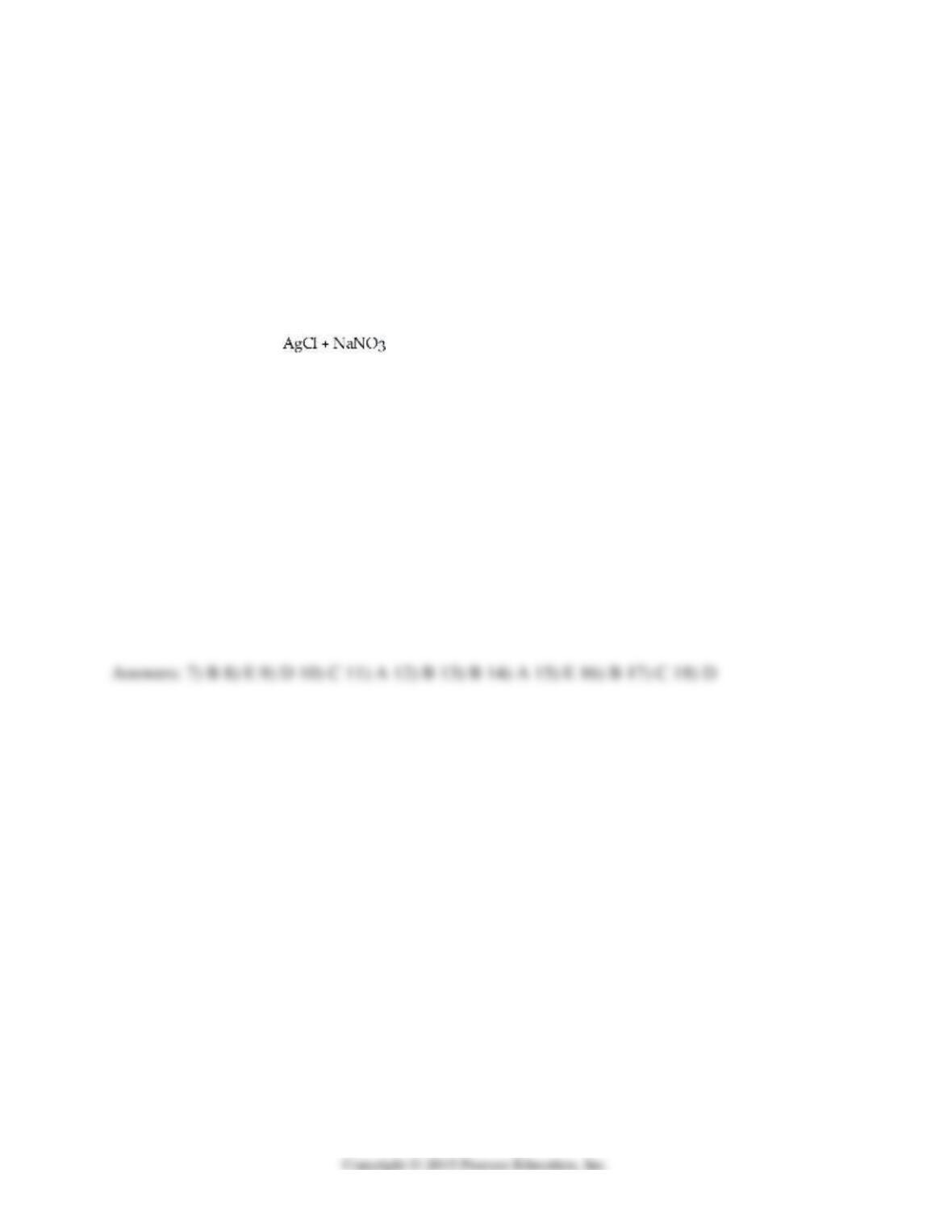
16) NaCl +AgNO3 →
Section: Section 8.5
Learning Outcome: 8.4 Describe and identify the different reaction types.
Global Obj: G2 Demonstrate the ability to think critically and employ critical thinking skills.
17) H2O2 → H2 + O2
Section: Section 8.4
Learning Outcome: 8.4 Describe and identify the different reaction types.
Global Obj: G2 Demonstrate the ability to think critically and employ critical thinking skills.
18) C2H4O + O2 → CO + H2O
Section: Section 8.4
Learning Outcome: 8.4 Describe and identify the different reaction types.
Global Obj: G2 Demonstrate the ability to think critically and employ critical thinking skills.

Predict whether each of the compounds listed on the left column is water soluble or insoluble.
A) water insoluble
B) water soluble
19) potassium nitrate
Section: Section 8.5
Global Obj: G2 Demonstrate the ability to think critically and employ critical thinking skills.
20) silver (I) chloride
Section: Section 8.5
Global Obj: G2 Demonstrate the ability to think critically and employ critical thinking skills.
21) lithium acetate
Section: Section 8.5
Global Obj: G2 Demonstrate the ability to think critically and employ critical thinking skills.
22) lead (II) sulfate
Section: Section 8.5
Global Obj: G2 Demonstrate the ability to think critically and employ critical thinking skills.
23) cobalt (II) sulfide
Section: Section 8.5
Global Obj: G2 Demonstrate the ability to think critically and employ critical thinking skills.
24) potassium bromide
Section: Section 8.5
Global Obj: G2 Demonstrate the ability to think critically and employ critical thinking skills.
25) ammonium phosphate
Section: Section 8.5
Global Obj: G2 Demonstrate the ability to think critically and employ critical thinking skills.
26) barium carbonate
Section: Section 8.5
Global Obj: G2 Demonstrate the ability to think critically and employ critical thinking skills.
27) aluminum hydroxide
Section: Section 8.5
Global Obj: G2 Demonstrate the ability to think critically and employ critical thinking skills.
28) lithium sulfate
Section: Section 8.5
Global Obj: G2 Demonstrate the ability to think critically and employ critical thinking skills.

Match the acid-base pairs.
A) HNO3
B) HCl
C) SO42-
D) OH–
E) H2SO4
F) NO2
G) H3O+
29) the conjugate acid of NO3–
Section: Section 8.6
Global Obj: G2 Demonstrate the ability to think critically and employ critical thinking skills.
30) the conjugate acid of Cl–
Section: Section 8.6
Global Obj: G2 Demonstrate the ability to think critically and employ critical thinking skills.
31) the conjugate base of HSO4–
Section: Section 8.6
Global Obj: G2 Demonstrate the ability to think critically and employ critical thinking skills.
32) the conjugate acid of HSO4–
Section: Section 8.6
Global Obj: G2 Demonstrate the ability to think critically and employ critical thinking skills.
33) the conjugate base of H2O
Section: Section 8.6
Global Obj: G2 Demonstrate the ability to think critically and employ critical thinking skills.
34) the conjugate acid of H2O
Section: Section 8.6
Global Obj: G2 Demonstrate the ability to think critically and employ critical thinking skills.

Match each of the acids that appear in the left column with a use or alternative name that
appears in the right column.
A) used to dissolve metals
B) found in lemons
C) used to clean steel, also known as muriatic acid
D) used in car batteries
E) used to etch glass
F) is the active ingredient in vinegar
35) hydrochloric acid
Section: Section 8.6
Global Obj: G2 Demonstrate the ability to think critically and employ critical thinking skills.
36) sulfuric acid
Section: Section 8.6
Global Obj: G2 Demonstrate the ability to think critically and employ critical thinking skills and
G5 Demonstrate an understanding of the impact of science on society.
37) acetic acid
Section: Section 8.6
Global Obj: G2 Demonstrate the ability to think critically and employ critical thinking skills and
G5 Demonstrate an understanding of the impact of science on society.
38) citric acid
Section: Section 8.6
Global Obj: G2 Demonstrate the ability to think critically and employ critical thinking skills and
G5 Demonstrate an understanding of the impact of science on society.
39) hydrofluoric acid
Section: Section 8.6
Global Obj: G2 Demonstrate the ability to think critically and employ critical thinking skills.
40) nitric acid
Section: Section 8.6
Global Obj: G2 Demonstrate the ability to think critically and employ critical thinking skills.