Introductory Chemistry: Atoms First, 5e (Russo/Silver)
Chapter 12 Solutions
12.1 Multiple Choice Questions
1) Solutions are considered to be which general type of matter?
A) homogeneous mixtures
B) heterogeneous mixtures
C) pure substances
D) pure elements
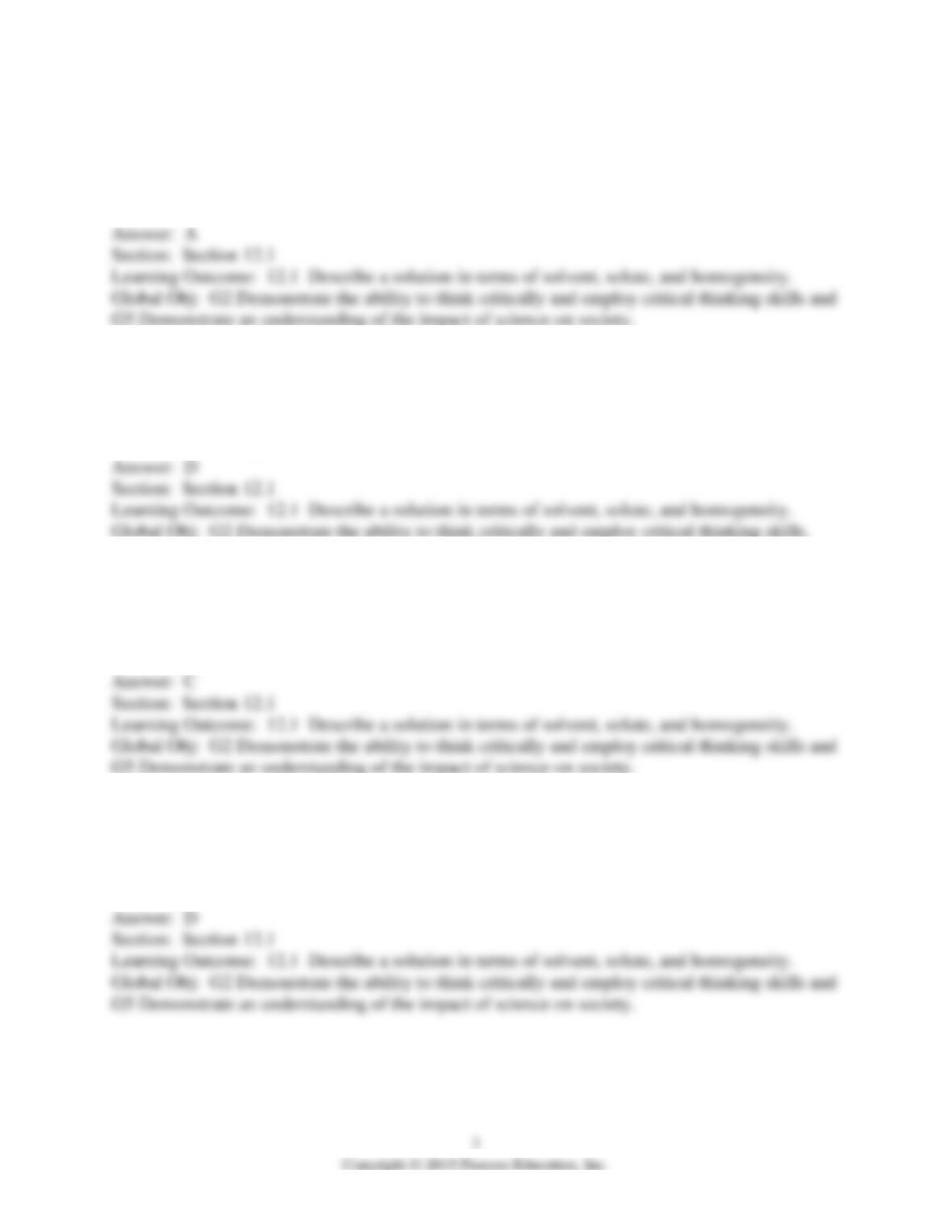
2) In a solution made by dissolving 50 grams of calcium chloride ( ) in 1000 grams of
water, which component is considered to be the solute?
A) Water is the solute.
B) Both water and calcium chloride are solutes in this example.
C) Calcium chloride is the solute.
D) The solute cannot be determined from the information given.
3) In a solution made by dissolving 200 grams of sugar in 1000 grams of water, which
component is considered to be the solvent?
A) Water is the solvent.
B) Both water and sugar are solvents in this example.
C) Sugar is the solvent.
D) The solvent cannot be determined from the information given.
4) In a dilute saline solution the solute is in the form of ________.
A) Na+ and Cl–
B) NaCl (s)
C) NaCl (ℓ)
D) both A and B
5) Which of the following solutions are possible?
A) Both the solvent and solute are liquids.
B) Both the solvent and solute are solids.
C) The solvent is a liquid and the solute is a gas.
D) All of them are possible.
6) Sterling silver is a solution (ALLOY) of ________.
A) silver and zinc
B) silver and gold
C) silver and copper
D) silver and iron
7) Which of the following is a solution?
A) air
B) amalgam
C) metal alloys
D) All of the above are solutions.
8) Which of the following is not a solution?
A) ice in water
B) vinegar in water
C) sugar in water
D) metal alloys
9) The solute in a saline solution is ________.
A) water
B) salt
C) the salt solution
D) One cannot say unless the exact concentration is known.
10) Which of the following statements is correct?
A) Energy is needed to overcome the solute-solute attractive forces.
B) Energy is needed to overcome the solvent-solvent attractive forces.
C) Solvation releases energy.
D) All the above statements are correct.
11) Which of the following has the highest hydration energy?
A) sodium chloride
B) magnesium chloride
C) aluminum chloride
D) silicon tetrachloride
12) Which of the following has the lowest hydration energy?
A) sodium chloride
B) magnesium chloride
C) aluminum chloride
D) silicon tetrachloride
13) The statement “like dissolves like” justifies why ________.
A) water will dissolve ethyl alcohol
B) octane will dissolve methane
C) water will not dissolve fats
D) All of the above statements are correct.
14) Which of the following examples demonstrates a net decrease in entropy?
A) melting an ice cube
B) adding cream to hot coffee
C) ripping a finished jigsaw puzzle into a thousand pieces
D) assembling a 1000-piece jigsaw puzzle
E) All of the preceding are examples of net increases in entropy.
15) If a solute is to be soluble in a given solvent, which step in the solution-making process must
have a negative value for its energy?
A) the physical separation of solvent particles
B) the physical separation of solute particles
C) the formation of solvent/solute interactions
D) All three of the preceding steps must be negative for a solute to be soluble.
16) How are solubility and temperature generally related in a system consisting of a solid solute
and a liquid solvent?
A) Solubility generally increases with increasing temperature.
B) Solubility generally increases with decreasing temperature.
C) Changing the temperature has no effect on solubility.
D) Solubility generally decreases with increasing temperature.
17) How are the solubilities of gases (solutes) in liquids (solvents) affected by changing
pressure?
A) Gases are more soluble in liquids when the pressure is decreased.
B) Pressure has no effect on how soluble a gas is in a liquid.
C) Gases are less soluble in liquids when the pressure is increased.
D) Gases are more soluble in liquids when the pressure is increased.
18) Under what conditions would a gas be most soluble in a liquid?
A) high temperature and high pressure
B) high temperature and low pressure
C) low temperature and high pressure
D) low temperature and low pressure
19) Which of the following statements is correct?
A) Temperature usually increases the solubility of a solid in water.
B) Pressure usually increases the solubility of a gas in water.
C) Solubility involves the statement “like dissolves like.”
D) All of the above statements are correct.
20) Which of the following is the least water soluble at 50°C?
A) Ce2(SO4)3
B) KBr
C) NaNO3
D) CH3COONa
21) Which of the following is the most water soluble at 50°C?
A) CH3COONa
B) NaNO3
C) Ce2(SO4)3
D) KBr
22) Which end, the polar end or the nonpolar end, of a detergent molecule is attracted to dirt
particles?
A) the polar end
B) both the polar and the nonpolar end
C) neither the polar nor the nonpolar end
D) the nonpolar end
23) Which end, the polar end or the nonpolar end, of a detergent molecule is attracted to water?
A) the polar end
B) both the polar and the nonpolar end
C) neither the polar nor the nonpolar end
D) the nonpolar end
24) Soap consists of a long ________ head and a long ________ tail.
A) polar; polar
B) polar; nonpolar
C) nonpolar; polar
D) nonpolar; nonpolar
25) The spherical structure of a soap molecule that is formed when soap molecules are in contact
with water is called ________.
A) detergent
B) hydrophobic end
C) hydrophilic end
D) micelle
26) What is the molarity of 3.68 mL of a solution containing 0.0025 moles of calcium chloride?
A) 6.8 × M
B) 0.68 M
C) 1.5 M
D) 6.8 × M
27) The molarity of a solution that contains 5.85 g of NaCl in 2.0 L of solution is ________.
A) 2.93 M
B) 0.050 M
C) 5.0 M
D) 0.29 M
28) To prepare 100 mL of 0.4 M HCl solution from a stock solution of 2 M HCl solution one
needs to ________.
A) dilute 20 mL of 2 M HCl solution with 100 mL of HCl solution.
B) dilute 20 mL of 2 M HCl solution with enough water to make a total volume of 100 mL of
solution.
C) use 500 mL of 2 M HCl solution and boil it down to a final volume of 100 mL of solution.
D) dilute 80 mL of 2 M HCl solution to a total volume of 100 mL of solution.
29) To prepare 500. mL of 0.5 M NaCl from a stock of 2.0 M NaCl one needs to ________.
A) dilute 125 mL 2.0 M NaCl with enough water to a total of 500. mL solution
B) dilute 125 mL 2.0 M NaCl with 500. mL water
C) dilute 375 mL 2.0 M NaCl with enough water to a total of 500. mL solution
D) dilute 375 mL 2.0 M NaCl with 500. mL water
30) 25 mL of a 0.1 M NaCl solution contains ________ g of NaCl.
A) 0.0025
B) 0.15
C) 2.5
D) 0.25
31) 7.5 g of calcium carbonate in 150 mL of aqueous solution will provide a ________ M
solution.
A) 0.10
B) 0.50
C) 1.0
D) 2.0
32) 200. mL of a 0.100 M NaCl solution contains ________ g of NaCl.
A) 1.17
B) 11.7
C) 117
D) 5.85
33) 500 mL of a 0.4 M sodium nitrate contains ________ moles of sodium ions and ________
moles of nitrate ions.
A) 0.4; 0.2
B) 0.2; 0.4
C) 0.4; 0.6
D) 0.2; 0.2
34) 500 mL of a 0.4 M calcium nitrite contains ________ moles of calcium ions and ________
moles of nitrite ions.
A) 0.4; 0.2
B) 0.2; 0.4
C) 0.4; 0.6
D) 0.2; 0.2
35) 500 mL of a 0.4 M potassium dichromate contains ________ moles of potassium ions and
________ moles of dichromate ions.
A) 0.4; 0.2
B) 0.2; 0.4
C) 0.4; 0.6
D) 0.2; 0.2
36) 500 mL 0.4 M aluminum nitrate solution contains ________ moles of aluminum ions and
________ moles of nitrate ions.
A) 0.6; 0.2
B) 0.2; 0.4
C) 0.2; 0.6
D) 0.2; 0.2
37) 10.0 mL of 0.50 M HCl solution neutralizes ________ mL of 0.50 M NaOH solution.
A) 5.0
B) 10.
C) 20.
D) 40.
38) 10.0 mL of 0.50 M sulfuric acid neutralizes ________ mL of 0.50 M ammonium hydroxide
solution.
A) 5.0
B) 10.
C) 20.
D) 40.
39) 10.0 mL of 0.50 M sulfuric acid neutralizes ________ mL of 0.50 M magnesium hydroxide
solution.
A) 5.0
B) 10.
C) 20.
D) 40.
40) 10.0 mL of 0.50 M hydrochloric acid neutralizes ________ mL of 0.50 M magnesium
hydroxide solution.
A) 5.0
B) 10.
C) 20.
D) 40.
41) The percent composition of a solution made by dissolving 5.0 g NaOH in 20. g of water is
________.
A) 4.0%
B) 5.0%
C) 20.%
D) 25%
42) How many grams of NaCl are in 200 g of a 10 percent-by-mass salt solution?
A) 10 g
B) 20 g
C) 40 g
D) 80 g
43) How many grams of water are in 100 g of a 30 percent-by-mass sugar solution?
A) 30 g
B) 60 g
C) 70 g
D) 100 g
44) Phenolphthalein turns ________ when the solution is basic.
A) clear
B) blue
C) pink
D) orange
45) Henry’s law gives the relationship between ________.
A) colligative properties and the freezing point
B) solubility of a gas and concentration
C) solubility of a gas and pressure
D) hydrophobic and hydrophilic solutions
46) An impurity ________ the melting point of a compound.
A) decreases
B) increases
C) has no effect on
D) One cannot say unless the physical properties of the compound are known.
47) An impurity ________ the boiling point of a compound.
A) decreases
B) increases
C) has no effect on
D) One cannot say unless the physical properties of the compound are known.
48) Which of the following is not a colligative property?
A) molarity
B) freezing point depression
C) vapor pressure lowering
D) boiling point elevation
49) What is the freezing point depression of a sugar solution prepared by dissolving 375.00 g of
sucrose (342.3 g/mol) in 1500.0 g of water (Kf of water = 1.86 °C∙ kg solvent/mol solute)?
A) 1.36 °C
B) -1.36 °C
C) -1.86 °C
D) -0.465 °C
50) A 0.2119 g sample of an acid, HA, was neutralized by 34.7 mL of 0.0500 M NaOH solution.
The molecular mass of the acid is ________.
A) 61
B) 92
C) 122
D) 244
51) 4.173 g of an organic compound (non-electrolyte) lowered the freezing point of 100.0 g of
nitrobenzene by 2.6 °C. If the Kf of nitrobenzene is 8.1 °C∙ kg solvent/mol solute, the molecular
mass of the non-electrolyte is ________.
A) 260
B) 195
C) 65
D) 130
52) If the empirical formula is C4H3N and the molecular weight is 130 g/mole, then the
molecular formula is ________.
A) C16H12N4
B) C12H9N3
C) C4H3N
D) C8H6N2
53) A 2.154 g sample of an unknown non-electrolyte is dissolved in 50. g of water (Kf of water =
1.86 °C∙ kg solvent/mol solute). If the solution freezes at -1.23 °C, the molecular mass of the
non-electrolyte is ________.
A) 33
B) 65
C) 130
D) 260
54) A 2.00 g sample of a non-electrolyte (molar mass = 118) is dissolved in 55.0 g of benzene
(Kf of benzene is What is the freezing point depression of the
solution?
A) 1.58 °C
B) 3.16 °C
C) 0.79 °C
D) 2.33 °C
1) Transparent solutions are examples of homogeneous matter.
2) The solvent in a saline solution is water.
3) A solid solution is a solution of two metals that are not necessarily evenly distributed in each
other.
4) The solute in a sugar solution is water.
5) Vinegar is a liquid solution where acetic acid serves as the solvent.
6) Alloys are solid solutions.
7) Air is a gas solution where oxygen is the solvent.
8) A mixture is not necessarily a solution.
9) If a liquid is volatile it evaporates readily.
10) A mixture of sand, sodium carbonate, and calcium oxide is a homogeneous solution.