26) Carbon monoxide is the only compound that forms between carbon and oxygen.
27) Sulfur tetrafluoride is the only compound that forms between sulfur and fluorine.
28) Silicon dioxide is the compound that forms between silicon and oxygen.
29) Silicon in silicon dioxide has four bonds and zero non-bonded pair of electrons.
30) Carbon dioxide obeys the octet rule.
31) There are no lone pairs in ethane.
32) The sulfur atom in sulfur dioxide has two unpaired electrons.
33) Carbon dioxide has two non-bonded pairs of electrons.
34) Multiple covalent bonds arise when two atoms will share more than one pair of electrons
with each other.
35) The nitrogen molecule has 10 total valence electrons.
36) The electrons in a carbon-chlorine covalent bond are “shared” exactly equally between these
two atoms.
37) If the electronegativity difference between the two atoms that make up a bond is 0.0, then the
compound is covalent.
38) If the electronegativity difference between the two atoms that make up a bond is 2.1, then the
bond is considered polar covalent.
39) Fluorine is the most electronegative element in the periodic table.
40) A chemical compound formed from lithium and chlorine should be ionic in character.
41) The least electronegative element is oxygen.
42) Sodium is the least electronegative in the group H, S, Cl, and Na.
43) Sulfur is the most electronegative in the group H, S, Cl, and Na.
44) Compounds formed from carbon and hydrogen should be ionic in character.
45) Metals are generally more electronegative than non-metals.
46) Magnesium in magnesium chloride has two bonds and two non-bonded pair of electrons.
47) Sodium chloride has bonded pairs of electrons.
44
48) The nitrite, sulfite and bicarbonate anions have the same number of hydrogen atoms.
49) The ion P3- is named phosphate.
50) The compound P2O5 is named diphosphorus pentaoxide.
51) The chemical compound, Na2S, has the is named sodium sulfate.
52) Metals are always going to be the more electropositive elements in a bond as long as they are
attached to a non-metal.
53) Germanium has four valence electrons.
54) Carbon may have a +4 or -4 charge.
55) Hydrogen cyanide may also be called hydrocyanic acid when in aqueous solution.
56) The correct name for ammonia is nitrogen hydride.
57) Another name for the hydrogen sulfate anion is bisulfate.
58) Twice as many hydrogen atoms than oxygen atoms are present in the acetate anion.
59) Twice as many oxygen atoms than hydrogen atoms are present in the dihydrogen phosphate
anion.
60) The perchlorate, phosphate and sulfate anions have the same number of hydrogen atoms.
61) The bicarbonate, bisulfate and dihydrogen phosphate anions have the same number of
hydrogen atoms.
62) In naming binary compounds, the negatively charged ion has the -ide suffix.
63) The hypochlorite, permanganate, and cyanide ions are called oxyanions.
64) The chlorate, bisulfate, and chromate anions are called oxyanions.
65) The number of valence electrons in the ammonium ion is 10.
66) The compound P2O3 is named diphosphorus pentoxide.
67) The compound Ca3(PO4)3 is named dicalcium triphosphate.
68) The compound CS2 is named carbon disulfide.
69) Fe(OH)2 is named ferrous hydroxide.
70) Ca3P2 is named calcium phosphate.
71) The bonds that are associated with covalent bonds are among the strongest a chemist may
encounter.
72) When vaporized into steam water molecules decompose into hydrogen and oxygen
molecules.
73) The ferrous ion is referred to as iron (III).
74) Ions that may be named with -ous and -ic suffixes have only two stable ions.
75) The negatively charged species is written first when writing a formula.
76) Ammonium chloride may be considered as an exception of an ionic compound although it
does not include any metals in its formula.
5.3 Short Answer Questions
Draw the dot structures for the atomic or molecular species shown. Be sure to include all
relevant resonance structures.
1) NO3–
2) CN–
3) BF3
4) H2Se
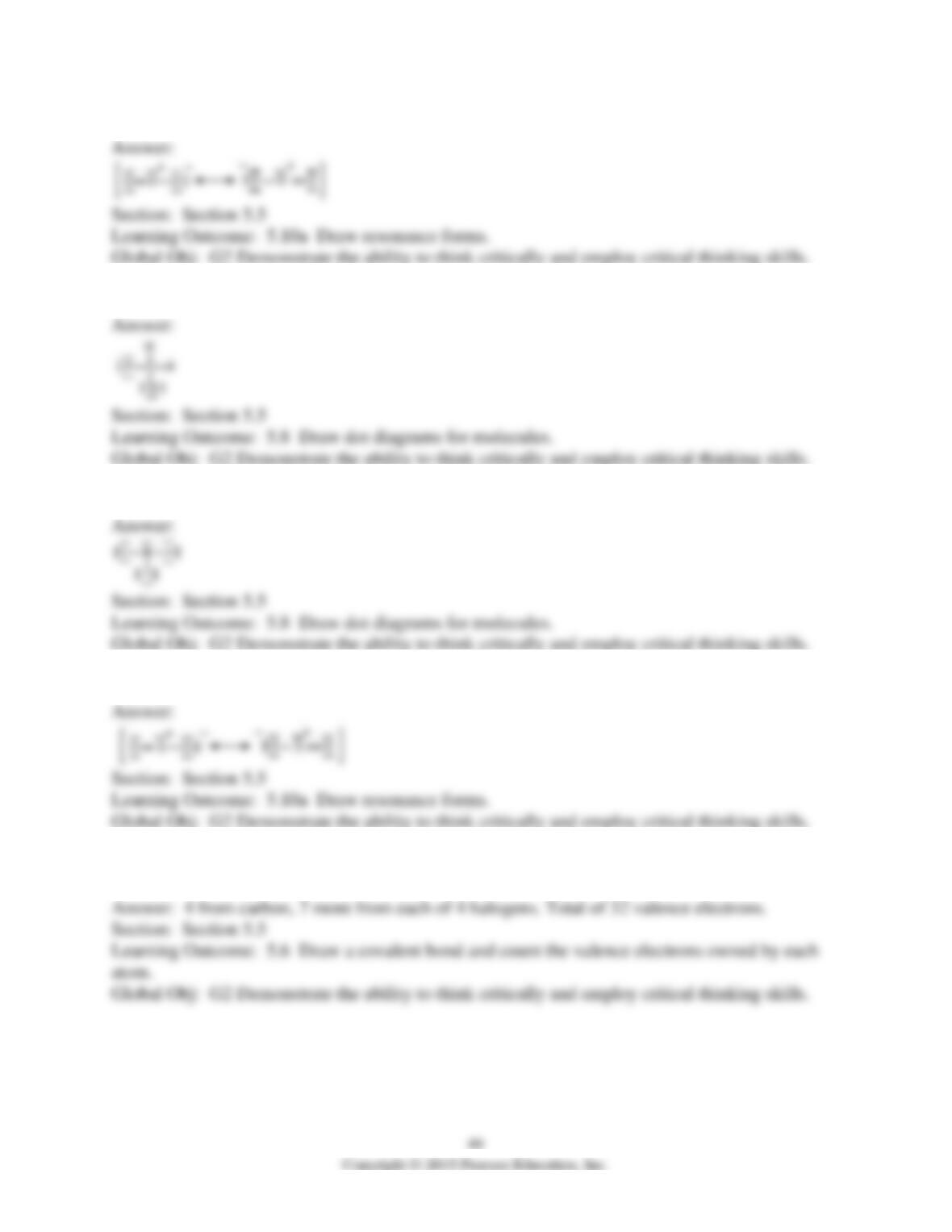
5) O3 (ozone)
6) CH2ClF
7) NI 3
8) SO2
9) How many valence electrons are required from each element when constructing a complete
Lewis dot structure of the compound CF2C12?
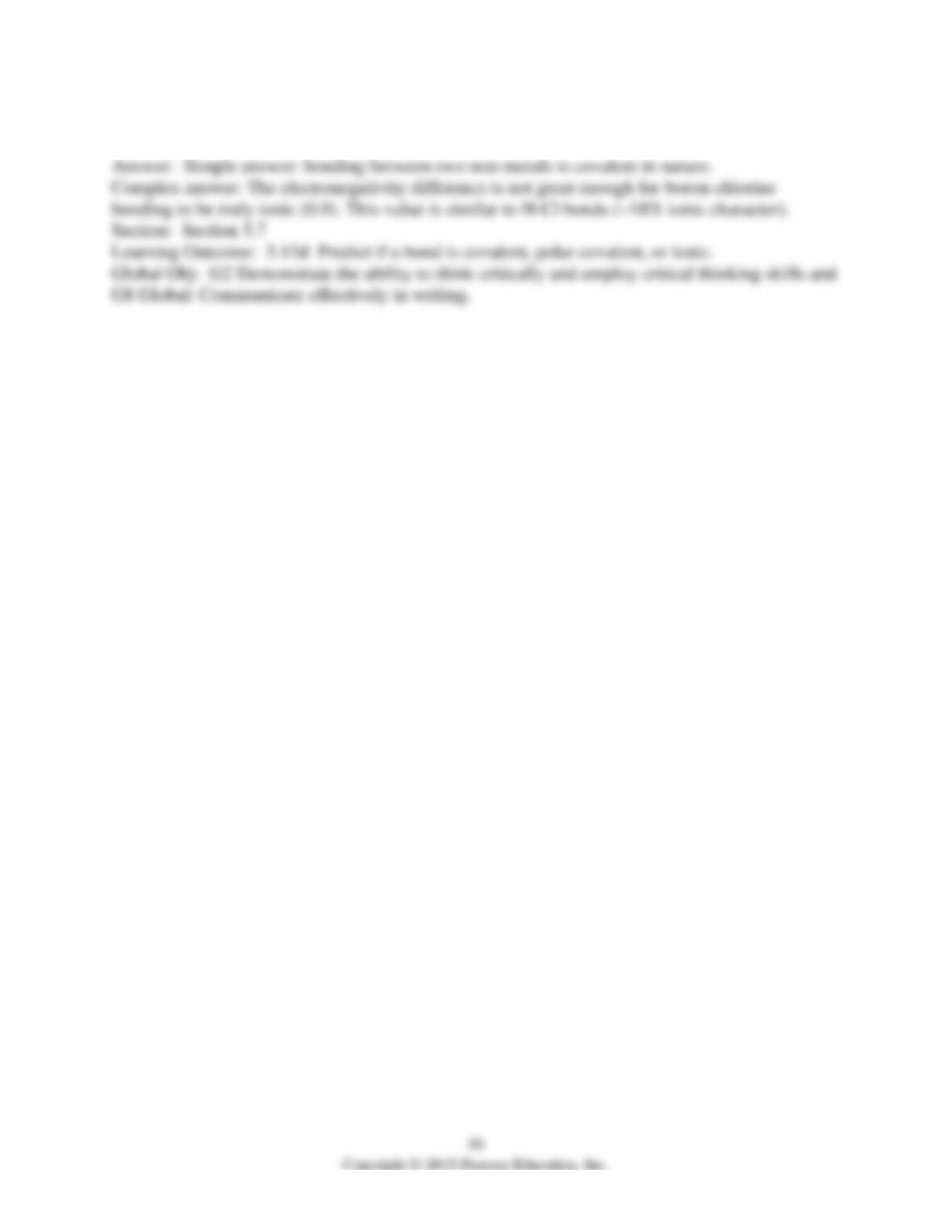
10) Would you expect a chemical bond formed between the elements boron and chlorine to be
ionic or covalent in character?

51
5.4 Matching Questions
Match the description from the column on the left to the molecular species that appear on the
right column.
A) Ca2+
B) CO2
C) LiCl
D) CO
E) N2
F) Cr2O72-
G) CH4
1) An ionic compound.
Section: Section 5.6
Learning Outcome: 5.13d Predict if a bond is covalent, polar covalent, or ionic.
Global Obj: G2 Demonstrate the ability to think critically and employ critical thinking skills.
2) A molecule with a triple bond.
Section: Section 5.5
Learning Outcome: 5.8 Draw dot diagrams for molecules.
Global Obj: G2 Demonstrate the ability to think critically and employ critical thinking skills.
3) A cation.
Section: Section 5.6
Learning Outcome: 5.7 Draw dot diagrams for atoms.
Global Obj: G2 Demonstrate the ability to think critically and employ critical thinking skills.
4) A covalent, non-polar molecule.
Section: Section 5.5
Learning Outcome: 5.13d Predict if a bond is covalent, polar covalent, or ionic.
Global Obj: G2 Demonstrate the ability to think critically and employ critical thinking skills.
5) An anion.
Section: Section 5.6
Learning Outcome: 5.17h Name and give formulas for compounds possessing polyatomic ions.
Global Obj: G2 Demonstrate the ability to think critically and employ critical thinking skills.
6) A compound with one double bond.
Section: Section 5.5
Learning Outcome: 5.8 Draw dot diagrams for molecules.
Global Obj: G2 Demonstrate the ability to think critically and employ critical thinking skills.

7) A compound with two double bonds.
Section: Section 5.5
Learning Outcome: 5.8 Draw dot diagrams for molecules.
Global Obj: G2 Demonstrate the ability to think critically and employ critical thinking skills.

Match the names in the second column with each of the ions that appear in the first column.
A) carbonate
B) nitrite
C) bicarbonate
D) nitride
E) cyanide
F) nitrate
G) ammonium
8) N3-
Section: Section 5.7
Learning Outcome: 5.14e Name and give formulas for binary ionic compounds.
Global Obj: G2 Demonstrate the ability to think critically and employ critical thinking skills.
9) NH4+
Section: Section 5.7
Learning Outcome: 5.17h Name and give formulas for compounds possessing polyatomic ions.
Global Obj: G2 Demonstrate the ability to think critically and employ critical thinking skills.
10) NO2–
Section: Section 5.7
Learning Outcome: 5.17h Name and give formulas for compounds possessing polyatomic ions.
Global Obj: G2 Demonstrate the ability to think critically and employ critical thinking skills.
11) NO3–
Section: Section 5.7
Learning Outcome: 5.17h Name and give formulas for compounds possessing polyatomic ions.
Global Obj: G2 Demonstrate the ability to think critically and employ critical thinking skills.
12) CN–
Section: Section 5.7
Learning Outcome: 5.17h Name and give formulas for compounds possessing polyatomic ions.
Global Obj: G2 Demonstrate the ability to think critically and employ critical thinking skills.
13) CO32-
Section: Section 5.7
Learning Outcome: 5.17h Name and give formulas for compounds possessing polyatomic ions.
Global Obj: G2 Demonstrate the ability to think critically and employ critical thinking skills.
14) HCO3–
Section: Section 5.7
Learning Outcome: 5.17h Name and give formulas for compounds possessing polyatomic ions.
Global Obj: G2 Demonstrate the ability to think critically and employ critical thinking skills.

54
Match the names in the second column with each of the names hat appear in the first column.
A) sulfite
B) bisulfite
C) sulfide
D) bisulfate
E) hydrogen sulfide
F) thiocyanate
G) sulfate
15) S2-
Section: Section 5.7
Learning Outcome: 5.14e Name and give formulas for binary ionic compounds.
Global Obj: G2 Demonstrate the ability to think critically and employ critical thinking skills.
16) SO32-
Section: Section 5.7
Learning Outcome: 5.17h Name and give formulas for compounds possessing polyatomic ions.
Global Obj: G2 Demonstrate the ability to think critically and employ critical thinking skills.
17) SO42-
Section: Section 5.7
Learning Outcome: 5.17h Name and give formulas for compounds possessing polyatomic ions.
Global Obj: G2 Demonstrate the ability to think critically and employ critical thinking skills.
18) SCN–
Section: Section 5.7
Learning Outcome: 5.17h Name and give formulas for compounds possessing polyatomic ions.
Global Obj: G2 Demonstrate the ability to think critically and employ critical thinking skills.
19) H2S
Section: Section 5.7
Learning Outcome: 5.16g Name and give formulas for binary covalent compounds.
Global Obj: G2 Demonstrate the ability to think critically and employ critical thinking skills.
20) HSO3–
Section: Section 5.7
Learning Outcome: 5.17h Name and give formulas for compounds possessing polyatomic ions.
Global Obj: G2 Demonstrate the ability to think critically and employ critical thinking skills.
21) HSO4–
Section: Section 5.7
Learning Outcome: 5.17h Name and give formulas for compounds possessing polyatomic ions.
Global Obj: G2 Demonstrate the ability to think critically and employ critical thinking skills.
Match the names in the second column with each of the chlorine containing anions that appear
in the first column.
A) hypochlorite
B) perchlorate
C) chloride
D) chlorate
E) chlorite
22) Cl–
Section: Section 5.7
Learning Outcome: 5.14e Name and give formulas for binary ionic compounds.
Global Obj: G2 Demonstrate the ability to think critically and employ critical thinking skills.
23) ClO4–
Section: Section 5.7
Learning Outcome: 5.17h Name and give formulas for compounds possessing polyatomic ions.
Global Obj: G2 Demonstrate the ability to think critically and employ critical thinking skills.
24) ClO3–
Section: Section 5.7
Learning Outcome: 5.17h Name and give formulas for compounds possessing polyatomic ions.
Global Obj: G2 Demonstrate the ability to think critically and employ critical thinking skills.
25) ClO2–
Section: Section 5.7
Learning Outcome: 5.17h Name and give formulas for compounds possessing polyatomic ions.
Global Obj: G2 Demonstrate the ability to think critically and employ critical thinking skills.
26) ClO–
Section: Section 5.7
Learning Outcome: 5.17h Name and give formulas for compounds possessing polyatomic ions.
Global Obj: G2 Demonstrate the ability to think critically and employ critical thinking skills.

Match every phosphorus anion formula in the left column with the corresponding name in the
right column.
A) dihydrogen phosphate
B) phosphide
C) hydrogen phosphate
D) phosphate
27) H2PO4–
Section: Section 5.7
Learning Outcome: 5.17h Name and give formulas for compounds possessing polyatomic ions.
Global Obj: G2 Demonstrate the ability to think critically and employ critical thinking skills.
28) HPO42-
Section: Section 5.7
Learning Outcome: 5.17h Name and give formulas for compounds possessing polyatomic ions.
Global Obj: G2 Demonstrate the ability to think critically and employ critical thinking skills.
29) PO43-
Section: Section 5.7
Learning Outcome: 5.17h Name and give formulas for compounds possessing polyatomic ions.
Global Obj: G2 Demonstrate the ability to think critically and employ critical thinking skills.
30) P3-
Section: Section 5.7
Learning Outcome: 5.14e Name and give formulas for binary ionic compounds.
Global Obj: G2 Demonstrate the ability to think critically and employ critical thinking skills.

57
Identify the following as binary ionic or binary covalent compound.
A) binary covalent
B) binary ionic
31) CCl4
Section: Section 5.7
Learning Outcome: 5.13d Predict if a bond is covalent, polar covalent, or ionic.
Global Obj: G2 Demonstrate the ability to think critically and employ critical thinking skills.
32) CaI2
Section: Section 5.7
Learning Outcome: 5.13d Predict if a bond is covalent, polar covalent, or ionic.
Global Obj: G2 Demonstrate the ability to think critically and employ critical thinking skills.
33) MgO
Section: Section 5.7
Learning Outcome: 5.13d Predict if a bond is covalent, polar covalent, or ionic.
Global Obj: G2 Demonstrate the ability to think critically and employ critical thinking skills.
34) CO2
Section: Section 5.7
Learning Outcome: 5.13d Predict if a bond is covalent, polar covalent, or ionic.
Global Obj: G2 Demonstrate the ability to think critically and employ critical thinking skills.
35) NaCl
Section: Section 5.7
Learning Outcome: 5.13d Predict if a bond is covalent, polar covalent, or ionic.
Global Obj: G2 Demonstrate the ability to think critically and employ critical thinking skills.
36) PI3
Section: Section 5.7
Learning Outcome: 5.13d Predict if a bond is covalent, polar covalent, or ionic.
Global Obj: G2 Demonstrate the ability to think critically and employ critical thinking skills.
37) Cal2
Section: Section 5.7
Learning Outcome: 5.13d Predict if a bond is covalent, polar covalent, or ionic.
Global Obj: G2 Demonstrate the ability to think critically and employ critical thinking skills.
38) SF4
Section: Section 5.7
Learning Outcome: 5.13d Predict if a bond is covalent, polar covalent, or ionic.
Global Obj: G2 Demonstrate the ability to think critically and employ critical thinking skills.

58
39) LiN3
Section: Section 5.7
Learning Outcome: 5.13d Predict if a bond is covalent, polar covalent, or ionic.
Global Obj: G2 Demonstrate the ability to think critically and employ critical thinking skills.
40) BaO
Section: Section 5.7
Learning Outcome: 5.13d Predict if a bond is covalent, polar covalent, or ionic.
Global Obj: G2 Demonstrate the ability to think critically and employ critical thinking skills.
41) BF3
Section: Section 5.7
Learning Outcome: 5.13d Predict if a bond is covalent, polar covalent, or ionic.
Global Obj: G2 Demonstrate the ability to think critically and employ critical thinking skills.
42) H2O2
Section: Section 5.7
Learning Outcome: 5.13d Predict if a bond is covalent, polar covalent, or ionic.
Global Obj: G2 Demonstrate the ability to think critically and employ critical thinking skills.
43) SrCl2
Section: Section 5.7
Learning Outcome: 5.13d Predict if a bond is covalent, polar covalent, or ionic.
Global Obj: G2 Demonstrate the ability to think critically and employ critical thinking skills.
44) Rb3N
Section: Section 5.7
Learning Outcome: 5.13d Predict if a bond is covalent, polar covalent, or ionic.
Global Obj: G2 Demonstrate the ability to think critically and employ critical thinking skills.
45) Ba2N3
Section: Section 5.7
Learning Outcome: 5.13d Predict if a bond is covalent, polar covalent, or ionic.
Global Obj: G2 Demonstrate the ability to think critically and employ critical thinking skills.
46) RaF2
Section: Section 5.7
Learning Outcome: 5.13d Predict if a bond is covalent, polar covalent, or ionic.
Global Obj: G2 Demonstrate the ability to think critically and employ critical thinking skills.

59
Match each element that appears on the left column with the number of valence electrons that
appears on the right column.
A) 6
B) 3
C) 8
D) 1
E) 4
F) 7
G) 2
H) 5
47) oxygen
Section: Section 5.4
Learning Outcome: 5.7 Draw dot diagrams for atoms.
Global Obj: G2 Demonstrate the ability to think critically and employ critical thinking skills.
48) nitrogen
Section: Section 5.4
Learning Outcome: 5.7 Draw dot diagrams for atoms.
Global Obj: G2 Demonstrate the ability to think critically and employ critical thinking skills.
49) carbon
Section: Section 5.4
Learning Outcome: 5.7 Draw dot diagrams for atoms.
Global Obj: G2 Demonstrate the ability to think critically and employ critical thinking skills.
50) sulfur
Section: Section 5.4
Learning Outcome: 5.7 Draw dot diagrams for atoms.
Global Obj: G2 Demonstrate the ability to think critically and employ critical thinking skills.
51) phosphorus
Section: Section 5.4
Learning Outcome: 5.7 Draw dot diagrams for atoms.
Global Obj: G2 Demonstrate the ability to think critically and employ critical thinking skills.
52) hydrogen
Section: Section 5.4
Learning Outcome: 5.7 Draw dot diagrams for atoms.
Global Obj: G2 Demonstrate the ability to think critically and employ critical thinking skills.
53) calcium
Section: Section 5.4
Learning Outcome: 5.7 Draw dot diagrams for atoms.
Global Obj: G2 Demonstrate the ability to think critically and employ critical thinking skills.