Introductory Chemistry: Atoms First, 5e (Russo/Silver)
Chapter 6 The Shape of Molecules
6.1 Multiple-Choice Questions
1) In a molecule having four pairs of electrons around the central atom and a pyramidal shape,
how many bonding pairs of electrons does the central atom have?
A) 2
B) 1
C) 4
D) 3
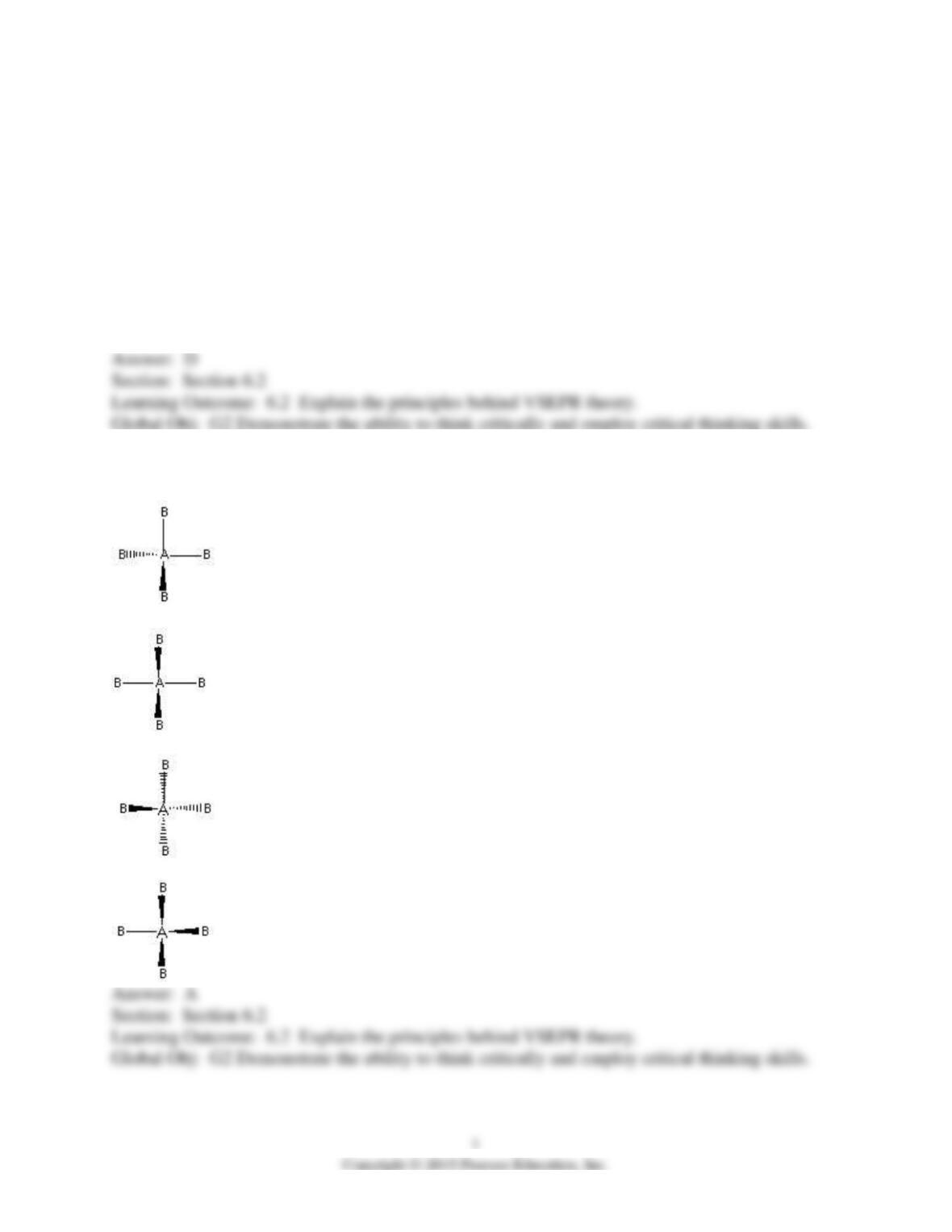
2) Which of the following pictures best illustrates a tetrahedral shape for the molecule AB4?
A)
B)
C)
D)
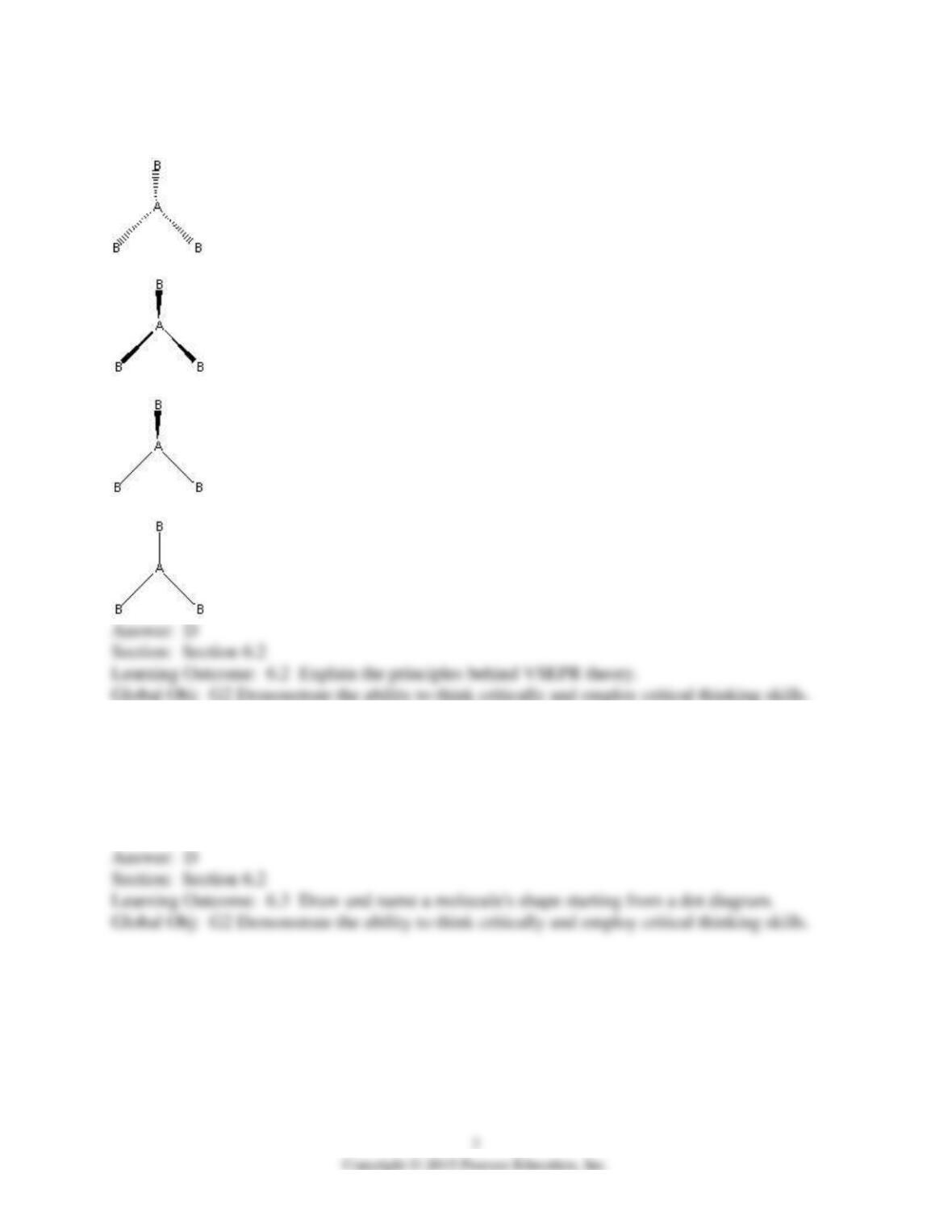
3) Which of the following pictures best illustrates a trigonal planar shape for the molecule AB3?
A)
B)
C)
D)
4) Which compound listed below would you expect to have the greatest H-C-H bond angle?
A) CH2ClF
B) CH2 CI2
C) CH4
D) CH2O
5) Which compound listed below has a bond angle of 180° around the central atom?
A) H2O
B) CO2
C) CC14
D) NH3
6) In a molecule having four pairs of electrons around the central atom and a pyramidal shape,
how many lone pairs of electrons does the central atom have?
A) 2
B) 1
C) 4
D) 3
7) In a molecule having four pairs of electrons around the center atom and a bent shape, how
many bonding pairs does the central atom have?
A) 2
B) 1
C) 4
D) 3
8) In a molecule having three pairs of electrons around a central atom and a trigonal planar
shape, how many lone pairs of electrons does the central atom have?
A) 1
B) 0
C) 2
D) 3
9) When drawing the three-dimensional structure diagram of a molecule the bold line ________.
A) shows a bond that projects out from the page.
B) shows a bond that goes back behind the page.
C) indicates that the bond is in the plane of the page.
D) One cannot say unless the formula of the molecule is known.
10) When drawing the three-dimensional structure diagram of a molecule the dotted line
________.
A) shows a bond that projects out from the page.
B) shows a bond the goes back behind the page.
C) indicates that the bond is in the plane of the page.
D) One cannot say unless the formula of the molecule is known.
11) When drawing the three-dimensional structure diagram of a molecule the solid (not bold or
dotted) line ________.
A) shows a bond that projects out from the page.
B) shows a bond that goes back behind the page.
C) indicates that the bond is in the plane of the page.
D) One cannot say unless the formula of the molecule is known.
12) Which of the following statements is correct about the pyramidal structure?
A) The pyramidal structure is very similar to the tetrahedral structure except one electron pair in
the pyramidal structure replaces a bond in the tetrahedral one.
B) The pyramidal structure is the shape of the ammonia molecule.
C) The bond angles around the central atom very close to the 107°.
D) All above statements are correct.
13) Which of the following statements is correct about the bent structure?
A) The bent structure has three bonding electrons pairs with at least one lone pair around the
central atom.
B) The bent structure is the shape of the ammonia molecule.
C) The bent structure has bond angles around the central atom very close to the 105°.
D) All above statements are correct.
14) Which of the following molecules is not linear?
A) hydrogen cyanide
B) beryllium chloride
C) boron trifluoride
D) acetylene, C2H2
15) Which of the following molecules is linear?
A) hydrogen chloride
B) ethane, C2H6
C) ethene, C2H4
D) ammonia
16) Which of the following molecules is not tetrahedral?
A) carbon tetrachloride
B) chloroform, CHCl3
C) methane, CH4
D) boron trifluoride
17) Which of the following molecules is tetrahedral?
A) sulfur trioxide
B) sulfur dioxide
C) sulfur dichloride
D) ammonium ion
18) Which of the following molecules is bent?
A) water
B) sulfur dioxide
C) carbon dioxide
D) both A and B
19) Which of the following molecules is bent and has a bond angle close to 118° around the
central atom?
A) sulfur dioxide
B) boron trifluoride
C) ammonia
D) both A and C
20) Which of the following molecules is pyramidal and has a bond angle close to 107° around
the central atom?
A) sulfur dioxide
B) boron trifluoride
C) ammonia
D) both A and C
21) The angle around nitrogen in the ammonium ion is ________.
A) 60°
B) 90°
C) 109.5°
D) 120°
22) The angle around boron in boron trifluoride is ________.
A) 60°
B) 90°
C) 109.5°
D) 120°
23) The angle around carbon in hydrogen cyanide is ________.
A) 105°
B) 109.5°
C) 120°
D) 180°
24) What is the molecular shape of H2S?
A) tetrahedral
B) pyramidal
C) linear
D) bent
25) What is the molecular shape of CC14?
A) tetrahedral
B) pyramidal
C) linear
D) bent
26) What is the molecular shape of NO2–
A) tetrahedral
B) pyramidal
C) linear
D) bent
27) What is the molecular shape of CH2O?
A) tetrahedral
B) bent
C) trigonal planar
D) pyramidal
28) What is the steric number of the central atom in CH4?
A) 1
B) 2
C) 3
D) 4
29) What is the steric number of the central atom in carbon disulfide?
A) 1
B) 2
C) 3
D) 4
30) What is the steric number of the central atom in boron trichloride?
A) 1
B) 2
C) 3
D) 4
31) Which of the following compounds would be soluble in a nonpolar solvent?
A) H2S
B) NH3
C) CC14
D) SO2
32) Which of the following compounds would you expect to be the most polar molecule?
A) H2S
B) H2Se
C) H2Te
D) H2O
33) Which of the following compounds contains bonds that are the most polar (greatest
electronegativity difference between hydrogen and the central atom)?
A) H2O
B) H2S
C) H2Se
D) H2Te
34) Which of the following compounds is non-polar?
A) acetylene, C2H2
B) ethene, C2H4
C) methane
D) All of the above are non-polar.
35) Which of the following nitrogen-containing compounds is least polar?
A) NH3
B) CH3 – N = N – CH3
C) (CH3 CH2)3N
D) (CH3)3N
36) Which of the following sulfur-containing compounds or ions is not polar?
A) SO3
B) H2S
C) HS–
D) SOCl2
37) Which of the following chlorine-containing compounds is not polar?
A) CHCl3
B) CH2Cl2
C) HCl
D) CCl4
38) Which of the following compounds is polar?
A) SO3
B) CO2
C) CS2
D) H2CO
39) Which of the following compounds is non-polar?
A) SO2
B) CH2O
C) CS2
D) SOCl2
40) Which of the following compounds is pure covalent?
A) H2CO
B) Cl2SO
C) O2
D) CO
41) Which of the following compounds is polar?
A) N2
B) O2
C) SOCl2
D) CO2
42) Which of the following compounds will be affected by the presence of an electric field?
A) H2
B) O2
C) HCl
D) N2
43) In which of the three phases of matter would you expect hydrogen bonding between water
molecules to be the strongest?
A) solid phase (H2O Os very close together)
B) liquid phase (H2O Os more separated than solid phase)
C) gas phase (H2O Os much farther apart than liquid phase)
D) It is equally strong in all three phases.
44) Dipole dipole forces are an important factor to consider in determining whether or not a
substance will dissolve in water (a molecule which has a dipole). Which of the following
compounds would you expect to be the most soluble in water?
A) CCl4
B) NH3
C) N2
D) CO2
45) Dipole dipole forces are an important factor to consider in determining whether or not a
substance will dissolve in water (a molecule which has a dipole). Which of the following
compounds would you expect to be the least soluble in water?
A) BF3
B) NH3
C) HF
D) H2S
46) Which of the following compounds will be the least soluble in water?
A) CH3OH
B) CH4
C) NH3
D) CH3CH2OH
6.2 True/False Questions
1) When drawing the three-dimensional structure diagram of a molecule the bold line goes back
behind the page.
2) The ball-and-stick model emphasizes the bonding pattern.
3) In the VSEPR model the multiple bond is treated as a single electron group, just the way a
single bond is treated.
4) The angle around the central atom in the pyramidal structure is very close to that of the
tetrahedral one.
5) Any molecule of the form AX3 is tetrahedral.
6) SO2, HCN and CO2 are linear.
7) NH3, CH3–, and PCl3 are pyramidal.
8) When determining the shape of a molecule, count all electron groups around the central atom.
9) When naming the shape of a molecule count only the lone pairs.
10) The pyramidal structure is the tetrahedral arrangement minus a bond but with a lone pair.
11) Sulfur dioxide is linear.
12) The bond angle in carbon tetrachloride is 109.5°.
13) The bond angle in ammonia is 109.5°.
14) Bonds are regions of negative charge and therefore repel each other.
15) Carbon tetrachloride is polar.
16) SO3, CO2, and CS2 are all non-polar.
17) Carbon dioxide contains polar bonds and is a nonpolar molecule.
18) Carbon tetrachloride contains polar bonds and is a polar molecule.
19) Compounds with polar bonds may be nonpolar.
20) A polar covalent compound is unaffected by the presence of an electric field.
21) The difference in electronegativity between H and in HF is higher than that between H and
Cl in HCl.
6.3 Short Answer Questions
Use VSEPR theory to predict the shape of the molecule or complex ion shown. Draw a Lewis dot
structure to assist you in determining these shapes.
1) CO32-
2) PH3