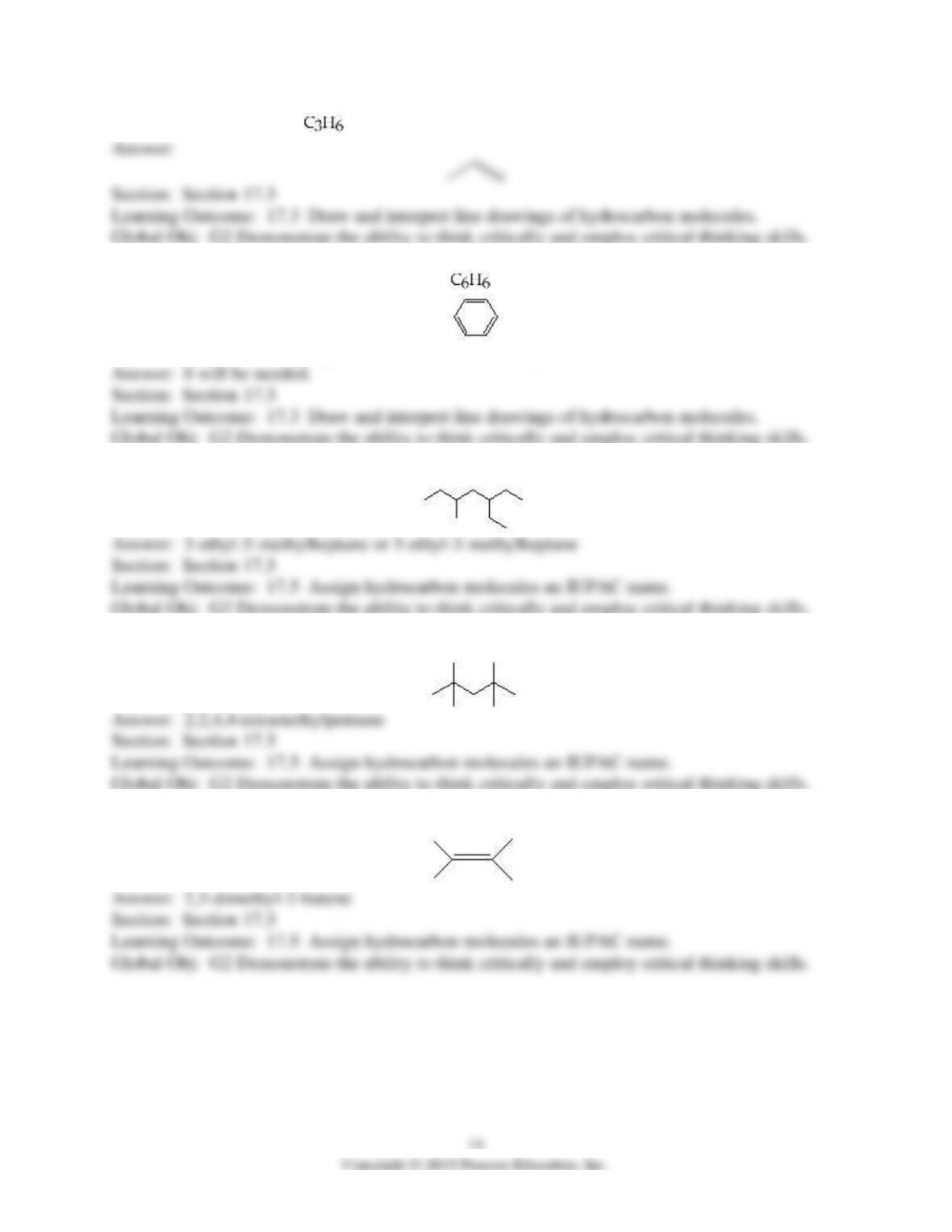
5) Give a line drawing of .
6) The hydrocarbon benzene has the formula , and a line drawing that looks like this:
How many additional hydrogen atoms are needed to fully saturate this structure?
7) Given this hydrocarbon line drawing, state its IUPAC name:
8) Given this hydrocarbon line drawing, state its IUPAC name:
9) Given this hydrocarbon line drawing, state its IUPAC name:
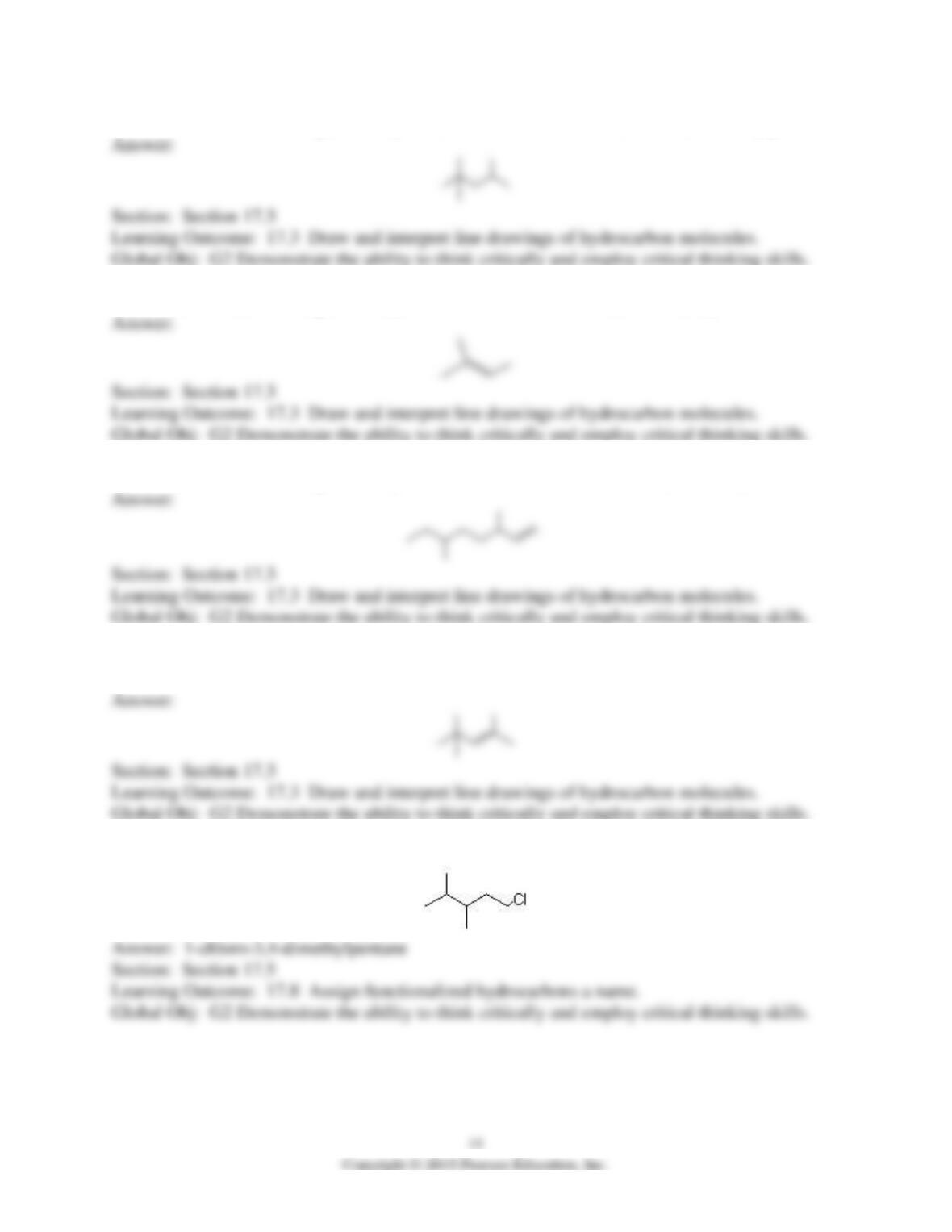
10) Construct a line drawing for the hydrocarbon whose IUPAC name is 2,2,4-trimethylpentane.
11) Construct a line drawing for the hydrocarbon whose IUPAC name is 2-methyl-2-butene.
12) Construct a line drawing for the hydrocarbon whose IUPAC name is 3,6-dimethyl-1-octene.
13) Construct a line drawing for the hydrocarbon whose IUPAC name is 2,4,4-trimethyl-2-
pentene.
14) Give the IUPAC name for this compound:
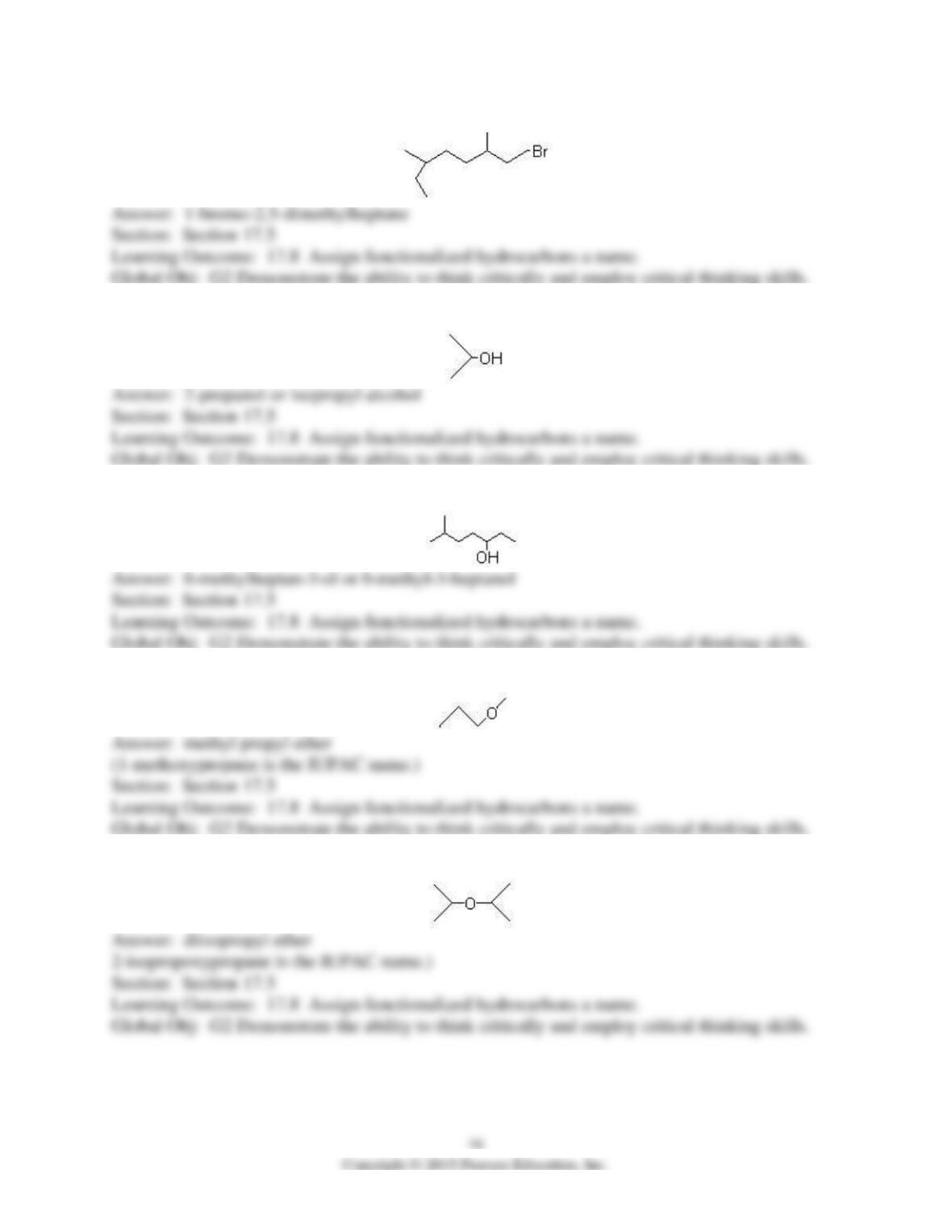
15) Give the IUPAC name of this compound:
16) Give the IUPAC name for this alcohol:
17) Give the IUPAC name for this alcohol:
18) Give a systemic name for this compound:
19) Give the IUPAC name for this compound:
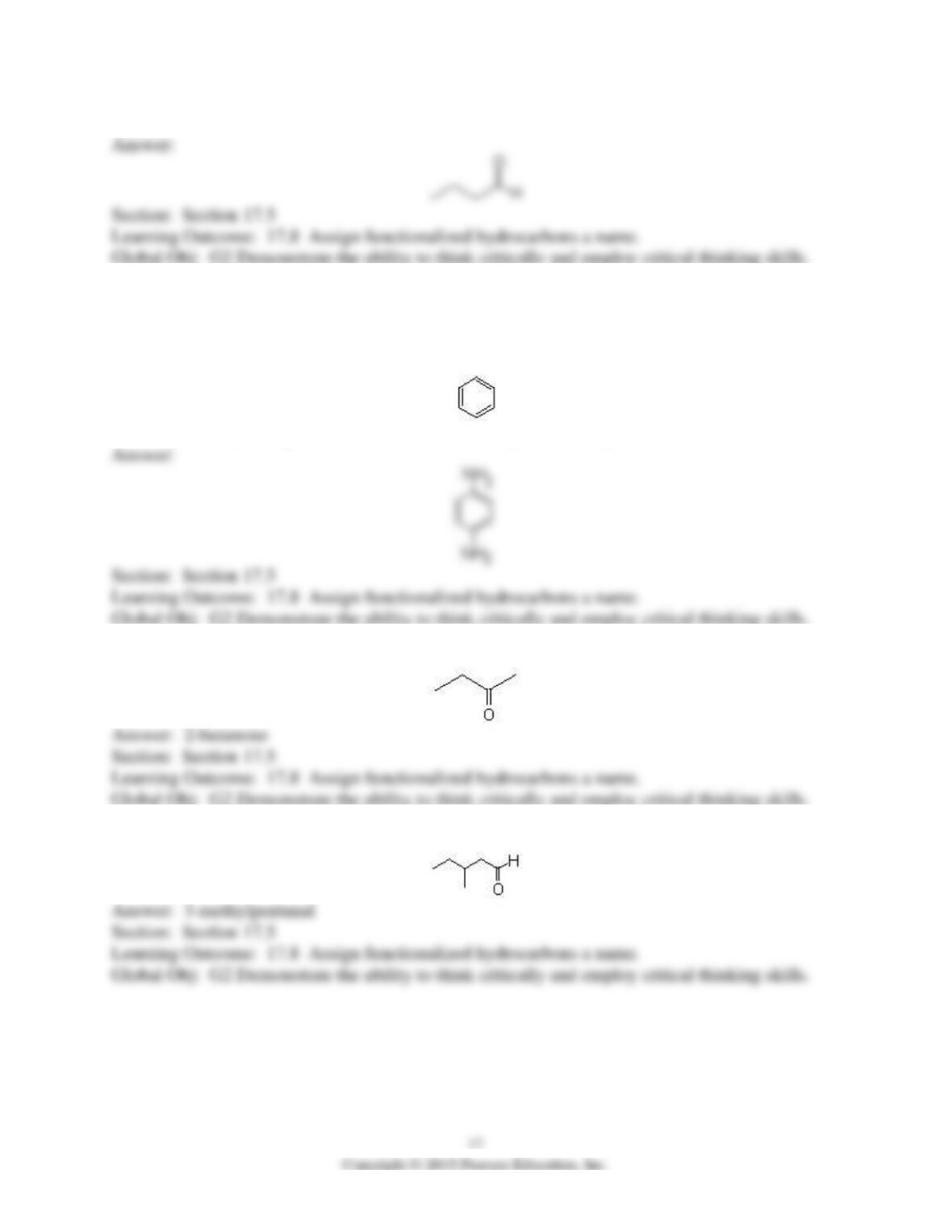
20) Draw the structure of butanal.
21) 1,4-diaminobenzene is one component used to make Kevlar, which is then used in
bulletproof vests. Draw the line structure of 1,4-diaminobenzene.
Remember that benzene has the structure:
Labeling of carbons begins at “1” in the “12 o’clock” position and proceeds clockwise.
22) Give the IUPAC name for the compound whose line drawing structure is:
23) Give the IUPAC name for the compound whose line drawing structure is:
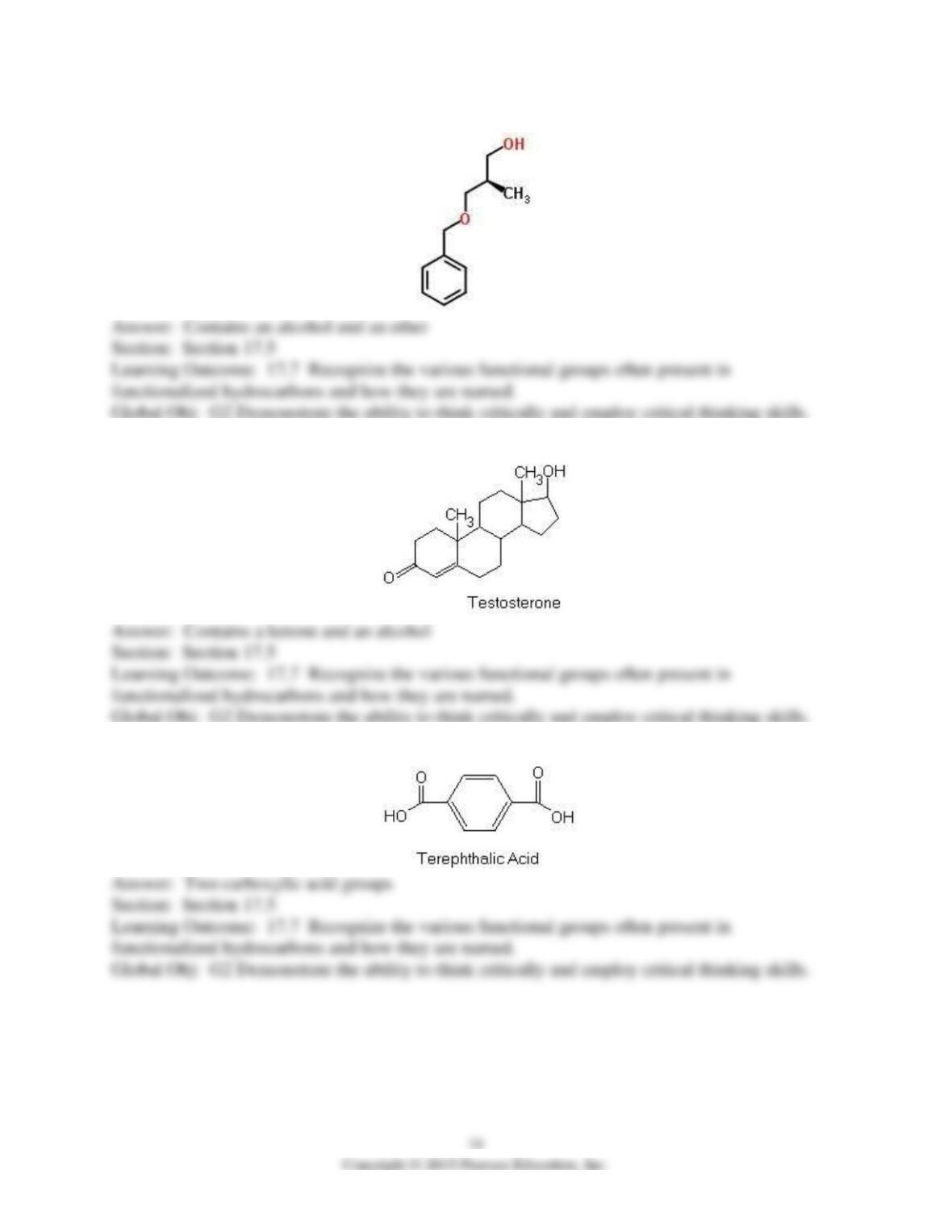
24) Circle and identify the organic functional groups in the following molecule:
25) Circle and identify the organic functional groups in the following molecule:
26) Circle and identify the organic functional groups in the following molecule:
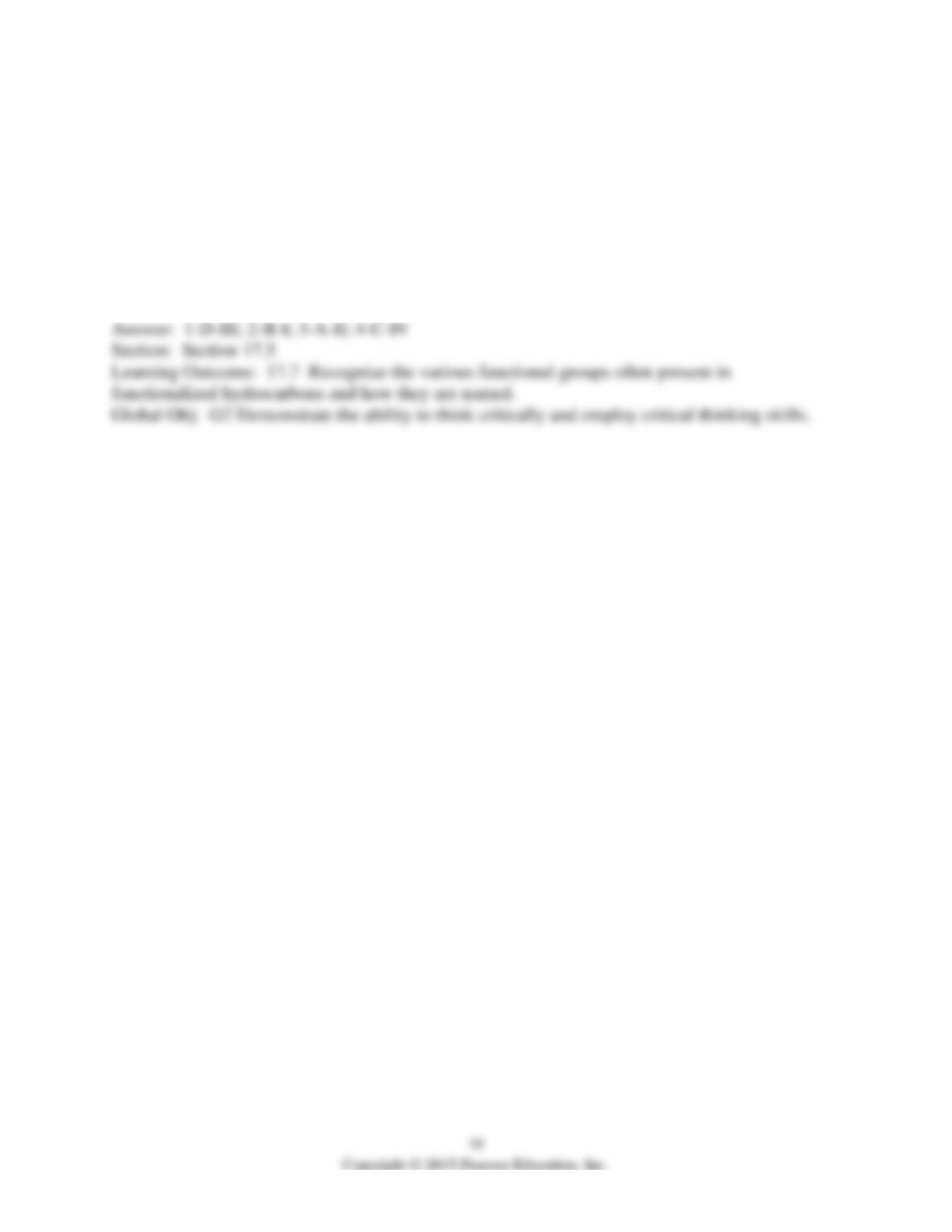
27) Match the molecular formula in the left column with the corresponding alcohol in the middle
column and the appropriate application in the right column.
Molecular Formula Alcohol Application
1. CH3CH2OH A- ethylene glycol I- wood alcohol
2. CH3OH B- methanol II– antifreeze used in autos
3. HOCH2CH2OH C- 2-propanol III– alcohol found in liquor
4. (CH3)2CHOH D- ethanol IV– rubbing alcohol

17.4 Matching Questions
Match the name of each alkane in the left column with the condensed formula that appears in the
right column.
A) CH4
B) CH3CH2CH2CH2CH2CH3
C) CH3CH2CH2CH2CH3
D) CH3CH2CH2CH3
E) CH3CH3
F) CH3CH2CH3
1) methane
Section: Section 17.3
Learning Outcome: 17.5 Assign hydrocarbon molecules an IUPAC name.
Global Obj: G2 Demonstrate the ability to think critically and employ critical thinking skills.
2) pentane
Section: Section 17.3
Learning Outcome: 17.5 Assign hydrocarbon molecules an IUPAC name.
Global Obj: G2 Demonstrate the ability to think critically and employ critical thinking skills.
3) propane
Section: Section 17.3
Learning Outcome: 17.5 Assign hydrocarbon molecules an IUPAC name.
Global Obj: G2 Demonstrate the ability to think critically and employ critical thinking skills.
4) ethane
Section: Section 17.3
Learning Outcome: 17.5 Assign hydrocarbon molecules an IUPAC name.
Global Obj: G2 Demonstrate the ability to think critically and employ critical thinking skills.
5) butane
Section: Section 17.3
Learning Outcome: 17.5 Assign hydrocarbon molecules an IUPAC name.
Global Obj: G2 Demonstrate the ability to think critically and employ critical thinking skills.
6) hexane
Section: Section 17.3
Learning Outcome: 17.5 Assign hydrocarbon molecules an IUPAC name.
Global Obj: G2 Demonstrate the ability to think critically and employ critical thinking skills.

21
Match the name of each alkene in the left column with the condensed formula that appears in the
right column.
A) CH3CH2CH=CHCH2CH3
B) CH2=CHCH2CH2CH2CH3
C) CH3CH=CHCH3
D) CH3CH=CHCH2CH3
E) CH2=CHCH3
F) CH3CH=CHCH2CH2CH3
G) CH2=CHCH2CH2CH3
H) CH2=CHCH2CH3
I) CH2=CH2
7) 1-pentene
Section: Section 17.3
Learning Outcome: 17.5 Assign hydrocarbon molecules an IUPAC name.
Global Obj: G2 Demonstrate the ability to think critically and employ critical thinking skills.
8) propene
Section: Section 17.3
Learning Outcome: 17.5 Assign hydrocarbon molecules an IUPAC name.
Global Obj: G2 Demonstrate the ability to think critically and employ critical thinking skills.
9) 2-butene
Section: Section 17.3
Learning Outcome: 17.5 Assign hydrocarbon molecules an IUPAC name.
Global Obj: G2 Demonstrate the ability to think critically and employ critical thinking skills.
10) ethene
Section: Section 17.3
Learning Outcome: 17.5 Assign hydrocarbon molecules an IUPAC name.
Global Obj: G2 Demonstrate the ability to think critically and employ critical thinking skills.
11) 2-hexene
Section: Section 17.3
Learning Outcome: 17.5 Assign hydrocarbon molecules an IUPAC name.
Global Obj: G2 Demonstrate the ability to think critically and employ critical thinking skills.
12) 2-pentene
Section: Section 17.3
Learning Outcome: 17.5 Assign hydrocarbon molecules an IUPAC name.
Global Obj: G2 Demonstrate the ability to think critically and employ critical thinking skills.

13) 3-hexene
Section: Section 17.3
Learning Outcome: 17.5 Assign hydrocarbon molecules an IUPAC name.
Global Obj: G2 Demonstrate the ability to think critically and employ critical thinking skills.
14) 1-butene
Section: Section 17.3
Learning Outcome: 17.5 Assign hydrocarbon molecules an IUPAC name.
Global Obj: G2 Demonstrate the ability to think critically and employ critical thinking skills.
15) 1-hexene
Section: Section 17.3
Learning Outcome: 17.5 Assign hydrocarbon molecules an IUPAC name.
Global Obj: G2 Demonstrate the ability to think critically and employ critical thinking skills.

23
Match the name of each alkyne in the left column with the condensed formula that appears in the
right column.
A) CH3CH2C≡CCH2CH3
B) HC≡CCH2CH2CH3
C) CH3C≡CCH3
D) CH3C≡CH
E) HC≡CCH2CH2CH2CH3
F) CH3C≡CCH2CH3
G) CH3C≡CCH2CH2CH3
H) HC≡CH
I) HC≡CCH2CH3
16) 1-hexyne
Section: Section 17.3
Learning Outcome: 17.5 Assign hydrocarbon molecules an IUPAC name.
Global Obj: G2 Demonstrate the ability to think critically and employ critical thinking skills.
17) 1-pentyne
Section: Section 17.3
Learning Outcome: 17.5 Assign hydrocarbon molecules an IUPAC name.
Global Obj: G2 Demonstrate the ability to think critically and employ critical thinking skills.
18) propyne
Section: Section 17.3
Learning Outcome: 17.5 Assign hydrocarbon molecules an IUPAC name.
Global Obj: G2 Demonstrate the ability to think critically and employ critical thinking skills.
19) ethyne
Section: Section 17.3
Learning Outcome: 17.5 Assign hydrocarbon molecules an IUPAC name.
Global Obj: G2 Demonstrate the ability to think critically and employ critical thinking skills.
20) 3-hexyne
Section: Section 17.3
Learning Outcome: 17.5 Assign hydrocarbon molecules an IUPAC name.
Global Obj: G2 Demonstrate the ability to think critically and employ critical thinking skills.
21) 2-pentyne
Section: Section 17.3
Learning Outcome: 17.5 Assign hydrocarbon molecules an IUPAC name.
Global Obj: G2 Demonstrate the ability to think critically and employ critical thinking skills.

22) 2-butyne
Section: Section 17.3
Learning Outcome: 17.5 Assign hydrocarbon molecules an IUPAC name.
Global Obj: G2 Demonstrate the ability to think critically and employ critical thinking skills.
23) 1-butyne
Section: Section 17.3
Learning Outcome: 17.5 Assign hydrocarbon molecules an IUPAC name.
Global Obj: G2 Demonstrate the ability to think critically and employ critical thinking skills.
24) 2-hexyne
Section: Section 17.3
Learning Outcome: 17.5 Assign hydrocarbon molecules an IUPAC name.
Global Obj: G2 Demonstrate the ability to think critically and employ critical thinking skills.
25
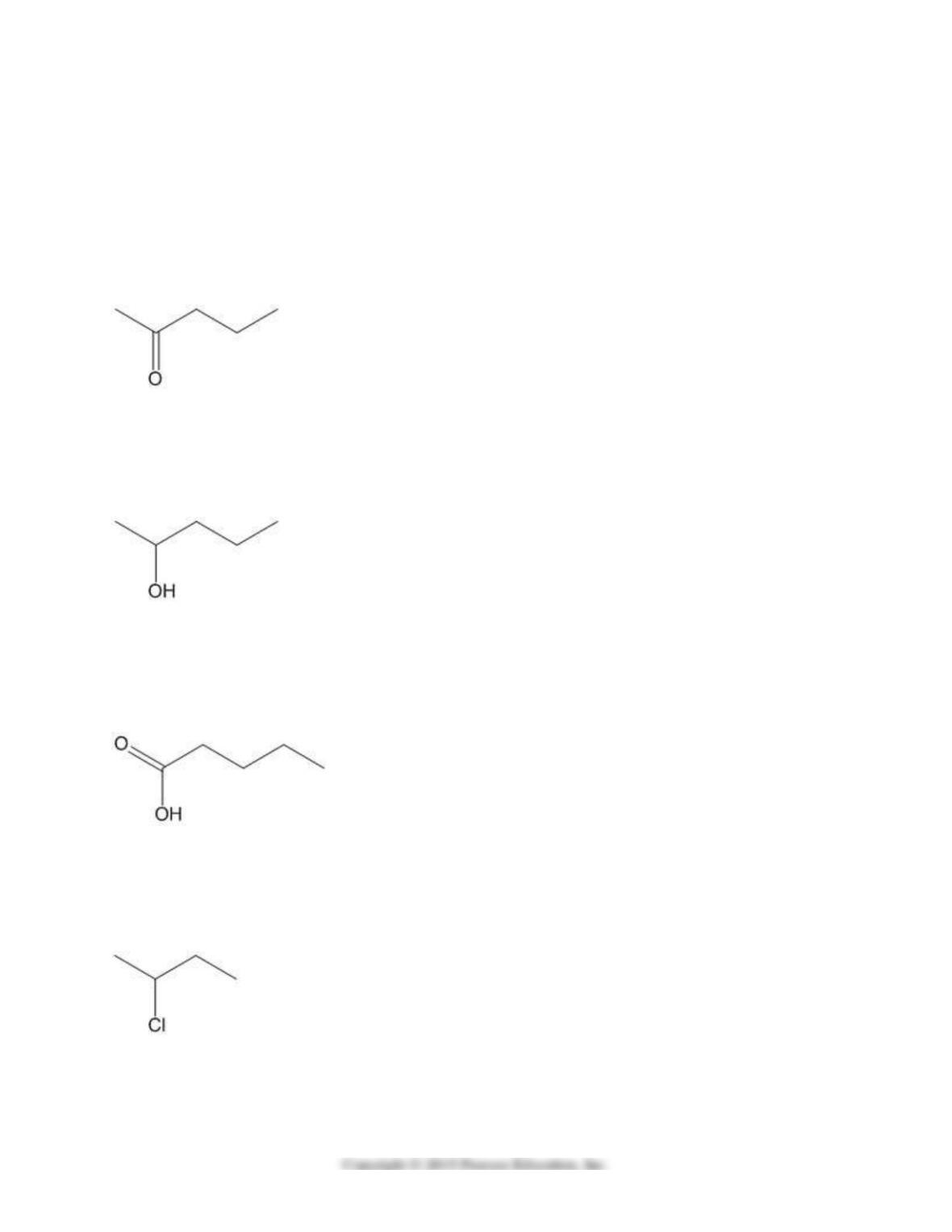
Match each formula in the left column to the corresponding organic family in the right column.
A) alcohol
B) carboxylic acid
C) alkyl halide
D) ketone
E) amine
25)
Section: Section 17.5
Learning Outcome: 17.7 Recognize the various functional groups often present in
functionalized hydrocarbons and how they are named.
Global Obj: G2 Demonstrate the ability to think critically and employ critical thinking skills.
26)
Section: Section 17.5
Learning Outcome: 17.7 Recognize the various functional groups often present in
functionalized hydrocarbons and how they are named.
Global Obj: G2 Demonstrate the ability to think critically and employ critical thinking skills.
27)
Section: Section 17.5
Learning Outcome: 17.7 Recognize the various functional groups often present in
functionalized hydrocarbons and how they are named.
Global Obj: G2 Demonstrate the ability to think critically and employ critical thinking skills.
28)
Section: Section 17.5
Learning Outcome: 17.7 Recognize the various functional groups often present in
functionalized hydrocarbons and how they are named.
Global Obj: G2 Demonstrate the ability to think critically and employ critical thinking skills.
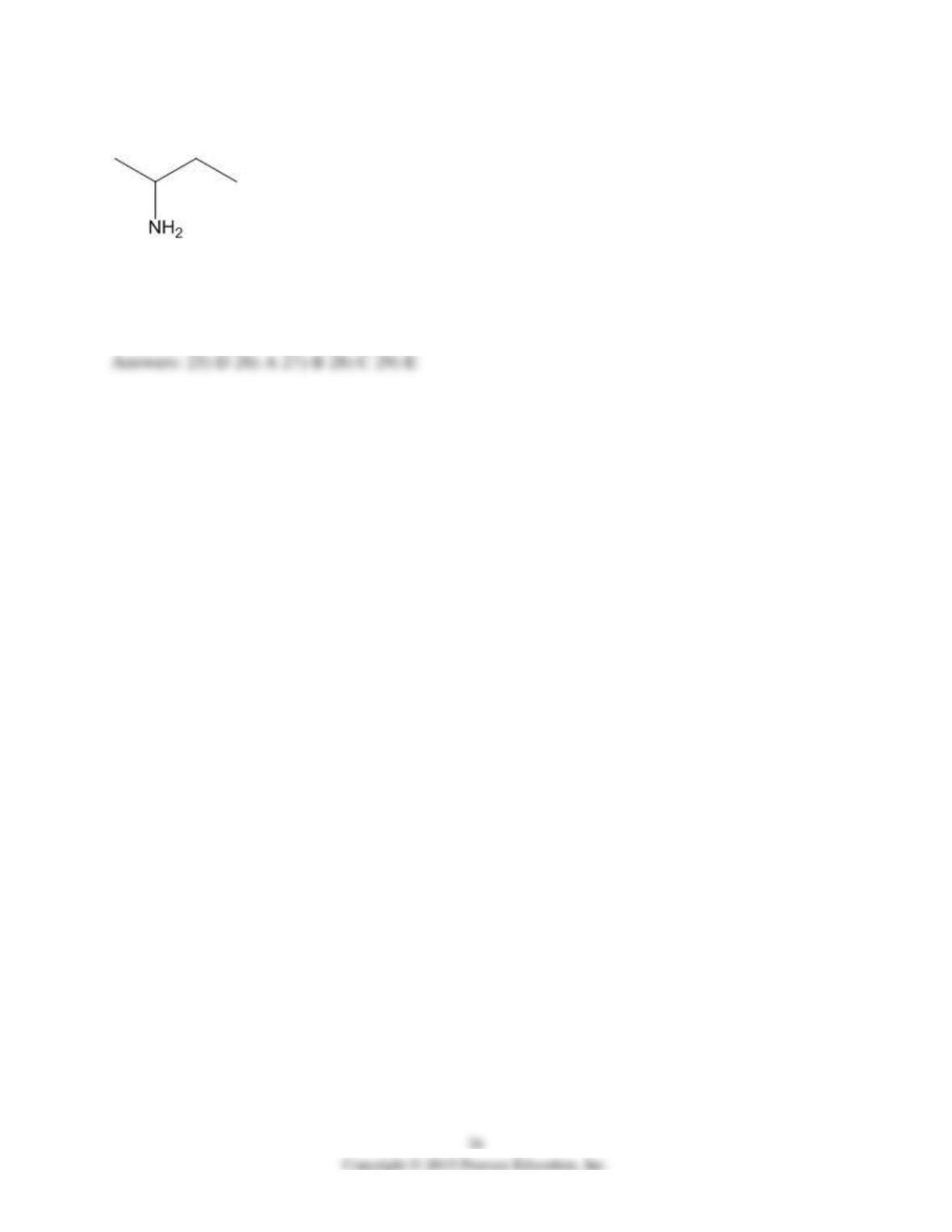
29)
Section: Section 17.5
Learning Outcome: 17.7 Recognize the various functional groups often present in
functionalized hydrocarbons and how they are named.
Global Obj: G2 Demonstrate the ability to think critically and employ critical thinking skills.