61) The conjugate base of ammonia is ________.
A) NH2–
B) NH–
C) N3-
D) NH4+
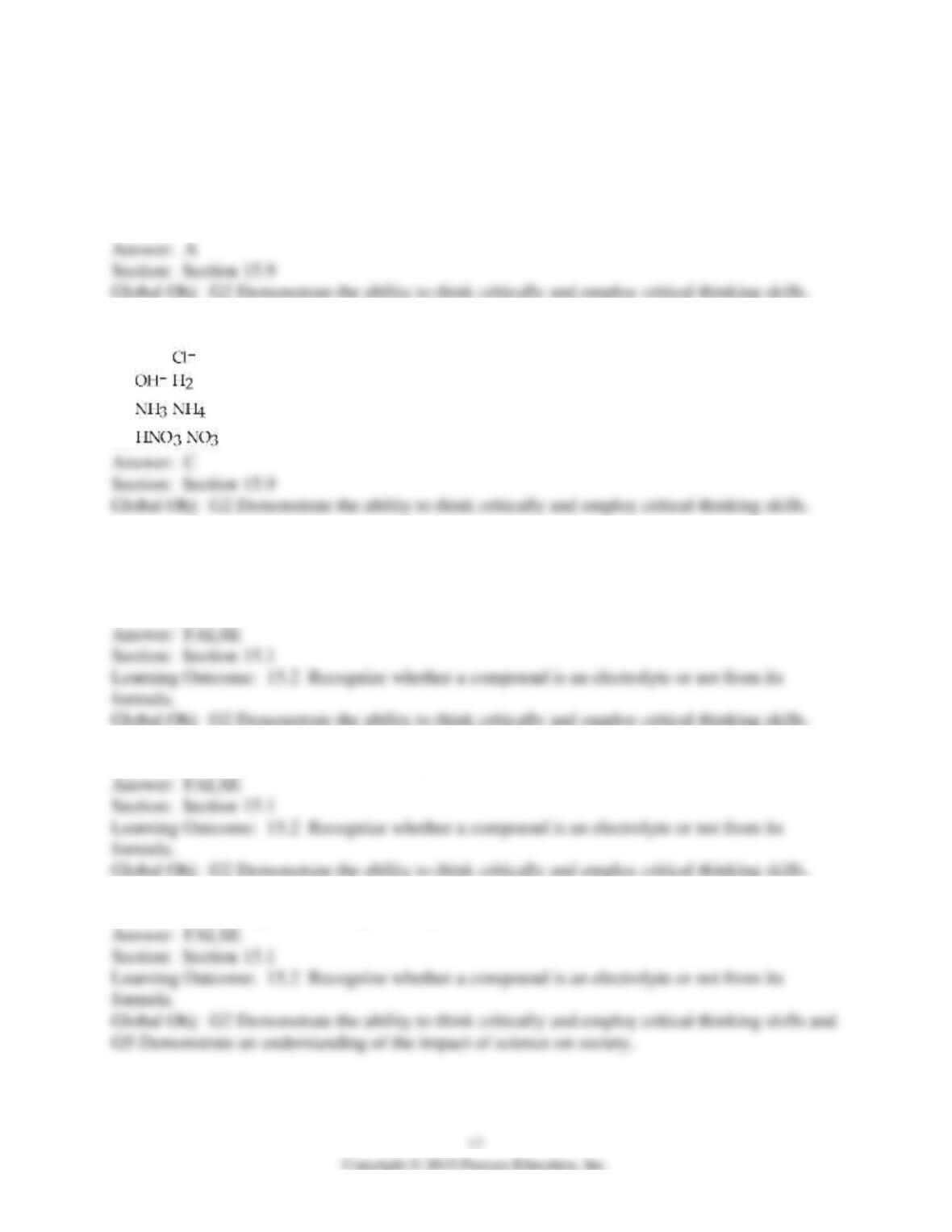
62) Which of the following conjugate pairs would form a good buffer?
A) HCl/
B) / O
C) / +
D) /–
15.2 True/False Questions
1) A concentrated solution of a non-electrolyte such as glucose can be made to conduct
electricity.
2) Deionized water can conduct electricity.
3) Sucrose (table sugar) is a strong electrolyte.
4) An electrolyte is a substance that, when dissolved in water, yields a solution that conducts
electric current.
5) A sodium hydroxide solution is a non-electrolyte.
6) Solid sodium chloride is a strong electrolyte.
7) Sodium chloride (NaCl) is considered an electrolyte because it dissolves in water into positive
and negative ions.
8) A baking soda solution is a strong electrolyte.
9) A sodium sulfate solution will not conduct an electric current.
10) An aqueous solution of HCl is called hydrochloric acid.
11) Hydrochloric, hypochlorous and hydrobromic acids produce only one H3O+ ion per
molecule of acid when dissolved in water.
12) Carbonic acid, phosphoric acid, and sulfuric acid can produce two H3O+ ions per molecule
of acid when dissolved in water.
13) CH3CO2H has four acidic hydrogens.
14) Sulfuric acid is a diprotic acid.
15) Acetic acid is a diprotic acid.
16) Arrhenius’ definition of a base is an electrolyte that contains a metal and hydroxide ions that
dissociate when placed in water.
17) The compound HCl is considered a Bronsted-Lowry base because it increases the
concentration of when it dissociates in water.
18) Water can serve both as a Bronsted-Lowry acid and Bronsted-Lowry base.
19) PH3 cannot serve as a Bronsted-Lowry base.
20) In a solution of a strong monoprotic acid in water, the hydrogen-ion concentration is
approximately equal to the molarity of the acid.
21) Approximately one out of every 555 million water molecules autoionize.
22) The autodissociation of water gives pure water a pH of 4 and thus a higher concentration of
than .
23) An aqueous solution of pH 9.5 is more basic than an aqueous solution of pH 8.2.
24) The hydrogen-ion concentration of a solution of pOH 10.5 is 3.16 × mol/L (remember
that pH + pOH = 14 for aqueous systems).
25) An aqueous solution of pOH 5 is more basic than an aqueous solution of pOH 8.
26) The pH of natural rainwater is 5.6 due to the carbon dioxide in the atmosphere.
27) Milk is slightly basic.
28) If the pOH of a solution is 9, the [H+] = 10-5 M.
29) The carbonate ( )/bicarbonate ( ) pair represents a base and its conjugate acid.
22
30) A solution of HF/ can act as a buffer.
31) “Buffered” solutions are resistant to pH changes, even when small amounts of strong acid or
base are added to them.
32) A solution of HCl/ can act as a buffer.
33) H2PO4– is the conjugate acid of PO42-.
34) HPO42- is the conjugate base of H2PO4–.
15.3 Short Answer Questions
1) What were the three main defining characteristics of acids, according to the alchemists?
2) What were the defining characteristics of bases as known to the alchemists?
3) Write down the chemical equation for the reaction of ammonia ( ) with water. In aqueous
solution, what is the formula for conjugate acid of ammonia?
4) What is the pH of an aqueous solution that has a hydrogen-ion concentration of 4.83 ×
mol/L?
5) What is the concentration of a solution of pH 8.36?
6) The pH of an aqueous solution of acetic acid is 3.76. What is the concentration of in this
solution?
7) The stomach is very sensitive to changes in pH (particularly highly acidic conditions). Suggest
why aspirin, acetylsalicylic acid, causes stomach upset. What is the purpose of so-called buffered
aspirin tablets?

24
15.4 Matching Questions
Identify each of the substances that appear in the left column as an electrolyte or non-electrolyte.
A) non-electrolyte
B) electrolyte
1) aqueous sucrose solution
Section: Section 15.1
Learning Outcome: 15.2 Recognize whether a compound is an electrolyte or not from its
formula.
Global Obj: G2 Demonstrate the ability to think critically and employ critical thinking skills and
G5 Demonstrate an understanding of the impact of science on society.
2) solid sodium chloride
Section: Section 15.1
Learning Outcome: 15.2 Recognize whether a compound is an electrolyte or not from its
formula.
Global Obj: G2 Demonstrate the ability to think critically and employ critical thinking skills and
G5 Demonstrate an understanding of the impact of science on society.
3) aqueous hydrochloric acid solution
Section: Section 15.1
Learning Outcome: 15.2 Recognize whether a compound is an electrolyte or not from its
formula.
Global Obj: G2 Demonstrate the ability to think critically and employ critical thinking skills.
4) aqueous sodium chloride solution
Section: Section 15.1
Learning Outcome: 15.2 Recognize whether a compound is an electrolyte or not from its
formula.
Global Obj: G2 Demonstrate the ability to think critically and employ critical thinking skills and
G5 Demonstrate an understanding of the impact of science on society.
5) aqueous sulfuric acid solution
Section: Section 15.1
Learning Outcome: 15.2 Recognize whether a compound is an electrolyte or not from its
formula.
Global Obj: G2 Demonstrate the ability to think critically and employ critical thinking skills.
6) gasoline
Section: Section 15.1
Learning Outcome: 15.2 Recognize whether a compound is an electrolyte or not from its
formula.
Global Obj: G2 Demonstrate the ability to think critically and employ critical thinking skills and
G5 Demonstrate an understanding of the impact of science on society.

7) aqueous baking soda solution
Section: Section 15.1
Learning Outcome: 15.2 Recognize whether a compound is an electrolyte or not from its
formula.
Global Obj: G2 Demonstrate the ability to think critically and employ critical thinking skills and
G5 Demonstrate an understanding of the impact of science on society.
8) aqueous rubbing alcohol
Section: Section 15.1
Learning Outcome: 15.2 Recognize whether a compound is an electrolyte or not from its
formula.
Global Obj: G2 Demonstrate the ability to think critically and employ critical thinking skills and
G5 Demonstrate an understanding of the impact of science on society.
9) pure water
Section: Section 15.1
Learning Outcome: 15.2 Recognize whether a compound is an electrolyte or not from its
formula.
Global Obj: G2 Demonstrate the ability to think critically and employ critical thinking skills and
G5 Demonstrate an understanding of the impact of science on society.
10) sports drink
Section: Section 15.1
Learning Outcome: 15.2 Recognize whether a compound is an electrolyte or not from its
formula.
Global Obj: G2 Demonstrate the ability to think critically and employ critical thinking skills and
G5 Demonstrate an understanding of the impact of science on society.
11) seawater
Section: Section 15.1
Learning Outcome: 15.2 Recognize whether a compound is an electrolyte or not from its
formula.
Global Obj: G2 Demonstrate the ability to think critically and employ critical thinking skills and
G5 Demonstrate an understanding of the impact of science on society.
12) tap water
Section: Section 15.1
Learning Outcome: 15.2 Recognize whether a compound is an electrolyte or not from its
formula.
Global Obj: G2 Demonstrate the ability to think critically and employ critical thinking skills and
G5 Demonstrate an understanding of the impact of science on society.

26
Match each of the acids that appear in the left column with the maximum number of H3O+
produced per molecule of acid.
A) 3
B) 1
C) 2
13) hydrochloric acid
Section: Section 15.3
Learning Outcome: 15.4 Recognize acids and their properties from their formula.
Global Obj: G2 Demonstrate the ability to think critically and employ critical thinking skills.
14) sulfuric acid
Section: Section 15.3
Learning Outcome: 15.4 Recognize acids and their properties from their formula.
Global Obj: G2 Demonstrate the ability to think critically and employ critical thinking skills.
15) nitric acid
Section: Section 15.3
Learning Outcome: 15.4 Recognize acids and their properties from their formula.
Global Obj: G2 Demonstrate the ability to think critically and employ critical thinking skills.
16) phosphoric acid
Section: Section 15.3
Learning Outcome: 15.4 Recognize acids and their properties from their formula.
Global Obj: G2 Demonstrate the ability to think critically and employ critical thinking skills.
17) acetic acid
Section: Section 15.3
Learning Outcome: 15.4 Recognize acids and their properties from their formula.
Global Obj: G2 Demonstrate the ability to think critically and employ critical thinking skills.
18) carbonic acid
Section: Section 15.3
Learning Outcome: 15.4 Recognize acids and their properties from their formula.
Global Obj: G2 Demonstrate the ability to think critically and employ critical thinking skills.
19) sulfurous acid
Section: Section 15.3
Learning Outcome: 15.4 Recognize acids and their properties from their formula.
Global Obj: G2 Demonstrate the ability to think critically and employ critical thinking skills.
20) hypochlorous acid
Section: Section 15.3
Learning Outcome: 15.4 Recognize acids and their properties from their formula.
Global Obj: G2 Demonstrate the ability to think critically and employ critical thinking skills.

Identify each of the acids that appear in the left column as a strong acid or a weak acid.
A) weak acid
B) strong acid
21) hydrobromic acid
Section: Section 15.3
Learning Outcome: 15.4 Recognize acids and their properties from their formula.
Global Obj: G2 Demonstrate the ability to think critically and employ critical thinking skills.
22) sulfuric acid
Section: Section 15.3
Learning Outcome: 15.4 Recognize acids and their properties from their formula.
Global Obj: G2 Demonstrate the ability to think critically and employ critical thinking skills.
23) nitric acid
Section: Section 15.3
Learning Outcome: 15.4 Recognize acids and their properties from their formula.
Global Obj: G2 Demonstrate the ability to think critically and employ critical thinking skills.
24) phosphoric acid
Section: Section 15.3
Learning Outcome: 15.4 Recognize acids and their properties from their formula.
Global Obj: G2 Demonstrate the ability to think critically and employ critical thinking skills.
25) acetic acid
Section: Section 15.3
Learning Outcome: 15.4 Recognize acids and their properties from their formula.
Global Obj: G2 Demonstrate the ability to think critically and employ critical thinking skills.
26) carbonic acid
Section: Section 15.3
Learning Outcome: 15.4 Recognize acids and their properties from their formula.
Global Obj: G2 Demonstrate the ability to think critically and employ critical thinking skills.
27) hydrofluoric acid
Section: Section 15.3
Learning Outcome: 15.4 Recognize acids and their properties from their formula.
Global Obj: G2 Demonstrate the ability to think critically and employ critical thinking skills.
28) hypochlorous acid
Section: Section 15.3
Learning Outcome: 15.4 Recognize acids and their properties from their formula.
Global Obj: G2 Demonstrate the ability to think critically and employ critical thinking skills.

29
Identify the household products that appear in the left column as acidic or basic.
A) Acidic
B) Basic
29) Coffee
Section: Section 15.8
Learning Outcome: 15.12c Describe both qualitatively and quantitatively whether an aqueous
solution is acidic, neutral, or basic.
Global Obj: G2 Demonstrate the ability to think critically and employ critical thinking skills and
G5 Demonstrate an understanding of the impact of science on society.
30) Blood
Section: Section 15.8
Learning Outcome: 15.12c Describe both qualitatively and quantitatively whether an aqueous
solution is acidic, neutral, or basic.
Global Obj: G2 Demonstrate the ability to think critically and employ critical thinking skills and
G5 Demonstrate an understanding of the impact of science on society.
31) Milk of magnesia
Section: Section 15.8
Learning Outcome: 15.12c Describe both qualitatively and quantitatively whether an aqueous
solution is acidic, neutral, or basic.
Global Obj: G2 Demonstrate the ability to think critically and employ critical thinking skills and
G5 Demonstrate an understanding of the impact of science on society.
32) Lemonade
Section: Section 15.8
Learning Outcome: 15.12c Describe both qualitatively and quantitatively whether an aqueous
solution is acidic, neutral, or basic.
Global Obj: G2 Demonstrate the ability to think critically and employ critical thinking skills and
G5 Demonstrate an understanding of the impact of science on society.
33) Natural rainwater
Section: Section 15.8
Learning Outcome: 15.12c Describe both qualitatively and quantitatively whether an aqueous
solution is acidic, neutral, or basic.
Global Obj: G2 Demonstrate the ability to think critically and employ critical thinking skills and
G5 Demonstrate an understanding of the impact of science on society.
34) Rainwater that falls in industrial areas
Section: Section 15.8
Learning Outcome: 15.12c Describe both qualitatively and quantitatively whether an aqueous
solution is acidic, neutral, or basic.
Global Obj: G2 Demonstrate the ability to think critically and employ critical thinking skills and
G5 Demonstrate an understanding of the impact of science on society.
35) Milk
Section: Section 15.8
Learning Outcome: 15.12c Describe both qualitatively and quantitatively whether an aqueous
solution is acidic, neutral, or basic.
Global Obj: G2 Demonstrate the ability to think critically and employ critical thinking skills and
G5 Demonstrate an understanding of the impact of science on society.
36) Household ammonia
Section: Section 15.8
Learning Outcome: 15.12c Describe both qualitatively and quantitatively whether an aqueous
solution is acidic, neutral, or basic.
Global Obj: G2 Demonstrate the ability to think critically and employ critical thinking skills and
G5 Demonstrate an understanding of the impact of science on society.

31
Identify each [H3O+] / [OH–] / pH / pOH that appears in the left column as acidic or basic.
A) Basic
B) Acidic
37) [H3O+] = 1.2 × 10⁻⁹
Section: Section 15.8
Learning Outcome: 15.12c Describe both qualitatively and quantitatively whether an aqueous
solution is acidic, neutral, or basic.
Global Obj: G2 Demonstrate the ability to think critically and employ critical thinking skills.
38) [OH–] = 1.2 × 10⁻⁸
Section: Section 15.8
Learning Outcome: 15.12c Describe both qualitatively and quantitatively whether an aqueous
solution is acidic, neutral, or basic.
Global Obj: G2 Demonstrate the ability to think critically and employ critical thinking skills.
39) pH = 5.24
Section: Section 15.8
Learning Outcome: 15.12c Describe both qualitatively and quantitatively whether an aqueous
solution is acidic, neutral, or basic.
Global Obj: G2 Demonstrate the ability to think critically and employ critical thinking skills.
40) pOH = 9.1
Section: Section 15.8
Learning Outcome: 15.12c Describe both qualitatively and quantitatively whether an aqueous
solution is acidic, neutral, or basic.
Global Obj: G2 Demonstrate the ability to think critically and employ critical thinking skills.
41) [H3O+] = 4.2 × 10⁻²
Section: Section 15.8
Learning Outcome: 15.12c Describe both qualitatively and quantitatively whether an aqueous
solution is acidic, neutral, or basic.
Global Obj: G2 Demonstrate the ability to think critically and employ critical thinking skills.
42) [OH–] = 1.2 × 10⁻⁴
Section: Section 15.8
Learning Outcome: 15.12c Describe both qualitatively and quantitatively whether an aqueous
solution is acidic, neutral, or basic.
Global Obj: G2 Demonstrate the ability to think critically and employ critical thinking skills.
43) pH = 10.24
Section: Section 15.8
Learning Outcome: 15.12c Describe both qualitatively and quantitatively whether an aqueous
solution is acidic, neutral, or basic.
Global Obj: G2 Demonstrate the ability to think critically and employ critical thinking skills.
44) pOH = 3.1
Section: Section 15.8
Learning Outcome: 15.12c Describe both qualitatively and quantitatively whether an aqueous
solution is acidic, neutral, or basic.
Global Obj: G2 Demonstrate the ability to think critically and employ critical thinking skills.
Match each substance in the left column with the corresponding fact in the right column.
A) It is the conjugate base of CH3CO2H.
B) It does not have a conjugate base.
C) It is the conjugate acid of HCO3–.
D) Its conjugate acid is HSO3–.
E) Its conjugate base is CO32-.
F) Its conjugate base is HSO3–.
45) HCO3–
Section: Section 15.9
Global Obj: G2 Demonstrate the ability to think critically and employ critical thinking skills.
46) H2SO4
Section: Section 15.9
Global Obj: G2 Demonstrate the ability to think critically and employ critical thinking skills.
47) Cl–
Section: Section 15.9
Global Obj: G2 Demonstrate the ability to think critically and employ critical thinking skills.
48) H2CO3
Section: Section 15.9
Global Obj: G2 Demonstrate the ability to think critically and employ critical thinking skills.
49) CH3CO2–
Section: Section 15.9
Global Obj: G2 Demonstrate the ability to think critically and employ critical thinking skills.
50) SO32-
Section: Section 15.9
Global Obj: G2 Demonstrate the ability to think critically and employ critical thinking skills.