58) If the solubility of calcium fluoride is 2.0 × 10⁻⁴ M, the solubility product value is ________.
A) 1.6 × 10⁻¹²
B) 3.2 × 10⁻¹¹
C) 4.0 × 10⁻⁸
D) 8.0 × 10⁻¹²
14.2 True/False Questions
1) At equilibrium, the concentrations of reactants and products are always exactly the same.
2) At equilibrium, the amount of product present is always greater than the amount of reactant
present.
3) At equilibrium, the rate of the forward reaction is equal to the rate of the reverse reaction.
4) A reaction is approaching equilibrium when the rate of a forward reaction slows down and the
rate of a reverse reaction speeds up.
5) An equilibrium condition can be achieved only when 100% of the reactants have been
converted to products.
6) Reducing the pressure will shift the equilibrium to the right.
Cl2 (g) + 3F2 (g) ⇔ 2ClF3 (g)
7) The double arrow in a chemical reaction indicates that the equilibrium is established since the
rate of the forward reaction is equal to the rate of the reverse reaction.
8) A reaction is close to equilibrium when a rapid reverse reaction slows down and a slower
forward reaction speeds up.
9) The concentrations of reactants and products do not change as equilibrium is approached, only
the rate at which products are formed and reactants are consumed.
10) A reaction that favors products has a Keq > 1.
11) A product favored reaction has Keq = 1.
12) If the value of the equilibrium constant for the forward reaction is 2.5 × 1030, the value of
the equilibrium constant for the reverse reaction is 4.0 × 10⁻³⁰.
13) At 500 K, the equilibrium concentrations of each species are [PCl5] = 0.008 M, [PCl3] =
0.02 M, and [Cl2] = 0.02 M. The equilibrium constant value is 0.5.
PCl5 ⇔ PCl3 + Cl2
14) For the following reaction at 1500 K, the equilibrium concentrations of each species are,
[N2] = 0.10 M, and [N2H4] = 0.10 M. The equilibrium constant value is 0.04.
N2H4 (g) ⇔ 2 H2 (g) + N2 (g)
15) Among the two reactions whose equilibrium constants are 0.003 and 30, the one that will
produce greater quantities of products is the one whose equilibrium constant is 30.
16) If a chemical reaction at an equilibrium state is disturbed, the reaction will compensate for
the disturbance in some way so that equilibrium can be restored.
17) If more reactants are added to a chemical reaction already at equilibrium, a shift to the
products is required to restore an equilibrium condition.
18) Removing ozone as soon as it is formed will shift the equilibrium to the right.
3O2 (g) ⇔ 2O3 (g)
19) Expanding the reaction vessel will shift the equilibrium to the right.
3O2 (g) ⇔ 2O3 (g)
20) Reducing the pressure will shift the equilibrium to the left.
N2 (g) + 2O2 (g) ⇔ 2NO2 (g)
21) Decreasing the concentration of nitrogen will shift the equilibrium to the left.
N2 (g) + 2O2 (g) ⇔ 2NO2 (g)
22) Reducing the pressure will shift the equilibrium to the right.
N2 (g) + O2 (g) ⇔ 2NO (g)
23) Adding extra nickel will shift the equilibrium to the right.
Ni (s) + 4CO (g) ⇔ Ni(CO)4 (g)
24) The equilibrium condition of a chemical reaction is not related to temperature.
25) Changing the temperature of a reaction will not change the equilibrium value.
26) Adding a catalyst to any reaction will always change the value of the equilibrium constant.
27) If the solubility product of tin(II) carbonate is 1.03 × 10⁻⁹, the molar solubility is 3.21 × 10⁻⁵
M.
28) No reaction exists in which 100% of the reactants are consumed.
29) The term “molar solubility of a salt” refers to the molar concentration of one anion (or
cation) formed in an aqueous, saturated solution of that salt.
14.3 Short Answer Questions
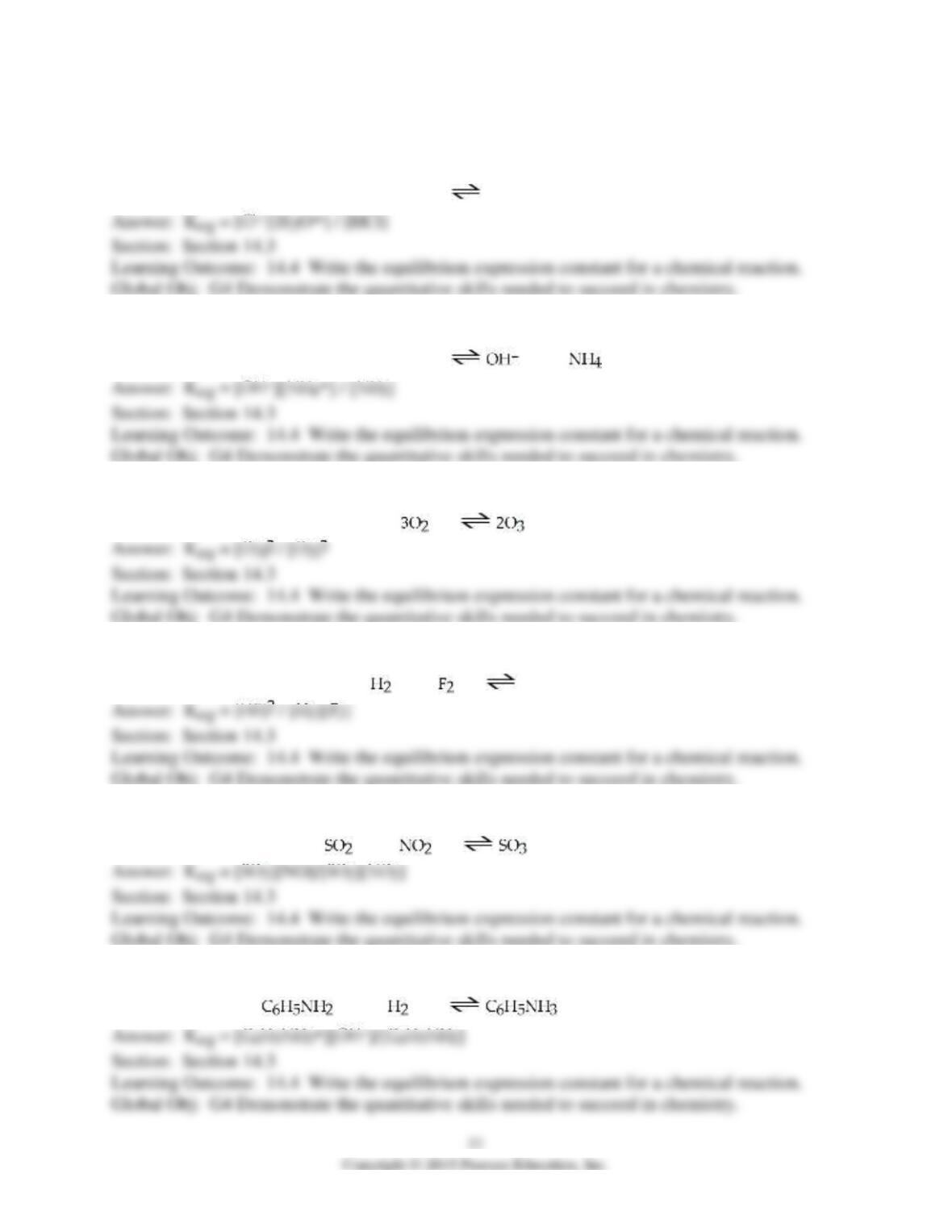
1) Write an expression for the equilibrium constant (Keq) for the following reaction.
HCl (g) + H2O (l) H3O+ (aq)+ Cl– (aq)
2) Write an expression for the equilibrium constant (Keq) for the following reaction.
NH3 (g) + H2O (l) (aq) + + (aq)
3) Write an expression for the equilibrium constant (Keq) for the following reaction.
(g) (g)
4) Write an expression for the equilibrium constant (Keq) for the following reaction.
(g) + (g) 2HF (g)
5) Write an expression for the equilibrium constant (Keq) for the following reaction.
(g) + (g) (g) + NO (g)
6) Write an expression for the equilibrium constant (Keq) for the following reaction.
(aq) + O (l) + (aq) + OH– (aq)
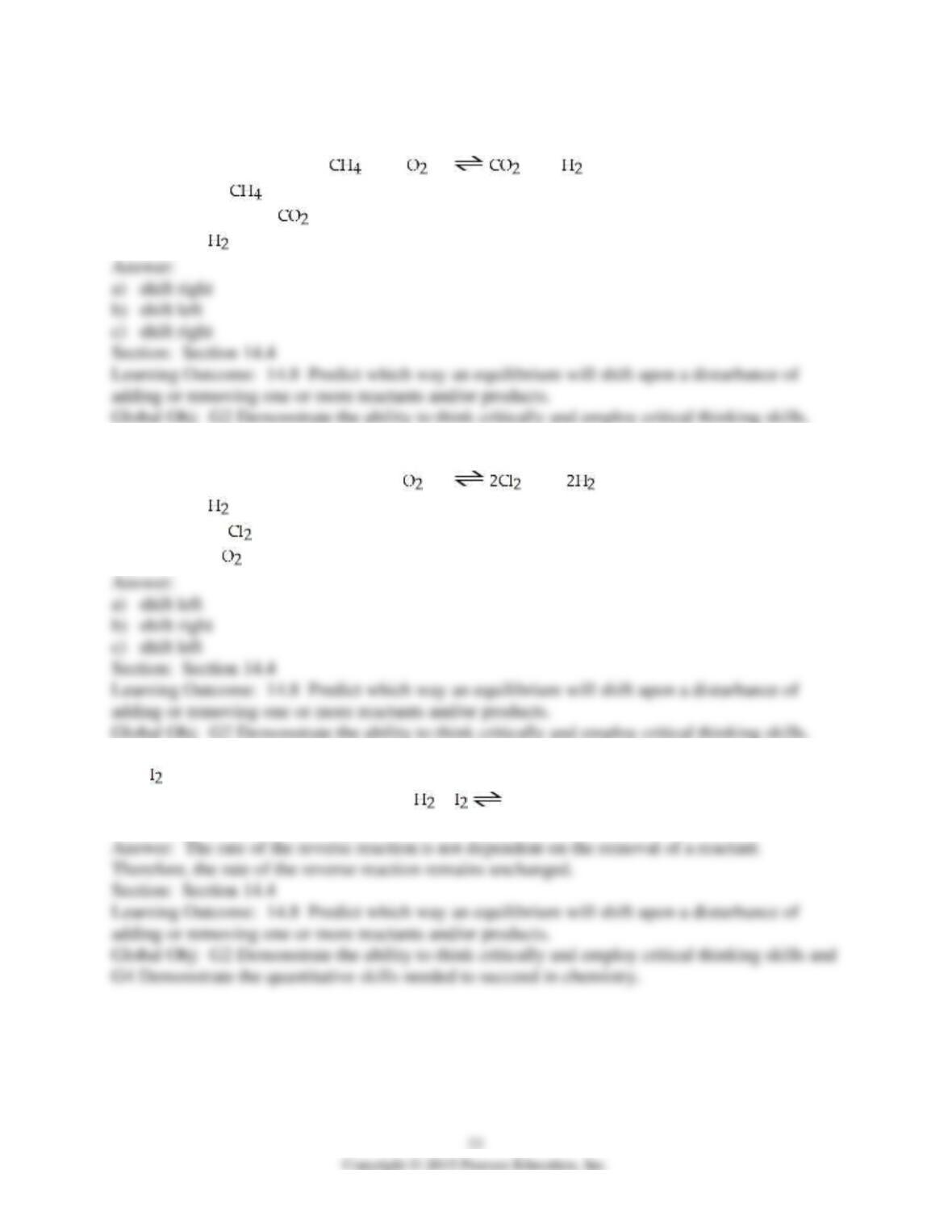
7) Predict the shift in the direction of the reaction for the following chemical reaction:
(g) + (g) (g)+ O (g)
a) if methane ( ) is added
b) if carbon dioxide ( ) is added
c) if water ( O) is removed
8) Predict the shift in the direction of the reaction for the following chemical reaction:
4HCl (g) + (g) (g) + O (g)
a) if water ( O) is added
b) if chlorine ( ) is removed
c) if oxygen ( ) is removed
9) If is removed from the following reaction already at equilibrium:
+ 2HI
what would be expected to happen to the rate of the reverse reaction?
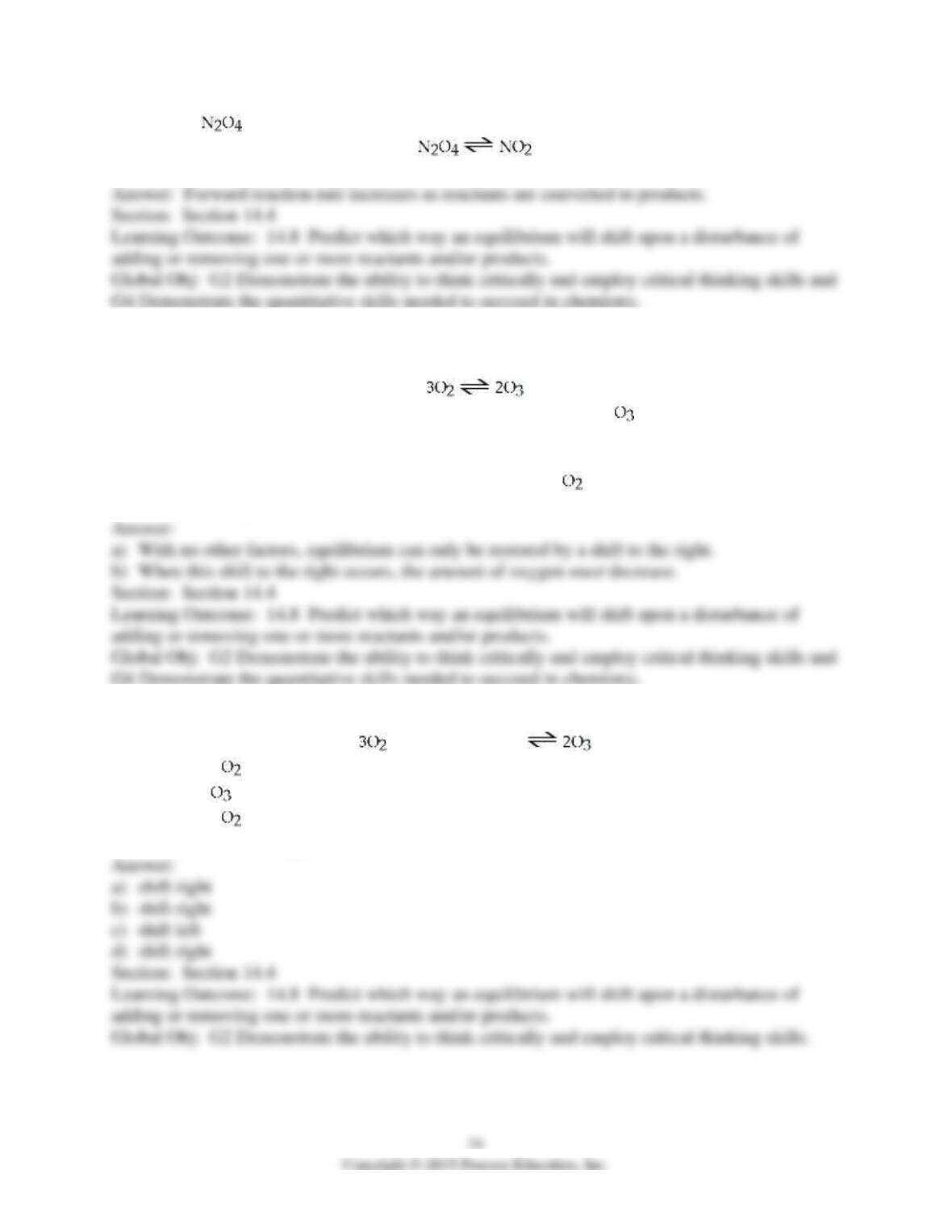
10) If more is added to the following reaction already at equilibrium:
what would be expected to happen to the rate of the forward reaction?
11) Oxygen (O2) and ozone (O3) coexist in the stratosphere and are in equilibrium with one
another:
a) Assuming that no other factors affect this equilibrium, if ozone ( ) is being “depleted”
(somehow removed from the reaction system entirely), what is the direction of the equilibrium
shift?
b) What must be happening to the concentration of oxygen ( ) as a result of the equilibrium
shift predicted in part a?
12) Predict the shift in the direction of the reaction for the following chemical reaction:
+ ultraviolet light
a) if oxygen ( ) is added.
b) if ozone ( ) is removed.
c) if oxygen ( ) is removed.
d) if more ultraviolet light is added.
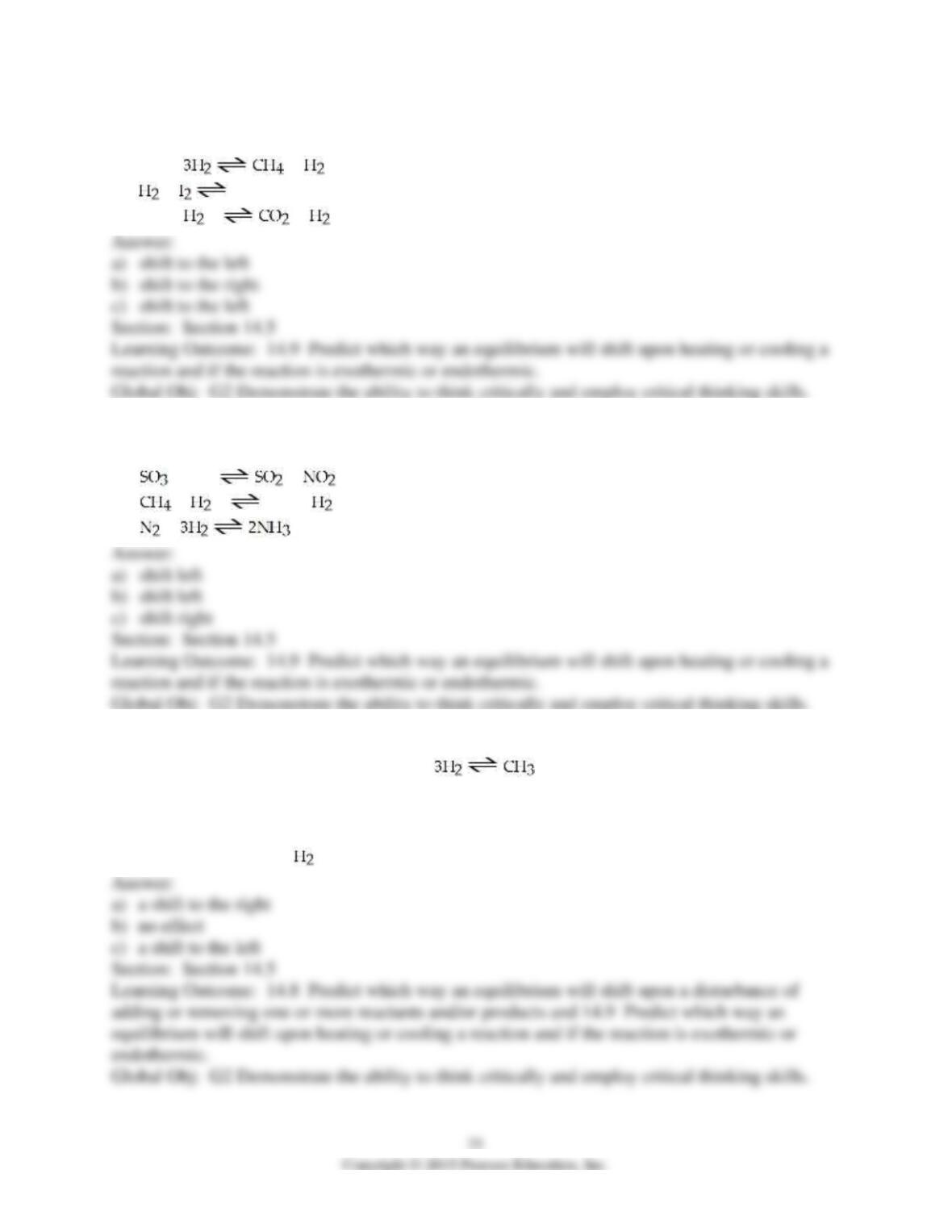
13) Predict the direction in which the reaction will shift for the following reactions if the
temperature is increased:
a) CO + + O (exothermic)
b) + 2HI (endothermic)
c) CO + O + (exothermic)
14) Predict the direction in which the reaction will shift for the following reactions if the
temperature is decreased:
a) + NO + (endothermic)
b) + O CO + (endothermic)
c) + (exothermic)
15) For the following exothermic reaction:
CO + OH
predict the direction of the reaction if:
a) temperature is decreased with the concentrations remaining the same.
b) a catalyst is added with the concentrations AND temperature remaining the same.
c) the concentration of is halved.
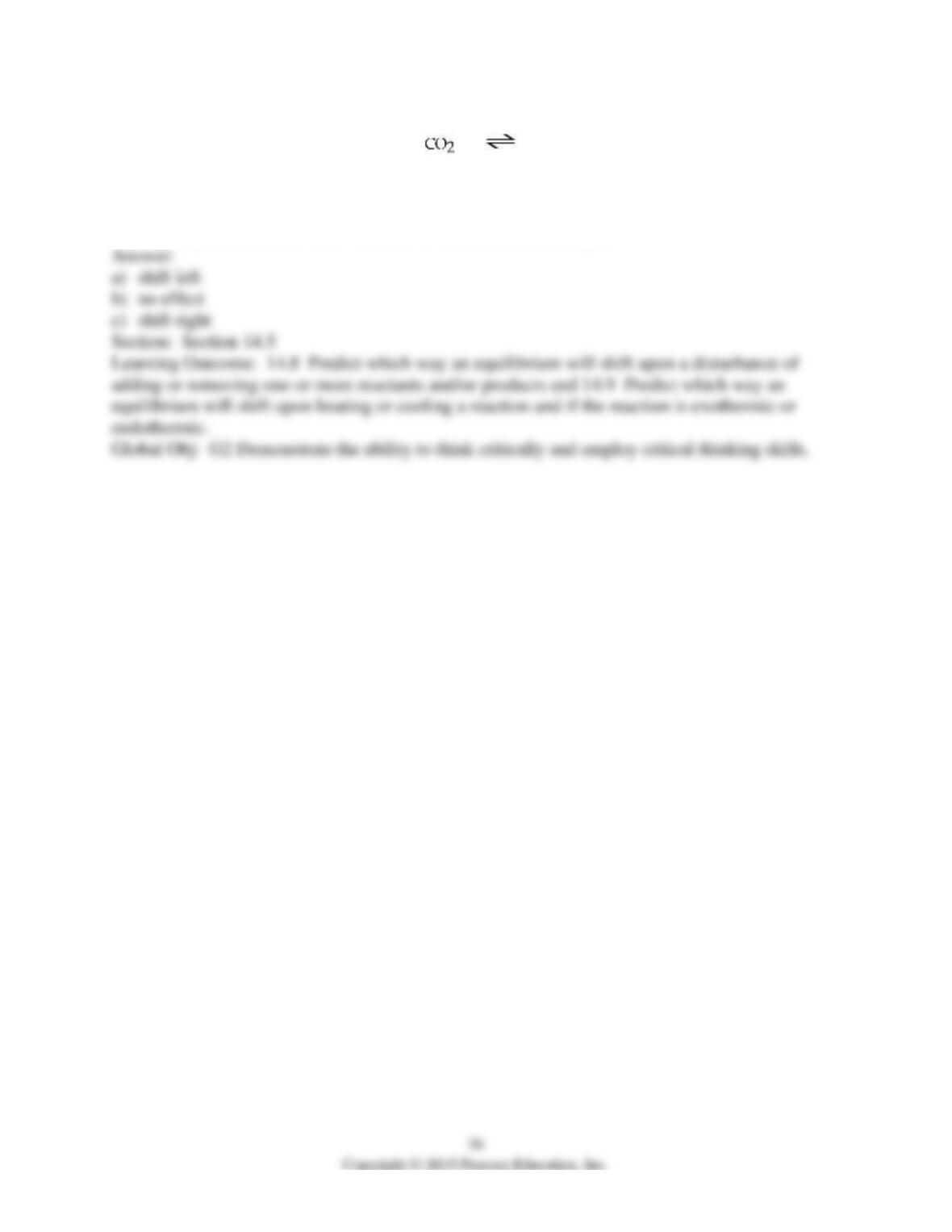
16) For the following endothermic reaction:
C (s) + (g) 2CO (g)
predict the direction of the reaction if:
a) CO concentration is increased with the temperature remaining constant.
b) some carbon (C) is removed with the temperature remaining constant)
c) the temperature is increased with the concentrations unchanged.

27
14.4 Matching Questions
Identify each of the equilibrium constant values in the first column as “Equilibrium lies to the
right/products favored” or “Equilibrium lies to the left/reactants favored.”
A) Equilibrium lies to the right/ products favored
B) Equilibrium lies to the left/reactants favored
1) 0.563
Section: Section 14.3
Learning Outcome: 14.6 Interpret the meaning of an equilibrium constant based on its
magnitude.
Global Obj: G2 Demonstrate the ability to think critically and employ critical thinking skills.
2) 4.23
Section: Section 14.3
Learning Outcome: 14.6 Interpret the meaning of an equilibrium constant based on its
magnitude.
Global Obj: G2 Demonstrate the ability to think critically and employ critical thinking skills.
3) 2.3 × 10³
Section: Section 14.3
Learning Outcome: 14.6 Interpret the meaning of an equilibrium constant based on its
magnitude.
Global Obj: G2 Demonstrate the ability to think critically and employ critical thinking skills.
4) 4.5 × 10⁻²
Section: Section 14.3
Learning Outcome: 14.6 Interpret the meaning of an equilibrium constant based on its
magnitude.
Global Obj: G2 Demonstrate the ability to think critically and employ critical thinking skills.
5) 3.7 × 10³
Section: Section 14.3
Learning Outcome: 14.6 Interpret the meaning of an equilibrium constant based on its
magnitude.
Global Obj: G2 Demonstrate the ability to think critically and employ critical thinking skills.
6) 2356.3
Section: Section 14.3
Learning Outcome: 14.6 Interpret the meaning of an equilibrium constant based on its
magnitude.
Global Obj: G2 Demonstrate the ability to think critically and employ critical thinking skills.

28
7) 3.1 × 10⁻⁸
Section: Section 14.3
Learning Outcome: 14.6 Interpret the meaning of an equilibrium constant based on its
magnitude.
Global Obj: G2 Demonstrate the ability to think critically and employ critical thinking skills.
8) 6.2 × 10¹⁰
Section: Section 14.3
Learning Outcome: 14.6 Interpret the meaning of an equilibrium constant based on its
magnitude.
Global Obj: G2 Demonstrate the ability to think critically and employ critical thinking skills.
Match each reaction and its equilibrium concentrations that appear in the left column with the
corresponding equilibrium constant value that appears in the right column.
A) 25
B) 12.3
C) 5.0
9) N2 (g)+ 2 H2 (g) N2H4 (g)
[H2] = 0.20 M, [N2] = 0.10 M, [N2H4] = 0.10 M
Section: Section 14.3
Learning Outcome: 14.5 Calculate the value of the equilibrium constant for a reaction.
Global Obj: G4 Demonstrate the quantitative skills needed to succeed in chemistry.
10) 2 NH3 (g) N2 (g) + 3H2 (g)
[H2] = 0.420 M, [N2] = 0.600 M, [NH3] = 0.060 M
Section: Section 14.3
Learning Outcome: 14.5 Calculate the value of the equilibrium constant for a reaction.
Global Obj: G4 Demonstrate the quantitative skills needed to succeed in chemistry.
11) N2O5 (g) 2 O2 (g) +
[N2O] = 0.50 M, [O2] = 1.0 M, [N2O5] = 0.10 M
Section: Section 14.3
Learning Outcome: 14.5 Calculate the value of the equilibrium constant for a reaction.
Global Obj: G4 Demonstrate the quantitative skills needed to succeed in chemistry.

29
Predict the effect of increasing pressure in each of the reactions in the first column by choosing
the appropriate direction shift in the right column.
A) no effect
B) right (→)
C) left (←)
12) 2 SO3 (g) + 2 Cl2 (g)
Section: Section 14.4
Global Obj: G2 Demonstrate the ability to think critically and employ critical thinking skills.
13) 2 NH3 (g) N2 (g) + 3 H2 (g)
Section: Section 14.4
Global Obj: G2 Demonstrate the ability to think critically and employ critical thinking skills.
14) l2 (g) + H2 (g) 2 HI (g)
Section: Section 14.4
Global Obj: G2 Demonstrate the ability to think critically and employ critical thinking skills.
15) O2 (g) + 2F2 (g) 2 OF2 (g)
Section: Section 14.4
Global Obj: G2 Demonstrate the ability to think critically and employ critical thinking skills.
16) CH4 (g) + 2 O2 (g)
Section: Section 14.4
Global Obj: G2 Demonstrate the ability to think critically and employ critical thinking skills.
17) 2 C8H18 (g) + 25 O2 (g)
Section: Section 14.4
Global Obj: G2 Demonstrate the ability to think critically and employ critical thinking skills.

30
Predict the effect of increasing the concentration of the bolded species in each of the balanced
equations in the first column by choosing the appropriate direction shift in the right column.
A) left (←)
B) right (→)
18) 2 SO3 (g) + 2 Cl2 (g)
Section: Section 14.4
Learning Outcome: 14.8 Predict which way an equilibrium will shift upon a disturbance of
adding or removing one or more reactants and/or products.
Global Obj: G2 Demonstrate the ability to think critically and employ critical thinking skills.
19) 2 NH3 (g) N2 (g) + 3 H2 (g)
Section: Section 14.4
Learning Outcome: 14.8 Predict which way an equilibrium will shift upon a disturbance of
adding or removing one or more reactants and/or products.
Global Obj: G2 Demonstrate the ability to think critically and employ critical thinking skills.
20) l2 (g) + H2 (g) 2 HI (g)
Section: Section 14.4
Learning Outcome: 14.8 Predict which way an equilibrium will shift upon a disturbance of
adding or removing one or more reactants and/or products.
Global Obj: G2 Demonstrate the ability to think critically and employ critical thinking skills.
21) O2 (g) + 2 F2 (g) 2 OF2 (g)
Section: Section 14.4
Learning Outcome: 14.8 Predict which way an equilibrium will shift upon a disturbance of
adding or removing one or more reactants and/or products.
Global Obj: G2 Demonstrate the ability to think critically and employ critical thinking skills.
22) CH4 (g) + 2 O2 (g)
Section: Section 14.4
Learning Outcome: 14.8 Predict which way an equilibrium will shift upon a disturbance of
adding or removing one or more reactants and/or products.
Global Obj: G2 Demonstrate the ability to think critically and employ critical thinking skills.
23) 2 C8H18 (g) + 25 O2
Section: Section 14.4
Learning Outcome: 14.8 Predict which way an equilibrium will shift upon a disturbance of
adding or removing one or more reactants and/or products.
Global Obj: G2 Demonstrate the ability to think critically and employ critical thinking skills.

31
Consider the reaction: C (s) + CO2 (g) 2 CO (g) (endothermic). Match each equilibrium
change described in the left column with the corresponding consequence in the right column.
A) Equilibrium is shifted to the right.
B) No effect on the equilibrium.
C) Equilibrium is shifted to the left.
24) adding heat
Section: Section 14.5
Learning Outcome: 14.9 Predict which way an equilibrium will shift upon heating or cooling a
reaction and if the reaction is exothermic or endothermic.
Global Obj: G2 Demonstrate the ability to think critically and employ critical thinking skills.
25) adding a catalyst
Section: Section 14.4
Global Obj: G2 Demonstrate the ability to think critically and employ critical thinking skills.
26) adding carbon monoxide
Section: Section 14.4
Learning Outcome: 14.8 Predict which way an equilibrium will shift upon a disturbance of
adding or removing one or more reactants and/or products.
Global Obj: G2 Demonstrate the ability to think critically and employ critical thinking skills.
27) adding extra carbon
Section: Section 14.4
Learning Outcome: 14.8 Predict which way an equilibrium will shift upon a disturbance of
adding or removing one or more reactants and/or products.
Global Obj: G2 Demonstrate the ability to think critically and employ critical thinking skills.
28) adding extra carbon dioxide
Section: Section 14.4
Learning Outcome: 14.8 Predict which way an equilibrium will shift upon a disturbance of
adding or removing one or more reactants and/or products.
Global Obj: G2 Demonstrate the ability to think critically and employ critical thinking skills.
29) increasing the pressure
Section: Section 14.4
Global Obj: G2 Demonstrate the ability to think critically and employ critical thinking skills.
30) cooling the mixture
Section: Section 14.5
Learning Outcome: 14.9 Predict which way an equilibrium will shift upon heating or cooling a
reaction and if the reaction is exothermic or endothermic.
Global Obj: G2 Demonstrate the ability to think critically and employ critical thinking skills.

31) expanding the reaction vessel
Section: Section 14.4
Global Obj: G2 Demonstrate the ability to think critically and employ critical thinking skills.
32) decreasing the pressure
Section: Section 14.4
Global Obj: G2 Demonstrate the ability to think critically and employ critical thinking skills.