11) is expected to have a greater energy of hydration than .
12) The process of surrounding solute ions with solvent molecules is called solvation.
13) Situations of great disorder are said to have “high entropies.”
14) It is not possible to make a solution in which both the solute and the solvent are gases.
15) For most molecular solids an increase in temperature generally causes an increase in
solubility.
16) The bends, a condition encountered by divers, is attributed to the rapid depressurized escape
of nitrogen from blood to form bubbles in the blood.
17) Once the temperature of 100.°C is reached, liquid water spontaneously becomes a gas.
18) A hydrophobic group will be attracted to water.
19) Dry cleaning uses perchloroethane to remove grease and oil from clothes.
20) Nonpolar solutes will usually dissolve in polar solvents.
21) Polar solutes will usually dissolve in polar solvents.
22) C8H18 will dissolve in CCl4.
23) NH3 will dissolve in BF3.
24) Hydrocarbons, such as pentane C5H12, are water soluble.
25) A solution prepared by dissolving 24 g potassium sulfate in 150 mL total solution has a
molarity of 0.92 M.
26) Molarity is defined as moles of solute per liter of solvent.
27) There is no difference between the “molarity” and the “percent composition” of a given
solution.
28) A 1.0 percent by mass of saline solution contains 1 g of NaCl plus 99 g of water.
29) A 20 percent by mass of NaOH solution is made by dissolving 5 g NaOH in 25 g water.
30) 25 mL of 0.2 M NaOH solution will neutralize 10 mL of 0.5 M HCl solution.
31) 100 mL of 1.0 M KOH solution will neutralize 100 mL of 1.0 M H2SO4 solution.
32) The addition of NaCl to water will decrease the freezing point.
33) A saline solution will boil at 100 °C.
1) How does the phrase “like dissolves like” help to explain why a solute like sodium chloride
(NaCl) and a solvent like water should form a solution?
2) What are two physical properties of water that make it an especially useful and common
solvent?
3) Use the general rule “like dissolves like” to briefly explain why vegetable oil (nonpolar) will
not dissolve in water (polar).
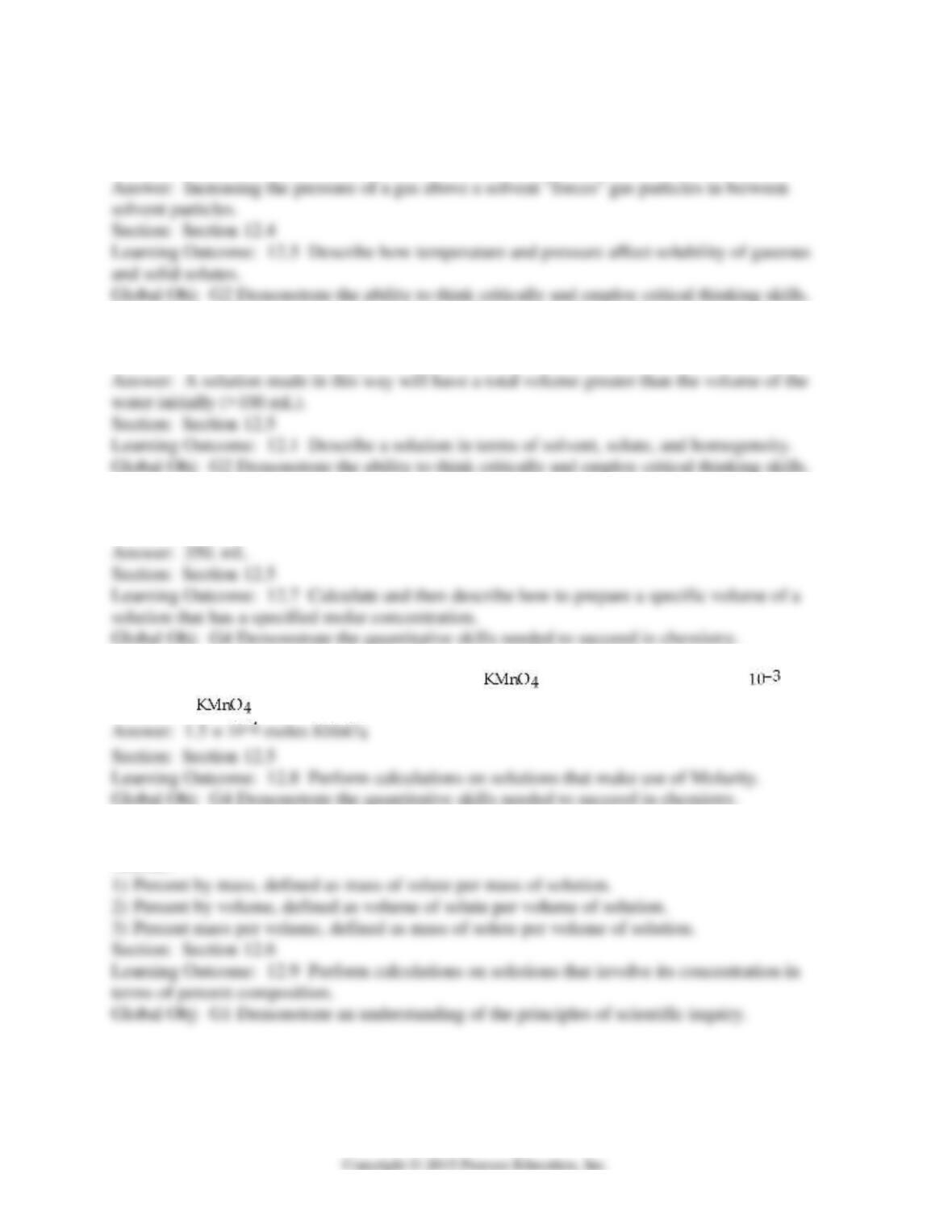
20
4) Briefly, how does increasing the pressure of a gas over a given solvent increase the amount of
that gas that can be dissolved in that solvent?
5) If 30 grams of sodium chloride are added to 100 mL of water, will the resulting volume of the
solution be less than, exactly, or greater than 100 mL?
6) What volume of a 1.05 M stock solution of HCl should be used to prepare 4.00 L of a 0.0920
M HCl solution?
7) How many moles of potassium permanganate ( ) are in 28.86 mL of a 5.2 × M
solution of ?
8) What are the three ways that “percent composition” can be described for a given solution?
Answer:
9) How many grams of NaOH are needed to prepare 500. mL of an aqueous solution that is
10.0% NaOH by mass? (Assume the density of such a solution to be 1.08 g/mL.)
10) How many grams of are in 2.60 L of a 1.28 M solution of ?

12.4 Matching Questions
Match each term in the left column with the corresponding definition that appears in the right
column.
A) insoluble in water, such as the nonpolar hydrocarbon tail of a detergent molecule
B) soluble in water, such as the polar end of a detergent molecule
C) the spherical structure formed by detergent molecules when added to water
D) a measure of the disorder in a system
E) a solution of two or more metals
1) micelle
Section: Section 12.9
Learning Outcome: 12.13d Describe the two parts of a soap molecule and how it functions to
make unlikes dissolve.
Global Obj: G1 Demonstrate an understanding of the principles of scientific inquiry.
2) hydrophobic
Section: Section 12.9
Learning Outcome: 12.13d Describe the two parts of a soap molecule and how it functions to
make unlikes dissolve.
Global Obj: G1 Demonstrate an understanding of the principles of scientific inquiry.
3) hydrophilic
Section: Section 12.9
Learning Outcome: 12.13d Describe the two parts of a soap molecule and how it functions to
make unlikes dissolve.
Global Obj: G1 Demonstrate an understanding of the principles of scientific inquiry.
4) alloy
Section: Section 12.1
Learning Outcome: 12.1 Describe a solution in terms of solvent, solute, and homogeneity.
Global Obj: G1 Demonstrate an understanding of the principles of scientific inquiry.
5) entropy
Section: Section 12.3
Learning Outcome: 12.3 Define entropy and its natural tendency.
Global Obj: G1 Demonstrate an understanding of the principles of scientific inquiry.

Match each sodium salt solution in the left column with the corresponding number of sodium ion
moles that appear in the right column.
A) 0.04
B) 0.02
C) 0.06
6) 100 mL of 0.2 M sodium hydroxide solution
Section: Section 12.5
Learning Outcome: 12.8 Perform calculations on solutions that make use of Molarity.
Global Obj: G4 Demonstrate the quantitative skills needed to succeed in chemistry.
7) 100 mL of 0.2 M sodium sulfate solution
Section: Section 12.5
Learning Outcome: 12.8 Perform calculations on solutions that make use of Molarity.
Global Obj: G4 Demonstrate the quantitative skills needed to succeed in chemistry.
8) 100 mL of 0.2 M sodium phosphate solution
Section: Section 12.5
Learning Outcome: 12.8 Perform calculations on solutions that make use of Molarity.
Global Obj: G4 Demonstrate the quantitative skills needed to succeed in chemistry.
9) 100 mL of 0.2 M sodium chromate solution
Section: Section 12.5
Learning Outcome: 12.8 Perform calculations on solutions that make use of Molarity.
Global Obj: G4 Demonstrate the quantitative skills needed to succeed in chemistry.
10) 100 mL of 0.2 M sodium nitrate solution
Section: Section 12.5
Learning Outcome: 12.8 Perform calculations on solutions that make use of Molarity.
Global Obj: G4 Demonstrate the quantitative skills needed to succeed in chemistry.
11) 100 mL of 0.2 M sodium hypochlorite solution
Section: Section 12.5
Learning Outcome: 12.8 Perform calculations on solutions that make use of Molarity.
Global Obj: G4 Demonstrate the quantitative skills needed to succeed in chemistry.
12) 100 mL of 0.2 M sodium cyanide solution
Section: Section 12.5
Learning Outcome: 12.8 Perform calculations on solutions that make use of Molarity.
Global Obj: G4 Demonstrate the quantitative skills needed to succeed in chemistry.

24
Match each of the aqueous solutions on the left with the corresponding molarity that appears in
the right column.
A) 1.3 M
B) 0.80 M
C) 4.4 M
D) 2.80 M
E) 0.5 M
F) 0.11 M
G) 0.60 M
13) 2.0 moles of glucose in solution
Section: Section 12.5
Learning Outcome: 12.8 Perform calculations on solutions that make use of Molarity.
Global Obj: G4 Demonstrate the quantitative skills needed to succeed in chemistry.
14) 0.70 moles NaCl in 250 mL of solution
Section: Section 12.5
Learning Outcome: 12.8 Perform calculations on solutions that make use of Molarity.
Global Obj: G4 Demonstrate the quantitative skills needed to succeed in chemistry.
15) 0.50 moles HCl in 375 mL of solution
Section: Section 12.5
Learning Outcome: 12.8 Perform calculations on solutions that make use of Molarity.
Global Obj: G4 Demonstrate the quantitative skills needed to succeed in chemistry.
16) 0.60 moles KI in 1.0 L of solution
Section: Section 12.5
Learning Outcome: 12.8 Perform calculations on solutions that make use of Molarity.
Global Obj: G4 Demonstrate the quantitative skills needed to succeed in chemistry.
17) 0.50 moles NaOH in 4.5 L of solution
Section: Section 12.5
Learning Outcome: 12.8 Perform calculations on solutions that make use of Molarity.
Global Obj: G4 Demonstrate the quantitative skills needed to succeed in chemistry.
18) 0.16 moles KOH in 2.0 x 10³ mL of solution
Section: Section 12.5
Learning Outcome: 12.8 Perform calculations on solutions that make use of Molarity.
Global Obj: G4 Demonstrate the quantitative skills needed to succeed in chemistry.
19) 2.2 moles of sugar in 5.0 x 10² mL of solution
Section: Section 12.5
Learning Outcome: 12.8 Perform calculations on solutions that make use of Molarity.
Global Obj: G4 Demonstrate the quantitative skills needed to succeed in chemistry.

20) 0.90 moles HI in 1.5 L of solution
Section: Section 12.5
Learning Outcome: 12.8 Perform calculations on solutions that make use of Molarity.
Global Obj: G4 Demonstrate the quantitative skills needed to succeed in chemistry.
Match each solution that appears in the left column with the corresponding mass of solute that
appears in the right column.
A) 3.9 g
B) 0.15 g
C) 1.07 g
D) 15.6 g
E) 78 g
21) 25.0 mL of 0.10 M NaCl
Section: Section 12.5
Learning Outcome: 12.8 Perform calculations on solutions that make use of Molarity.
Global Obj: G4 Demonstrate the quantitative skills needed to succeed in chemistry.
22) 3.0 x 10² mL of 1.5 M K2SO4
Section: Section 12.5
Learning Outcome: 12.8 Perform calculations on solutions that make use of Molarity.
Global Obj: G4 Demonstrate the quantitative skills needed to succeed in chemistry.
23) 1.50 L of 0.0694 M CsOH
Section: Section 12.5
Learning Outcome: 12.8 Perform calculations on solutions that make use of Molarity.
Global Obj: G4 Demonstrate the quantitative skills needed to succeed in chemistry.
24) 800. mL of 0.050 M H2SO4
Section: Section 12.5
Learning Outcome: 12.8 Perform calculations on solutions that make use of Molarity.
Global Obj: G4 Demonstrate the quantitative skills needed to succeed in chemistry.
25) 125 mL of 0.0250 M C12H22O11
Section: Section 12.5
Learning Outcome: 12.8 Perform calculations on solutions that make use of Molarity.
Global Obj: G4 Demonstrate the quantitative skills needed to succeed in chemistry.

Match each mass of solute and molarity of the solution that appears in the left column with the
corresponding total volume of the solution that appears in the right column.
A) 2.0 L
B) 1.20 L
C) 0.99 L
D) 10.0 mL
26) 0.15 M nickel(II) sulfate solution containing 47 g of solute
Section: Section 12.5
Learning Outcome: 12.8 Perform calculations on solutions that make use of Molarity.
Global Obj: G4 Demonstrate the quantitative skills needed to succeed in chemistry.
27) 1.10 M lead(II) nitrate solution containing 437 g of solute
Section: Section 12.5
Learning Outcome: 12.8 Perform calculations on solutions that make use of Molarity.
Global Obj: G4 Demonstrate the quantitative skills needed to succeed in chemistry.
28) 0.32 M HNO3 solution containing 20. g of solute
Section: Section 12.5
Learning Outcome: 12.8 Perform calculations on solutions that make use of Molarity.
Global Obj: G4 Demonstrate the quantitative skills needed to succeed in chemistry.
29) 0.0510 M H2SO4 solution containing 50.0 mg of solute
Section: Section 12.5
Learning Outcome: 12.8 Perform calculations on solutions that make use of Molarity.
Global Obj: G4 Demonstrate the quantitative skills needed to succeed in chemistry.

Match each sulfate salt solution in the left column with the corresponding number of sulfate ion
moles that appear in the right column. Assume all salts dissolve in water.
A) 0.0002
B) 0.0001
C) 0.0003
30) 500 mL of 0.0002 M sodium sulfate solution
Section: Section 12.5
Learning Outcome: 12.8 Perform calculations on solutions that make use of Molarity.
Global Obj: G4 Demonstrate the quantitative skills needed to succeed in chemistry.
31) 500 mL of 0.0002 M magnesium sulfate solution
Section: Section 12.5
Learning Outcome: 12.8 Perform calculations on solutions that make use of Molarity.
Global Obj: G4 Demonstrate the quantitative skills needed to succeed in chemistry.
32) 500 mL of 0.0002 M aluminum sulfate solution
Section: Section 12.5
Learning Outcome: 12.8 Perform calculations on solutions that make use of Molarity.
Global Obj: G4 Demonstrate the quantitative skills needed to succeed in chemistry.
33) 500 mL of 0.0002 M ammonium sulfate solution
Section: Section 12.5
Learning Outcome: 12.8 Perform calculations on solutions that make use of Molarity.
Global Obj: G4 Demonstrate the quantitative skills needed to succeed in chemistry.
34) 500 mL of 0.0002 M iron(III) sulfate solution
Section: Section 12.5
Learning Outcome: 12.8 Perform calculations on solutions that make use of Molarity.
Global Obj: G4 Demonstrate the quantitative skills needed to succeed in chemistry.
35) 500 mL of 0.0002 M tin(IV) sulfate solution
Section: Section 12.5
Learning Outcome: 12.8 Perform calculations on solutions that make use of Molarity.
Global Obj: G4 Demonstrate the quantitative skills needed to succeed in chemistry.

Match each of the solutions in the left column with the corresponding w/w % of that solution that
appears in the right column.
A) 5.0%
B) 25%
C) 2.0%
D) 20.%
E) 40.%
F) 11%
36) 20. g NaOH in 50. g of solution
Section: Section 12.6
Learning Outcome: 12.9 Perform calculations on solutions that involve its concentration in
terms of percent composition.
Global Obj: G4 Demonstrate the quantitative skills needed to succeed in chemistry.
37) 5.0 g NaCl in 25 g of solution
Section: Section 12.6
Learning Outcome: 12.9 Perform calculations on solutions that involve its concentration in
terms of percent composition.
Global Obj: G4 Demonstrate the quantitative skills needed to succeed in chemistry.
38) 2.0 g KBr in 40. g of solution
Section: Section 12.6
Learning Outcome: 12.9 Perform calculations on solutions that involve its concentration in
terms of percent composition.
Global Obj: G4 Demonstrate the quantitative skills needed to succeed in chemistry.
39) 5.0 g LiI in 250 g of solution
Section: Section 12.6
Learning Outcome: 12.9 Perform calculations on solutions that involve its concentration in
terms of percent composition.
Global Obj: G4 Demonstrate the quantitative skills needed to succeed in chemistry.
40) 15 g sugar in 60. g of solution
Section: Section 12.6
Learning Outcome: 12.9 Perform calculations on solutions that involve its concentration in
terms of percent composition.
Global Obj: G4 Demonstrate the quantitative skills needed to succeed in chemistry.
41) 1.0 g CaCl2 in 9.0 g of solution
Section: Section 12.6
Learning Outcome: 12.9 Perform calculations on solutions that involve its concentration in
terms of percent composition.
Global Obj: G4 Demonstrate the quantitative skills needed to succeed in chemistry.

Match the term in the left column with the corresponding definition that appears in the right
column.
A) the point at which the number of moles of acid equal the number of moles of base
B) a process used to find out when stoichiometrically equal quantities of an acid and a base
neutralize each other
C) a compound that is used to detect the end point of a titration by a color change
D) a solution whose concentration is accurately known
E) a piece of glassware through which a solution volume is accurately dispensed during
neutralization
42) standardized solution
Section: Section 12.7
Learning Outcome: 12.1 Describe a solution in terms of solvent, solute, and homogeneity.
Global Obj: G1 Demonstrate an understanding of the principles of scientific inquiry.
43) buret
Section: Section 12.7
Global Obj: G1 Demonstrate an understanding of the principles of scientific inquiry.
44) equivalence point
Section: Section 12.7
Global Obj: G1 Demonstrate an understanding of the principles of scientific inquiry.
45) indicator
Section: Section 12.7
Global Obj: G1 Demonstrate an understanding of the principles of scientific inquiry.
46) titration
Section: Section 12.7
Global Obj: G1 Demonstrate an understanding of the principles of scientific inquiry.