80) 100. cal of heat are added to 10 g of ethanol (0.581 cal/g °C) originally at 15 °C. The final
temperature is ________.
A) 17 °C
B) 27 °C
C) 32 °C
D) 38 °C
81) How many Joules of heat are required to raise the temperature of 35 mL of water from 25 °C
to 100 °C?
A) 630 J
B) 2.6 × 10³ J
C) 1.1 × 10⁴ J
D) 1.0 × 10³ J
82) Which of the following statements about energy is correct?
A) Energy is the ability to do work.
B) When energy is absorbed by a system, its temperature increases.
C) Heat energy may be converted to work.
D) All of the above are correct.
83) The specific heat of water is higher than that of iron. Which of the following statements is
correct?
A) The energy needed to heat iron to a certain temperature is less than the energy needed to raise
the water temperature to the same level.
B) If the same quantity of energy is applied to both water and iron, iron’s temperature will be
much higher.
C) Iron is a better heat conductor.
D) All of the above statements are correct.
84) Which of the following is not a conversion factor?
A) speed
B) density
C) energy
D) specific heat
85) Which of the following is a conversion factor?
A) mass
B) density
C) volume
D) time
2.2 True/False Questions
1) Precision refers to how close the measured result is to the true value.
2) The measured value 12.011 can be assumed to be accurate to +/- 0.001.
3) The commonly quoted distance from the earth to the sun (93,000,000 miles) is accurate to
only miles.
4) Leading zeros are all the zeros that follow the first non-zero digit.
5) When determining the number of significant figures in a number, leading zeros are not
significant.
6) When determining the number of significant figures in a number, trailing zeros are not
significant.
7) Trailing zeros are also called place-holding zeros.
8) When adding or subtracting measured numbers, the answer contains no more significant
figures than the number with the least number of significant figures being added or subtracted.
9) The correct answer for the product (2.150 × 12.2) is 26.23.
10) Coulomb is the derived SI unit that measures electrical charge.
11) Joule is the derived SI unit that measures energy.
12) The derived SI unit for pressure is cubic inches.
13) 1 kilowatt is equal to 10,000 watts.
14) 2 × 10⁻³ meters is equal to 2 kilometers.
15) One meter is equal to 1 million micrometers.
16) The prefix micro- indicates one millionth.
17) The prefix pico- indicates one billionth.
18) One mL is equal to 1 cc.
19) A pound of feathers really does not weigh more than a pound of gold.
20) 0 K is equal to -273.15 °C.
21) -40 °C is equivalent to -40 °F.
22) 40 °C is equivalent to 40 °F.
23) There has never been recorded a negative Kelvin temperature.
24) The Kelvin temperature is not always higher than the equivalent Celsius temperature.
25) The Fahrenheit temperature is always numerically higher than the equivalent Celsius
temperature.
26) Density is an extensive property of matter the more of a given substance you have, the more
dense it becomes.
27) Oil “floats” on water because oil weighs less than water.
28) Oil “floats” on water because oil is less dense than water.
29) Density units may be in lb/ gallon.
30) The fact that ice has a lower density than liquid water is advantageous to marine life.
31) Salt water has a density that is less than 1 g/mL.
32) Ice always occupies a smaller volume than water.
33) Density is a conversion factor.
34) One week contains 604,800 seconds.
35) There are 4 pints in a gallon.
36) Specific heat may be measured as cal. g/°C.
37) A substance that may be a good heat conductor usually has a low value for specific heat.
38) Water is a good heat conductor.
39) When heat is absorbed the temperature of the system increases.
40) Temperature changes that may be used for energy difference calculations are measured
through a bomb calorimeter.
41) One Cal of energy used by dieticians and the food industry is equal to 4.184 joules.
42) One Cal is equal to 1 kcal.
1) How many significant digits are there in the number 740.2?
2) How many significant digits are there in the number 0.0038040?
3) What is the Greek prefix and abbreviation which signifies one thousand?
4) Convert 16.8 meters to: a) millimeters, b) centimeters, c) kilometers.
5) Convert 65 °F, a cool summer’s daytime temperature, to:
a) degrees Celsius.
b) absolute temperature (Kelvin).
6) What is the density, in g/mL, of a piece of metal that weighs 0.408 kg and displaces 0.0297 L
of water?
7) Convert 302 cubic inches to liters (1 inch = 2.54 centimeters). Show the math.
8) Convert 15.0 ft3 to m3. Show the math.
9) It is 1148 miles from Grand Rapids, Michigan, to Starkville, Mississippi. What is the same
distance in kilometers (1 mile = 1.61 kilometers)?
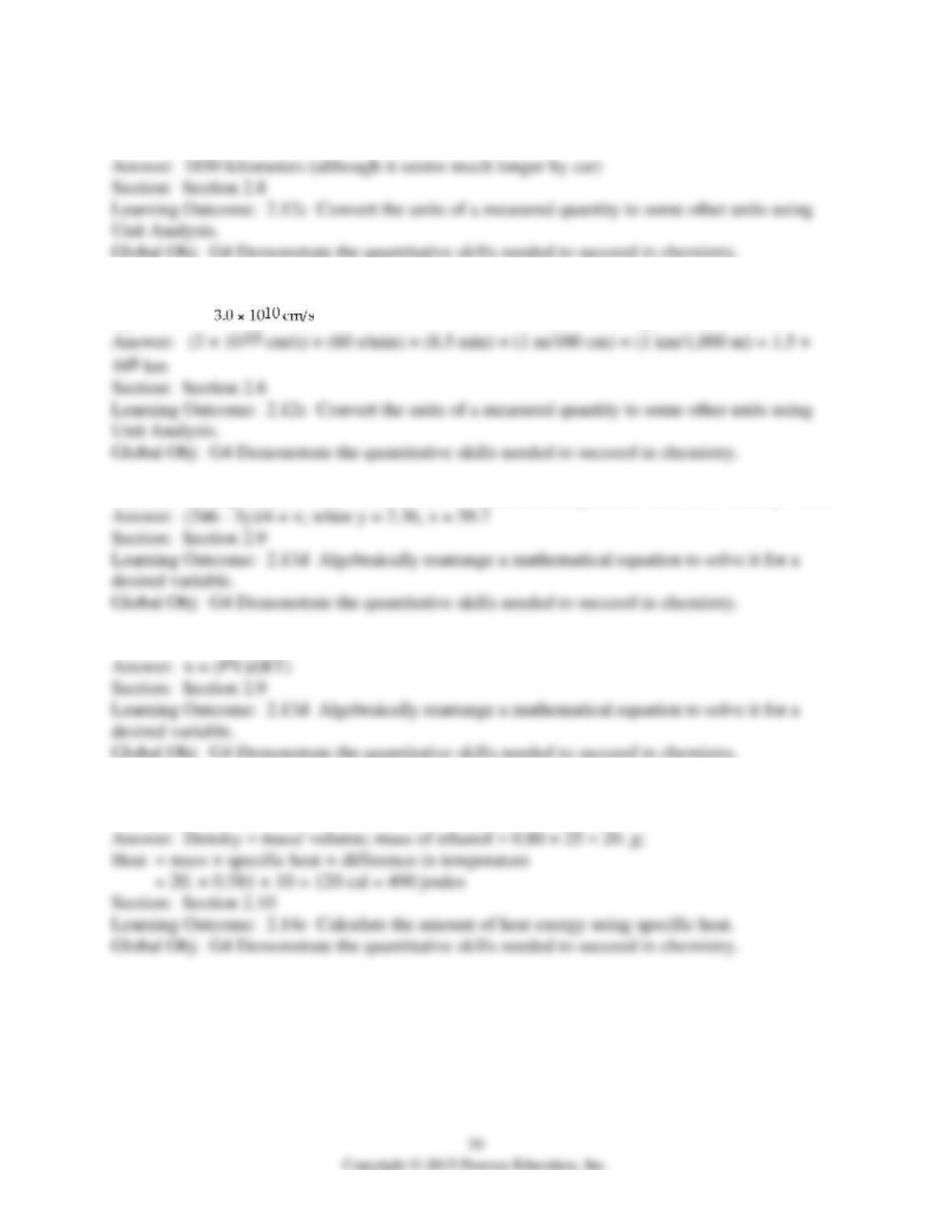
10) Calculate the approximate distance (in km) between earth and sun, given that the speed of
light is about and that it takes about 8.5 minutes for sunlight to reach earth.
11) Solve the equation 4x + 3y = 246 for the x-variable, and report the value for x when y = 2.36.
12) Solve the equation PV = nRT for the n-variable.
13) Calculate the amount of energy needed to raise the temperature of 25 mL ethanol (density =
0.80 g/mL) from 10.0 °C to 20.0 °C (c = 0.581 cal/g°C) both in cal and joules.

31
2.4 Matching Questions
Match the correct number of significant figures from the second column with each of the
numbers in the first column.
A) 7
B) 3
C) 2
D) 6
E) 5
F) 4
G) 1
1) 2.456 × 10⁻³
Section: Section 2.3
Learning Outcome: 2.4 Identify leading zeros and trailing zeros in a measured number.
Global Obj: G2 Demonstrate the ability to think critically and employ critical thinking skills.
2) 0.00201
Section: Section 2.3
Learning Outcome: 2.4 Identify leading zeros and trailing zeros in a measured number.
Global Obj: G2 Demonstrate the ability to think critically and employ critical thinking skills.
3) 34.3004
Section: Section 2.3
Learning Outcome: 2.4 Identify leading zeros and trailing zeros in a measured number.
Global Obj: G2 Demonstrate the ability to think critically and employ critical thinking skills.
4) 0.40001
Section: Section 2.3
Learning Outcome: 2.4 Identify leading zeros and trailing zeros in a measured number.
Global Obj: G2 Demonstrate the ability to think critically and employ critical thinking skills.
5) 4.0
Section: Section 2.3
Learning Outcome: 2.4 Identify leading zeros and trailing zeros in a measured number.
Global Obj: G2 Demonstrate the ability to think critically and employ critical thinking skills.
6) 0.7
Section: Section 2.3
Learning Outcome: 2.4 Identify leading zeros and trailing zeros in a measured number.
Global Obj: G2 Demonstrate the ability to think critically and employ critical thinking skills.
7) 0.02
Section: Section 2.3
Learning Outcome: 2.4 Identify leading zeros and trailing zeros in a measured number.
Global Obj: G2 Demonstrate the ability to think critically and employ critical thinking skills.

8) 5.2406
Section: Section 2.3
Learning Outcome: 2.4 Identify leading zeros and trailing zeros in a measured number.
Global Obj: G2 Demonstrate the ability to think critically and employ critical thinking skills.
9) 8.901070
Section: Section 2.3
Learning Outcome: 2.4 Identify leading zeros and trailing zeros in a measured number.
Global Obj: G2 Demonstrate the ability to think critically and employ critical thinking skills.
10) 0.002003
Section: Section 2.3
Learning Outcome: 2.4 Identify leading zeros and trailing zeros in a measured number.
Global Obj: G2 Demonstrate the ability to think critically and employ critical thinking skills.
11) 5000
Section: Section 2.3
Learning Outcome: 2.4 Identify leading zeros and trailing zeros in a measured number.
Global Obj: G2 Demonstrate the ability to think critically and employ critical thinking skills.
12) 5000.
Section: Section 2.3
Learning Outcome: 2.4 Identify leading zeros and trailing zeros in a measured number.
Global Obj: G2 Demonstrate the ability to think critically and employ critical thinking skills.