Introductory Chemistry: Atoms First, 5e (Russo/Silver)
Chapter 16 Nuclear Chemistry
16.1 Multiple Choice Questions
1) Isotopes have ________.
A) the same number of protons but different number of neutrons
B) the same number of neutrons but different number of protons
C) the same number protons and the same number of neutrons
D) different number protons and neutrons
2) 16O, 17O and 18O are ________ of oxygen.
A) isotopes
B) isomers
C) isobars
D) none of the above
3) Heavy water is ________.
A) water that contains cations such as magnesium, ferric and calcium
B) water whose hydrogens are deuterium
C) water whose hydrogens carry one neutron
D) both B and C
4) Which of the following particles has a mass number of 1?
A) proton
B) neutron
C) helium
D) both A and B
5) Which of the following particles is a nucleon?
A) proton
B) electron
C) positron
D) both A and B
6) Mass defect is ________.
A) the amount of mass that is converted to energy during a nuclear reaction
B) the amount of mass produced during a nuclear reaction
C) the amount of energy released when an atom forms from its subatomic particles
D) the amount of energy absorbed when an atom forms from its subatomic particles
7) Binding energy is ________.
A) the amount of mass that is converted to energy during a nuclear reaction
B) the amount of mass produced during a nuclear reaction
C) the amount of energy released when an atom forms from its subatomic particles
D) the amount of energy absorbed when an atom forms from its subatomic particles
8) Which of the following is the easiest to block from penetrating?
A) alpha emissions
B) beta emissions
C) neutrons
D) gamma rays
9) The n/p ratio is greater than 1 for stable isotopes, when the atomic number is larger than
________.
A) 10
B) 18
C) 20
D) 24
10) The only element whose most stable isotope has n/p < 1 is ________.
A) hydrogen
B) carbon
C) oxygen
D) helium
11) Which of the following half-lives is the most stable for an isotope?
A) 0.015 hr
B) 0.92 min
C) 56 s
D) 72 s
12) Which of the following half-lives is the most stable for an isotope?
A) 0.001 s
B) 0.92 s
C) 56 s
D) 72 s
13) If the half-life of an isotope is 5 hr, the amount of 20.0 g remaining after 15 hr will be
________.
A) 2.5 g
B) 5.0 g
C) 6.67 g
D) 10.0 g
14) How long will it take for a 5.0 g tritium sample to decay down to 0.313 g? The half-life of
tritium is 12 years.
A) 12 yrs
B) 24 yrs
C) 48 yrs
D) 96 yrs
15) Which of the following does not have an atomic number of 1?
A) proton
B) neutron
C) electron
D) deuterium
16) Which of the following has an atomic number of 0?
A) proton
B) neutron
C) positron
D) deuterium
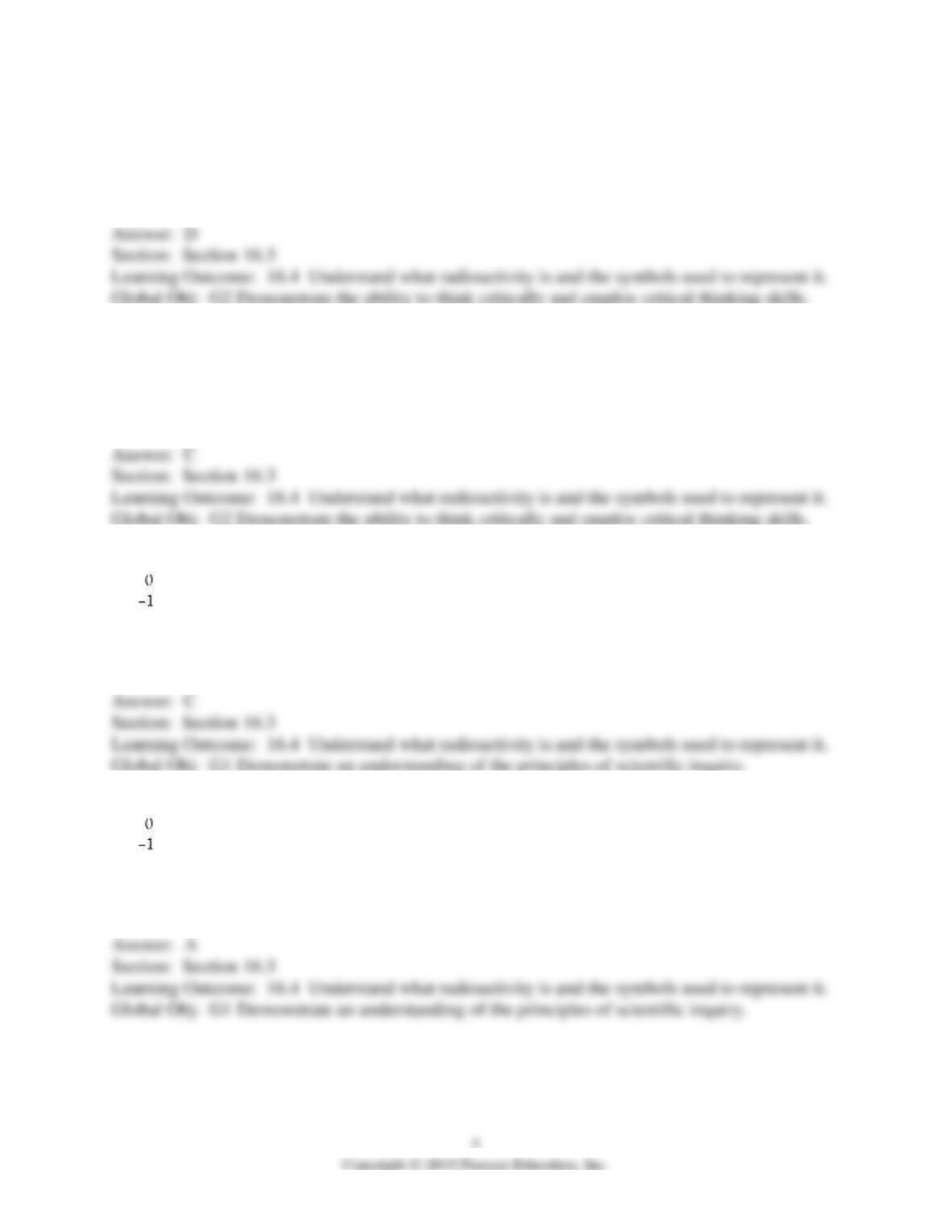
17) Which of the following does not carry proton(s)?
A) 1H
B) alpha rays
C) deuterium
D) gamma-rays
18) Which of the following does not carry neutrons?
A) 1n
B) alpha rays
C) 1H
D) deuterium
19) An alpha particle may be represented by ________.
A) e
B) 1n
C) 4He
D) 1H
20) An beta particle may be represented by ________.
A) e
B) 1n
C) 4He
D) 1H
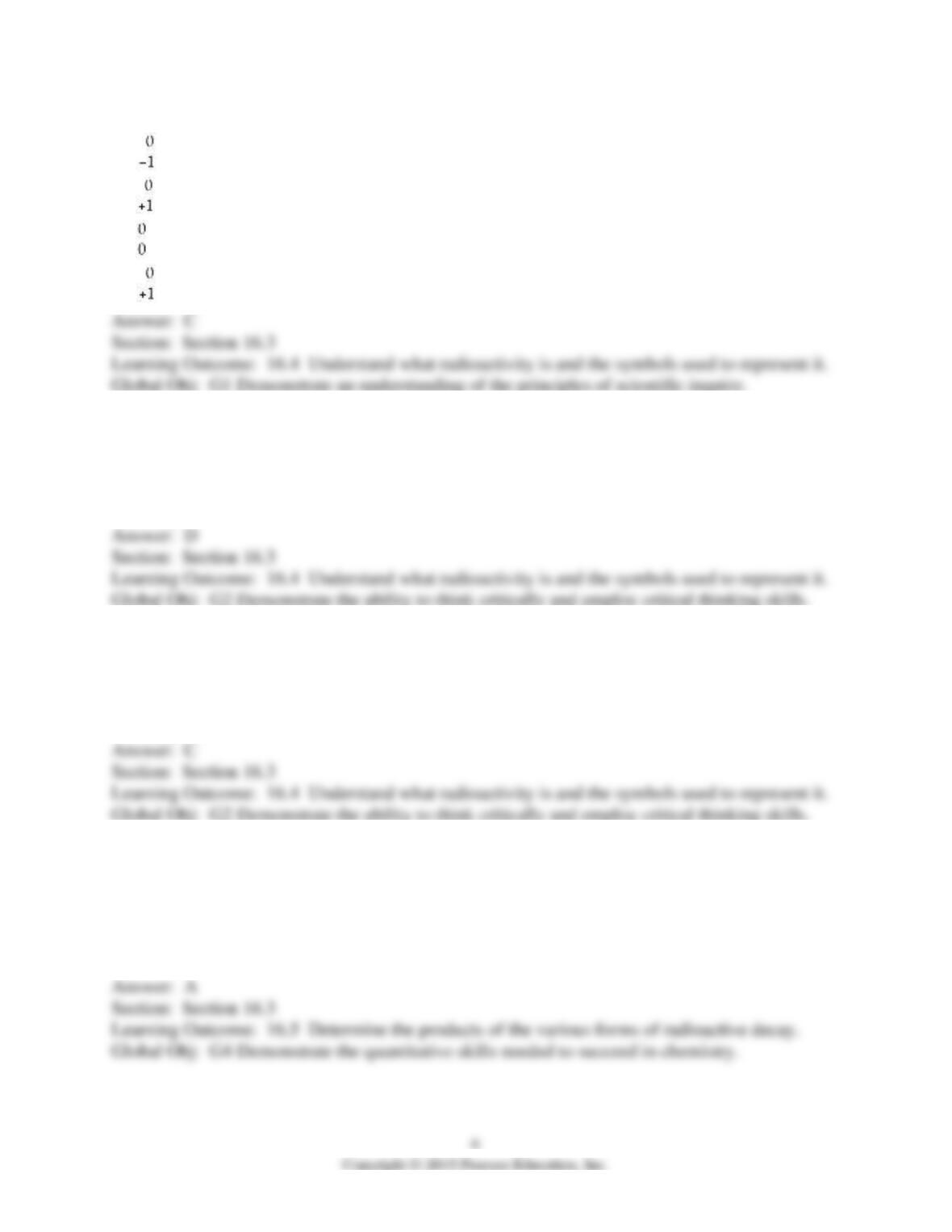
21) An gamma particle may be represented by ________.
A) e
B) e
C) γ
D) γ
22) Which is the lightest among the following particles?
A) proton
B) neutron
C) alpha particle
D) beta particle
23) Which of the following particles is the heaviest?
A) deuterium
B) neutron
C) alpha particle
D) beta particle
24) The process below is an example of ________.
238U → 234Th + 4He
A) alpha emission
B) beta emission
C) gamma emission
D) neutron emission
25) Which of the following is able to penetrate the easiest through human tissue?
A) alpha rays
B) beta rays
C) neutrons
D) gamma rays
26) When a neutron is transformed into a proton what else is emitted?
A) a beta particle
B) a gamma particle
C) an alpha particle
D) None of the above.
27) Which of the following transformations is not an electron capture?
A) 201Hg → 201Au
B) 81Rb → 81Kr
C) 231Th → 231Pa
D) p → n
28) Which of the following transformations is not an alpha emission?
A) 14C → 14N
B) 225Ac → 221Fr
C) 241Am → 237Np
D) 208Po → 204Pb
29) Which of the following is not a beta emitting reaction?
A) 231Th → 231Pa
B) 131I → 131Xe
C) 90Sr → 90Y
D) 226Ra → 222Rn
30) When carbon-14 is converted to nitrogen-14 ________.
A) an electron is captured
B) an alpha particle is emitted
C) an electron is released
D) a neutron is released
31) When nickel-63 is converted to copper-63 ________.
A) an electron is captured
B) an alpha particle is emitted
C) an electron is released
D) a neutron is released
32) When radium-226 is converted to radon-222 ________.
A) an electron is captured
B) an alpha particle is emitted
C) an electron is released
D) a neutron is released
33) The mercury-197 to gold-197 conversion is accompanied by ________.
A) an electron capture
B) an electron release
C) an alpha emission
D) a neutron capture
34) When an unstable nucleus emits a beta particle ________.
A) its mass number is decreased by four units
B) its atomic number is decreased by two units
C) its atomic number is increased by one unit
D) its mass number is decreased by one unit
35) When an unstable nucleus emits an alpha particle ________.
A) its mass number is decreased by four units
B) its atomic number is decreased by one unit
C) its atomic number is increased by one unit
D) its mass number is decreased by one unit
36) When an unstable nucleus expels a positron ________.
A) its mass number is decreased by four units
B) its atomic number is decreased by one unit
C) its atomic number is increased by one unit
D) its mass number is decreased by one unit
37) What is the missing particle in the reaction below?
? + 6Li → 2 4He (alpha particles)
A) 3H
B) 1H
C) 2H
D) 4He
38) What is the missing particle in the reaction below?
1p + 0e →?
A) 2p
B) 1H
C) 1n
D) 4He
39) Identify X in the reaction below.
238U + 12C → 244Cf + X
A) 6 electrons
B) 1 alpha particle
C) 3 protons
D) 6 neutrons
40) Identify X in the reaction below.
27Al + 4He → X + 1n
A) 31P
B) 30P
C) 30S
D) 31Si
41) Identify X in the reaction below.
X + 1n → 142Ba + 91Kr + 3 1n
A) 235Th
B) 238U
C) 235U
D) 234Pa
42) The main problem that nuclear reactors have when uranium-235 serves as the fuel is
________.
A) the production of more neutrons that the reaction consumes
B) the production of gamma rays
C) the consumption of more alpha particles than the available alpha particles
D) the immense amount of energy produced
43) Nuclear radiation is harmful because of ________.
A) the high energy particles produced
B) the electromagnetic radiation emitted by a nucleus during the nuclear change
C) the ionizing of biological molecules
D) all of the above
44) The reaction below is an example of ________.
12C + 12C → 24Mg
A) fission
B) fusion
C) isotope coupling
D) transmutation
45) The reaction below is an example of ________.
230U → 139Ba + 89Kr + 2 1n
A) fission
B) fusion
C) isotope
D) transmutation
16.2 True/False
1) 12C is the most stable carbon isotope.
2) The n/p > 1 ratio appears in elements whose atomic number is greater than 24.
3) 40Ar, 40K and 40Ca are isotopes.
4) 35Cl and 37Cl are isotopes.
5) The larger the half-life value, the more stable the isotope.