42) If the concentration of B is doubled while the concentration of A is unchanged, the rate will
________.
A (g) + 3B (g) → C (g) + 2D (g)
Rate = k[A][B]3
A) stay the same
B) be increased by a factor of 6
C) double
D) be increased by a factor of 8
43) The overall order of this reaction is ________.
A + B + C → Products
Rate = k[A]1[B]-1[C]2
A) 2
B) 3
C) 4
D) 5
44) The overall order is ________.
Rate = k[A]3[B]-1
A) -1
B) 0
C) 2
D) 3
45) The overall order is ________.
Rate = k[A]2[B]1
A) -1
B) 0
C) 2
D) 3
46) Doubling the concentration of A leads to doubling the rate, while doubling the concentration
of B has no effect on the rate. The rate equation is, therefore, ________.
A + B → C
A) Rate = k[A][B]
B) Rate = k[A]
C) Rate = k[A]2
D) Rate = k[A]2[B]
47) Doubling the concentration of A leads to doubling the rate, while doubling the concentration
of B quadruples the rate. The rate equation is, therefore, ________.
A + B → C
A) Rate = k[A][B]2
B) Rate = k[A]
C) Rate = k[A]2
D) Rate = k[A]2[B]
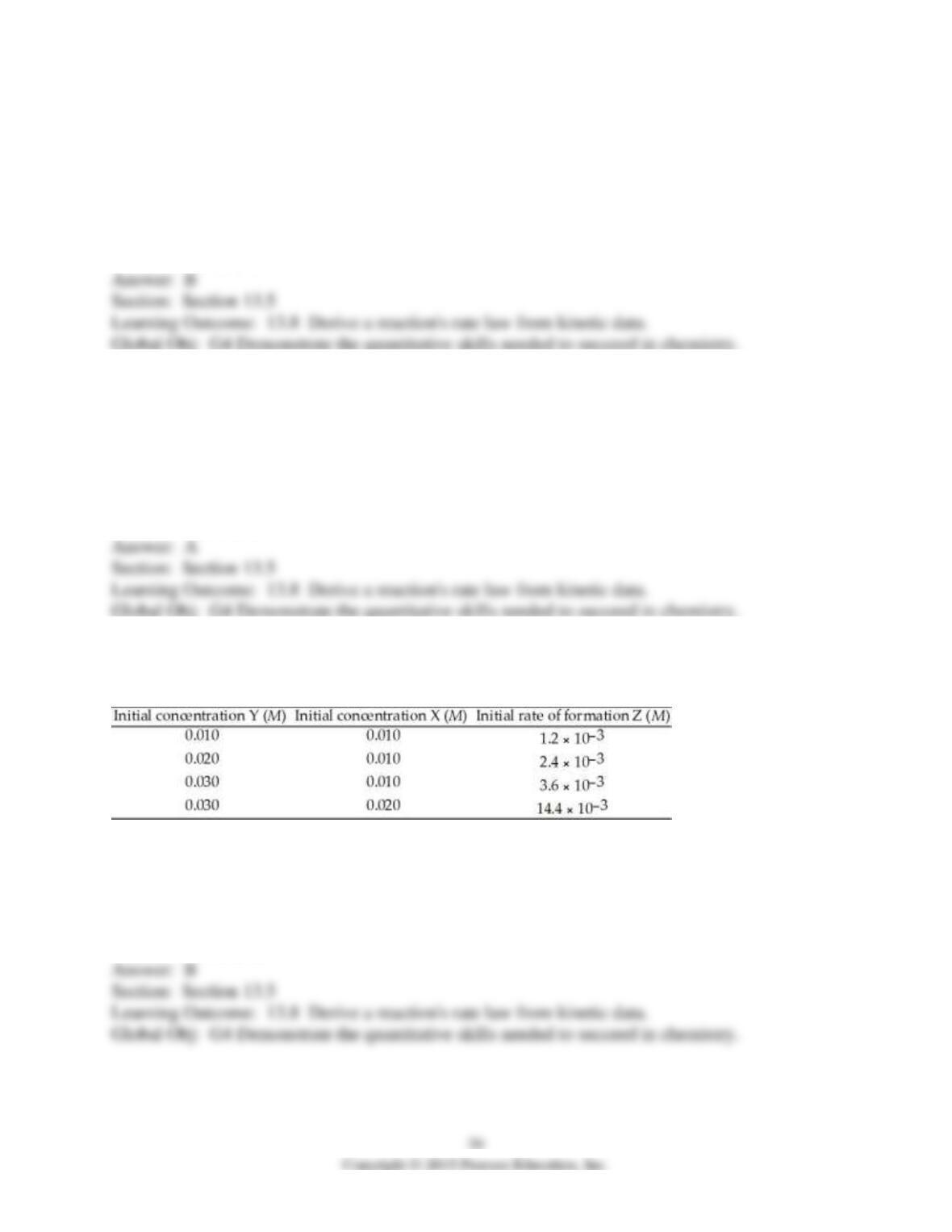
48) The following data was obtained at 100 °C.
2 Y (g) + X (g) → Z (g)
The rate law for this reaction is ________..
A) Rate = k[Y]2[X]
B) Rate = k[Y][X]2
C) Rate = k[Y][X]
D) Rate = k[Y]2[X]2
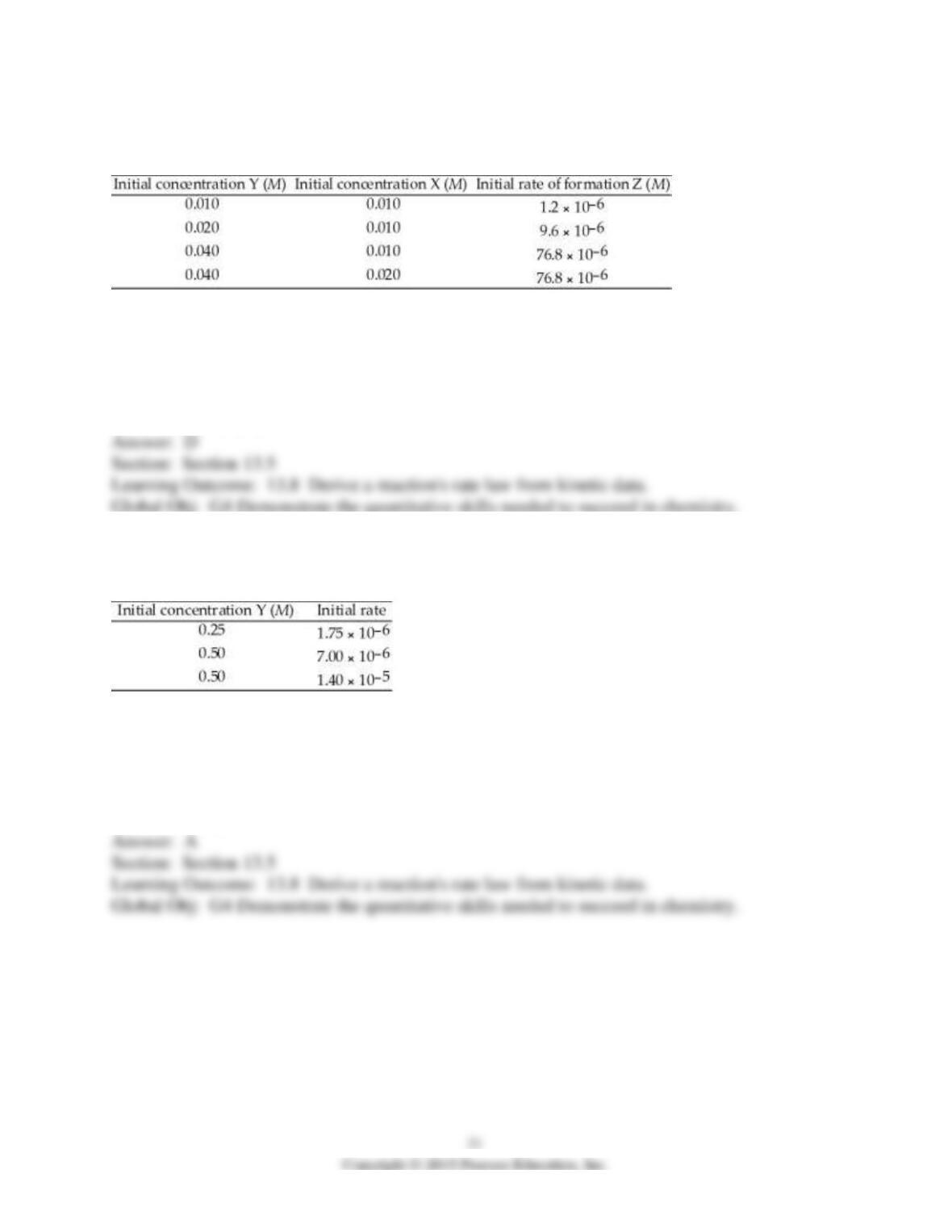
49) The following data was obtained at 100 °C.
2Y (g) + X (g) → Z (g)
The rate law for this reaction is ________.
A) Rate = k[Y]2[X]
B) Rate = k[Y][X]2
C) Rate = k[Y]3[X]
D) Rate = k[Y]3[X]0
50) The following data was obtained at 20 °C.
2Y (g) → Z (g)
The rate law for this reaction is ________.
A) Rate = k[Y]2
B) Rate = k[Y]
C) Rate = k[Y]0
D) Rate = k[Y]-1
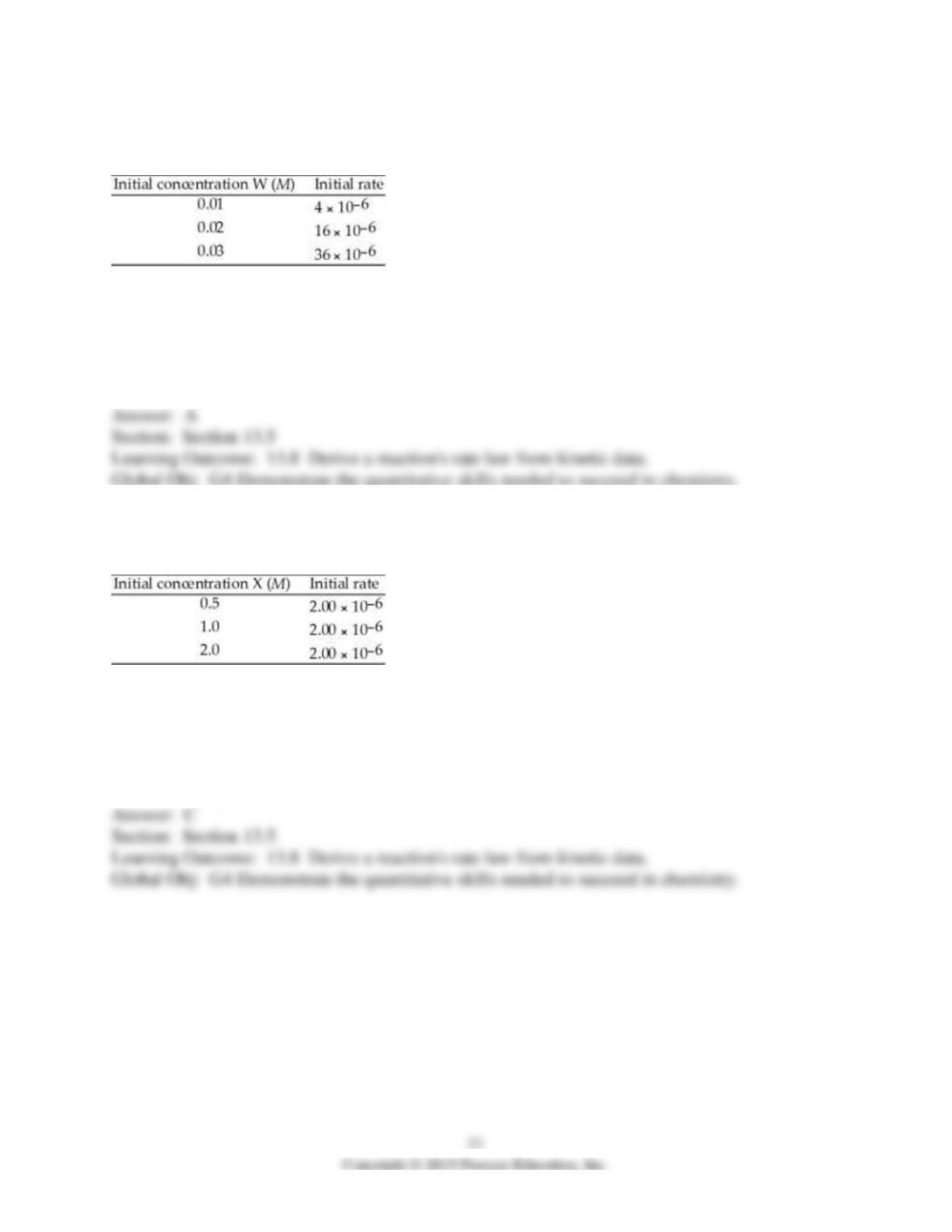
51) The following data was obtained at 20 °C.
2W (g) → V (g)
The rate law for this reaction is ________.
A) Rate = k[W]2
B) Rate = k[W]
C) Rate = k[W]0
D) Rate = k[W]-1
52) The following data was obtained at 20 °C.
X (g) → Y (g)
The rate law for this reaction is ________.
A) Rate = k[X]2
B) Rate = k[X]
C) Rate = k[X]0
D) Rate = k[X]-1
53) Which of the following statements regarding reaction mechanisms is true?
A) A mechanism is a series of steps whereby reactants are converted to products.
B) Reaction mechanisms must be determined experimentally.
C) Neither A nor B is true.
D) Both A and B are true.
54) Which of the following responses contains the two rate factors that comprise the rate
constant (k) for a given chemical reaction?
A) the temperature and the number of collisions per unit volume
B) the number of collisions per unit volume and the fraction of collisions with a favorable
orientation
C) the number of collisions with energy greater than the activation energy and the fraction of
collisions with a favorable orientation
D) the number of collisions with energy greater than the activation energy and the temperature
55) The order of the reaction with respect to A, B, and the total order respectively is ________.
A + B → Products
Rate = k[A][B]
A) 1, 1, 1
B) 1, 1, 2
C) 1, 2, 2
D) 1, 2, 3
56) The order of the reaction with respect to A, B, and the total order respectively is ________.
A + B → Products
Rate = k[A]3[B]0
A) 3, 1, 1
B) 3, 0, 2
C) 3, 0, 3
D) 3, 1, 4
57) The slow step in the multistep mechanism of a reaction ________.
A) controls the rate at which the products are formed
B) is the only step that involves the breaking of bonds
C) is equally significant in measuring the rate
D) is insignificant in the formation of products
58) Which of the following statements is false?
A) The rate determining step is always the slowest step in a multistep mechanism.
B) The rate constant always changes with a variation in temperature.
C) The energy of activation affects the speed of reaction.
13.2 True/False Questions
1) Knowing the mechanism of a reaction is advantageous because one may influence its rate to
make the reaction useful.
2) An endothermic reaction usually leads to cooling.
3) For chemical reactions to occur at all, “old” bonds must be broken and “new” bonds must
form.
4) For an endothermic reaction, the value for ΔErxn is a negative number.
5) For an exothermic reaction, the energy level of the products is lower than the energy level of
the reactants..
6) The reaction energy profile can tell if a reaction is exothermic or endothermic.
7) An exothermic reaction always leads to a release in energy.
8) In an exothermic reaction, more energy is absorbed on the reactant bonds breaking than is
released as the product bonds form.
9) In an endothermic reaction, the top of the energy barrier to the products is a higher value than
the top of the energy barrier to the reactants.
10) If the forward reaction is exothermic, the reverse is endothermic.
11) When the products are higher in energy than the reactants, the reaction is endothermic.
12) The value of Ea(reaction) is equal to the difference Ea(reactants) – Ea(products).
13) A catalyst need not be present in large quantities.
14) The reaction: HCl + NaOH → H2O + NaCl is a substitution reaction.
15) Adding a catalyst increases the rate of reaction by providing the additional energy needed to
overcome a large energy of activation.
16) Enzymes serve as catalysts in biochemical reaction systems.
17) A catalyst lowers the activation energy for a chemical reaction.
18) A lower energy of activation leads to more products favored in the reaction.
19) A catalyst works by providing a new mechanism, higher in energy that the original reaction.
20) The transition state for a reaction occurs at the bottom of the energy barrier.
21) The magnitude (size) of the energy of activation for the reverse reaction is exactly identical
as it is for the forward reaction in an exothermic (or endothermic) process.
22) A catalyst can be recovered at the end of the reaction.
23) Reaction rates can be varied by changing either the concentrations of the reacting species or
the temperature at which the reaction is carried out.
24) The rate constant is dependant on the activation energy and reactant orientation during a
collision.
25) The reactants must collide with an energy greater than the energy of activation for the
reaction to occur.
26) The greater the concentration of the reactants, the greater the rate of the reaction.
27) Based on the collision theory, decreasing temperature for a reaction increases the reaction
rate.
28) Based on the collision theory, adding a catalyst to a reaction increases the reaction rate.
29) It is possible to determine a given reaction’s mechanism without performing any experiments
of any kind.
30) The rate is second order with respect to the reactant and second order overall.
Rate = k[A]2
31) The rate is second order with respect to the reactant and sixth order overall.
Rate = k[A]2[B]3
32) The rate determining step is always the fastest step.
13.3 Short Answer Questions
1) Calculate a value for ΔErxn for a chemical reaction, if the reactants have an energy of +300
kJ/mol and the products have an energy of +100 kJ/mol. Is this reaction exothermic or
endothermic?
2) Calculate a value for ΔErxn for a chemical reaction if the reactants have an energy of -400
kJ/mol and the products have an energy of +100 kJ/mol. Is this reaction exothermic or
endothermic?
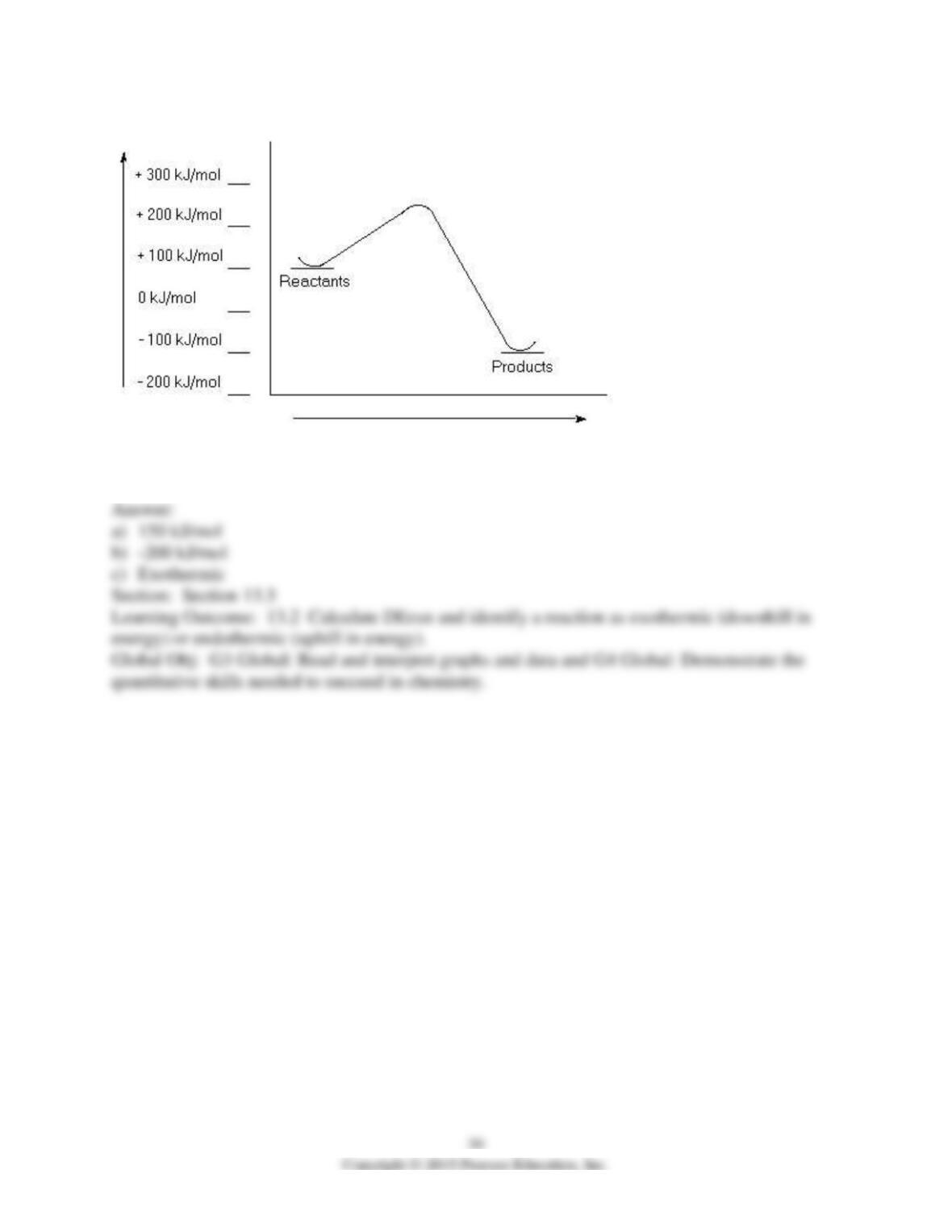
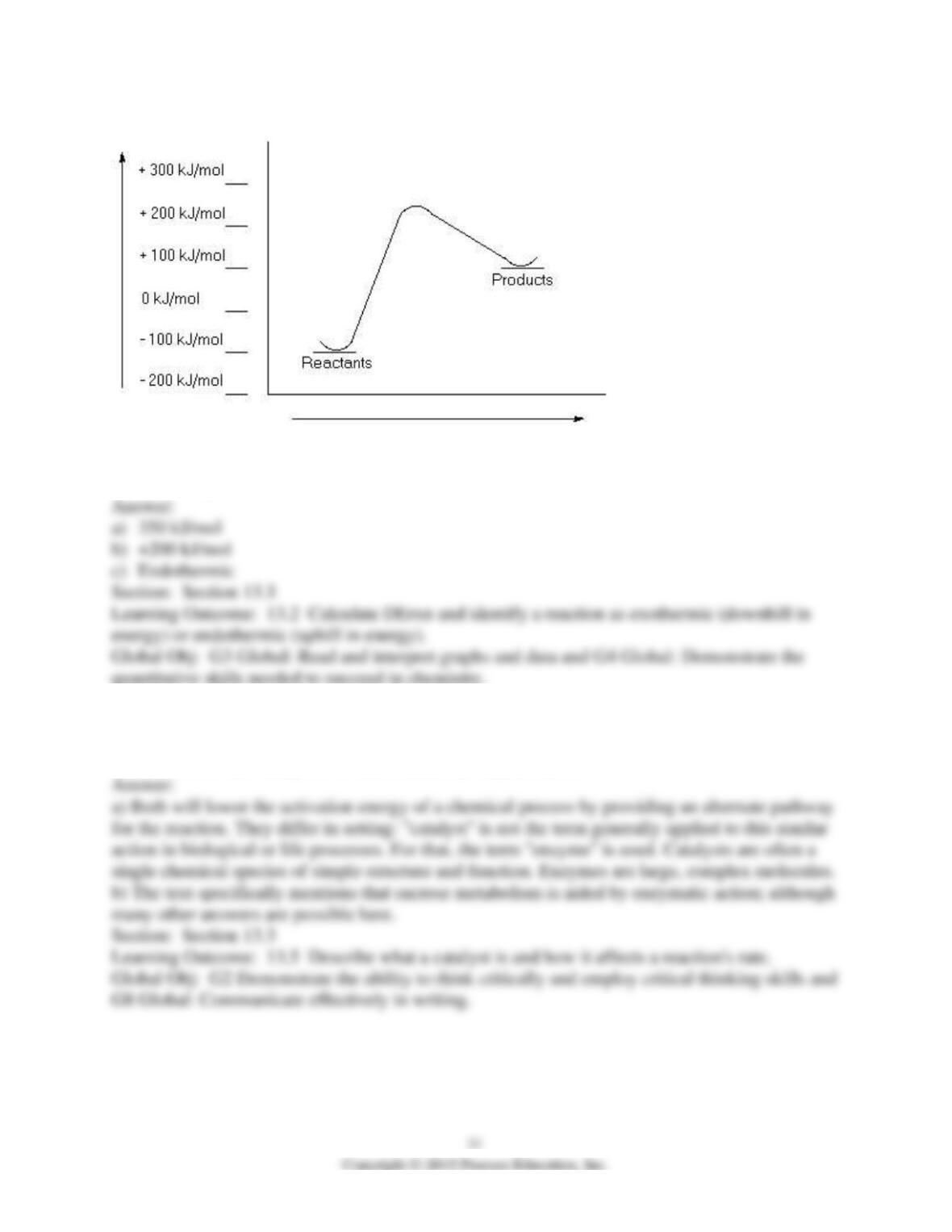
3) Examine this reaction coordinate diagram, and answer the questions that follow.
a) Estimate the value for the activation energy for this reaction.
b) Calculate ΔErxn.
c) Is this reaction exothermic or endothermic?
4) Examine this reaction coordinate diagram and answer the questions that follow.
a) Estimate the value for the activation energy for this reaction.
b) Calculate ΔErxn.
c) Is this reaction exothermic or endothermic?
5) Compare the roles of catalysts and enzymes in chemical reactions:
a) How are enzymes and catalysts similar? How are they different?
b) Describe a chemical process that is aided by enzyme action.
6) Industrial chemists often have their choice of catalysts to use when designing, for example, a
factory that produces ammonia. Explain why biochemists studying life processes (such as protein
metabolism) do not have the same variety of choices for which enzyme they would use.
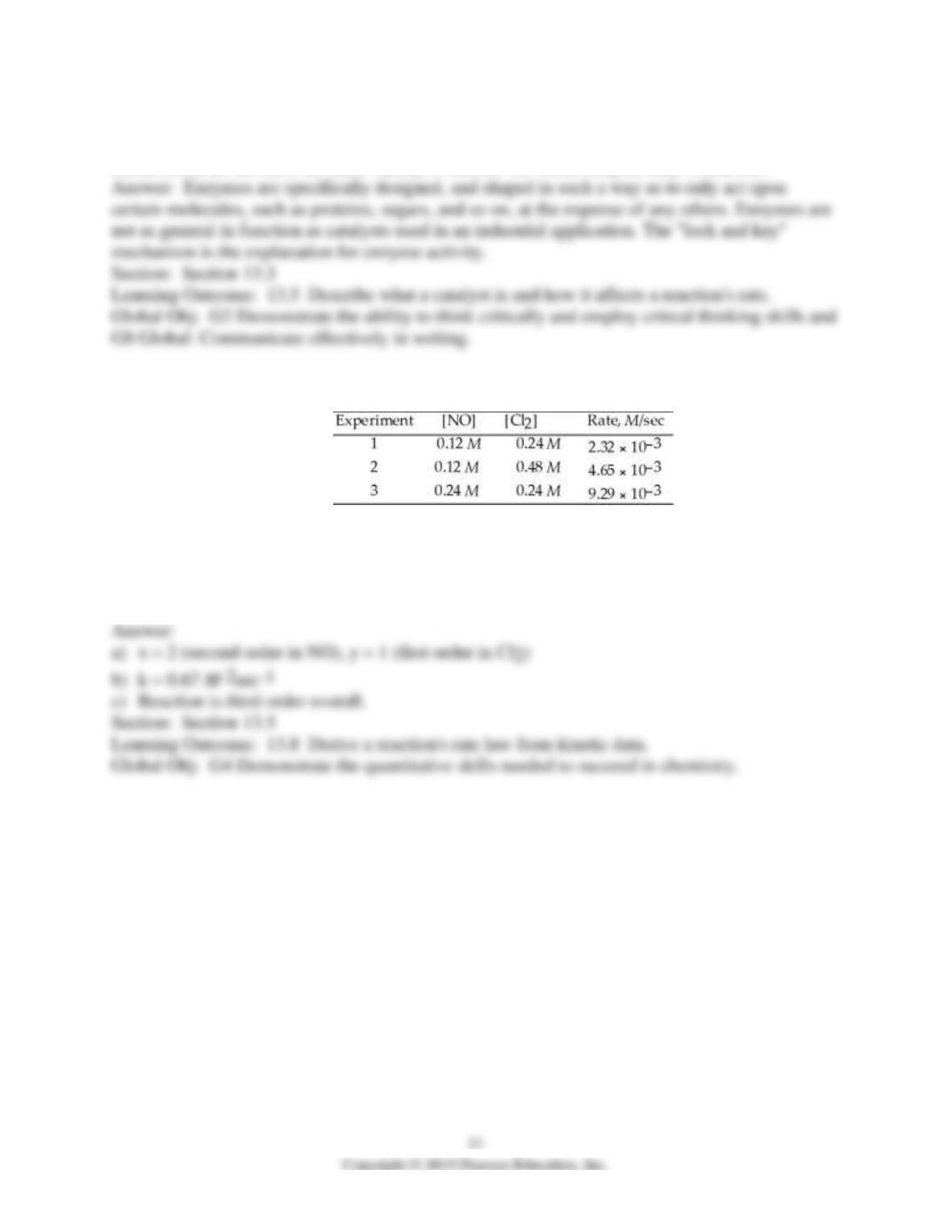
Use the table below to answer the question that follows:
7) The above data were obtained in a kinetic study of the reaction.
a) Determine the orders x and y, assuming that rate = k[NO]x[Cl2]y.
b) Determine the value for the rate constant, k, in Experiment 2.
c) Determine the overall order of this reaction.
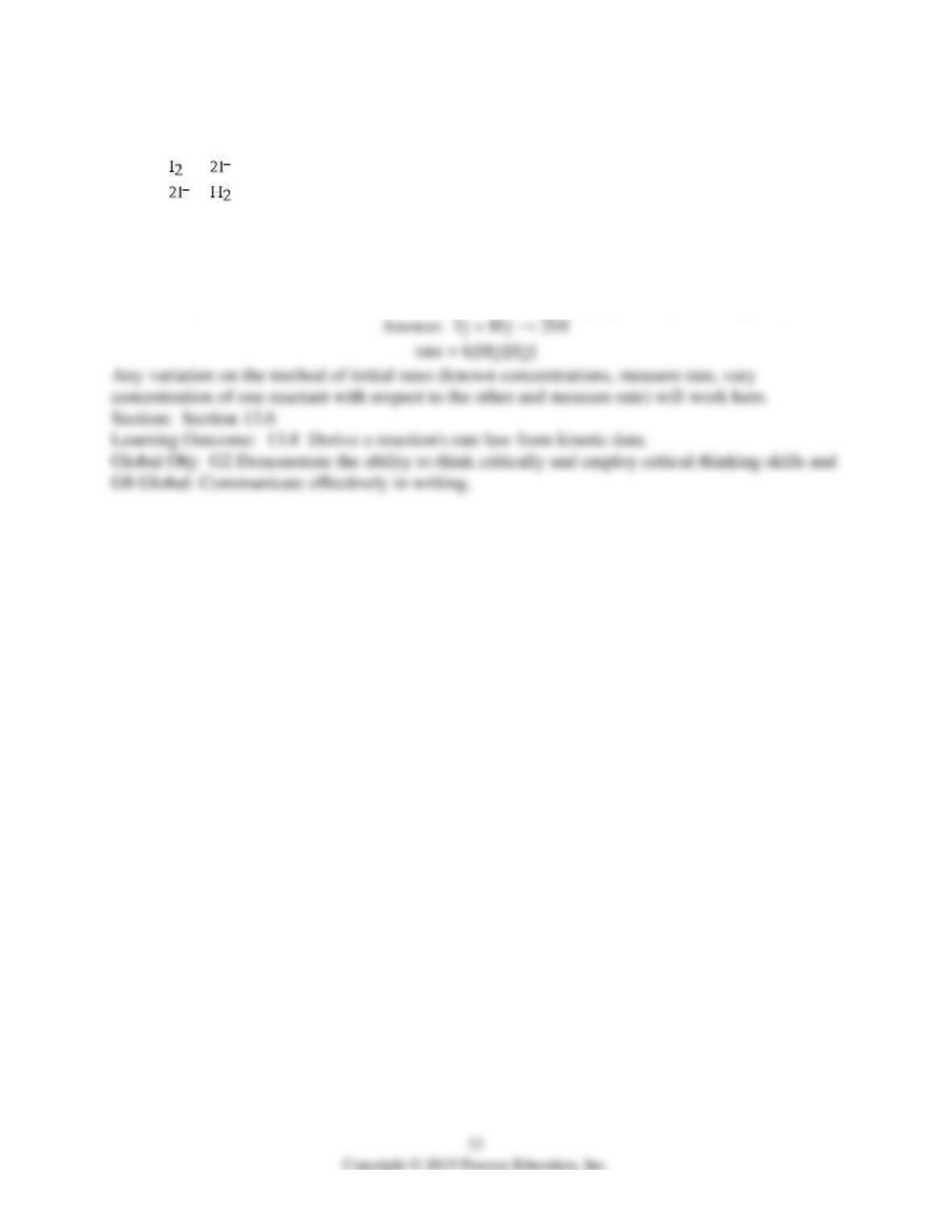
8) Write the overall balanced equation that is consistent with the following mechanism:
Step 1: ↔ (fast)
Step 2: + → 2HI (slow)
Next, give a rate law expression that is consistent with this proposed mechanism.
Explain a series of three experiments that could help you to determine the values for the overall
order of reaction, and the orders of the individual terms in your proposed rate law expression.

34
13.4 Matching Questions
Match the rate of each reaction in the left column with the overall order that appears in the right
column.
A) 3
B) 1
C) 0
D) 2
E) 4
1) Rate = k[A]2[B]-1
Section: Section 13.5
Learning Outcome: 13.7 Understand the meaning of reaction orders in a rate law.
Global Obj: G4 Demonstrate the quantitative skills needed to succeed in chemistry.
2) Rate = k[A]1[B]2
Section: Section 13.5
Learning Outcome: 13.7 Understand the meaning of reaction orders in a rate law.
Global Obj: G4 Demonstrate the quantitative skills needed to succeed in chemistry.
3) Rate = k[A][B]
Section: Section 13.5
Learning Outcome: 13.7 Understand the meaning of reaction orders in a rate law.
Global Obj: G4 Demonstrate the quantitative skills needed to succeed in chemistry.
4) Rate = k[A]2[B]2
Section: Section 13.5
Learning Outcome: 13.7 Understand the meaning of reaction orders in a rate law.
Global Obj: G4 Demonstrate the quantitative skills needed to succeed in chemistry.
5) Rate = k[A][B]-1
Section: Section 13.5
Learning Outcome: 13.7 Understand the meaning of reaction orders in a rate law.
Global Obj: G4 Demonstrate the quantitative skills needed to succeed in chemistry.
6) Rate = k[A]3[B]0
Section: Section 13.5
Learning Outcome: 13.7 Understand the meaning of reaction orders in a rate law.
Global Obj: G4 Demonstrate the quantitative skills needed to succeed in chemistry.
7) Rate = k[A]3/[B]
Section: Section 13.5
Learning Outcome: 13.7 Understand the meaning of reaction orders in a rate law.
Global Obj: G4 Demonstrate the quantitative skills needed to succeed in chemistry.

8) Rate = k[A]/[B]
Section: Section 13.5
Learning Outcome: 13.7 Understand the meaning of reaction orders in a rate law.
Global Obj: G4 Demonstrate the quantitative skills needed to succeed in chemistry.