Introductory Chemistry: Atoms First, 5e (Russo/Silver)
Chapter 3 The Evolution of Atomic Theory
3.1 Multiple-Choice Questions
1) Calcium carbonate (CaCO3) is 34.5% Ca by mass. In a 418 g sample of CaCO3, how many
grams of calcium are present?
A) 144 g
B) 40.08 g
C) 235.1 g
D) 83.6 g
2) 24.3 g of magnesium yield 40.3 g MgO upon combustion with oxygen. How much
magnesium needs to be burned to yield 12.1 g MgO?
A) 4.30 g
B) 6.10 g
C) 7.30 g
D) 8.40 g
3) What is the mass of the single product that is formed from the complete reaction of 2.5 g
hydrogen with 7.5 g oxygen?
A) 5.0 g
B) 7.5 g
C) 9.5 g
D) 10.0 g
4) A 3.45 gram sample of hematite (Fe2O3) that contains 2.41 grams of Fe has what percentage
Fe by mass?
A) 41.0%
B) 31.1%
C) 69.9%
D) 59.9%
5) A compound is produced when 6.08 g of nitrogen combine with 13.92 g oxygen. What is the
empirical formula of this compound?
A) NO
B) NO2
C) N2O3
D) N2O5
6) According to the experiments of Ernest Rutherford, where can a majority of a given atom’s
mass be found?
A) scattered randomly throughout an approximately cube-shaped atom
B) at the center of an approximately spherical atom
C) in concentric layers of spherical shape
D) as small pieces orbiting a common center in circular paths
7) The structure of individual atoms can roughly be described as ________.
A) positively charged center and mostly empty space
B) an even mixture of mass and charge scattered throughout a spherical shape
C) positively charged, low-mass pieces in orbit around a massive, negatively charged center
D) positively charged pieces in orbit around a low-mass, negatively charged center
8) What is the relative charge on a neutron, proton, and electron?
A) 0, -1, +1
B) 0, 0, -1
C) 0, +1, -1
D) -1, +1, -1
9) How is the term “atomic number” defined for a given atom?
A) as the mass of one mole of that element or isotope
B) as the sum of the number of protons, neutrons, and electrons
C) as the sum of the number of protons and neutrons in the nucleus
D) as the number of protons in the nucleus
10) How is the term “mass number” defined for a given atom or isotope?
A) as the mass of one mole of that element or isotope
B) as the sum of the number of protons, neutrons, and electrons
C) as the sum of the number of protons and neutrons in the nucleus
D) as the number of protons in the nucleus
11) A neutral atom’s atomic number is equal to ________.
A) the number of nucleons
B) the sum of the number of protons and neutrons
C) the number of electrons
D) the number of neutrons
12) An atomic mass unit, also known as amu, is equal to ________ the mass of a 12C atom.
A) 1/2
B) 1/12
C) 1/6
D) 1/1840
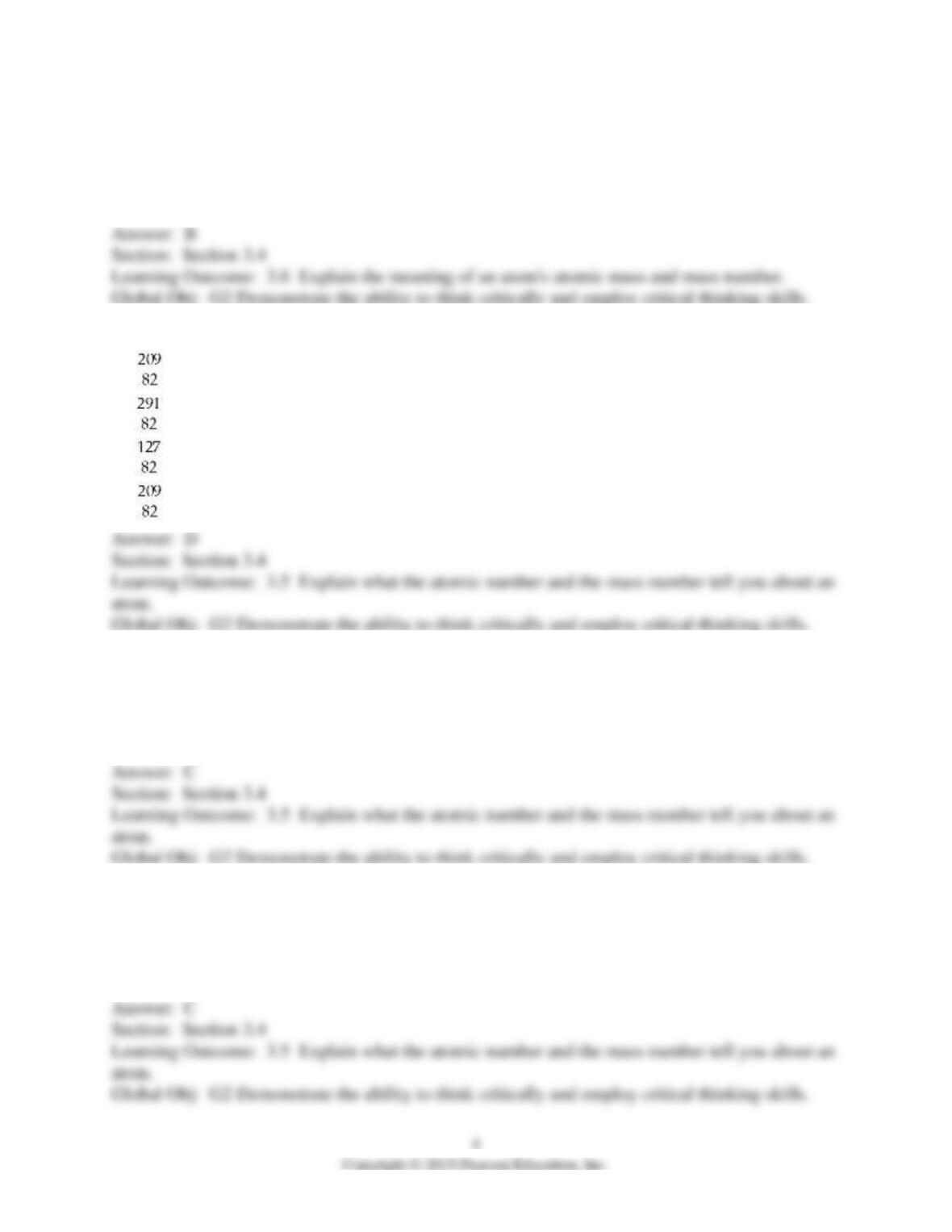
13) Which of the following is the correct symbolic representation of the lead-209 isotope?
A) Li
B) Pb
C) Pb
D) Pb
14) How many neutrons does the nucleus of the phosphorus-32 isotope have?
A) 15
B) 16
C) 17
D) 32
15) What is the atomic number of uranium-235?
A) 235
B) 238
C) 92
D) 143
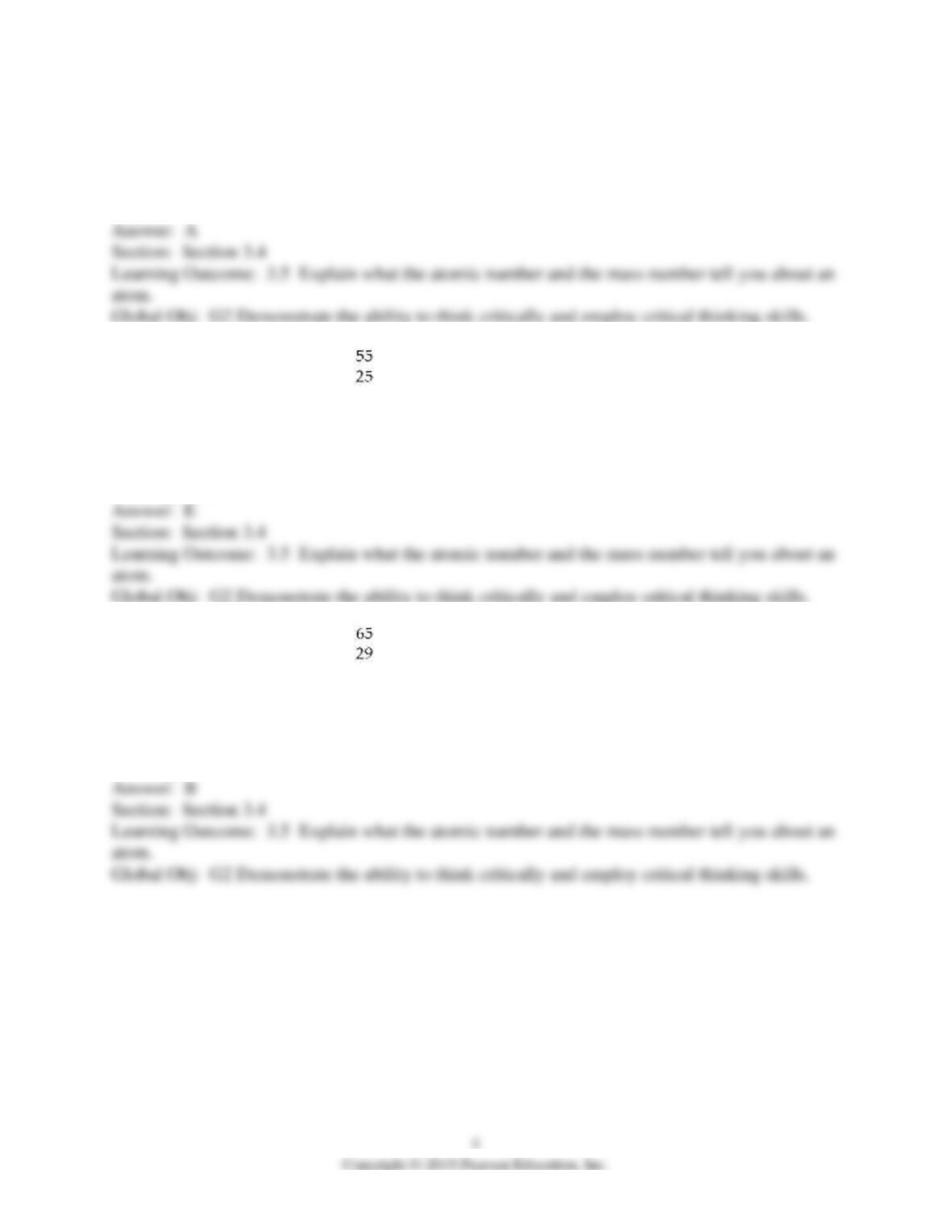
16) How many protons does the nucleus of the sulfur-35 isotope have?
A) 16
B) 19
C) 32
D) 35
17) Identify X in the expression X.
A) zinc
B) iron
C) iridium
D) cesium
E) manganese
18) Identify X in the expression X.
A) selenium
B) copper
C) cobalt
D) cesium
E) manganese
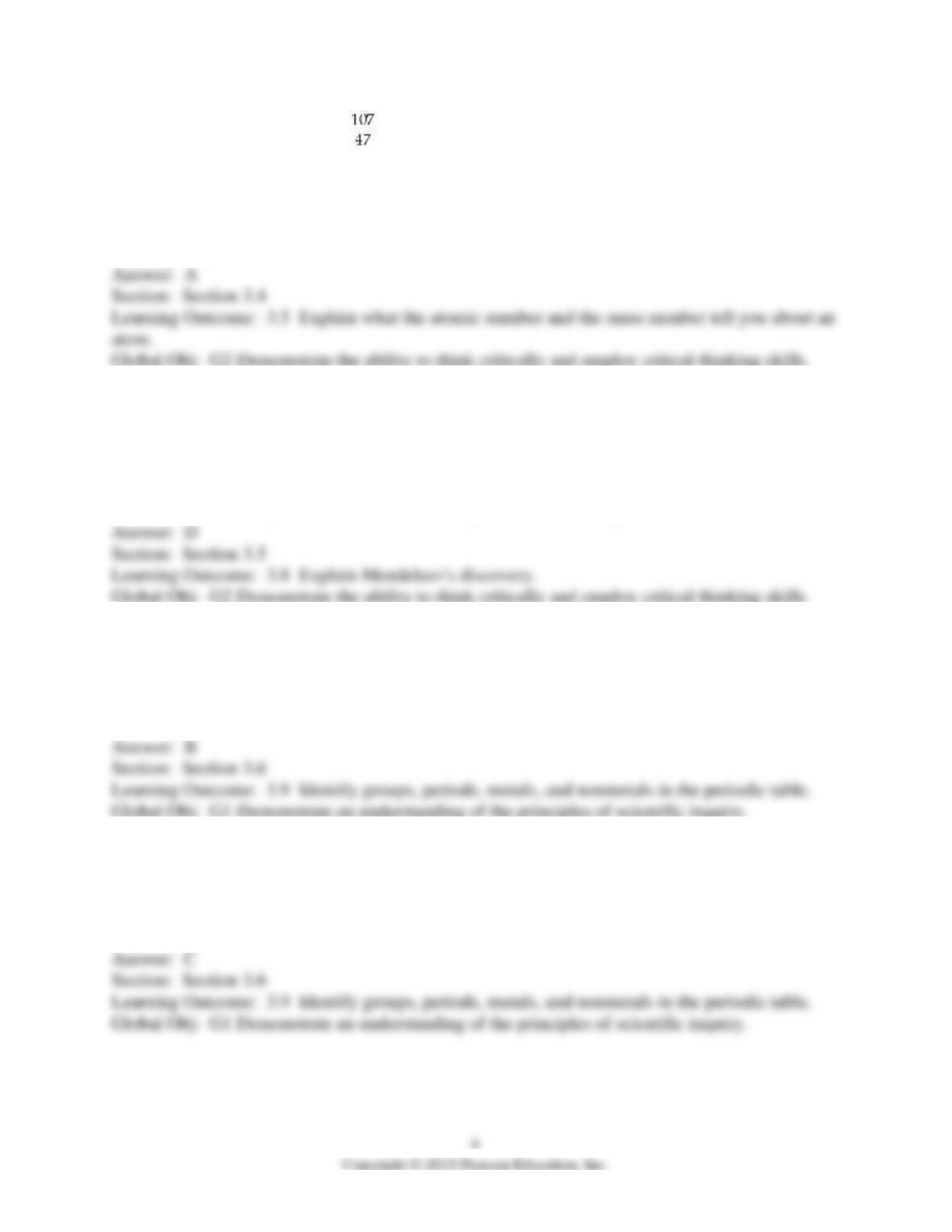
19) Identify X in the expression X.
A) silver
B) gold
C) bohrium
D) cobalt
E) neodymium
20) The breakthrough Dmitri Mendeleev had when constructing the periodic table occurred
________.
A) when J. J. Thomson discovered the electron
B) when Sir James Chadwick discovered the neutron
C) when Thomson and E. Goldstein discovered the proton
D) when Mendeleev placed the elements in a sequence of increasing atomic mass
21) Which of the following terms applies to the vertical columns found on a periodic table?
A) arrangement
B) group
C) period
D) isotope
22) Which of the following terms applies to the horizontal rows found on a periodic table?
A) arrangement
B) group
C) period
D) isotope
23) What name is commonly given to the elements of Group IA of the periodic table?
A) alkaline earth metals
B) transition metals
C) platinum metals
D) alkali metals
24) What name is commonly given to the elements of Group IIA of the periodic table?
A) alkaline earth metals
B) transition metals
C) platinum metals
D) alkali metals
25) Which is expected to be the most chemically similar element to phosphorus?
A) S
B) As
C) Se
D) O
26) Which element would have a similar chemical reactivity in water as K?
A) Ca
B) Ar
C) Rb
D) H
27) Which of the following is not a metal?
A) Ca
B) Pt
C) Kr
D) Mg
28) Which of the following is a metal?
A) Xe
B) C
C) As
D) W
29) Which of the following is a metalloid in the third period of the periodic table?
A) Al
B) Si
C) P
D) S
30) Which of the following is a transition metal in the fourth period of the periodic table?
A) Ga
B) Ca
C) Fe
D) Ag
31) Which of the following elements is a chalcogen?
A) H
B) N
C) O
D) F
32) Which of the following elements is a halogen?
A) He
B) B
C) F
D) Kr
33) Which of the following is not a main group element?
A) S
B) As
C) Cu
D) Xe
34) Which of the following elements is an actinide?
A) Np
B) Pr
C) W
D) Fr
35) Which of the following is a transition element?
A) Co
B) Eu
C) Es
D) He
36) Which representative element is found in the fourth group and fifth period?
A) Br
B) Te
C) Sn
D) Ge
37) Which of the following elements may have a cation that has 16 electrons?
A) Si
B) P
C) S
D) Cl
38) Which of the following elements can have an anion with 18 electrons?
A) Cl
B) Ar
C) Sc
D) Fe
39) Which ion contains 18 electrons?
A) Ca+
B) Cl2-
C) Ar–
D) P3-
40) How many electrons are found in a Fe3+ ion?
A) 23
B) 26
C) 29
D) 56
41) How many protons are found in a N3- ion?
A) 7
B) 10
C) 14
D) 15
42) Which has more electrons?
A) Br–
B) Sr2+
C) Rb
D) As3+
43) Which of the following has more electrons than neutrons?
A) 24Mg2+
B) 27Al
C) 75As3-
D) 32S2-
44) Which of the following has more protons than electrons?
A) Mg2+
B) Al
C) P3-
D) O2-
45) Ionization energy ________ from top to bottom in a group and ________ from left to right in
a period.
A) increases; increases
B) increases; decreases
C) decreases; increases
D) decreases; decreases
46) Which of the following has the highest ionization energy?
A) O
B) Sn
C) As
D) C
13
47) Which of the following has the lowest ionization energy?
A) F
B) P
C) Ca
D) Cs
48) Fr+ is called ________.
A) a cation
B) an anion
C) an isotope
D) a non-metal
49) Which of the following pairs are isotopes?
A) Ca2+ and Mg2+
B) 199Hg and 200Hg
C) 18O and 19F
D) 238U and 238Np
50) Which cation has the atomic number of 20 and a charge of +2?
A) C2+
B) Mg2+
C) Ca2+
D) S2+
51) Which species has 16 protons, 18 neutrons and 18 electrons?
A) 34S2+
B) 34S2-
C) 36Ar2+
D) 36Se2-
52) Ions are ________.
A) atoms that have gained electrons
B) atoms or groups of atoms with a net electrical charge that is not equal to zero
C) atoms that have lost electrons
D) all of the above
53) Which element, isotope, or ion listed below contains 16 protons, 17 neutrons, and 18
electrons?
A) 33Ar2-
B) 33S2-
C) 33Cl
D) 34S2-
54) Which element, isotope, or ion listed below contains 35 protons, 46 neutrons, and 36
electrons?
A) 81Kr+
B) 81Br
C) 81Kr
D) 81Br –
3.2 True/False Questions
1) The conservation of mass law states that matter can neither be created nor destroyed during a
chemical reaction.
2) Atoms combine to form molecules (compounds) in simple, whole number ratios.
3) In Dalton’s atomic theory, all matter is made up of atoms.
4) The law of constant composition states that atoms must combine in a one to one ratio.
5) An alpha particle consists of two protons and two neutrons.
6) The atomic weight for an atom is the weighted average of all the naturally occurring isotopes.
7) Each element is defined by its atomic number.