Introductory Chemistry: Atoms First, 5e (Russo/Silver)
Chapter 17 The Chemistry of Carbon
17.1 Multiple Choice Questions
1) The ability of carbon to connect and link together is called ________.
A) isomerism
B) allotropism
C) catenation
D) ring formation
2) Which of the following are allotropes of carbon?
A) fullerene
B) diamond
C) graphite
D) All of the above are allotropes of carbon.
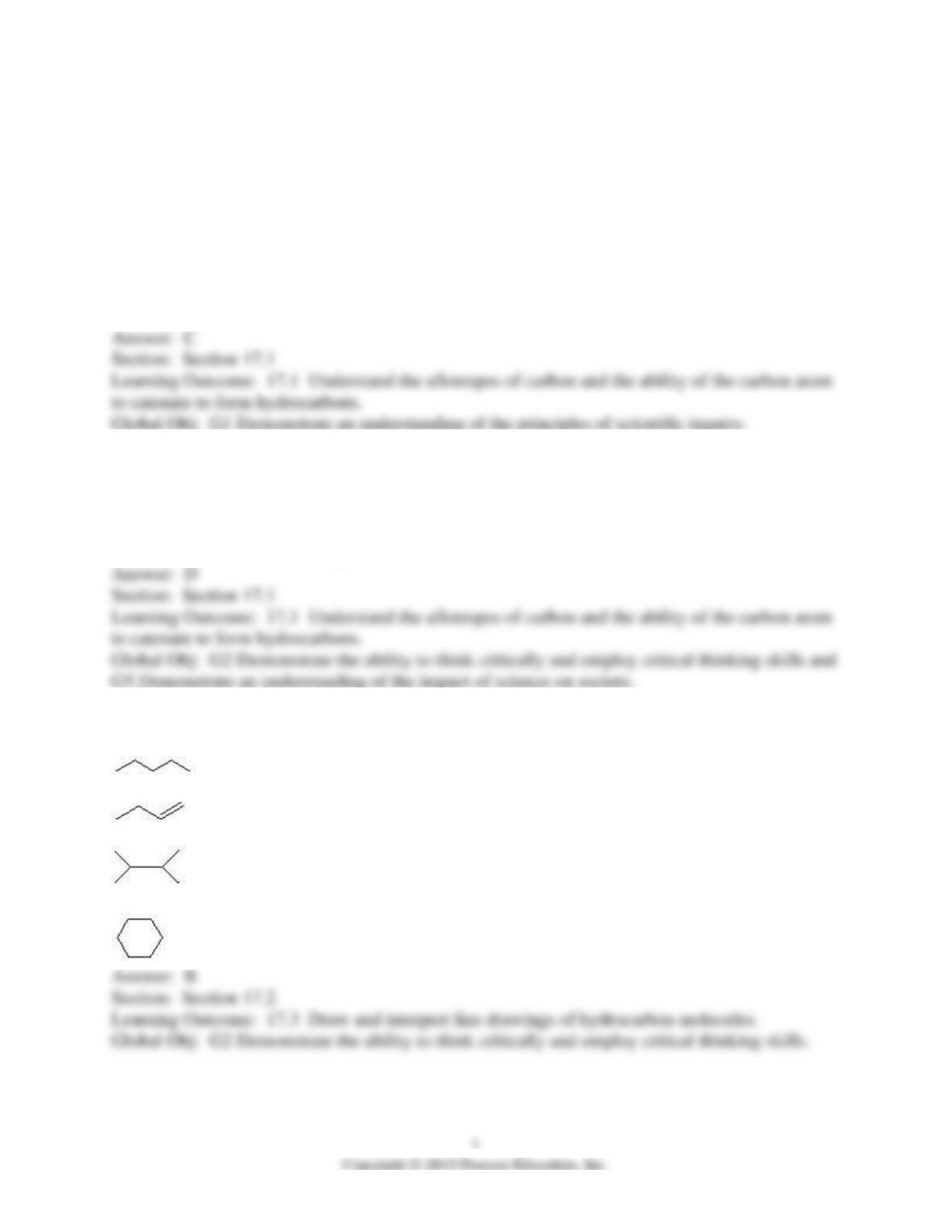
3) Which of the following line drawings represents an unsaturated hydrocarbon?
A)
B)
C)
D)
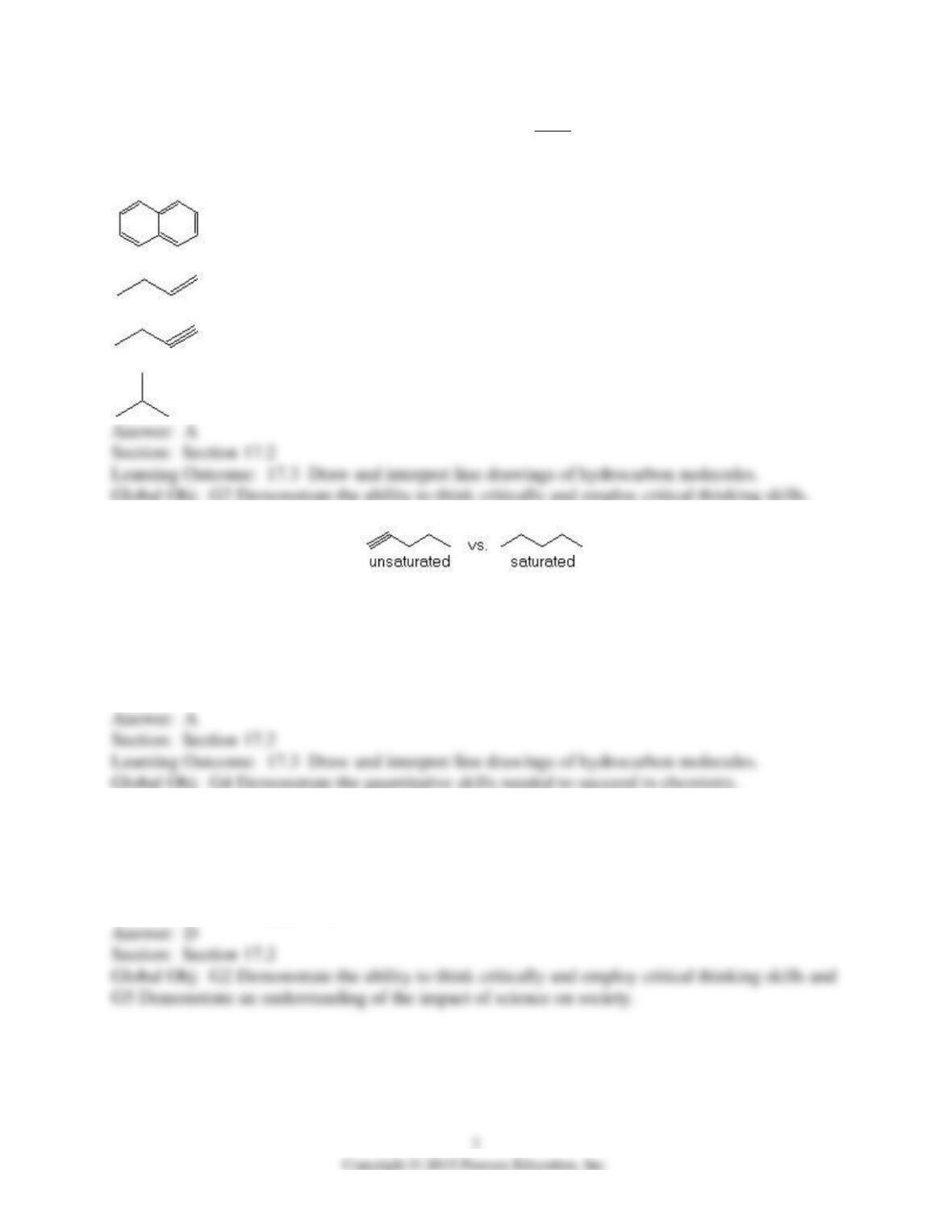
4) Which of the following hydrocarbon molecules is the most unsaturated?
(Think also: Which of the following needs to have the most hydrogens added to achieve
saturation?)
A)
B)
C)
D)
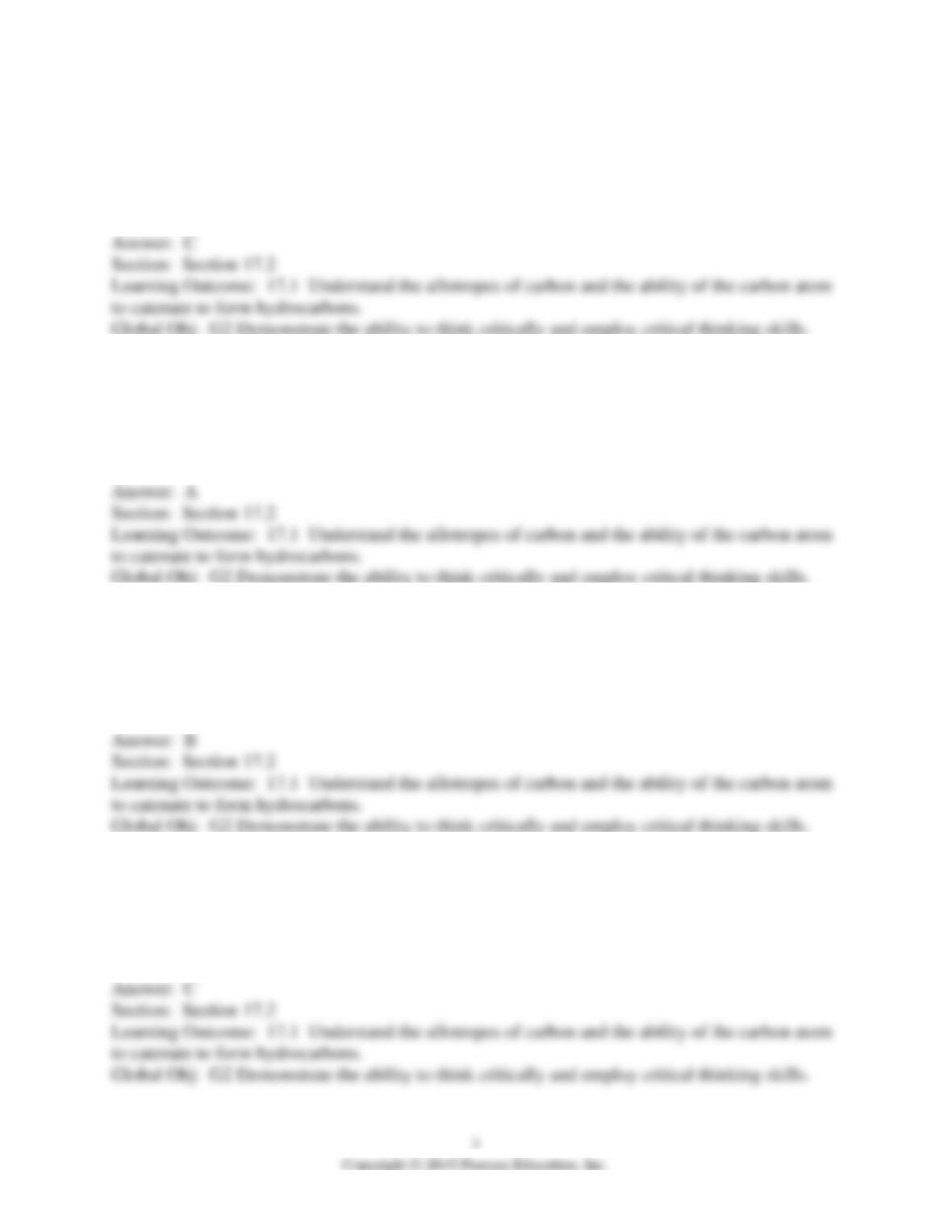
5) In the above compounds, how many more hydrogen atoms would you need to add to the
hydrocarbon line drawing on the left in order to fully saturate it like the compound on the right?
A) 4
B) 2
C) 6
D) 5
6) Petroleum ________.
A) is mostly a mixture of compounds that are composed of carbon and hydrogen
B) is mostly a mixture of compounds that are covalent
C) is the source of many polymers, fertilizers, insecticides, and plastics
D) All of the above apply to petroleum.
7) Which of the following unbranched hydrocarbons is not saturated?
A) C6H14
B) C10H22
C) C9H16
D) C16H34
8) Which of the following unbranched/acyclic hydrocarbons is saturated?
A) C6H14
B) C10H20
C) C12H22
D) C5H10
9) Which of the following unbranched/acyclic hydrocarbons will only have one double bond?
A) C6H14
B) C10H20
C) C12H22
D) C5H8
10) Which of the following unbranched/acyclic hydrocarbons may have a triple bond?
A) C6H14
B) C10H20
C) C12H22
D) C5H10
11) Which of the following unbranched/acyclic hydrocarbons may have three double bonds?
A) C6H10
B) C10H16
C) C12H22
D) C5H12
12) The number of possible isomers of molecular C5H12 is ________.
A) 2
B) 3
C) 4
D) 5
13) Which of the following names is incorrect?
A) 1-hexene
B) 2-hexene
C) 3-hexene
D) 4-hexene
14) Which of the following formulas may be attributed to an alkyne?
A) C4H8O
B) C4H10O
C) C4H8O2
D) C4H6
15) Which of the following is a hydrocarbon?
A) C4H8O
B) C4H10O
C) C4H8O2
D) C4H6
16) The IUPAC name of C5H12 in a straight chain is ________.
A) ethane
B) butane
C) hexane
D) pentane
17) The IUPAC name of C3H4 is ________.
A) propane
B) butene
C) propyne
D) propene
18) What is the chemical formula of 2,3-dimethylhexane?
A) C6H14
B) C7H18
C) C8H18
D) C6H18
19) Which straight chain hydrocarbon has the lowest boiling point?
A) C6H14
B) C4H10
C) C2H6
D) C3H8
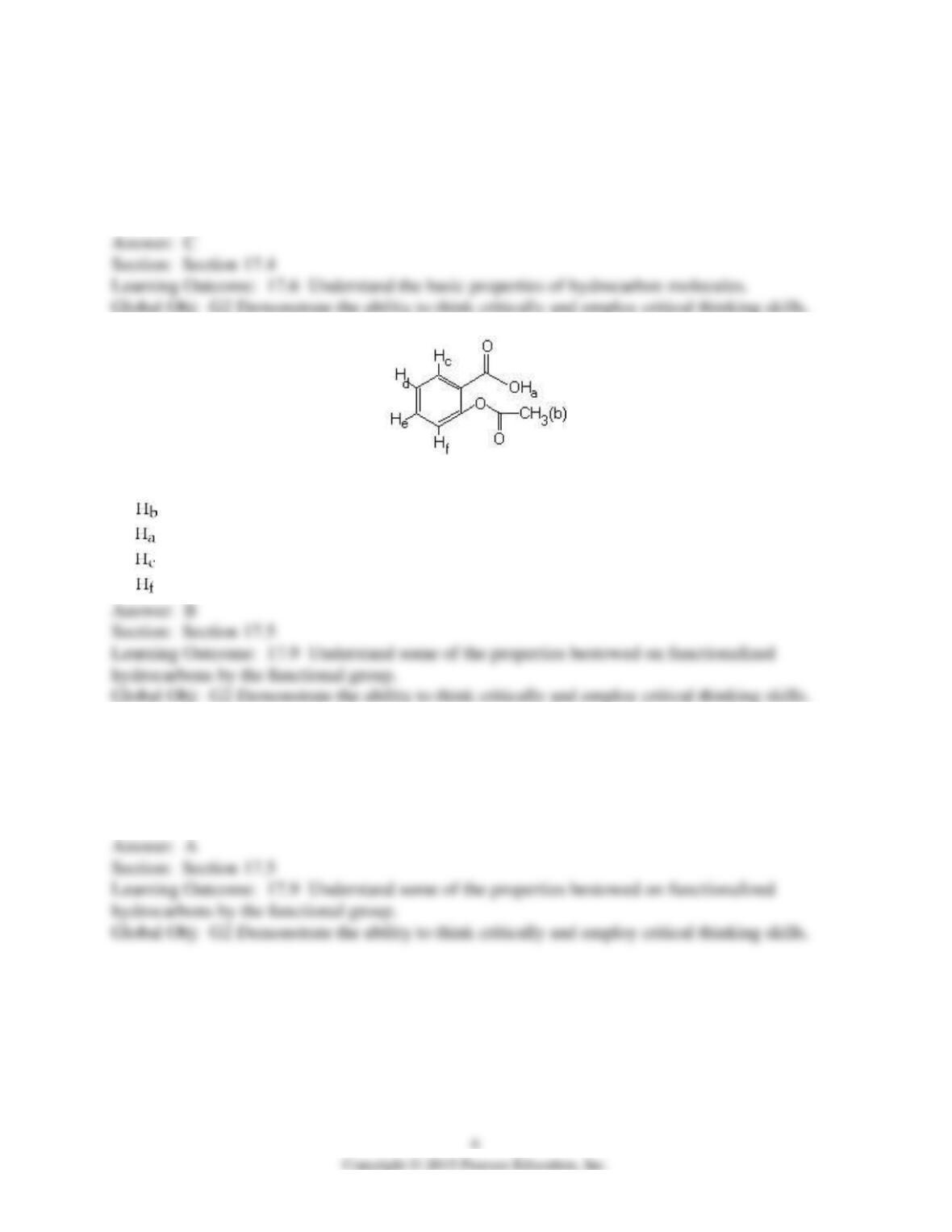
20) In aspirin, a carboxylic acid whose structure is shown above, which labeled H atom is the
one that is acidic (makes the entire structure one of the carboxylic acid subclass)?
A)
B)
C)
D)
21) Which compounds typically have an unpleasant smell?
A) amines
B) esters
C) alcohols
D) ethers
22) Chloroalkanes (R-X) have roles in which of the following applications or processes?
A) As “nonstick” coatings and films
B) As refrigerants
C) As destroyers of the ozone layer
D) All of the above
23) Ethers were once used extensively as ________.
A) antibiotics (germ-killers)
B) paint thinners
C) fuel for automobiles
D) anesthetics
24) People put lemon juice, a source of citric acid, on fish to quench the “fishy” smell, even on
perfectly good fish fillets. What type of chemical reaction is occurring when people are
quenching the fishy smell by adding lemon juice?
A) an oxidation-reduction reaction
B) a double displacement reaction
C) an acid-base reaction
D) a single displacement reaction
25) Which of the following formulas may be attributed to a ketone?
A) C4H8O
B) C4H10O
C) C4H8O2
D) C4H6
26) Which of the following formulas may be attributed to a carboxylic acid?
A) C4H8O
B) C4H10O
C) C4H8O2
D) C4H6
27) Which of the following formulas may be attributed to an amine?
A) C4H10S
B) CH5N
C) C4H8O2
D) C4H6
28) Which of the following formulas may be attributed to an UNSATURATED alcohol?
A) C4H8O
B) C4H10O
C) C4H8O2
D) C4H6
29) What is the chemical formula for methanol?
A) CH3OH
B) CH3OCH3
C) CH3CH2OH
D) CH3NH2
30) Which of the following is not classified as a functional group?
A) the C O of an aldehyde
B) the -COOH of a carboxylic acid
C) the CH3 of an alkane
D) the -OH of an alcohol
17.2 True / False Questions
1) Unlike carbon, nitrogen has the potential of bonding to other atoms of itself, but cannot form
long chains of nitrogen.
2) Carbon always forms four bonds in a compound.
3) No other element in the periodic table is able to covalently bond with other atoms of its own
kind as extensively as carbon.
4) Diamond is a hydrocarbon.
5) When making models of n-octane, the chain appears to be linear.
6) The H-C-H angle in alkanes is 109.5°.
7) There are three possible isomers of molecular formula C4H10.
8) The IUPAC name for C4H8 as a straight chain is butane.
9) Octane has a lower boiling point than decane.
10) C Br is an alkyl halide.
11) C N is a primary amine.
12) All amines contain a nitrogen atom.
13) The general formula for an ether is R-O-R.
14) Organic amines are acidic.
15) The formula C5H10O may be applicable to an aldehyde or a ketone.
16) The formula C2H6O may be attributed to an alcohol or an ether.
17) The formula C5H10O may be attributed to a carboxylic acid.
18) Methanol is the compound used in automobile radiators as antifreeze.
19) 1-propanol is the formula for rubbing alcohol.
20) Ethanol may be obtained via the fermentation of grains.
17.3 Short Answer Questions
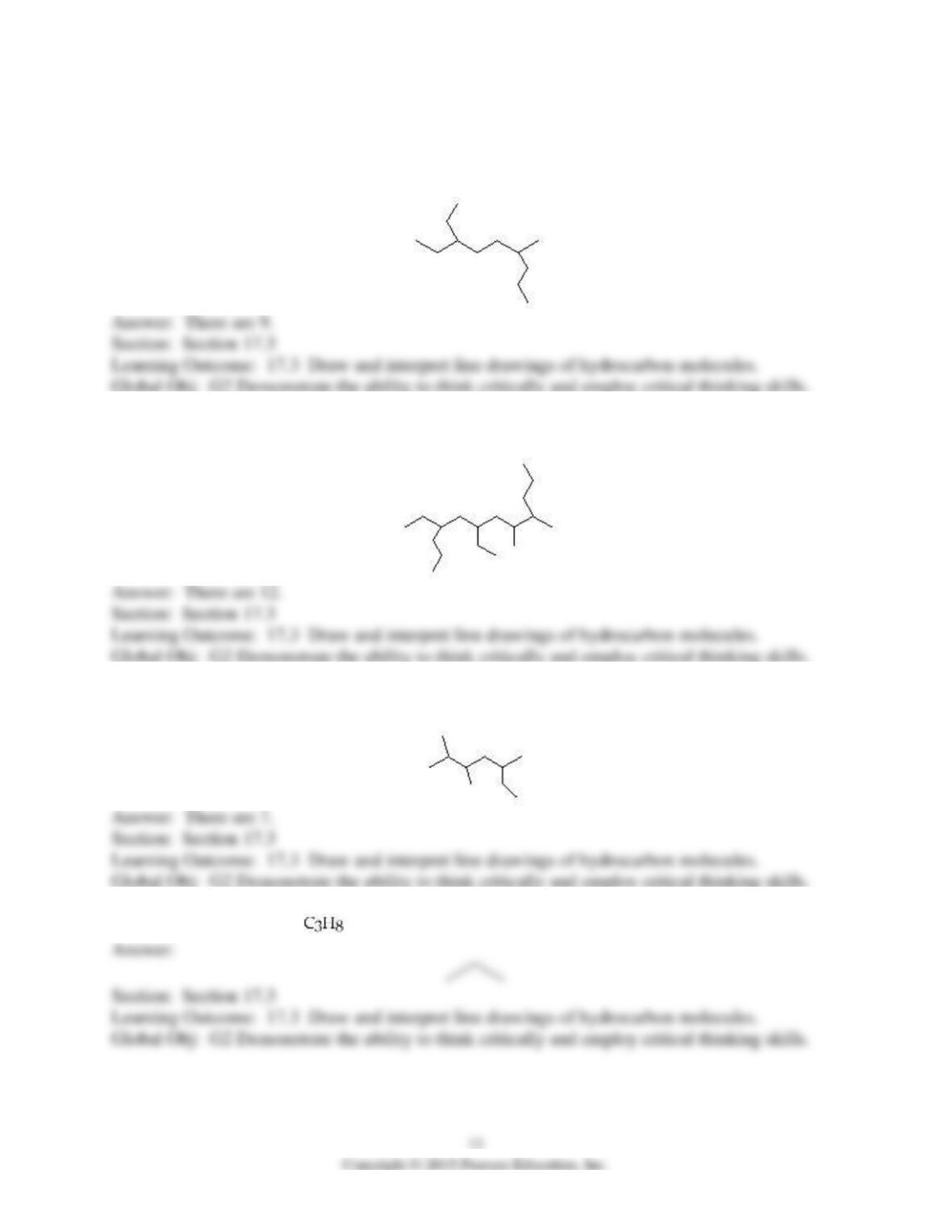
1) How many carbon atoms are there in the longest possible continuous chain in the following
molecule?
2) How many carbon atoms are there in the longest possible continuous chain in the following
molecule?
3) How many carbon atoms are there in the longest possible continuous chain in the following
molecule?
4) Give a line drawing of .