Introductory Chemistry: Atoms First, 5e (Russo/Silver)
Chapter 14 Chemical Equilibrium
14.1 Multiple Choice Questions
1) When a reaction shows one arrow pointing from left to right, this means ________.
A) the reaction has reached equilibrium
B) the reaction favors the right direction
C) there is practically no reactant left
D) both B and C
2) Which statement is true about equilibrium?
A) The forward reaction rate is greater than the reverse reaction rate.
B) The reverse reaction rate is greater than the forward reaction rate.
C) The forward reaction rate is equal to the reverse reaction rate.
D) Either A or B depending on the reaction.
3) Which of the following statements about the equilibrium constant is incorrect?
A) If Keq > 1 the reaction favors product formation.
B) If Keq > 1 the reaction does not favor product formation.
C) If Keq = 1 the reaction is at equilibrium.
D) If Keq < 1 the reaction does not favor product formation.
4) The equilibrium concentrations for the reaction at 300 K are [Cl2] = 0.75 M,
and [PCl5] = 0.73 M. Based on the calculated value of the equilibrium constant, the reaction is
________.
Cl2 (g) + PCl3 (g) PCl5 (g)
A) favorable
B) unfavorable
C) temperature dependent
D) temperature independent
5) Increasing the pressure will ________.
2 HCl (g) Cl2 (g) + H2 (g)
A) shift the reaction to the right
B) shift the reaction to the left
C) have no effect
D) cannot be determined, since the temperature is unknown
6) Which of the following statements best describes the rate of the forward reaction as it
approaches equilibrium?
A) The rate increases as equilibrium is approached.
B) The rate decreases as equilibrium is approached.
C) The rate remains constant.
D) The rate slows down, then increases, as equilibrium is approached.
7) Which of the following statements is true for a chemical reaction that has not reached an
equilibrium?
A) The “reverse” reaction rate is zero.
B) The “forward” reaction rate is zero.
C) The “forward” and “reverse” reaction rates are equal.
D) Both A and B are true statements.
E) None of the above are true statements.
8) For this chemical reaction at equilibrium:
N2 (g) + 3H2 (g) 2NH3 (g)
which of the following statements is true of the reaction rate?
A) The forward rate is faster than the reverse rate.
B) The reverse rate is faster than the forward rate.
C) Both the forward and reverse rates are zero.
D) The forward and reverse rates are the same.
9) For the following reaction, the equilibrium constant, Keq, is equal to 53.3. What is the
concentration of I2 at equilibrium, if the concentrations of HI and are 0.212 M and 1.576 M,
respectively?
H2 + I2 2HI
A) 1.576 M
B) 0.000535 M
C) 0.212 M
D) 0.314 M
10) The following chemical reaction has reached equilibrium.
2NO (g) + O2 (g) 2NO2 (g)
Calculate the equilibrium constant, Keq, if the concentrations of reactants and products are 1.26
× 10-10 M for NO, 2.28 × 10⁻³ M for O2, and 9.32 × 10⁻⁶ M for NO2.
A) 2.40 ×
B) 3.28 ×
C) 2.61 ×
D) 2.40 ×
11) The following chemical reaction has reached equilibrium.
(g) (g)
Calculate the equilibrium constant, Keq, if the concentrations of and are 0.0238 M
and 0.196 M, respectively.
A) 8.34
B) 346
C) 0.621
D) 1.61
12) For which of the following values of an equilibrium constant, Keq, would you expect the
equilibrium to lie farthest to the right?
A) 0.491, at 20 °C
B) 1.04, at 20 °C
C) 10.6, at 20 °C
D) 1.46 × , at 20 °C
13) For which of the following values of an equilibrium constant, Keq, would you expect the
equilibrium to lie farthest to the left?
A) 0.491, at 20 °C
B) 1.04, at 20 °C
C) 10.6, at 20 °C
D) 1.46 × , at 20 °C
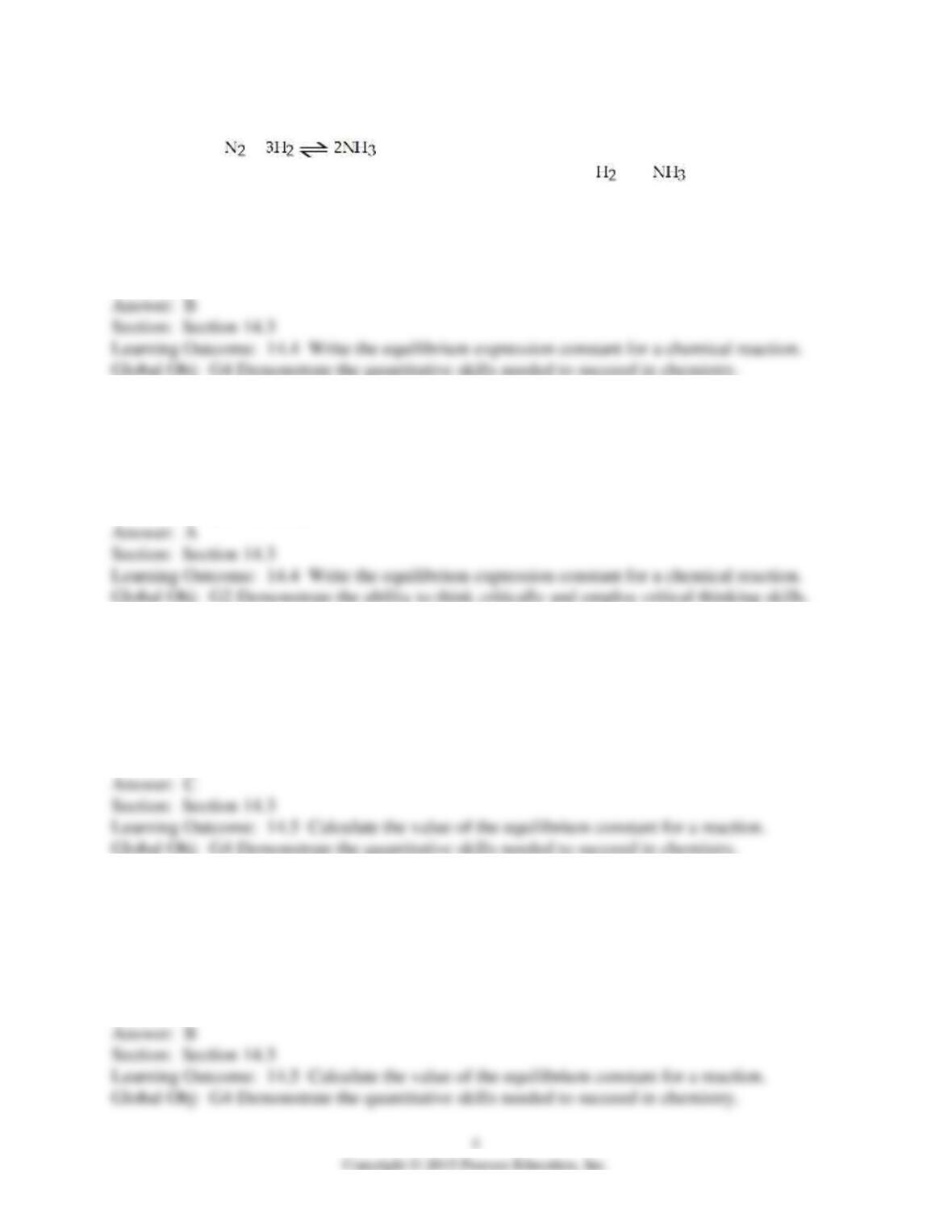
14) Calculate the equilibrium concentration of N2 for the following reaction.
+
The equilibrium constant Keq is 0.055 and the concentrations of and are 1.20 M and
0.225 M, respectively.
A) 0.0915 M
B) 0.533 M
C) 0.915 M
D) 3.41 M
15) The equilibrium constant is equal to which of the following?
A) kforward / kreverse
B) kreverse / kforward
C) kforward × kreverse
D) 1 / (kforward/kreverse)
16) If the value of the equilibrium constant for the forward reaction is 5.0 × 10¹⁰, the value of
the equilibrium constant for the reverse reaction is ________.
A) -5.0 × 1030
B) 5.0 × 10⁻¹⁰
C) 2.0 × 10⁻¹¹
D) 2.0 × 10⁻¹⁰
17) If the value of the equilibrium constant for the reverse reaction is 2.5 × 10⁻⁶, the value of the
equilibrium constant for the forward reaction is ________.
A) -2.5 × 10⁻⁶
B) 4.0 × 10⁵
C) 2.5 × 10⁶
D) 4.0 × 10⁷
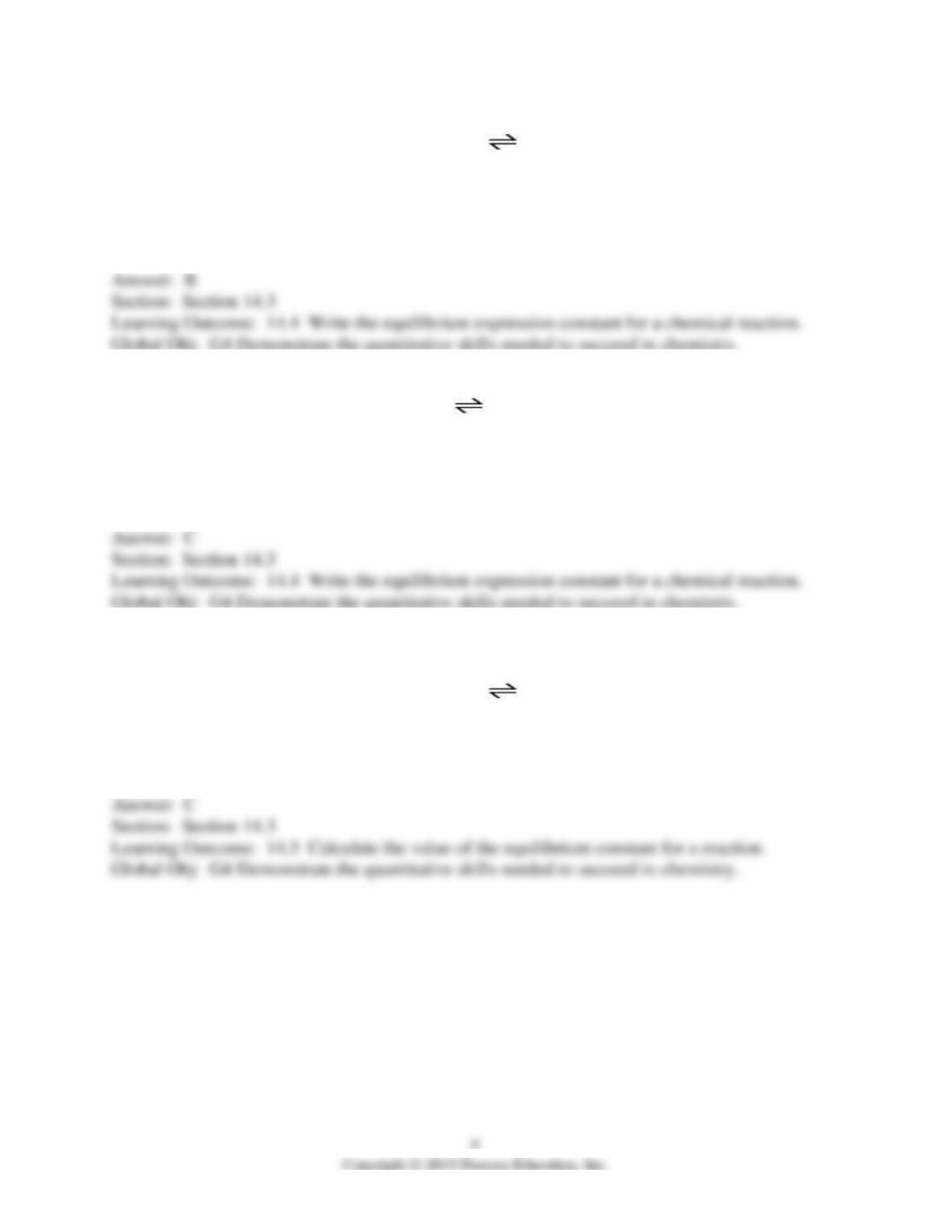
18) The equilibrium constant expression for the reaction is ________.
N2 (g) + 3H2 (g) 2NH3 (g)
A) Keq = [N2] [3H2]3 / [2NH3]2
B) Keq = [NH3]2 / [N2] [H2]3
C) Keq = [N2] [H2]3 / [NH3]2
D) Keq = [2NH3]2 / [N2] [3H2]3
19) The equilibrium constant expression for the reaction is ________.
2SO3 (g) + 2Cl2 (g) 2SO2Cl2 (g) + O2 (g)
A) Keq = [SO2Cl2] [O2] / [SO3] [Cl2]
B) Keq = [SO3] [Cl2] / [SO2Cl2] [O2]
C) Keq = [SO2Cl2]2[O2] / [SO3]2[Cl2]2
D) Keq = [SO3]2[Cl2]2 / [SO2Cl2]2[O2]
20) The equilibrium concentrations for the reaction at 673 K are [H2] = 0.63 M, [N2] = 0.45 M,
and [NH3] = 0.24 M. The value of Keq is ________.
N2 (g) + 3H2 (g) 2NH3 (g)
A) 0.85
B) 1.18
C) 0.51
D) 1.96
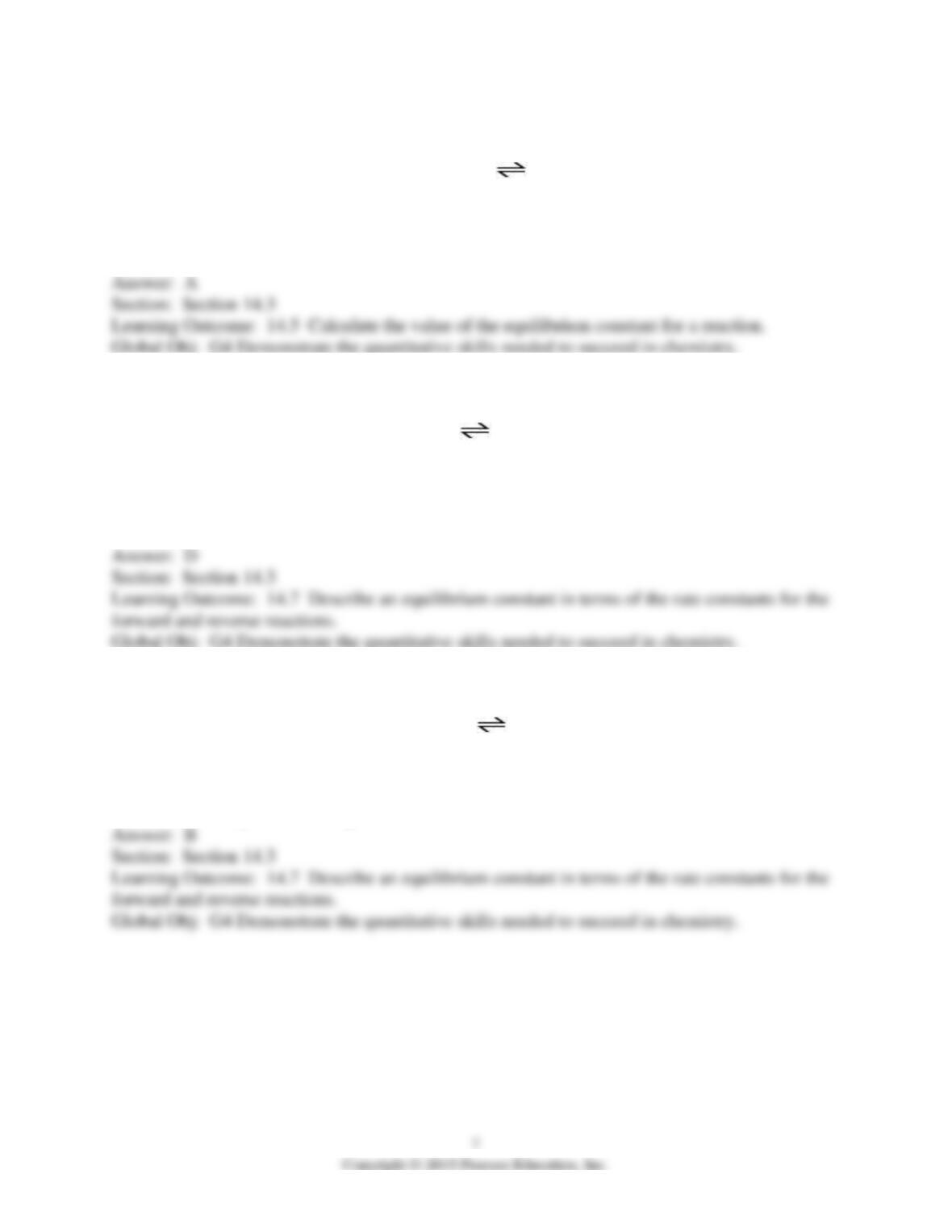
21) The equilibrium concentrations for the reaction at 300 K are [Cl2] = 0.75 M, [PCl3] = 0.45
M, and [PCl5] = 0.73 M. The value of Keq is ________.
Cl2 (g) + PCl3 (g) PCl5 (g)
A) 2.2
B) 0.15
C) 0.048
D) 4.7
22) Consider the reaction with Kc = 0.211. Which of the following pairs of concentrations
indicate that the system is not at equilibrium?
N2O4 (g) 2NO2 (g)
A) [N2O4] = 0.00140 M; [NO2] = 0.0172 M
B) [N2O4] = 0.00280 M; [NO2] = 0.0243 M
C) [N2O4] = 0.00452 M; [NO2] = 0.0309 M
D) [N2O4] = 0.00840 M; [NO2] = 0.0572 M
23) Equal numbers of moles for A and B are added to the reaction vessel and equilibrium
established. At that point ________.
A + 3B 2C
A) [A] < [B]
B) [A] > [B]
C) [A] = [B]
D) One cannot say unless the equilibrium constant value is known.
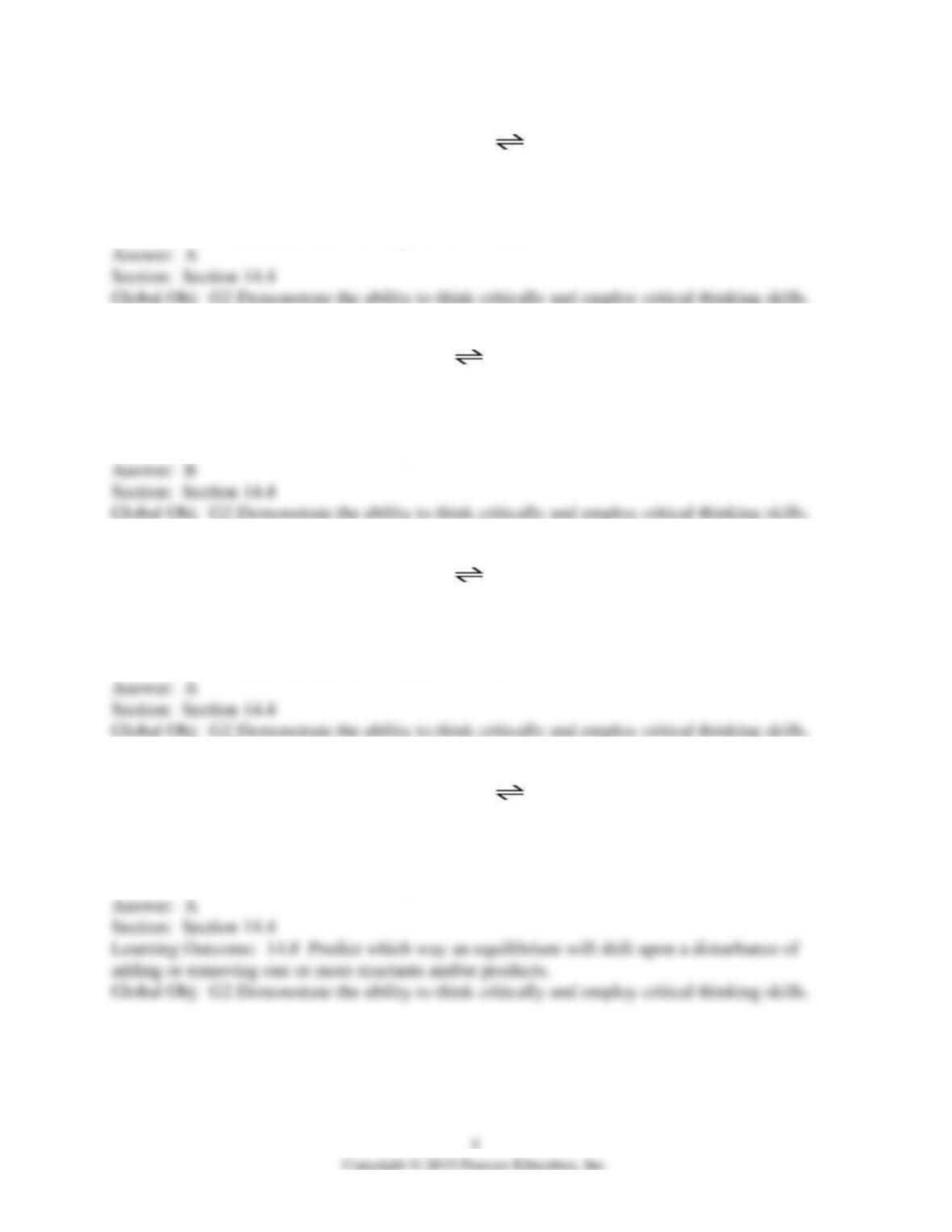
24) Increasing the pressure will ________.
2SO2 (g) + O2 (g) 2SO3 (g)
A) shift the reaction to the right
B) shift the reaction to the left
C) have no effect
D) cannot be determined, since the temperature is unknown
25) Decreasing the pressure will ________.
2SO3 (g) + 2Cl2 (g) 2SO2Cl2 (g) + O2 (g)
A) shift the reaction to the right
B) shift the reaction to the left
C) have no effect
D) cannot be determined, since the temperature is unknown
26) Decreasing the volume will ________.
2SO3 (g) + 2Cl2 (g) 2SO2Cl2 (g) + O2 (g)
A) shift the reaction to the right
B) shift the reaction to the left
C) have no effect
D) cannot be determined, since the temperature is unknown
27) Adding more oxygen will ________.
2SO2 (g) + O2 (g) 2SO3 (g)
A) shift the reaction to the right
B) shift the reaction to the left
C) have no effect
D) cannot be determined, since the temperature is unknown
28) Removing product will ________.
2SO2 (g) + O2 (g) 2SO3 (g)
A) shift the reaction to the right
B) shift the reaction to the left
C) have no effect
D) cannot be determined, since the temperature is unknown
29) Increasing the pressure will ________.
2NH3 (g) N2 (g) + 3H2 (g)
A) shift the reaction to the right
B) shift the reaction to the left
C) have no effect
D) cannot be determined, since the temperature is unknown
30) Decreasing the concentration of ammonia gas will ________.
2NH3 (g) N2 (g) + 3H2 (g)
A) shift the reaction to the right
B) shift the reaction to the left
C) have no effect
D) cannot be determined, since the temperature is unknown
31) Increasing the volume will ________.
2NH3 (g) N2 (g) + 3H2 (g)
A) shift the reaction to the right
B) shift the reaction to the left
C) have no effect
D) cannot be determined, since the temperature is unknown
32) Increasing the concentration of hydrogen gas will ________.
O2 (g) + 2H2 (g) 2H2O (g)
A) shift the reaction to the right
B) shift the reaction to the left
C) have no effect
D) cannot be determined, since the temperature is unknown
33) Removing ammonia as soon as it is formed will ________.
N2 (g) + 3H2 (g) 2NH3 (g)
A) shift the reaction to the right
B) shift the reaction to the left
C) have no effect
D) cannot be determined, since the temperature is unknown
34) Adding iron(III) chloride will ________.
FeCl3 (aq) + KSCN (aq) 3[Fe(SCN)6] (aq) + 3KCl (aq)
yellow colorless red colorless
A) turn the solution more red.
B) turn the solution less red.
C) turn the solution clear.
D) have no effect on the color.
35) Adding KSCN will ________.
FeCl3 (aq) + KSCN (aq) K3[Fe(SCN)6] (aq) + 3KCl (aq)
yellow colorless red colorless
A) turn the solution more red.
B) turn the solution less red.
C) turn the solution clear.
D) have no effect on the color.
36) Adding a couple of drops of an aqueous KCl solution will ________.
FeCl3 (aq) + KSCN (aq) K3[Fe(SCN)6] (aq) + 3KCl (aq)
yellow colorless red colorless
A) turn the solution more red.
B) turn the solution less red.
C) turn the solution clear.
D) have no effect on the color.
37) Adding H2O to the reaction vessel will ________.
2H2S (g) + 3O2 (g) 2SO2 (g) + 2H2O (g)
A) shift the reaction to the right
B) shift the reaction to the left
C) have no effect
D) cannot be determined, since the temperature is unknown
38) Adding helium to the reaction vessel will ________.
2H2S (g) + 3O2 (g) 2SO2 (g) + 2H2O (g)
A) shift the reaction to the right
B) shift the reaction to the left
C) have no effect
D) cannot be determined, since the temperature is unknown
39) Removing sulfur dioxide as it is formed will ________.
2H2S (g) + 3O2 (g) 2SO2 (g) + 2H2O (g)
A) shift the reaction to the right
B) shift the reaction to the left
C) have no effect
D) cannot be determined, since the temperature is unknown
40) Increasing the pressure will ________.
2H2S (g) + 3O2 (g) 2SO2 (g) + 2H2O (g)
A) shift the reaction to the right
B) shift the reaction to the left
C) have no effect
D) cannot be determined, since the temperature is unknown
41) Increasing the volume of the system will ________.
2H2S (g) + 3O2 (g) 2SO2 (g) + 2H2O (g)
A) shift the reaction to the right
B) shift the reaction to the left
C) have no effect
D) cannot be determined, since the temperature is unknown
42) Which of the following will shift the equilibrium to the left?
2H2S (g) + 3O2 (g) 2SO2 (g) + 2H2O (g)
A) adding sulfur dioxide
B) adding hydrogen sulfide
C) decreasing the pressure
D) both A and C
43) Adding excess oxygen will ________.
CH4 (g) + 2O2 (g) CO2 (g) + 2H2O (g)
A) shift the reaction to the right
B) shift the reaction to the left
C) have no effect
D) cannot be determined, since the temperature is not known
44) If oxygen is removed this will ________.
CH4 (g) + 2O2 (g) CO2 (g) + 2H2O (g)
A) shift the reaction to the right
B) shift the reaction to the left
C) have no effect
D) cannot be determined, since the temperature is unknown
45) If the reaction vessel is expanded, this will ________.
CH4 (g) + 2O2 (g) CO2 (g) + 2H2O (g)
A) shift the reaction to the right
B) shift the reaction to the left
C) have no effect
D) cannot be determined, since the temperature is unknown
46) Which of the following will shift the reaction to the right?
CH4 (g) + 2O2 (g) CO2 (g) + 2H2O (g)
A) adding excess oxygen
B) removing carbon dioxide as soon as it is formed
C) increasing the pressure
D) both A and B
47) Adding a catalyst will ________.
FeCl3 + KSCN K3[Fe(SCN)6] + 3KCl
yellow colorless red colorless
A) turn the solution red.
B) turn the solution less red.
C) turn the solution clear.
D) have no effect on the color.
48) In an endothermic reaction, adding heat will ________.
A) increase the amount of products
B) decrease the amount of reactants
C) decrease the amount of products
D) both A and B
49) For an endothermic reaction, lowering the temperature of the reaction will ________.
A) increase the amount of products
B) decrease the amount of reactants
C) decrease the amount of products
D) both A and B
50) In an exothermic reaction, adding heat will ________.
A) increase the amount of products
B) decrease the amount of reactants
C) decrease the amount of products
D) both A and B
51) For an exothermic reaction, lowering the temperature of the reaction will ________.
A) increase the amount of products
B) decrease the amount of reactants
C) decrease the amount of products
D) both A and B
52) For the following endothermic reaction, what condition will increase the yield of product?
N2 (g) + 2H2 (g) N2H4 (g)
A) high temperature, high pressure
B) high temperature, low pressure
C) low temperature, high pressure
D) low temperature, low pressure
53) For the following exothermic reaction, what condition will increase the yield of product?
C2H2 (g) + H2O (g) CH3CHO (g)
A) high temperature, high pressure
B) high temperature, low pressure
C) low temperature, high pressure
D) low temperature, low pressure
54) The solubility product expression for silver(I) sulfate is ________.
A) Ksp = [Ag+] [SO4-2]
B) Ksp = [2 Ag+] [SO4-2]
C) Ksp = [Ag+]2[SO4-2]
D) Ksp = [2Ag+]2[SO4-2]
55) If the solubility of a certain salt A2B is 1.4 × 10⁻⁴ M, the value of the solubility product will
be ________.
A) 2.7 × 10⁻¹²
B) 1.1 × 10⁻¹¹
C) 1.6 × 10⁻¹¹
D) 3.6 × 10⁻¹²
56) The solubility of SrF2 in water (given Ksp = 2.6 × 10⁻⁹ ) is ________.
A) 4.3 × 10⁻⁴ M
B) 1.2 × 10⁻⁴ M
C) 7.6 × 10⁻⁵ M
D) 8.7 × 10⁻⁴ M
57) If the solubility of copper(II) sulfate is 4.9 × 10⁻³ M, the solubility product is ________.
A) 2.4 × 10⁻⁵
B) 9.6 × 10⁻⁵
C) 1.2 × 10⁻²
D) 8.7 × 10⁻⁸