Archives
978-0133780581 Chapter 1 Lecture Note
Chapter 1. A Tour of the World I. MOTIVATING QUESTION What is macroeconomics? The chapter does not provide an explicit or formal answer. Instead, it takes you on an economic tour of the world and then describes the 2008global macroeconomic […]
978-0133780581 Chapter 1 Solution Manual
ANSWERS TO END-OF-CHAPTER PROBLEMS CHAPTER 1 Quick Check 1. a. True. 2. a. More flexible labor market institutions may lead to lower unemployment, but there are questions about how precisely to restructure these institutions. The United Kingdom has restructured its […]
978-0133780581 Chapter 10 Lecture Note
Chapter 10. The Facts of Growth I. MOTIVATING QUESTION What do economists know about growth? The chapter answers this question from two perspectives. First, it describes the empirical facts about growth across a spectrum of economies in the postwar period, […]
978-0133780581 Chapter 10 Solution Manual
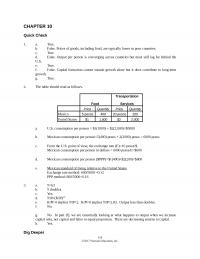
CHAPTER 10 Quick Check 1. a. True. 2. The table should read as follows. Food Transportation Services Price Quantity Price Quantity Mexico 5 pesos 400 20 pesos 200 United States $1 1,000 $2 2,000 a. U.S. consumption per person = […]
978-0133780581 Chapter 11 Lecture Note
Chapter 11. Saving, Capital Accumulation, and Output I. MOTIVATING QUESTION Does the saving rate affect growth? If the production function exhibits decreasing returns to capital, an increase in the saving rate can only affect the growth rate temporarily. In the […]
978-0133780581 Chapter 11 Solution Manual
CHAPTER 11 Quick Check 1. a. True, in a closed economy, and if saving includes public and private saving. b. False. The economy will eventually reach a steady state where output per worker does c. True. In the model without […]

978-0133780581 Chapter 12 Lecture Note
Chapter 12. Technological Progress and Growth I. MOTIVATING QUESTION How does growth relate to technological progress, and what determines the rate of technological progress? In the long run, the growth of output per person output equals the rate of technological […]
978-0133780581 Chapter 12 Solution Manual
CHAPTER 12 Quick Check 1. a. True. 2. a. Most technological progress seems to come from R&D activities. See discussion on fertility and appropriability in Chapter 12.2. b. This proposal would probably lead to lower growth in poorer countries, at […]

978-0133780581 Chapter 13 Lecture Note
Chapter 13. Technological Progress: The Short, the Medium, and the long run I. MOTIVATING QUESTION Does technological progress hurt workers? In the medium run, technological progress does not create unemployment, in theory or in evidence; in the short run, technological […]
978-0133780581 Chapter 13 Solution Manual
CHAPTER 13 Quick Check 1. a. False. Productivity growth is unrelated to the natural rate of unemployment. If the 2. a. u = 1-(1/(1+))(A/Ae) b. u = 1-(1/(1+0.05)) = 4.8% c. No. Since wages adjust to expected productivity, an increase […]
978-0133780581 Chapter 14 Lecture Note
Chapter 14. Financial Markets and Expectations I. MOTIVATING QUESTION How can consumers and firms compare present and future economic opportunities? Future economic opportunities (payments received or made) can be expressed in terms of the present by using a discount factor, […]
978-0133780581 Chapter 14 Solution Manual
CHAPTER 14 Quick Check 1 a. True b. True 2. a. Real. Nominal profits are likely to move with inflation; real profits are easier to forecast. b. Nominal. The payments are nominal. c. Nominal. Car lease and car loan payments […]

978-0133780581 Chapter 15 Lecture Note
Chapter 15. Expectations, Consumption, and Investment I. MOTIVATING QUESTION How do expectations about the future influence consumption and investment? If consumers are forward-looking and resources can be transferred across time through borrowing and lending, then consumption should depend on wealth, […]
978-0133780581 Chapter 15 Solution Manual
CHAPTER 15 Quick Check 1. a. False. Human wealth for a college student will be much higher since they have their h. True. The percentage change in investment is larger, but the absolute size of consumption is much bigger, so […]
978-0133780581 Chapter 16 Lecture Note
Chapter 16. Expectations, Output, and Policy I. MOTIVATING QUESTION How do expectations influence the determination of output and the effects of monetary and fiscal policy? Consumption and investment are influenced by expected future output, and investment is influenced by the […]
978-0133780581 Chapter 16 Solution Manual
CHAPTER 16 Quick Check 1. a. False. Changes in the current real policy rate have limited impact on spending, c.p. 2. a. Both quotes are clearly trying to influence the expected future policy interest rate. One says that the rate […]
978-0133780581 Chapter 17 Lecture Note
Chapter 17. Openness in Goods and Financial Markets I. MOTIVATING QUESTION How does openness modify the closed economy IS-LM model? An open economy allows domestic residents to choose between domestic and foreign goods and between domestic and foreign assets. The […]
978-0133780581 Chapter 17 Solution Manual
V CHAPTER 17 Quick Check 1. a. True. g. True h. False. The domestic rate must equal the foreign rate minus the expected appreciation of the domestic currency. i. False The statement should read: “Given the definition of the exchange […]
978-0133780581 Chapter 18 Lecture Note
Chapter 18. The Goods Market in an Open Economy I. MOTIVATING QUESTION How is output determined in the short run in an open economy? As in a closed economy, output in an open economy is determined by goods market equilibrium, […]
978-0133780581 Chapter 18 Solution Manual
CHAPTER 18 Quick Check 1. a. False. When savings declines consumption increases, both on domestic and imported f. True. g. True h. True 2. a. There is a real appreciation over time. Over time, the trade balance worsens. b. The […]
978-0133780581 Chapter 19 Lecture Note
OUTPUT, THE INTEREST RATE, AND THE EXCHANGE RATE 88 Chapter 19. Output, the Interest Rate, and the Exchange Rate I. MOTIVATING QUESTION How are output, the interest rate, and the exchange rate determined simultaneously in the short run in an […]
978-0133780581 Chapter 19 Solution Manual
CHAPTER 19 Quick Check 1. a. False. Interest rate parity means exchange rates will adjust to equate returns in countries. g. False. Fiscal expansion increases domestic output and creates a larger trade deficit. h. Uncertain. It depends on the policy […]
978-0133780581 Chapter 2 Lecture Note
Chapter 2. A Tour of the Book I. MOTIVATING QUESTIONS 1. How do economists define output, the unemployment rate, and the inflation rate, and why do economists care about these variables? Output and the unemployment rate are defined in the […]
978-0133780581 Chapter 2 Solution Manual
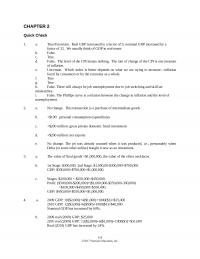
CHAPTER 2 Quick Check 1. a. True/Uncertain. Real GDP increased by a factor of 5; nominal GDP increased by a factor of 32. We usually think of GDP in real terms 2. a. No change. This transaction is a purchase […]
978-0133780581 Chapter 20 Lecture Note
Chapter 20. Exchange Rate Regimes I. MOTIVATING QUESTION How does the exchange rate regime affect macroeconomic adjustment? Under a fixed nominal exchange rate regime, there are two methods of adjustment: relatively slow, medium-run adjustment through the movement of prices and […]
978-0133780581 Chapter 20 Solution Manual
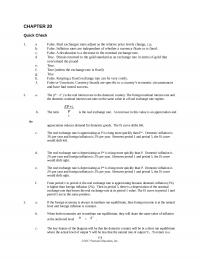
CHAPTER 20 Quick Check 1. a False. Real exchanges rates adjust as the relative price levels change, c.p. 2. a. The (i* – πe ) is the real interest rate in the domestic country. The foreign nominal interest rate and […]
978-0133780581 Chapter 21 Lecture Note
Chapter 21. Should Policymakers be Restrained? I. MOTIVATING QUESTION Should external limits be imposed on policymakers? The fact that the effects of policy are uncertain does not imply that limits should be imposed on policymakers. Policymakers understand that uncertainty provides […]
978-0133780581 Chapter 21 Solution Manual
CHAPTER 21 Quick Check 1. a. False. Monetary policy has been shown to be effective in stimulating growth. b. True c. True i. Uncertain. It may be wise for a government to commit not to negotiate with hostage takers as […]
978-0133780581 Chapter 22 Lecture Note
Chapter 22. Fiscal Policy: A SUMMING UP I. MOTIVATING QUESTION What do macroeconomists know about fiscal policy? Fiscal policy affects output in the short run—through its effect on aggregate demand—and in the long run— through its effect on investment. Fiscal […]
978-0133780581 Chapter 22 Solution Manual
CHAPTER 22 Quick Check 1. a. False The official deficit is a nominal number. 2. First, even a temporary deficit leads to an increase in the national debt, and therefore to higher interest payments. This, in turn, implies continued deficits, […]
978-0133780581 Chapter 23 Lecture Note
CHAPTER 23. MONETARY POLICY: A SUMMING UP I. MOTIVATING QUESTION What do macroeconomists know about monetary policy? In the long run, monetary policy affects only the inflation rate. Thus, a central bank should adopt a target inflation rate, based on […]
978-0133780581 Chapter 24 Lecture Note
Chapter 24. Epilogue: The Story of Macroeconomics I. MOTIVATING QUESTION How have the core ideas of macroeconomics developed? Modern macroeconomics starts with Keynes. Since his General Theory appeared, there have been a series of challenges and counter challenges to his […]
978-0133780581 Chapter 3 Lecture Note
Chapter 3. The Goods Market I. MOTIVATING QUESTION How is output determined in the short run? Output is determined by equilibrium in the goods market, i.e., by the condition that supply (production of goods) equals demand. This condition always determines […]
978-0133780581 Chapter 3 Solution Manual
CHAPTER 3 Quick Check 1. a. True. 2. a. Y=160+0.6(Y-100)+150+150 Y=1000 b. YD=Y–T=1000-100=900 c. C=160+0.6(900)=700 3. a. Equilibrium output is 1000. Total demand=C+I+G=700+150+150=1000. Total demand equals production. We used this equilibrium condition to solve for output. b. Output falls by […]
978-0133780581 Chapter 4 Lecture Note
Chapter 4. Financial Markets I. MOTIVATING QUESTION How is the interest rate determined in the short run? The interest rate is determined by equilibrium in the money market, i.e., by the condition that money supply equals money demand. Since the […]
978-0133780581 Chapter 4 Solution Manual
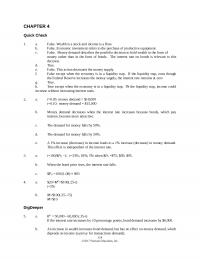
CHAPTER 4 Quick Check 1. a. False. Wealth is a stock and income is a flow. 2. a. i=0.05: money demand = $18,000 i=0.10: money demand = $15,000 b. Money demand decreases when the interest rate increases because bonds, which […]

978-0133780581 Chapter 5 Lecture Note
Chapter 5. Goods and Financial Markets: The IS-LM model I. MOTIVATING QUESTION How are output and the interest rate determined simultaneously in the short run? Output and the interest rate are determined by simultaneous equilibrium in the goods and money […]
978-0133780581 Chapter 5 Solution Manual
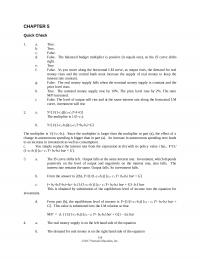
CHAPTER 5 Quick Check 1. a. True. g. False. The real money supply falls when the nominal money supply is constant and the price level rises h. True. The nominal money supply rose by 10%. The price level rose by […]
978-0133780581 Chapter 6 Lecture Note
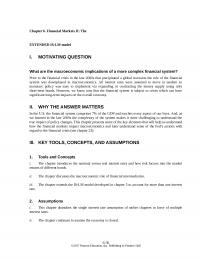
Chapter 6. Financial Markets II: The EXTENDED IS-LM model I. MOTIVATING QUESTION What are the macroeconomic implications of a more complex financial system? Prior to the financial crisis in the late 2000s that precipitated a global recession the role of […]
978-0133780581 Chapter 6 Solution Manual
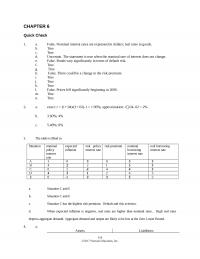
CHAPTER 6 Quick Check 1. a. False. Nominal interest rates are expressed in dollars; real rates in goods. f. True g. True h. False. There could be a change in the risk premium i. True j. True k. True l. […]

978-0133780581 Chapter 7 Lecture Note
Chapter 7. The Labor Market I. MOTIVATING QUESTION How is the unemployment rate determined in the medium run? In the medium run, the unemployment rate tends to return to the so-called natural rate, determined by equilibrium in the labor market […]
978-0133780581 Chapter 7 Solution Manual
CHAPTER 7 Quick Check 1. a. False. The participation rate has increased over time. 2. a. (Monthly hires + monthly separations)/monthly employment =(5.7+5.2)/139.0=7.8% b. 2.0/8.8=22.7% c. (2.0+1.9)/8.8=44.3%. Duration is 1/0.443 or 2.25 months. d. (3.7+3.4+1.8+2.0)/(139.0+8.8)=7.4%. e. new workers: 0.45/(3.7+2.0)=7.9%. 3. […]
978-0133780581 Chapter 8 Lecture Note
Chapter 8. The Phillips Curve, the Natural Rate of Unemployment and Inflation I. MOTIVATING QUESTION How are the inflation rate and the unemployment rate related in the short run and the medium run? Since 1970, the U.S. data can be […]
978-0133780581 Chapter 8 Solution Manual
CHAPTER 8 Quick Check 1. a. True. b. False. After 1970 the relationship between inflation and unemployment broke down. c. True 2. a. No. In the 1970s, we experienced high inflation and high unemployment. The expectations-augmented Phillips curve is a […]
978-0133780581 Chapter 9 Lecture Note
Chapter 9. FROM THE SHORT TO THE MEDIUM RUN: The IS-LM-PC Model I. MOTIVATING QUESTION How are output, the unemployment rate, and inflation determined in the short run and the medium run? Short run output in the goods and services […]
978-0133780581 Chapter 9 Solution Manual
CHAPTER 9 Quick Check 1. a. False. An increase in taxes (T) will shift the IS curve down as will an increase in risk premium (x). b. False. When unemployment exceeds the natural rate then the output gap is negative. […]
BUS 12114
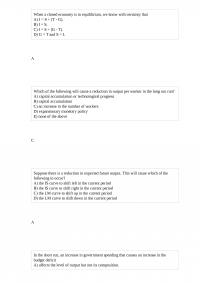
When a closed economy is in equilibrium, we know with certainty that A) I = S + (T – G). B) I = S. C) I = S + (G – T). D) G = T and S = I. […]
BUS 38866
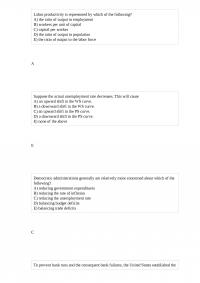
Labor productivity is represented by which of the following? A) the ratio of output to employment B) workers per unit of capital C) capital per worker D) the ratio of output to population E) the ratio of output to the […]
BUS 84781
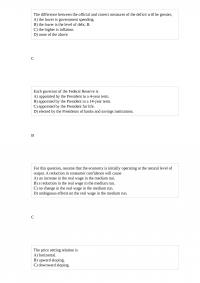
The difference between the official and correct measures of the deficit will be greater, A) the lower is government spending. B) the lower is the level of debt, B. C) the higher is inflation. D) none of the above Each […]
BUS 87795
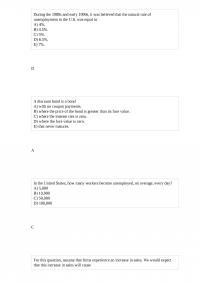
During the 1980s and early 1990s, it was believed that the natural rate of unemployment in the U.S. was equal to A) 4%. B) 4.5%. C) 5%. D) 6.5%. E) 7%. A discount bond is a bond A) with no […]
BUS 96024
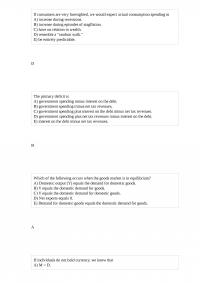
If consumers are very foresighted, we would expect actual consumption spending to A) increase during recessions. B) increase during episodes of stagflation. C) have no relation to wealth. D) resemble a “random walk.” E) be entirely predictable. The primary deficit […]
ECB 31371
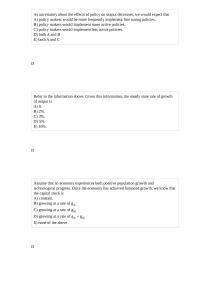
As uncertainty about the effects of policy on output decreases, we would expect that A) policy makers would be more frequently implement fine tuning policies. B) policy makers would implement more active policies. C) policy makers would implement less active […]
ECB 36135
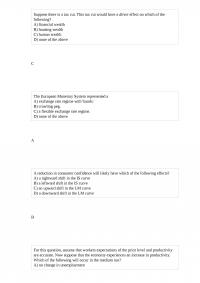
Suppose there is a tax cut. This tax cut would have a direct effect on which of the following? A) financial wealth B) housing wealth C) human wealth D) none of the above The European Monetary System represented a A) […]
ECB 46277
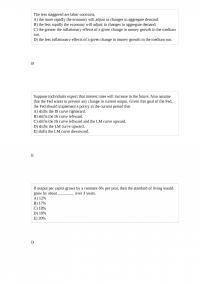
The less staggered are labor contracts, A) the more rapidly the economy will adjust to changes in aggregate demand. B) the less rapidly the economy will adjust to changes in aggregate demand. C) the greater the inflationary effects of a […]
ECB 67190
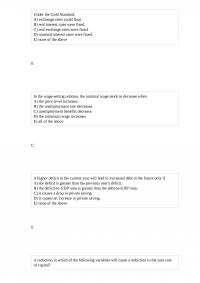
Under the Gold Standard, A) exchange rates could float. B) real interest rates were fixed. C) real exchange rates were fixed. D) nominal interest rates were fixed. E) none of the above In the wage-setting relation, the nominal wage tends […]
ECB 75191
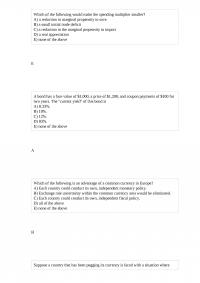
Which of the following would make the spending multiplier smaller? A) a reduction in marginal propensity to save B) a small initial trade deficit C) a reduction in the marginal propensity to import D) a real appreciation E) none of […]
ECB 79966
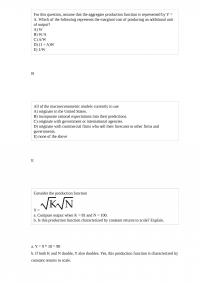
For this question, assume that the aggregate production function is represented by Y = A. Which of the following represents the marginal cost of producing an additional unit of output? A) W B) W/A C) A/W D) (1 + A)W […]
ECB 93470
The United States financed the additional government spending during World War II through A) an increase in the deficit. B) an increase in taxes. C) an increase in imports. D) increases in both the deficit and taxes. E) increases in […]
ECB 96372
Which of the following does not explain the relatively low price inflation compared to the higher wage inflation in the U.S. during the 1990s? A) the appreciation of the dollar B) a reduction in benefits paid to workers C) an […]
ECON 20001
For this question, assume that policy makers are pursuing a fixed exchange rate regime and that output is initially less than the natural level of output. The economy will tend to move toward the natural level of output when which […]
ECON 23341
Since 1971, the annual growth rate of real wages has been A) remarkably high. B) positive, but low. C) zero. D) negative. E) impossible to measure accurately, and so has not been reported. When answering this question, assume individuals consider […]
ECON 38362
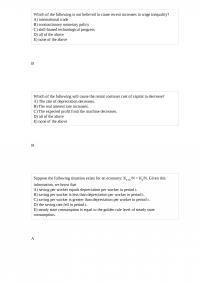
Which of the following is not believed to cause recent increases in wage inequality? A) international trade B) contractionary monetary policy C) skill-biased technological progress D) all of the above E) none of the above Which of the following will […]
ECON 79522
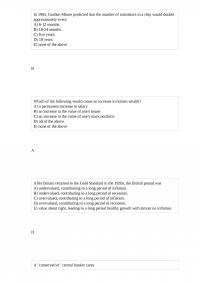
In 1965, Gordon Moore predicted that the number of transistors in a chip would double approximately every A) 6-12 months. B) 18-24 months. C) five years. D) 10 years. E) none of the above Which of the following would cause […]
ECON 93287
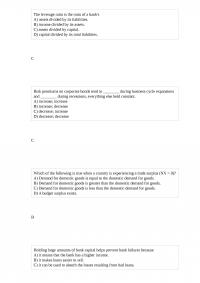
The leverage ratio is the ratio of a bank’s A) assets divided by its liabilities. B) income divided by its assets. C) assets divided by capital. D) capital divided by its total liabilities. Risk premiums on corporate bonds tend to […]
ECon A 13362
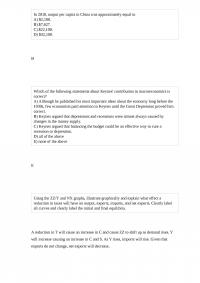
In 2010, output per capita in China was approximately equal to A) $2,100. B) $7,627. C) $22,100. D) $32,100. Which of the following statements about Keynes’ contribution to macroeconomics is correct? A) Although he published his most important ideas about […]
ECon A 57874
When the Current Population Survey (CPS) was introduced in 1940, it was based on a survey of approximately 8,000 households. The CPS survey is now based on a survey of how many households? A) 8,000 B) 10,000 C) 12,000 D) […]
ECon A 76022
From 2000 to 2007, which country had the highest nominal house price increase? A) Spain B) Portugal C) Greece D) Italy In the 1960s, the monetarist school of thought held that A) monetary and fiscal policy could explain most of […]
ECon A 92606
Suppose that financial market participants expect that the central bank will pursue a monetary expansion in the future. Also assume that the yield curve is initially upward sloping. Given this information, we would expect which of the following to occur? […]
ECon A 94474
Which of the following is considered out of the labor force? A) the unemployed B) those temporarily laid off who will soon be recalled C) those who worked full time, but in a family business D) those individuals who have […]
ECon A 99114
Based on price setting behavior, we know that an increase in the unemployment rate will cause A) no change in the real wage. B) a reduction in the real wage. C) an increase in the real wage. D) an upward […]
ECON E 20497
The golden rule level of capital refers to A) the level of capital that maximizes output per worker. B) the level of capital that maximizes the standard of living. C) the level of capital that maximizes consumption per worker in […]
ECON E 35295
Assume that political business cycles do not exist. Given this assumption, we would expect, all else fixed, the output growth to be highest in which period? A) just prior to an election B) just after an election C) in the […]
ECON E 53199
Because expected inflation is typically positive, we know that A) the nominal interest rate is generally less than the real interest rate. B) the real interest rate is generally less than the nominal interest rate. C) the nominal and real […]
ECON E 58286
We will generally observe that the less open an economy A) the larger the effect of fiscal policy on output and the larger the effect of fiscal policy on the trade position. B) the larger the effect of fiscal policy […]
ECON E 96375
Based on our understanding of the paradox of saving, we know that a reduction in the desire to save will cause A) an increase in equilibrium GDP. B) a reduction in GDP. C) an increase in the desire to invest. […]
Economics 11865
An increase in income will tend to cause which of the following? A) an increase in the monetary base (H) B) a reduction in H C) an increase in the interest rate D) a reduction in the money multiplier E) […]
Economics 12239
Assume that an economy experiences both positive population growth and technological progress. Once the economy has achieved balanced growth, we know that the capital per worker ratio (K/N) is A) constant. B) growing at a rate of gA – gN. […]
Economics 14831
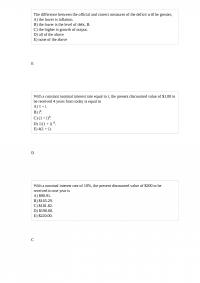
The difference between the official and correct measures of the deficit will be greater, A) the lower is inflation. B) the lower is the level of debt, B. C) the higher is growth of output. D) all of the above […]
Economics 23527
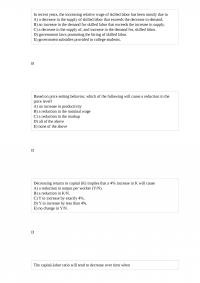
In recent years, the increasing relative wage of skilled labor has been mostly due to A) a decrease in the supply of skilled labor that exceeds the decrease in demand. B) an increase in the demand for skilled labor that […]
Economics 33077
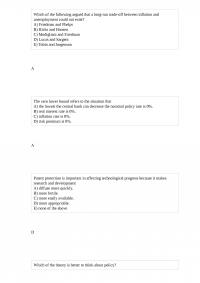
Which of the following argued that a long-run trade-off between inflation and unemployment could not exist? A) Friedman and Phelps B) Hicks and Hansen C) Modigliani and Friedman D) Lucas and Sargent E) Tobin and Jorgenson The zero lower bound […]
Economics 53533
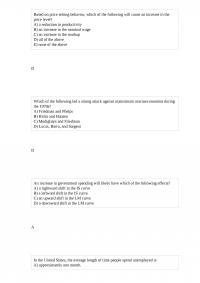
Based on price setting behavior, which of the following will cause an increase in the price level? A) a reduction in productivity B) an increase in the nominal wage C) an increase in the markup D) all of the above […]
Economics 98224
In the absence of technological progress, we know that the level of output per worker in the steady state will A) increase over time. B) remain constant. C) decrease as a result of decreasing returns to scale. D) increase or […]
MicroEconomic 45324
The Ricardian equivalence proposition states that an increase in the deficit causes A) consumption to decrease. B) savings to decrease. C) investment to decrease. D) all of the above E) none of the above Which of the following expressions represents […]
MicroEconomic 48366
Human wealth is a function (i.e., affected by changes in) of which of the following variables? A) future expected income B) future expected taxes C) current interest rates D) all of the above E) none of the above The primary […]
MicroEconomic 59938
Which of the following would cause a reduction in M1? A) an increase in the required ratio of reserves to deposits B) a reduction in the discount rate C) an open market operation where the Fed sells bonds D) all […]
MicroEconomic 70543
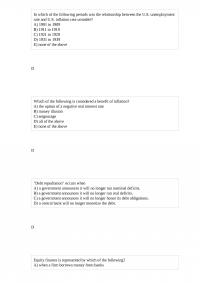
In which of the following periods was the relationship between the U.S. unemployment rate and U.S. inflation rate unstable? A) 1901 to 1909 B) 1911 to 1919 C) 1921 to 1929 D) 1931 to 1939 E) none of the above […]
MicroEconomic 86448
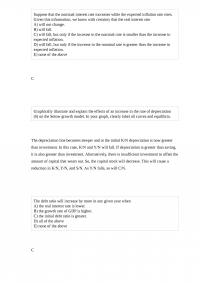
Suppose that the nominal interest rate increases while the expected inflation rate rises. Given this information, we know with certainty that the real interest rate A) will not change. B) will fall. C) will fall, but only if the increase […]
MicroEconomic 97309
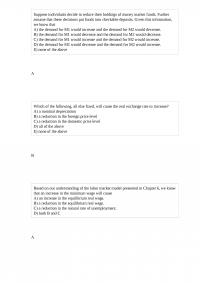
Suppose individuals decide to reduce their holdings of money market funds. Further assume that these decisions put funds into checkable deposits. Given this information, we know that A) the demand for M1 would increase and the demand for M2 would […]