V CHAPTER 17
Quick Check
1. a. True.
g. True
j. False. Domestic goods become relatively more expensive.
2. Domestic Country Balance of Payments ($)
Current Account
Exports 25
Capital Account
Foreign Country Balance of Payments ($)
Current Account
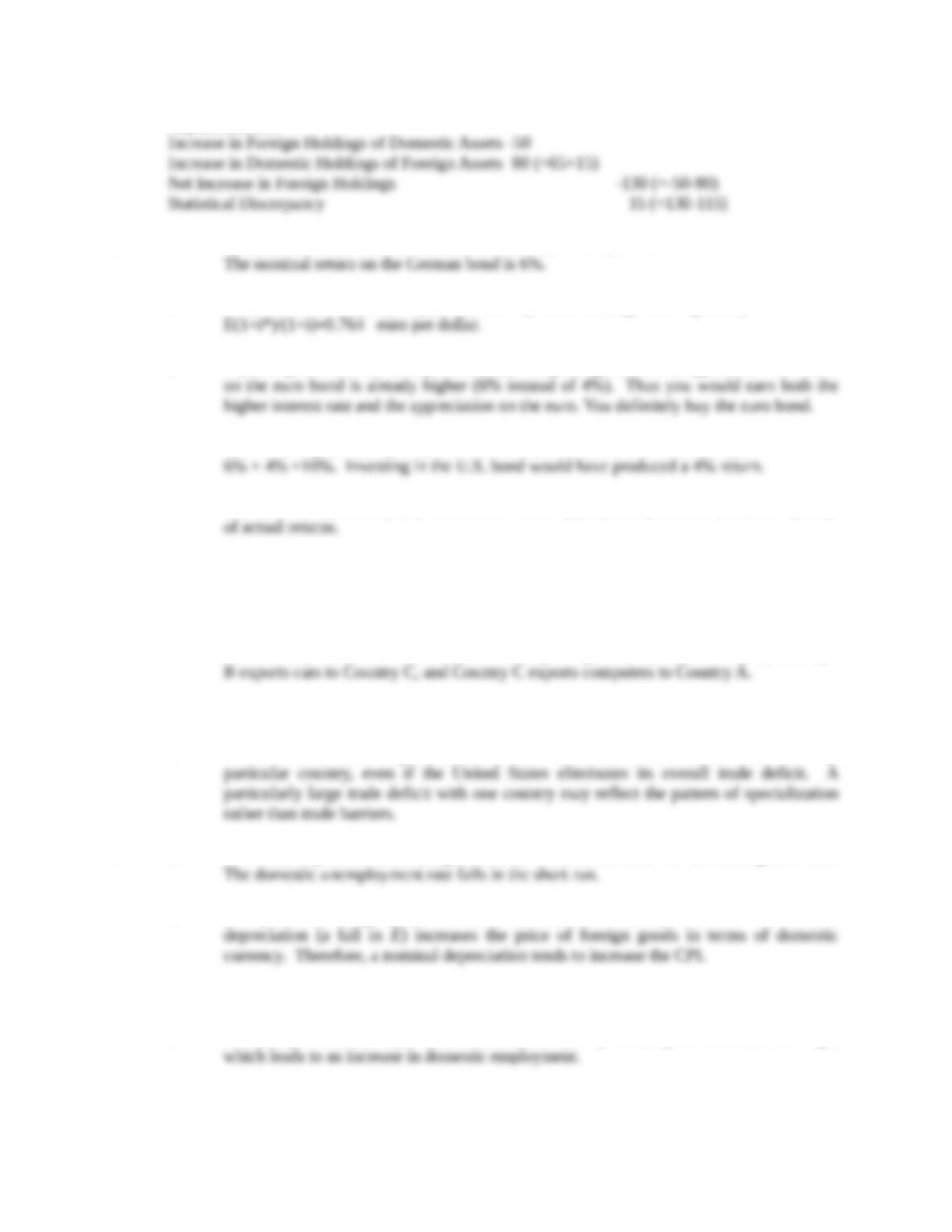
Capital Account
3. a. The nominal return on the U.S. bond is 10,000/(9615.38)–1=4%.
b. Uncovered interest parity implies that the expected exchange rate is given by
c. If you expect the dollar to depreciate, this is expecting the euro to appreciate. The return
d. The dollar depreciates by 4%, so the total return on the German bond (in $) is
e. The uncovered interest parity condition is about equality of expected returns, not equality
Dig Deeper
4. a. GDP is 15 in each economy. Consumers will spend 5 on each good.
b. Each country has a zero trade balance. Country A exports clothes to Country B, Country
c. No country will have a zero trade balance with any other country.
d. There is no reason to expect that the United States will have balanced trade with any
5. a. The relative price of domestic goods falls. Relative demand for domestic goods rises.
b. The price of foreign goods in terms of domestic currency is P*/E. A nominal
c. The real wage falls.
d. Essentially, a nominal depreciation stimulates output by reducing the domestic real wage,
Explore Further
6. a. We are treating the United States as the domestic country when E is expressed as the
b. Considering the evidence through 2015, the yen generally appreciated against the dollar
c. Depreciation of the yen.
d. The depreciation from 2012 to 2015 would help the Japanese recover from their
7. a. The sum of world current account balances should be zero. In 2014, the sum was
b. In 2014, the United States was the world’s biggest borrower by far. The rest of the
c. In 2014, the total saving of the advanced economies including the United States was
d. The projections in the October 2015 World Economic Outlook suggested one substantial
8. a. World saving essentially equals world investment, as must be true logically.
b. In 2014, U.S. saving was 18.8% of GDP, but U.S. investment was 19.5% of GDP. The
c. Real GNP is between ½ and 1 percentage point larger than real GDP. The difference is