For this question, assume that the aggregate production function is represented by Y =
A. Which of the following represents the marginal cost of producing an additional unit
of output?
A) W
B) W/A
C) A/W
D) (1 + A)W
E) 1/W
All of the macroeconometric models currently in use
A) originate in the United States.
B) incorporate rational expectations into their predictions.
C) originate with government or international agencies.
D) originate with commercial firms who sell their forecasts to other firms and
governments.
E) none of the above
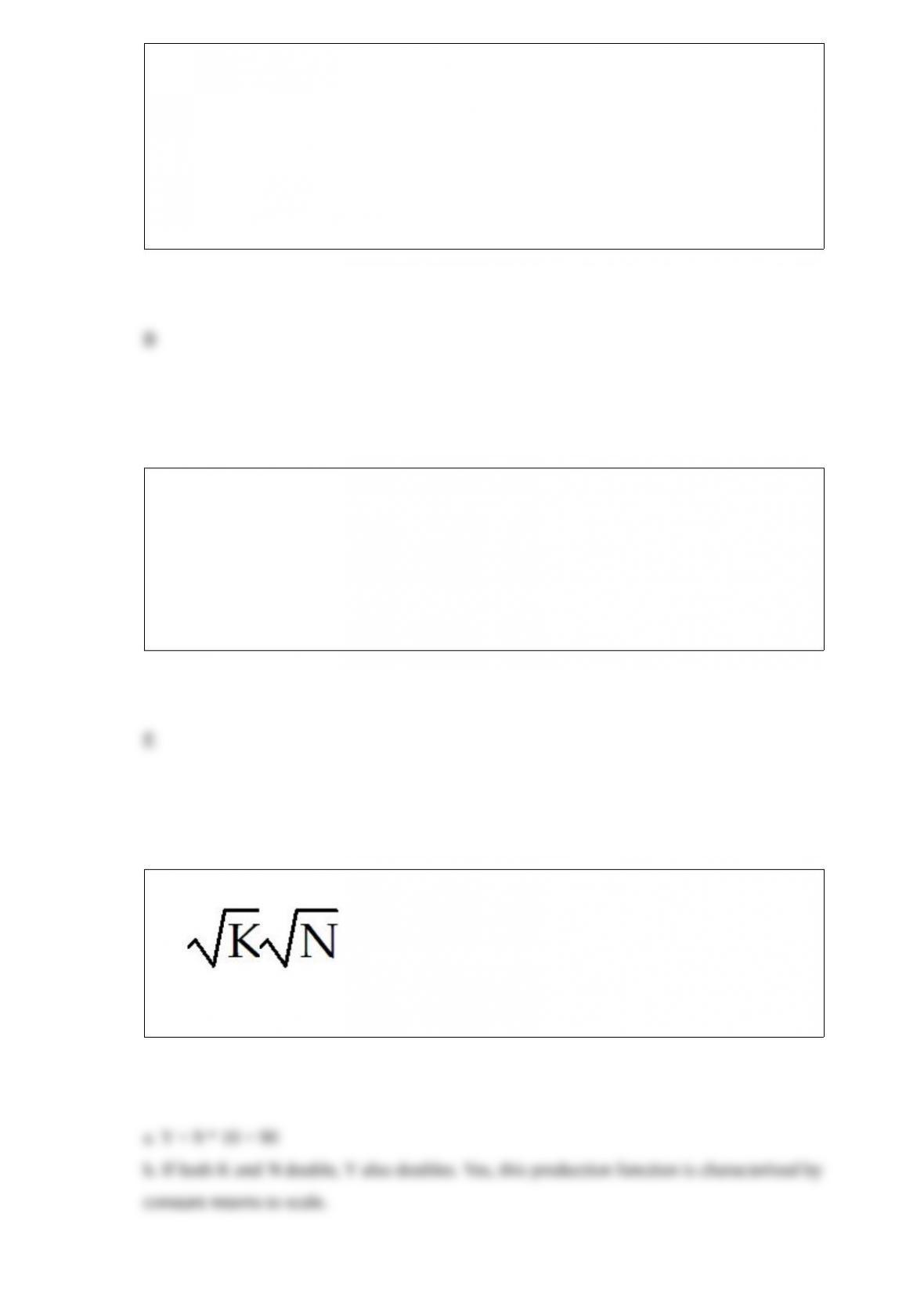
Consider the production function
Y =
a. Compute output when K = 81 and N = 100.
b. Is this production function characterized by constant returns to scale? Explain.

When using a logarithmic scale to plot output per capita over time, an upward-sloping
curve that becomes increasingly steep indicates
A) output per capita is not changing.
B) output per capita is growing by a constant amount each year.
C) output per capita is growing by a constant percentage each year.
D) output per capita is growing by an increasing percentage each year.
E) output per capita is not defined.
Assume that the nominal exchange rate decreases by 4%. If prices (both domestic and
foreign do not change), we know that
A) foreign goods are now relatively cheaper.
B) foreign goods are now relatively more expensive.
C) domestic goods are now relatively more expensive.
D) both A and C
Refer to the information above. The price of U.S. goods measured in pounds is
A) .8.
B) 1.0.
C) 1.6.
D) 2.
E) none of the above
Refer to the information above. The labor force is

A) 20 million.
B) 40 million.
C) 60 million.
D) 80 million.
E) 100 million.
Suppose a one-year discount bond offers to pay $100 in one year and currently sells for
$99. Given this
information, we know that the interest rate on the bond is
A) 11.1%.
B) 10%.
C) 5.3%.
D) 9.9%.
An increase in the price of oil will cause which of the following in the medium run?
A) no change in the level of output
B) no change in the price level
C) an increase in the unemployment rate
D) a reduction in the interest rate
E) none of the above
Assume individuals consider only the medium run effects of changes in future macro
variables when forming expectations of future output and future interest rates. Suppose

individuals expect future taxes to decrease. Given this information, individuals will
expect
A) an increase in the expected future interest rate and no change in expected future
output.
B) an increase in the expected future interest rate and an increase in expected future
output.
C) an increase in the expected future interest rate and a reduction in expected future
output.
D) an increase in the expected future interest rate and an ambiguous effect on expected
future output.
If GDP is less than GNP, we know with certainty that
A) a budget deficit exists.
B) a trade surplus exists.
C) a trade deficit exists.
D) none of the above
Which of the following best describes a situation where research is considered
appropriable?
A) research that is well suited to its commercial purpose
B) research that is easily copied by another firm
C) research that translates into many new products
D) all of the above
E) none of the above

An increase in productivity will cause which of the following according to the
price-setting behavior of firms?
A) a reduction in prices set by firms
B) an increase in the real wage paid by firms
C) a reduction in the markup set by firms
D) all of the above
E) none of the above
Which of the following is an argument of opponents of devaluations?
A) Devaluations cause relatively slow adjustments.
B) Participants in foreign exchange markets have a short memory: if the expected
devaluation doesn’t occur within a short time-period, they will stop expecting it.
C) A devaluation causes a nation with fixed exchange rates to lose credibility in the
medium run, driving its interest rate higher.
D) all of the above
E) none of the above
When the economy is in equilibrium, we know with certainty that
A) public saving equals investment.
B) private saving equals investment.
C) G = T.
D) none of the above

Assume individuals consider only the long run effects of changes in future macro
variables when forming expectations of future output and future interest rates. Suppose
current government spending increases and that individuals expect future government
spending to increase. Given this information, we know with certainty that
A) current output and the current interest rate will both increase.
B) current output will not change.
C) future expected output will decrease.
D) future expected output will not change.
Suppose policy makers want to increase Y and increase NX. Which of the following
policies would most likely achieve this?
A) an increase in government spending
B) a real depreciation
C) a reduction in taxes and an increase in the real exchange rate
D) an increase in the real exchange rate
Which of the following is not an asset on a bank’s balance sheet?
A) reserves
B) loans
C) checkable deposits
D) all of the above
E) none of the above

Suppose an economy is characterized by the equations below:
Price setting: P= (1 + m) (W/A)
Wage setting: W=AP(1 – u)
Solve for the natural rate of unemployment if the markup (m) is equal to 4%.
Which of the following is a component of money?
A) bonds
B) saving
C) income
D) stocks
E) none of the above
For this question, assume that expectations of P and A are correct. Based on price
setting behavior, the real wage will be equal to which of the following?
A) A/(1 + m)
B) AP/(1 + m)
C) APF(u,z)
D) P(1 + m)
E) none of the above
Which of the following is not a tool of the Fed?
A) the discount rate
B) reserve requirements

C) open market operations
D) the proportion of money held as currency
Assume that the current one-year rate is 5% and the two-year rate is 7%. Given this
information, the one-year rate expected one year from now is
A) 5%.
B) 6%.
C) 7%.
D) 9%.
E) 12%.
M1 consists of
A) currency only.
B) currency plus travelers checks only.
C) currency plus checkable deposits only.
D) checkable deposits only.
E) none of the above
Based on our understanding of the model presented in Chapter 3, a reduction in
investment will cause
A) an increase in the multiplier.
B) a reduction in the multiplier.
C) a reduction in the marginal propensity to save.

D) a reduction in output.
E) both B and D
Which of the following is a characteristic of bonds?
A) pay zero nominal interest
B) can be used for transactions
C) are sold for a price that varies inversely with the interest rate
D) all of the above
E) none of the above
Which of the following will occur in a small country with a high marginal propensity to
import?
A) Changes in government spending will cause large changes in output.
B) Changes in government spending will cause large changes in the trade balance.
C) A depreciation will cause only small changes in the trade balance.
D) There is no combination of policies that can eliminate the trade deficit.
E) all of the above
Based on the information above, the non-employment rate is
A) 4%.
B) 9.1%.
C) 10%.
D) 60%.

E) 66%.
Refer to the information above. Which of the following represents the steady-state
growth rate of output per worker in this economy?
A) 2%
B) 3%
C) 5%
D) 10%
E) 15%
Suppose a liquidity trap situation exists. Which of the following is most likely to occur
if taxes are cut?
A) no change in output and no change in the interest rate
B) an increase in output and an increase in the interest rate
C) an increase in output and little change in the interest rate
D) an increase in output and a reduction in the interest rate
E) none of the above
Suppose the saving rate is initially greater than the golden rule saving rate. We know
with certainty that an increase in the saving rate will cause
A) an increase in the rate of growth in the long run.
B) a reduction in output per worker.
C) a reduction in consumption per worker.

D) all of the above
E) none of the above
Assume the following: 1. the real cost of a unit of capital is one; 2. the unit of capital is
expected to increase a firm’s real profit by $10,000 each year, and depreciate by 8%
each year (δ = .08); and 3. The real interest rate is 2% (r = .02). What is the “user cost”
or “rental cost” of this unit of capital?
A) .02
B) .06
C) .10
D) .08/.02 = 4
E) none of the above
In 2014, which of the following countries had the highest ratio of exports to GDP?
A) Germany
B) Netherlands
C) Japan
D) United States
E) Austria
During democratic presidential administration since 1948, economic growth was
highest in ________ year of the administration?
A) first

B) second
C) third
D) fourth