
The United States financed the additional government spending during World War II
through
A) an increase in the deficit.
B) an increase in taxes.
C) an increase in imports.
D) increases in both the deficit and taxes.
E) increases in both the deficit and imports.
Monetary policy has short-run effects on which of the following?
A) the level of output but not its composition
B) both the level and composition of output
C) only the price level
D) only the nominal interest rate, not the real interest rate
E) none of the above
Suppose there is a reduction in the expected future interest rate. This will cause which
of the following to occur?
A) the IS curve to shift left in the current period
B) the IS curve to shift right in the current period
C) the LM curve to shift up in the current period
D) the LM curve to shift down in the current period
Which of the following will cause an increase in current consumption?

A) an increase in current disposable income
B) an increase in financial wealth
C) an increase in human wealth
D) all of the above
E) both B and C
In an open economy, we know that individuals must choose between which of the
following?
A) domestic bonds and foreign currency
B) foreign goods and domestic currency
C) domestic and foreign bonds
D) domestic goods and foreign currency
E) none of the above
Assume a country is open. Given this information, which of the following must occur?
A) demand for domestic goods will be equal to the domestic demand for goods
B) demand for domestic goods will be greater than the domestic demand for goods
C) demand for domestic goods will be less than the domestic demand for goods
D) S + T = I + G
E) none of the above
Which of the following argued that the Great Depression was caused by monetary
factors?

A) Friedman and Schwartz
B) Hicks and Hansen
C) Modigliani and Friedman
D) Lucas and Sargent
E) Tobin and Jorgenson
In the IS-LM-PC model, investment does not depend on
A) T.
B) Y.
C) r.
D) x.
Since 1970, the evidence for the U.S. suggests that the average rate of unemployment
required to keep inflation constant has been
A) between 1% and 2%.
B) between 2% and 3%.
C) between 3% and 4%.
D) between 9% and 10%.
E) none of the above
As the economy moves up and to the left along the IS curve, which of the following
will occur when exchange rates are flexible?
A) investment spending decreases

B) consumption decreases
C) the domestic currency appreciates
D) all of the above
E) none of the above
Assume that the current demand for goods DOES depend on expectations in the IS-LM
model. A monetary expansion in the current period will cause a rightward shift in the IS
curve if
A) current and expected future real interest rates are positively related.
B) current and expected future real interest rates are negatively related.
C) current and expected future real interest rates are unrelated.
D) the central bank is expected to reverse any current movements in monetary policy in
the future.
E) monetary policy cannot affect, directly or indirectly, the position of the IS curve in
the current period.
An expected increase in the money supply will tend to cause
A) an increase in stock prices.
B) a reduction in stock prices.
C) no change in stock prices.
D) an ambiguous effect on stock prices.
A tax cut will cause

A) a reduction in investment.
B) an increase in investment.
C) no change in investment.
D) no change in autonomous spending.
Most economists believe that the source of European high unemployment in the past
two decades is
A) labor market institutions.
B) tight monetary policy.
C) tight fiscal policy.
D) financial crisis.
In the medium run, an increase in inflation causes
A) an increase in the opportunity cost of holding money.
B) a reduction in the opportunity cost of holding money.
C) no change in the opportunity cost of holding money.
D) individuals to switch from holding bonds to money and increase their real money
balances.
The original Phillips curve implied or assumed that
A) the markup over labor costs was zero.
B) the expected rate of inflation would be zero.
C) the actual and expected rates of inflation would always be equal.

D) all of the above
E) none of the above
If individuals do not hold checkable deposits, we know that
A) M = CU.
B) H = CU.
C) the money multiplier is 1.
D) all of the above
Assume that policy makers are pursuing a fixed exchange rate regime and that the
economy is initially operating at the natural level. Which of the following will occur as
a result of a evaluation?
A) The real exchange rate will be permanently higher in the medium run.
B) The real exchange rate will be permanently lower in the medium run.
C) The effects of this devaluation on the real exchange rate will be ambiguous in the
medium run.
D) The nominal exchange rate will initially increase in the short run and then decrease
in the medium run.
E) none of the above
The reservation wage is
A) the wage that an employer must pay workers to reduce turnover to a reasonable
level.

B) the wage that ensures a laid-off individual will wait for re-hire, rather than find
another job.
C) the lowest wage firms are allowed by law to pay workers.
D) the wage offer that will end a labor-strike.
E) none of the above
Suppose the current one-year interest rate is 3%, and financial markets expect the
one-year interest rate next year to be 5%. Given this information, the yield to maturity
on a two-year bond will be approximately
A) 4%.
B) 6%.
C) 8%.
D) 12%.
E) none of the above
Suppose the following situation exists for an economy: Kt+1/N > Kt/N. Given this
information, we know that
A) saving per worker equals depreciation per worker in period t.
B) saving per worker is less than depreciation per worker in period t.
C) saving per worker is greater than depreciation per worker in period t.
D) the saving rate fell in period t.
E) none of the above

Let α represent labor’s share of total output. The Solow residual is represented by
A) gy – [αgN + (1 – α)gK].
B) gy.
C) gK.
D) αgN.
E) 1/(1 – α).
For this question, assume that expectations of productivity are slow to adjust. An
increase in productivity growth from 1% to 3% will cause
A) an increase in the real wage of 1% and an increase in un.
B) an increase in the real wage of 1% and a reduction in un.
C) an increase in the real wage of 3% and an increase in un.
D) an increase in the real wage of 3% and a reduction in un.
A reduction in the reserve ratio, θ, will cause
A) an increase in the monetary base (H).
B) a reduction in H and a reduction in the money multiplier.
C) an increase in the money multiplier.
D) a reduction in the money multiplier.
A common argument for fixed exchange rates is that they

A) give central banks greater freedom in adjusting their economy’s level of output.
B) forever free the central bank from have to adjust the exchange rate to fundamental
changes in the economy.
C) make trade more costly, and thus encourage domestic citizens to buy domestically
produced output.
D) all of the above
E) none of the above
Suppose policy makers want to increase NX and keep Y constant. Which of the
following policies would most likely achieve this?
A) a reduction in government spending
B) a real depreciation
C) a reduction in government spending and a reduction in the real exchange rate
D) a reduction in the real exchange rate and a tax cut
Suppose a reduction in the domestic one-year interest rate expected to occur in two
years . All else fixed, will the reduction in interest rate have which of the following
effects in a flexible exchange rate regime?
A) The real exchange rate will decrease with no change in the nominal exchange rate.
B) The nominal exchange rate will decrease with no change in the real exchange rate.
C) Both the real and nominal exchange rate will decrease.
D) No change in either the nominal or real exchange rate.

Which of the following is included in National Income?
A) indirect taxes
B) consumption of fixed capital
C) proprietors’ income
D) all of the above
The exchange rate policy of the United States is
A) the EMS.
B) a crawling peg.
C) a float.
D) a fixed rate within a band.
E) none of the above
Bracket creep would be more likely occur in which of the following?
A) a progressive income tax system
B) a regressive income tax system
C) a flat income tax system
D) none of the above
Which of the following represents non-human wealth?
A) total wealth minus housing wealth
B) total wealth minus financial wealth
C) wealth that cannot be taken from a person, by law

D) financial wealth minus housing wealth
E) none of the above
Which of the following occurs as the economy moves leftward along a given IS curve?
A) An increase in the interest rate causes investment spending to decrease.
B) An increase in the interest rate causes money demand to increase.
C) An increase in the interest rate causes a reduction in the money supply.
D) A reduction in government spending causes a reduction in demand for goods.
E) An increase in taxes causes a reduction in demand for goods.
Under which of the following assumptions would the nominal interest rate be equal to
the real interest rate?
A) Expected inflation is equal to the nominal interest rate.
B) Expected inflation is equal to the real interest rate.
C) Expected inflation is negative.
D) Expected inflation is equal to zero.
E) none of the above
For this question, assume that the interest rate is greater than 0. Given this information
and the information about the payments provided below, rank the following three
sequences of payments according to their present value
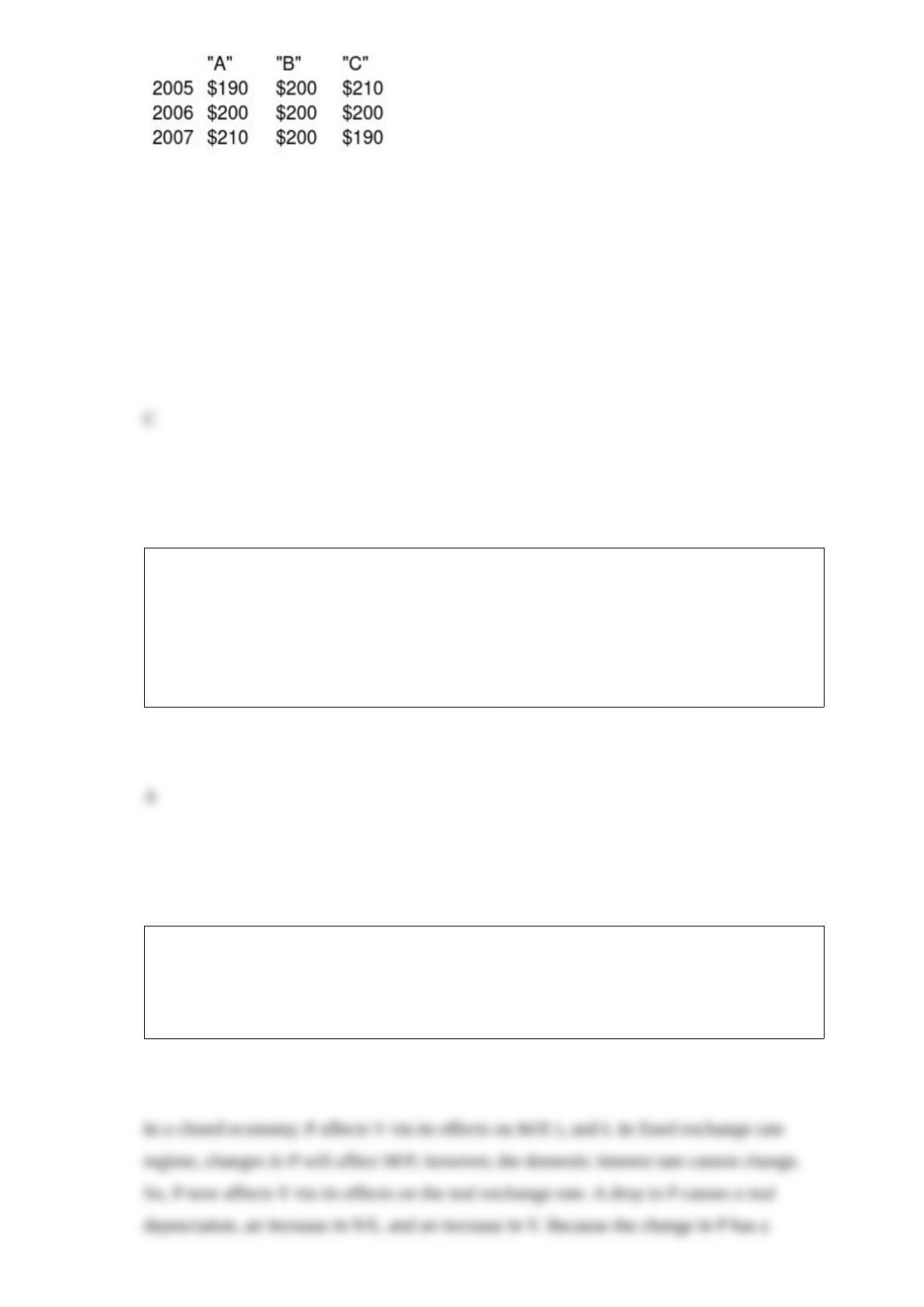
A) A > B > C
B) A > C > B
C) C > B > A
D) C > A > B
E) B > A > C
When the policy rate increases,
A) IS curve does not change.
B) IS curve shifts to the right.
C) IS curve shifts to the left.
D) LM curve shifts upward.
E) LM curve shifts downward.
First, briefly explain why the AD curve is downward sloping in a closed economy.
Second, briefly explain why the AD curve is downward sloping in an open economy
under fixed exchange rates. And finally, briefly compare the size of the slopes of the
two AD curves.
Assume expectations of prices are correct but expectations of productivity adjust
slowly. Use the PS/WS relations, graphically illustrate and explain the effects of a
decrease in productivity growth on the natural rate of unemployment.
Suppose an economy experiences an increase in productivity. Explain both the short-run
and medium-run effects of this increase in productivity on output, employment, and the
unemployment rate.
Suppose there is a report that the unemployment rate unexpectedly increased in the
previous month. To what extent will the expected central bank response to this news
affect how stock prices will respond to this report of a higher than expected
unemployment rate? Explain.
Explain what effect an increase in the unemployment rate will have on the real wage
based on: 1. the WS relation; and 2. the PS relation.
Explain how a change in expected future output could affect current output.
What are the primary causes of hyperinflations? Explain.
Based on your understanding of the labor market model presented by Blanchard (i.e.,
the WS and PS relations), explain what types of policies could be implemented to cause
a reduction in the natural rate of unemployment.
First, what can be done to increase central bank credibility? Second, why is central
bank credibility important?
Explain what is meant by the fundamental value of a share of stock.
Some economists argue that there were good reasons for housing price to rise. Explain
their argument.
Briefly explain why the decline in housing prices led to a major financial crisis.
Suppose there is an increase in the saving rate. Explain what effect this increase in the
saving rate will have on the rate of growth of output per worker.
Suppose the interest parity condition holds. Also assume that the one-year interest rate
in the United States is 6% and that the one-year interest rate in Canada is 6%. What
does this imply about the current versus future expected exchange rate (for the U.S. and
Canadian dollars)? Explain.
Explain why nominal wages are a function of the expected price level.
First, what are the primary determinants of output per worker? And second, to what
extent can each cause a permanent change in economic growth?
When we no longer assume that the exchange rate expected to occur in one year is
constant, explain what variables affect the current exchange rate in a flexible exchange
rate regime. Include in your answer an explanation of how changes in these variables
affect the current exchange rate.
Until the 1990s, how was monetary policy typically conducted in advanced countries?

Is it possible for a country to experience a permanent increase in output per worker over
time? If so, how can this occur?