CHAPTER 20
Quick Check
1. a False. Real exchanges rates adjust as the relative price levels change, c.p.
2. a. The (i* – πe ) is the real interest rate in the domestic country. The foreign nominal interest rate and
b. The term
EP∗¿
P
¿
is the real exchange rate. An increase in this value is an appreciation and
c. The real exchange rate is appreciating as P is rising more quickly than P*. Domestic inflation is
d. The real exchange rate is depreciating as P* is rising more quickly than P. Domestic inflation is
e. The real exchange rate is depreciating as P* is rising more quickly than P. Domestic inflation is
f. From period 1 to period 4, the real exchange rate is appreciating because domestic inflation (3%)
3. a. If the foreign economy is always in medium run equilibrium, then foreign income is at the natural
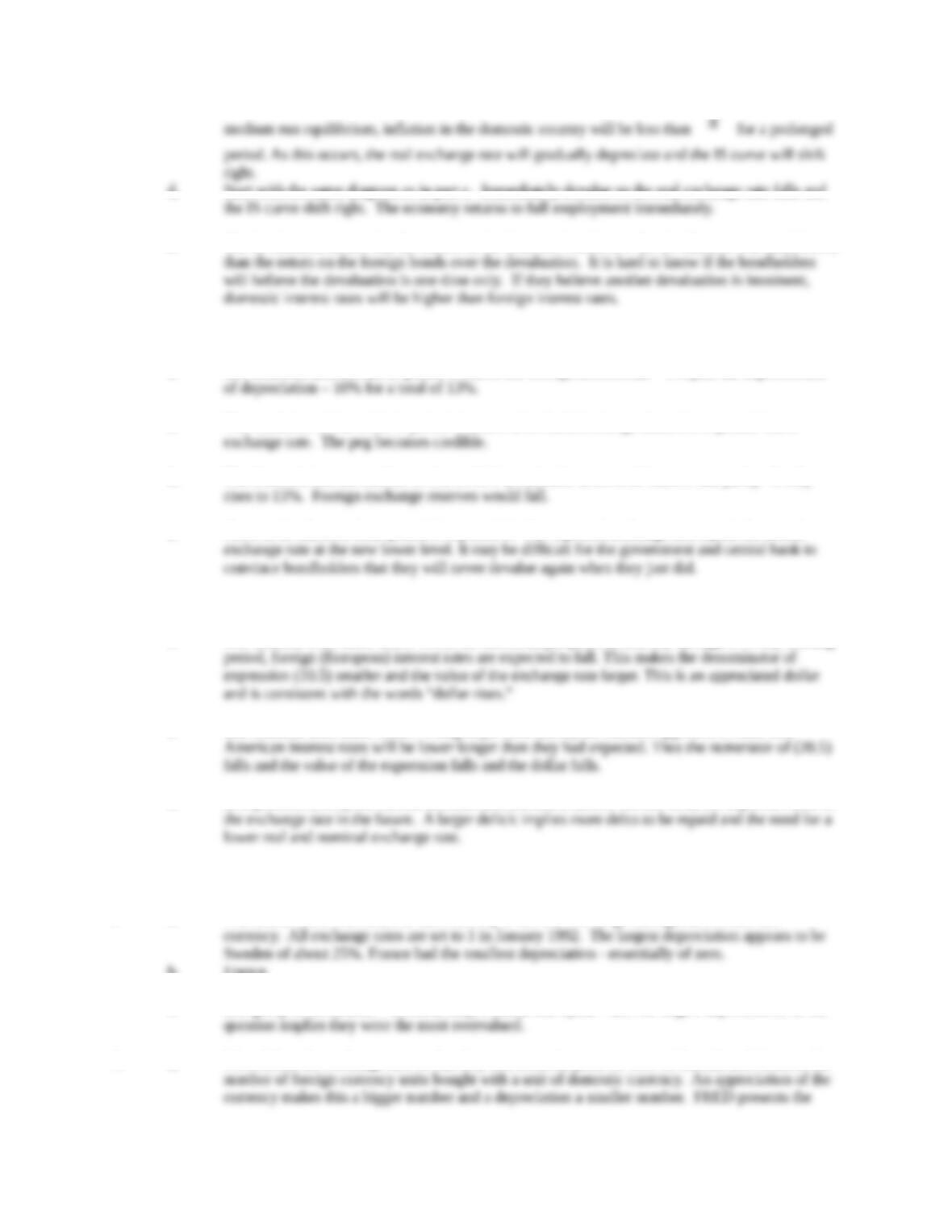
b. When both economies are in medium run equilibrium, they will share the same value of inflation
´π
´π¿
´π
d. Start with the same diagram as in part c. Immediately devalue so the real exchange rate falls and
e. The devaluation means that the return on the domestic bonds over the devaluation was much lower
4. a. The domestic interest rate in period 1 will be the foreign interest rate – 3%.
b. The domestic interest rate in period 1 will be the foreign interest rate – 3% plus the expected rate
c. The resolution of the crisis in period 4 occurs when beliefs change about the expected future
d. The domestic interest rate has to rise to 23% to maintain uncovered interest rate parity. It only
e. There is devaluation from period 5 to period 6. The expected exchange rate equals the actual
5. a. There must have been a change in the expected exchange rate in the future.
b. The headline does make sense. From an American perspective, halfway through a 30-day holding
c. The headline does make sense. Using Expression (20.5), the markets appeared to learn that
d. In expression (20.5), the current account announcement affects the last term, the expected value of
Dig Deeper
6 a. The vertical axis is an index of each country’s nominal exchange rate against the German
b. France
c. The group at the bottom – Sweden, Italy, Finland and Spain – had the largest depreciations so the
7. a. We redefine the exchange rate so that they are, from the point of view of Canada and Mexico, the
©2017 Pearson Education, Inc.
115
exchange rate in the opposite way.
b. There is a very brief period where the peso is fixed to the dollar from March 1994 to November
c. This is a real exchange rate that has fluctuated a lot – about 35% or more over the time period.
There may or may not have been benefits to have a fixed nominal exchange rate between these
Explore Further
8. The answer is given in the comments after part (c). The exchange rate is many times more
©2017 Pearson Education, Inc.
116