
Which of the following would make the spending multiplier smaller?
A) a reduction in marginal propensity to save
B) a small initial trade deficit
C) a reduction in the marginal propensity to import
D) a real appreciation
E) none of the above
A bond has a face value of $1,000, a price of $1,200, and coupon payments of $100 for
two years. The “current yield” of this bond is
A) 8.33%.
B) 10%.
C) 12%.
D) 83%.
E) none of the above
Which of the following is an advantage of a common currency in Europe?
A) Each country could conduct its own, independent monetary policy.
B) Exchange rate uncertainty within the common currency area would be eliminated.
C) Each country could conduct its own, independent fiscal policy.
D) all of the above
E) none of the above
Suppose a country that has been pegging its currency is faced with a situation where

financial market participants now expect some future devaluation. In such a situation,
we would generally expect which of the following to occur?
A) a reduction in the domestic interest rate
B) an announcement by the central bank that a large devaluation will occur in the near
future
C) reduction in demand for the country’s currency
D) all of the above
E) none of the above
As the proportion of labor contracts that index wages to prices declines, we would
expect that
A) a reduction in the unemployment rate will now have a smaller effect on inflation.
B) the natural rate of unemployment will increase.
C) the natural rate of unemployment will decrease.
D) nominal wages will become more sensitive to changes in unemployment.
Arguments for placing restraints on policy makers fall into which of the following?
A) policy makers understand completely how the economy operates
B) policy makers have good intentions, but end up doing more harm than good
C) policy makers do what is best for them, not necessarily what is best for the country
D) all of the above
E) both B and C

For each interest rate, the LM curve illustrates the level of output where
A) the goods market is in equilibrium.
B) inventory investment equals zero.
C) money supply equals money demand.
D) all of the above
E) none of the above
In the absence of technological progress, a decrease in the saving rate will cause which
of the following?
A) decrease temporarily the growth of output per worker
B) decrease the steady state growth of output per worker
C) increase temporarily the growth of output per worker
D) increase the steady state growth of output per worker
E) have an ambiguous effect on the growth of output per worker
Refer to the information above. Which of the following represents the steady-state
growth rate of output in this economy?
A) 2%
B) 3%
C) 5%
D) 10%
E) 15%

In the United States, presidential elections occur every four years. If a political business
cycle exists in the United States, in which year of a presidential term, all else fixed,
would we expect output growth to be highest?
A) the first year
B) the second year
C) the third year
D) the fourth year
GDP in current dollars is equivalent to which of the following?
A) real GDP
B) GDP in terms of goods
C) GDP in 2000 dollars
D) GDP in constant dollars
E) none of the above
How many countries are in the European Union?
A) 28
B) 6
C) 21
D) 17
Suppose you have one U.S. dollar with which you wish to purchase U.K. (one-year)
bonds in period t. Which of the following expressions represents the amount of U.K.

pounds you will receive in one year (i.e., period t + 1) from purchasing U.K. bonds in
period t?
A) i
B) 1 + i*
C) (1 + i*)Ee
t+1/Et
D) (1 + i*)Et/Ee
t+1
E) none of the above
Suppose the rest of the world experiences a recession that causes a reduction in foreign
income (Y*). From the domestic economy’s perspective, this reduction in foreign
income will cause which of the following as the domestic economy adjusts to the drop
in Y*?
A) a reduction in income and a reduction in imports
B) a reduction in imports and an increase in net exports
C) the NX line to shift up
D) an ambiguous effect on net exports
If the government runs a primary deficit in year zero of B0, and decides to repay it in
year t (i.e., bring the debt back down to its pre-existing level), then in year t it must run
a primary surplus equal to
A) zero.
B) one.
C) B0.
D) B0(1 + r).
E) none of the above

When the unemployment rate is on the horizontal axis and the real wage is on the
vertical axis, a reduction in productivity will cause which of the following to occur?
A) The wage-setting and price-setting curves will both shift downward.
B) The wage-setting and price-setting curves will both shift upward.
C) The price-setting curve to shift downward, and no shift in the wage-setting curve.
D) The wage-setting curve to shift upward, and the price-setting curve to shift
downward.
E) The wage-setting curve to shift downward, and the price-setting curve to shift
upward.
Based on our understanding of the model presented in Chapter 3, we know with
certainty that an equal and simultaneous reduction in G and T will cause
A) an increase in output.
B) no change in output.
C) a reduction in output.
D) an increase in investment.
Suppose there is a simultaneous Fed sale of bonds and increase in consumer
confidence. We know with certainty that these two simultaneous events will cause
A) an increase in the interest rate (i).
B) a reduction in i.
C) an increase in output (Y).
D) a reduction in Y.

Which of the following will not cause an increase in the present value of a sequence of
payments?
A) a reduction in the current interest rate
B) a reduction in expected future interest rates
C) an increase in a future expected payment
D) none of the above
Collateralized debt obligations (CDOs) were first issued in
A) 1980s.
B) 1990s.
C) 2000.
D) 2001.
For this question, assume that there is perfect arbitrage in the stock market. Given this
assumption, economists believe that
A) movements in stock prices can be easily predicted.
B) movements in stock prices are largely unpredictable.
C) most stocks will diverge from their fundamental value.
D) stocks will generally earn a lower rate of return than bonds.
E) the rate of return on stocks will be equal to the rate of return on bonds.

An increase in government spending will have a greater impact on net exports when
A) the marginal propensity to save is smaller.
B) the economy is closed.
C) the sensitivity of investment to income is smaller.
D) all of the above
E) none of the above
Government default is also called
A) debt restructuring.
B) debt rescheduling.
C) private sector involvement.
D) all of the above
In order for an individual to be indifferent between holding foreign or domestic bonds,
A) the Marshall-Lerner condition must hold.
B) the foreign and domestic interest rates must be equal.
C) the expected rate of depreciation of the domestic currency is zero.
D) the interest parity condition must hold.
The IS curve shifts to the left where there is
A) a reduction in current taxes.
B) an increase in expected future taxes.
C) an increase in expected future output.

D) all of the above
E) none of the above
The idea that the economy operates like a complicated, predictable machine is an
important aspect of
A) game theory.
B) attrition theory.
C) the theory of strategic interaction.
D) time inconsistency theory.
E) optimal control theory.
Between 1950 and 2004, standards of living in the OECD countries
A) did not change at all.
B) were converging.
C) all increased at the same rate.
D) decreased at the same rate.
E) decreased, but at different rates.
Which of the following will occur as a result of a tax cut?
A) private saving decreases
B) investment decreases
C) the trade balance improves
D) the trade balance worsens

E) the budget deficit decreases
Given the narrow interpretation of technology, technology will include which of the
following?
A) how well firms are run
B) the organization and sophistication of markets
C) the political environment
D) none of the above
The correct measure of the deficit is also called
A) the cyclically-adjusted deficit.
B) the structural deficit.
C) the full-employment deficit.
D) the inflation-adjusted deficit.
E) all of the above
For this question, assume that firms experience a reduction in sales. We would expect
that this decrease in sales will cause
A) an increase in profit per unit of capital.
B) a decrease in profit per unit of capital.
C) no change in profit per unit of capital.
D) ambiguous effects on profit per unit of capital.
E) none of the above

Okun’s law shows that when the unemployment rate is below the natural rate,
A) inflation is higher than expected.
B) inflation is lower than expected.
C) output is below potential.
D) output is above potential.
Which of the following represents a stock’s fundamental value?
A) the price the stock would sell at in the midst of a rational bubble
B) the price the stock would sell at if the interest rate were zero
C) the present value of its expected future dividend payments
D) the simple sum of its future dividend payments
E) none of the above
Suppose fiscal policy makers pass a budget that cuts taxes in the current period and are
expected to cut taxes in the future. Use the IS-LM model to illustrate graphically and
explain the effects of this policy on current output and the current interest rate.
During the latter half of the 1990s, the U.S. saving rate decreased. Will this reduction in
the saving rate have a permanent effect on the rate of growth of output per worker?
Explain.
Explain how inflation can lead to distortions.
Assume a country is in a fixed exchange rate regime. Now suppose that individuals
expect that policy makers will devalue its currency. Explain the various actions that
policy makers can choose in response to this expected devaluation.
Suppose individuals expect an increase in future taxes. Explain what effect this
expected increase in future taxes will have on the yield curve and on stock prices in the
current period.
Briefly explain the relationship between output per capita and happiness. Specifically,
to what extent are these two variables related?
Discuss the tools of the Federal Reserve and explain how each can be used to change
the money supply and equilibrium interest rate.
Suppose individuals expect future output to be lower and future interest rates to be
lower. Given this information, how will individuals alter consumption in the current
period? Explain.
Suppose output is above the natural level of output. In a fixed exchange rate regime,
explain the two ways the economy can return to the natural level of output.
Explain the natural unemployment rate and its relationship to inflation rate.
Will the CPI and GDP deflator always move together? Explain.
Assume a country is in a fixed exchange rate regime. Explain what factors might cause
individuals to expect that a country will devalue its currency.
Use the IS-LM model to answer this question. Suppose there is a simultaneous increase
in taxes and reduction in the money supply. Explain what effect this particular policy
mix will have on output and the interest rate. Based on your analysis, do we know with
certainty what effect this policy mix will have on investment? Explain.
Explain each of the following and why each might be used: hard pegs, currency boards,
and dollarizations.
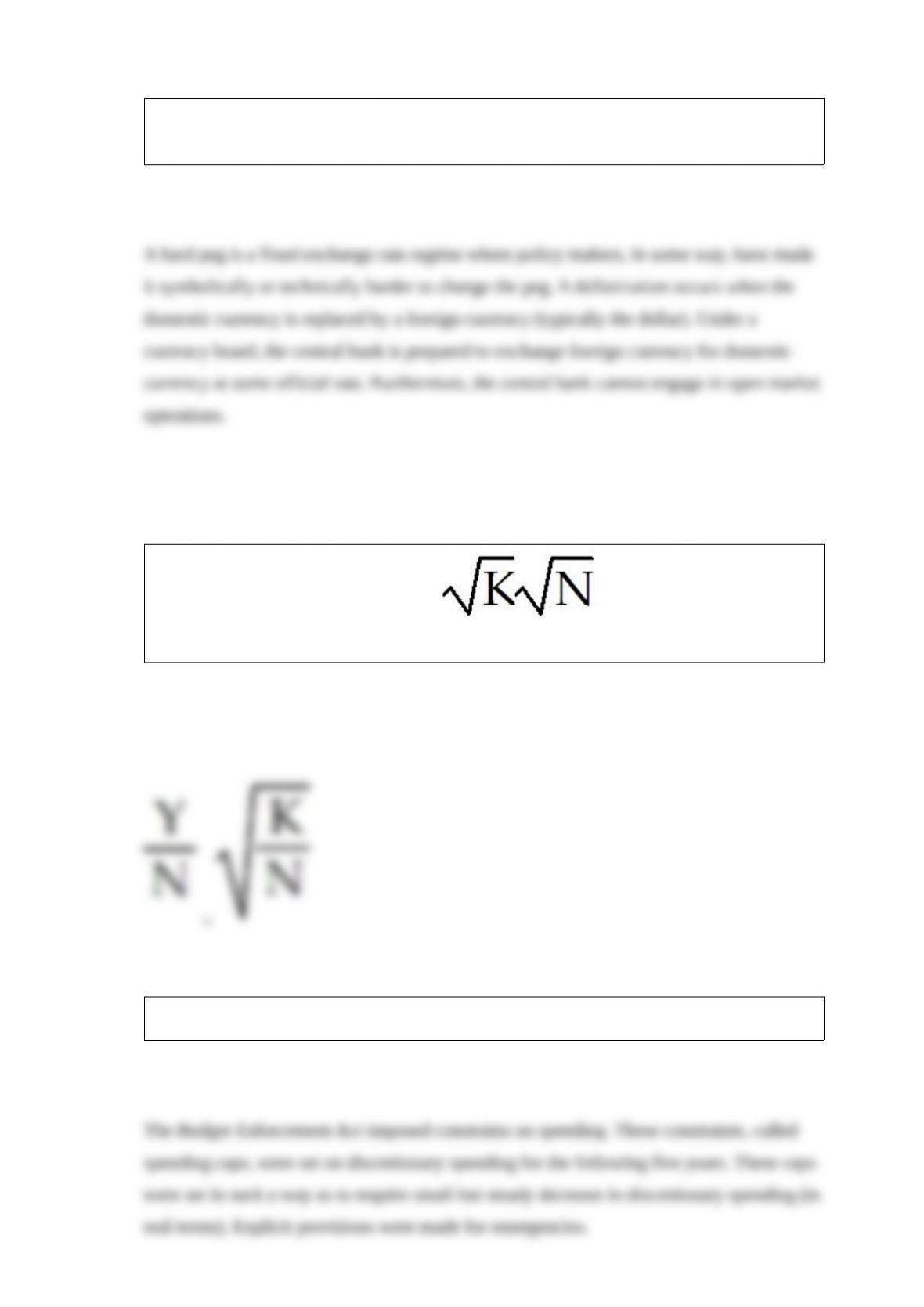
Consider the production function, Y = , write the production
function as a relation between output per worker and capital per worker.
Explain spending caps set by the Budget Enforcement Act.
Suppose you are considering the purchase of a bond issued in another country. What
calculations must you do to calculate the expected return on a foreign bond? Explain.
Use “wars of attrition” to explain the debate about deficit reduction.