CHAPTER 18
Quick Check
1. a. False. When savings declines consumption increases, both on domestic and imported
f. True.
h. True
2. a. There is a real appreciation over time. Over time, the trade balance worsens.
3. a. The share of European spending on U.S. goods relative to U.S. GDP is
b. U.S. GDP falls by 2(.05)(.029)=0.29%.
d. This is an overstatement. The numbers above indicated that even if U.S. exports fall by
4. You will need to follow the text. For the upper right corner of Table 18-1, The level of output is
You repeat this type of analysis for every quadrant.
Dig Deeper
5. a. The ZZ and NX lines shift up. Domestic output and domestic net exports increase.
©2017 Pearson Education, Inc.
114
b. Domestic investment will increase because output increases. Assuming taxes are fixed,
d. Except for G and (for our purposes) T, the variables in equation (18.5) are endogenous.
6. a. There must be a real depreciation.
b. Y=C+I+G+NX. If NX rises while Y remains constant, C+I+G must fall. The government
7. a. Y = C + I + G + X – IM
b. Output increases by the multiplier, which equals 1/(1-c1–d1+m1). The condition
c. When government purchases increase by one unit, net exports fall by m1Y=
d. The larger economy will likely have the smaller value of m1. Larger economies tend to
e. Y NX
f. Fiscal policy has a larger effect on output in the large economy, but a larger effect on net
8. a. It is convenient to wait to substitute for G until the last step.
©2017 Pearson Education, Inc.
115
b. Since the countries are identical, Y=Y*=110. Taking into account the endogeneity of
c. If Y=125, then Y*=44+0.6(125)=119. Using these two facts and the equation
d. If Y=Y*=125, then 125=24+2G+0.6(125), which implies G=G*=13. In both countries,
e. In part, fiscal coordination is difficult to achieve because of the benefits of doing nothing
(c).
Explore Further
9. a. NX=National Saving – I.
b. 2004 to 2008 have the largest trade deficits as a percent of GDP.
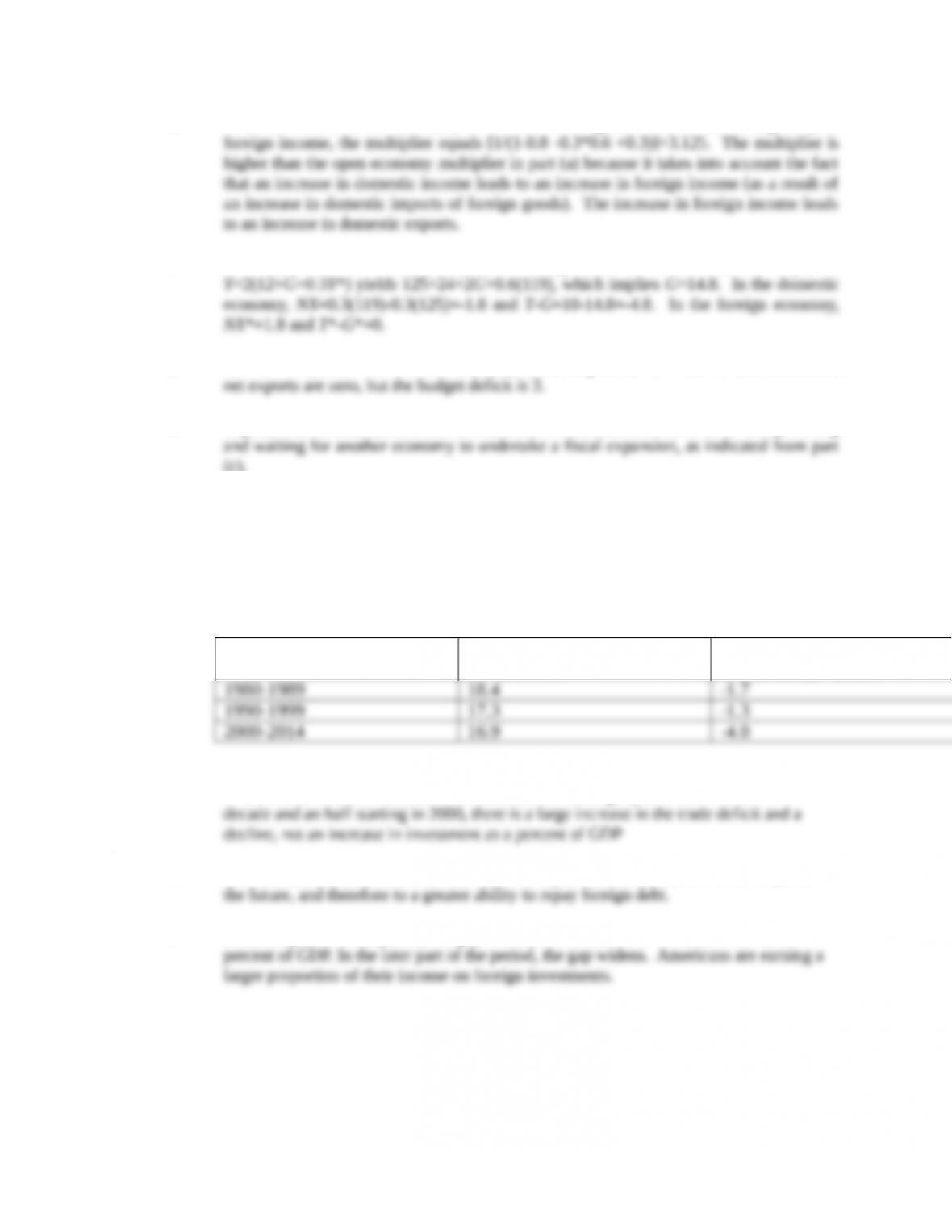
c.
Year Average Investment
(% of GDP0
Average Trade Balance
(% of GDP) – deficit
In the 1990s investment fell and the trade deficit was slightly smaller. But in the
.
d. Yes. An increase in investment leads to more capital accumulation and more output in
e. In the early part of the period, the gap between GNP and GDP was about one-half a
©2017 Pearson Education, Inc.
116