
Chapter 4. Financial Markets
I. MOTIVATING QUESTION
How is the interest rate determined in the short run?
The interest rate is determined by equilibrium in the money market, i.e., by the condition that money
supply equals money demand. Since the text abstracts from all assets other than bonds and money,
equilibrium in the money market is equivalent to equilibrium in the bond market. In this chapter, nominal
income is taken as given, so there is no need to consider simultaneous equilibrium of goods and financial
markets.
II. WHY THE ANSWER MATTERS
Investment is a function of the interest rate (as will be discussed in Chapter 5), so output is affected by the
interest rate. In addition, the determination of the interest rate is intimately connected with monetary
policy. This chapter introduces the simplest model needed to think about the determination of the interest
rate and the role of the central bank. This chapter takes nominal GDP, which affects money demand, as
given, so the financial markets can be considered in isolation from the goods market. Chapter 5 will
address the joint determination of output and the interest rate in the short run. Chapter 9 will address the
complexity of the financial system in light of the financial crisis.
III. KEY TOOLS, CONCEPTS, AND ASSUMPTIONS
1. Tools and Concepts
i. The chapter defines stock and flow variables and distinguishes wealth (a stock) from income (a
flow).
ii. The chapter introduces monetary policy and describes open market operations.
iii. The chapter makes use of balance sheets for the central bank and private banks.
iv. The chapter introduces various terms and concepts associated with the banking system. These
include currency, checkable deposits, reserves, the reserve ratio, central bank money (high powered
money, the monetary base), the federal funds market and the federal funds rate, and the money
multiplier.
2. Assumptions
i. This chapter assumes that nominal GDP is given. More precisely, the chapter maintains the
previous chapter’s assumption that the price level is fixed, and adds the assumption that real income is
given. Chapter 5 considers the joint determination of the interest rate and real income.
©2017 Pearson Education, Inc. Publishing as Prentice Hall
4-19
ii. For clarity, the chapter assumes that money and bonds are the only assets available and that money
does not pay interest. Money is divided into currency and checkable deposits in the section of the chapter
that describes the banking system. The assumption that money does not pay interest is maintained
throughout the book. Later chapters introduce other financial assets—stocks and bonds of different
maturities—and physical capital
IV. SUMMARY OF THE MATERIAL
1. The Demand for Money
Suppose the financial markets include only two assets: money, which can be used to purchase goods and
services and pays no interest; and bonds, which cannot be used for transactions, but pay a positive interest
rate i. Financial wealth equals the sum of money and bonds.
Financial wealth is a stock variable, i.e., a variable whose value can be measured at any point in time. An
individual’s financial wealth changes over time by saving or dissaving, but at any given moment,
financial wealth is fixed. Saving is a flow variable, i.e., a variable whose value is meaningful only when
expressed in terms of a time period. Income is also a flow variable, as is recognized in ordinary speech.
People speak of annual income or monthly income.
At every moment, households must decide how to allocate their given financial wealth between money
and bonds. Since financial wealth is fixed, the demand for bonds is known once the demand for money is
known, and vice-versa. Accordingly, the chapter restricts attention to the demand for money.
By assumption, money is needed for transactions. Although it is hard to measure the overall level of
transactions in the economy, it seems reasonable to assume that the level of transactions is proportional to
nominal income, denoted $Y. So, money demand should be proportional to $Y. On the other hand,
allocating wealth to money comes at the cost of forgone interest on bonds. So, money demand should
decrease with the interest rate. Putting these observations together, the chapter specifies money demand
as
Md=$YL(i), (4.1)
where the function L decreases as the interest rate increases.
A box in the text notes that most U.S. currency is held abroad by foreigners, so that factors beyond U.S.
economic variables affect U.S. money demand. Nevertheless, the text does not include foreign variables
in the specification of U.S. money demand.
2. The Determination of the Interest Rate, I
Assume all money is currency, so there are no checking accounts or banks. Consider the supply of money
to be fully in the control of the central bank, and take nominal income as given. Then, equilibrium in the
money market occurs when the supply of money (M) equals the demand for money (Md) given in equation
(4.1). Figure 4-2 illustrates this equilibrium point.
An increase in the money supply shifts the vertical line to the right, resulting in a new equilibrium with a
lower interest rate. In order to induce the private sector to hold more money, bonds must become less
©2017 Pearson Education, Inc. Publishing as Prentice Hall
4-20
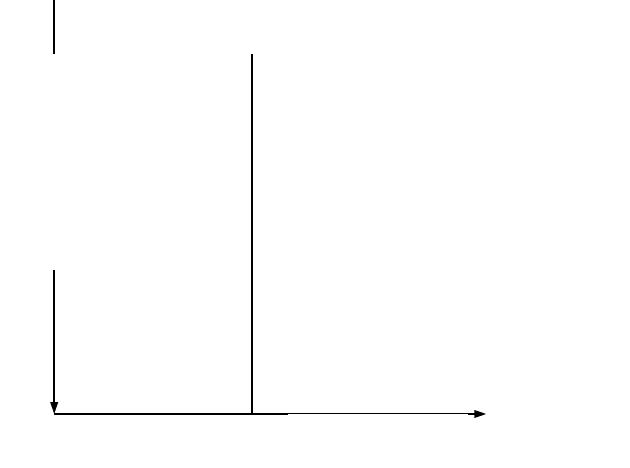
attractive (the interest rate must fall). An increase in nominal income (for a given money supply) shifts
the money demand curve to the right and generates a new equilibrium with a higher interest rate. The
increase in nominal income leads to an increase in the quantity of money demanded at the original interest
rate. Since the supply of money has not changed, the interest rate must rise to reduce the quantity of
money demanded and thereby offset the effect of the increase in income.
How does the central bank control the money supply? Consider the central bank’s balance sheet.
Currency held by the public constitutes the central bank’s liabilities. The central bank’s assets are any
bonds that it owns. To increase the money supply, the central bank creates currency to purchase bonds,
thus increasing assets (through the additional bonds) and liabilities (through the new currency created and
exchanged for bonds). To reduce the money supply, the central bank sells bonds for existing currency,
thus reducing assets (through the sale of bonds) and liabilities (through the reduction of currency held by
the general public). Purchases and sales of bonds by the central bank are called open market operations.
Figure 4-2: Equilibrium in the Money Market
The text also shows how bond prices and interest rates are related. Suppose a bond promises a payment
of $F one year in the future. Call the current price of the bond $PB. Then, the interest rate (or rate of
return) on this bond is given by
i=($F-$PB)/$PB.
We can solve this equation for the bond price:
$PB=$F/(1+i).
Given fixed nominal bond payments, we show that the nominal interest rate and the bond prices are
inversely related. For example, when the central bank purchases bonds through open market operations it
increases the demand for bonds and tends to increase their price which, in turn, reduces the interest rate.
©2017 Pearson Education, Inc. Publishing as Prentice Hall
Interest Rate, i
Money, M
Ms
Md=$YL(i)
4-21
3. The Determination of the Interest Rate, II
Now introduce banks into the model. Banks receive funds from depositors (individuals and firms) and
allow their depositors to write checks against (or withdraw) their account balances. These checkable
deposits are liabilities of banks. On the asset side, banks hold bonds, loans (which are claims against
borrowers), and reserves of some of their deposits. Some bank reserves are held in cash and the rest in
accounts at the central bank. Banks hold reserves in part to protect against daily excesses of withdrawals
(in currency or check form) over deposits and in part because they are required to do so by the central
bank. In the United States, the Federal Reserve sets the required reserve ratio for checkable deposits.
The actual reserve ratio in the United States is currently a minimum of 10%.
Adding banks to the economy alters the central bank balance sheet only on the liabilities side. Central
bank liabilities now consist of currency held by the public plus reserves held by banks. Central bank
liabilities—the money the central bank has created—are called central bank money.
Now reconsider money market equilibrium in terms of central bank money (Hd). The demand for central
bank money arises from two sources: currency held by the public and reserves held by banks. Since bank
reserves depend on the amount of checkable deposits we can model this relationship by letting the θ
(Greek lowercase letter theta) represent the reserve ratio. Recall from our original equation 4.1 that
money demand is given by;
Md=$YL(i),
(4.3)
The second component of money demand, bank reserve demand, can be modeled with the equation;
Hd = θMd = θ$Y L(i) (4.4)
Equilibrium in the money market can now be depicted as the point where the money supply controlled by
the Federal Reserve (H) is equal to the money demand (Hd).
We can rewrite this equation in the following manner;
H = θ$Y L(i) (4.6)
Graphically this equilibrium is presented in Figure 4-7. Now you can see that an increase or decrease in
the money supply impacts the price of money (i.e. the interest rate). The specific interest rate targeted by
the Fed is the federal funds rate.
4. The Liquidity Trap
The central bank can choose a desired interest rate by changing the money supply. However, the central
bank can push interest rates to zero which would limit further monetary stimulus. This condition is known
as a zero lower bound. When the economy is in this position and monetary policy is no longer effective
the economy is said to be in a liquidity trap. Increasing the money supply beyond this point has no impact
on interest rates. Both households and banks absorb increases in the money supply when interest rates are
zero so monetary policy loses its effectiveness. The Focus box on page 81 addresses the “Liquidity Trap
in Action” as a result of central bank policy following the financial crisis.
©2017 Pearson Education, Inc. Publishing as Prentice Hall
4-22
V. PEDAGOGY
1. Points of Clarification
i. The Definition of Money Demand. Money demand refers to a portfolio decision, the amount of
fixed wealth that the nonbank public desires to hold in money as opposed to bonds. Money demand does
not refer to the demand for income or wealth.
ii. Comparative Statics with Bond Prices. It may be useful to reconsider comparative statics in the
money market in terms of bond prices. The text carries out this exercise for open market operations, but
instructors could also do the analysis for an exogenous increase in national income. An increase in
income shifts the money demand curve to the right, which leads to an increase in the equilibrium interest
rate, as is evident from the graph. To tell the bond market story, note that at the initial interest rate, the
quantity of money demanded exceeds the quantity supplied. In other words, households are attempting to
sell bonds to acquire money. The pressure to sell bonds (effectively a shift to the left of the bond demand
curve) reduces the bond price and hence increases the interest rate.
iii. The Central Bank Balance Sheet. It is probably wise to assume that many undergraduates have
never seen a balance sheet of any kind. A few words of explanation would be useful. In addition, as a
memory aid for students, it may be useful to simplify the discussion of open market operations by noting
that when the central bank increases its assets, it increases the money supply. Thus, when the central bank
buys bonds, it increases the money supply.
iv. Currency, Government Bonds, and the Central Bank. The model without banks implies that
the central bank creates currency when conducting an open market purchase. Although this notion has
some intuitive appeal, and can be useful as a pedagogical step, it is worth clarifying that in fact the central
bank creates reserves, not currency.
Moreover, the central bank does not create government bonds, but conducts open market operations with
government bonds. The stock of government bonds outstanding is the government (in popular usage,
national) debt, which is the product of past fiscal deficits. Open market operations apportion this debt
between the central bank and the private sector.
2. Alternative Sequencing
Instructors have several options for presenting money market equilibrium. The most straightforward
presentation would rely on Section 4.2 for the cash economy and progress to Section 4.3 if banks and
checkable deposits are introduced. Section 4.3 equates the demand and supply for central bank money.
Alternatively, to emphasize the federal funds market, instructors could present equilibrium with banks in
terms of the supply and demand for reserves.
The interest rate was not introduced in the discussion of the goods market in Chapter 3. Thus, at this
point in the text, the determination of the interest rate seems to stand apart from the determination of real
output. As discussed in Part V of Chapter 3 of the Instructor’s Manual, an alternative is to introduce the
dependence of investment on the interest rate in Chapter 3 and to assume a fixed interest rate.
©2017 Pearson Education, Inc. Publishing as Prentice Hall
4-23
Another option is to introduce some of the material in Chapter 23, devoted to monetary policy, in the
discussion of the current chapter. Some of the basic facts about the structure of Monetary Policy and the
crisis may be helpful to orient students and to help facilitate discussion of current Fed policy.
3. Enlivening the Lecture
Casual empiricism suggests that undergraduates have more immediate interest in material related to
financial markets than in almost any other topic. A discussion relating the material of the chapter to
current Federal Reserve policy (perhaps with a few words about the stock market’s response to Fed
policy) would probably be interesting to students. In addition there is a current debate about negative
interest rates and whether or not central banks can use negative rates effectively.
Another suggestion is to look at the interest rate section of the financial pages of a major newspaper
during the lecture. Besides making the financial pages a bit more accessible to students, this strategy
might also provide an opportunity to discuss the inverse relationship between prices and interest rates.
VI. EXTENSIONS
1. The Balance Sheet Constraint
To clarify the relationship between bond market and money market equilibrium, it may be useful to be
more explicit about the implications of the balance sheet constraint. The constraint implies
Md+Bd=Financial Wealth=M+B,
or
(Md – M)=(B – Bd).
In other words, the excess demand for money must equal the excess supply of bonds. When one market
clears, the other must clear as well.
2. The Money Demand Function
This chapter assumes a money demand function of the form Md=$YL(i)=PYL(i). A more general
alternative would be Md=L($Y,i). The functional form assumed in the chapter allows for an easy
conversion to real money demand by dividing through by the price level. Introducing the more general
form requires explaining to students that money demand should be homogeneous of degree one in P. On
the other hand, this exercise does make clear what is assumed.
©2017 Pearson Education, Inc. Publishing as Prentice Hall
4-24