
We will generally observe that the less open an economy
A) the larger the effect of fiscal policy on output and the larger the effect of fiscal
policy on the trade position.
B) the larger the effect of fiscal policy on output and the smaller the effect of fiscal
policy on the trade position.
C) the smaller the effect of fiscal policy on output and the larger the effect of fiscal
policy on the trade position.
D) the smaller the effect of fiscal policy on output and the smaller the effect of fiscal
policy on the trade position.
Which of the following, all else fixed, will cause the real exchange rate to decrease?
A) a nominal appreciation
B) an increase in the foreign price level
C) an increase in the domestic price level
D) all of the above
E) none of the above
Suppose there is a real depreciation of the dollar. Which of the following may have
occurred?
A) foreign currency has become more expensive in dollars.
B) foreign goods have become more expensive to Americans.
C) the foreign price level has increased relative to the U.S. price level.
D) all of the above
E) none of the above

If efficiency wage theory is valid, we would expect a relatively low premium over the
reservation wage when
A) the unemployment rate is low.
B) the job requires very little training.
C) workers can be easily monitored.
D) workers have few other options for employment in the area.
E) all of the above
Which of the following about IS relation is not correct?
A) It is the the relation between interest rate and savings.
B) It is the equilibrium condition for the goods market.
C) It stands for “Investment equals saving.”
D) It shows what firms want to invest must be equal to what people and the government
want to save.
An increase in the marginal propensity to save from .3 to .4 will cause
A) the ZZ line to become steeper and a given change in autonomous consumption (c0)
to have a smaller effect on output.
B) the ZZ line to become steeper and a given change in autonomous consumption (c0)
to have a larger effect on output.
C) the ZZ line to become flatter and a given change in autonomous consumption (c0))
to have a smaller effect on output.
D) the ZZ line to become flatter and a given change in autonomous consumption (c0) to
have a larger effect on output.
Constant returns to scale implies that if N and K both increase by 3% that
A) output (Y) will increase by 3%.
B) Y/N will increase by 3%.
C) Y/N will increase by less than 3%.
D) the capital-labor ratio will increase by 3%.
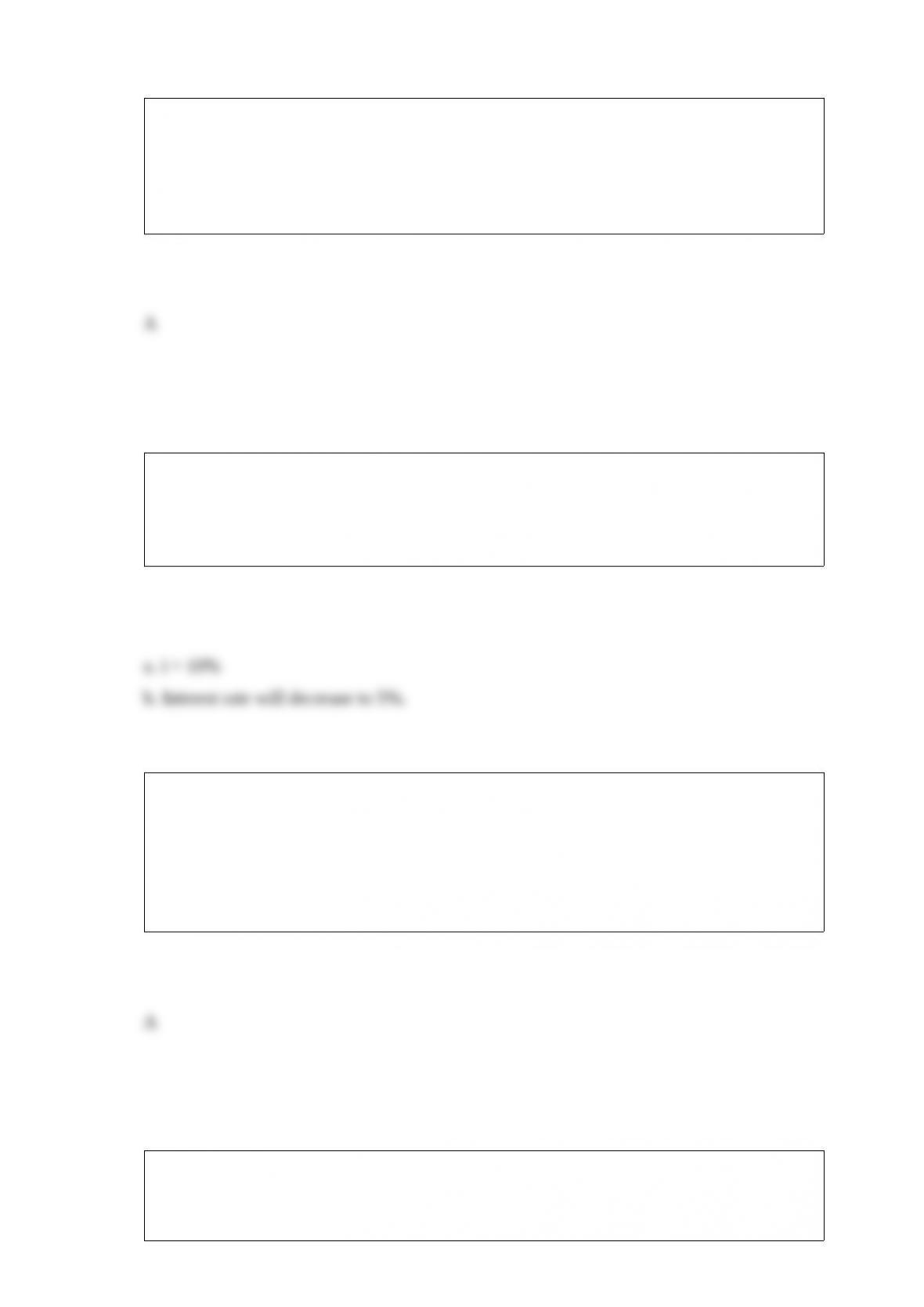
The demand for money is given by Md = $Y (0.3 – i), where $Y = 100 and the supply of
money is $20.
a. What is the equilibrium interest rate?
b. What is the impact on the interest rate if central bank money is increased to $25?
In ________, would-be members of the Euro area signed the Stability and Growth Pact
(SPG).
A) 1997
B) 1998
C) 1999
D) 2000
Suppose there is a reduction in foreign output (Y*). This reduction in Y* will cause
which of the following in the domestic country?
A) a reduction in output

B) a reduction in consumption
C) a reduction in net exports
D) all of the above
E) none of the above
The GDP deflator provides a measure of which of the following?
A) the ratio of GDP to the size of the population
B) the ratio of GDP to the number of workers employed
C) the ratio of nominal GDP to real GDP
D) the price of a typical consumer’s basket of goods
E) real GDP divided by the aggregate price level
America’s largest trading partner is
A) Canada.
B) Japan.
C) Mexico.
D) European Union.
E) none of the above
In 2015, the unemployment in the U.S. was
A) 5%.
B) 11%.
C) 5.4%.

D) 4.6%.
Based on our understanding of the model presented in Chapter 3, we know with
certainty that an equal and simultaneous increase in G and T will cause
A) an increase in output.
B) no change in output.
C) a reduction in output.
D) an increase in investment.
Based on our understanding of the IS-LM model that takes into account dynamics, we
know that an increase in government spending will cause
A) a gradual increase in i and gradual increase in Y.
B) an immediate increase in Y and immediate drop in i.
C) an immediate increase in i and no initial change in Y.
D) a gradual increase in i and an immediate increase in Y.
Suppose the economy is currently operating on both the LM curve and the IS curve.
Which of the following is true for this economy?
A) Production equals demand.
B) The quantity supplied of bonds equals the quantity demanded of bonds.
C) The money supply equals money demand.
D) Financial markets are in equilibrium.
E) all of the above

Which of the following countries experienced the lowest level of output per capita in
2011?
A) United States
B) France
C) Japan
D) United Kingdom
Suppose an economy experience a 4% increase in each of the following variables: N, K,
and H (human capital). Given this information, we know with certainty that
A) Y will increase by more than 4%.
B) Y will increase by exactly 4%.
C) Y will increase by less than 4%.
D) Y will increase by less than 12% but by more than 4%.
E) none of the above
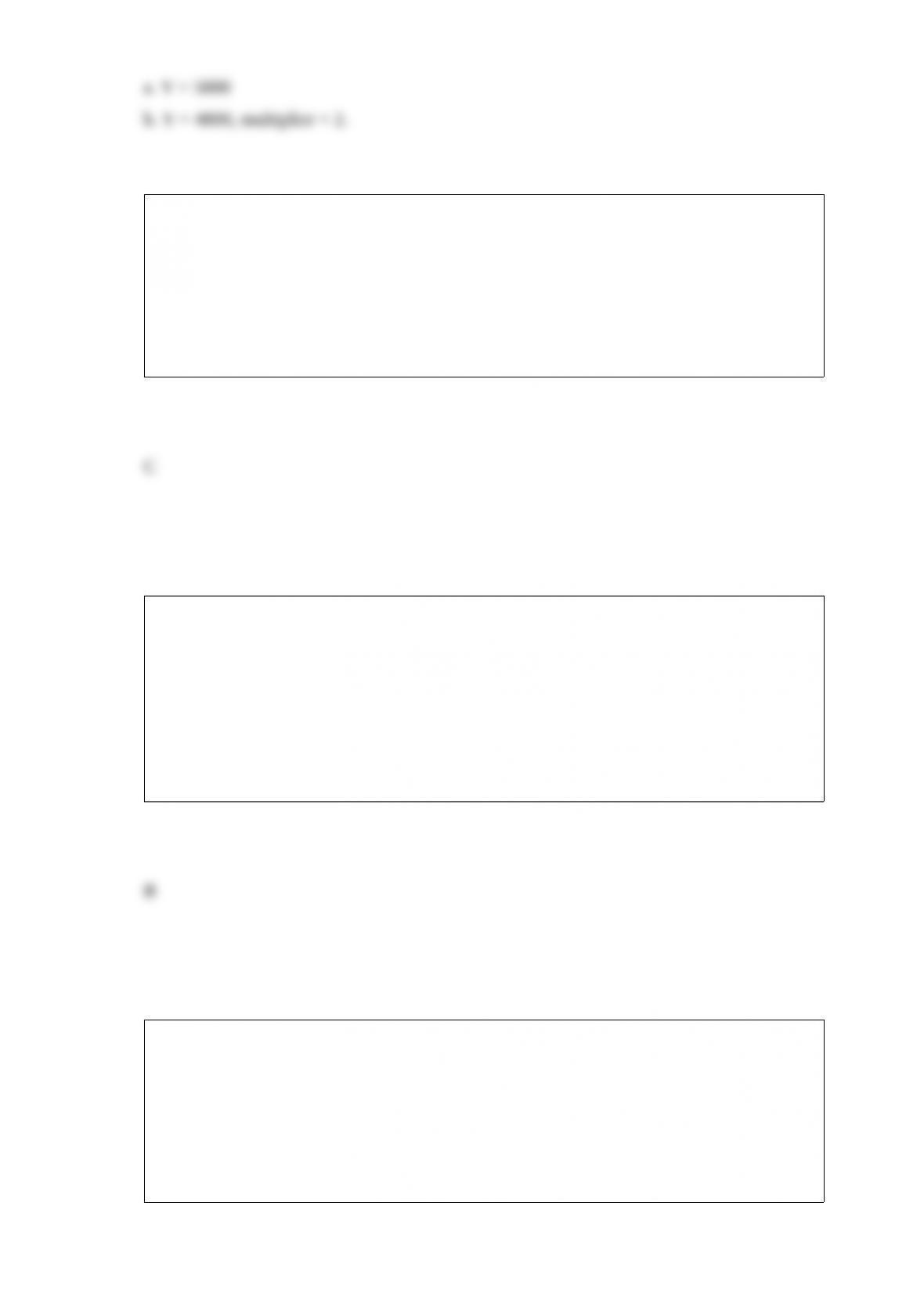
Suppose the United States economy is represented by the following equations:
Z = C + I + G C = 500 + .5YD T = 600 I = 300
YD = Y – T G = 2000
a. Given the above variables, calculate the equilibrium level of output.
b. Now, assume that government spending decreases from 2000 to 1900. What is the
new equilibrium level of output? How much does income change as a result of this
event? What is the multiplier for this economy?
Suppose there is a simultaneous fiscal expansion and monetary contraction. We know
with certainty that
A) output will increase.
B) output will decrease.
C) the interest rate will increase.
D) the interest rate will decrease.
E) both output and the interest rate will increase.
Under the reasonable dynamic assumptions discussed in the text, a monetary
contraction should result in
A) an immediate rise in the interest rate, and no further interest rate changes.
B) an immediate rise in the interest rate, and then a fall in the interest rate over time.
C) an immediate rise in the interest rate, and then a further rise over time.
D) a very gradual but steady rise in the interest rate to its new equilibrium level.
E) no change in the interest rate initially, and then a sudden rise to its new equilibrium
value.
Which of the following events will cause the smallest change in the real exchange rate
(ε)?
A) a 6% drop in E and a 6% increase in the foreign price level (P*)
B) a 6% increase in the domestic price level (P) and a 6% reduction in P*
C) a 6% drop in E and a 6% reduction in P*
D) a 3% increase in E
E) a 2% increase in E and a 2% increase in P

When we estimate a regression to determine the relationship between changes in
consumption and changes in current income, we find that
A) there are no residuals.
B) the R2 is zero.
C) the MPC is larger than one.
D) all of the above
E) none of the above
For this question, assume that exchange rates are flexible and that the exchange rate
expected to occur in one year is not constant. Suppose that individuals now expect that
the foreign central bank will pursue expansionary monetary policy in one year. This
expected future monetary expansion by the foreign central bank will cause which of the
following to occur?
A) The current nominal exchange rate will decrease.
B) The current nominal exchange rate will increase.
C) The current nominal exchange rate will not change.
D) The effects on the current nominal exchange rate are ambiguous.
Chairmen of the Federal Reserve Board
A) serve 14-year terms as chairmen.
B) serve 4-year renewable terms as chairmen.
C) also serve as members of the administration.
D) serve 4-year non-renewable terms as chairmen.
E) none of the above

Suppose there is a decrease in the short-term interest rate. Give this reduction in the
current short-term interest rate, which of the following will most likely occur?
A) The long-term interest rate will increase.
B) The long-term interest rate will remain the same.
C) The long-term interest rate will decrease by more than the short-term rate.
D) The long-term interest rate will decrease by the same amount as the short-term rate.
E) The long-term interest rate will decrease, but by less than the short-term rate.
Suppose current government spending increases and that individuals expect future
government spending to increase. Given this information, in which of the following
cases will output in the current period be more likely to increase?
A) Individuals consider only the short run effects of changes in future macro variables
when forming expectations of future output and future interest rates.
B) Individuals consider only the medium run effects of changes in future macro
variables when forming expectations of future output and future interest rates.
C) Individuals consider only the long run effects of changes in future macro variables
when forming expectations of future output and future interest rates.
D) The output effects will be the same in B and C.
Suppose there is an increase in consumer confidence. Which of the following represents
the complete list of variables that must increase in response to this increase in consumer
confidence?
A) consumption
B) consumption and investment
C) consumption, investment and output
D) consumption and output
E) consumption, output and the interest rate

If the output is too low, to achieve the medium run equilibrium, the central bank will
A) increases policy rate.
B) reduces policy rate.
C) increase money supply.
D) increases inflation rate.
A fiscal contraction will tend to cause which of the following to occur?
A) a reduction in the interest rate and a reduction in investment
B) a reduction in the interest rate and an upward shift in the LM curve
C) a reduction in the interest rate and an ambiguous effect on investment
D) no change in output if the Fed simultaneously pursues contractionary monetary
policy
Which of the following represents the appropriability of research?
A) the protection given to new products by the law
B) how R&D spending translates into new ideas
C) the extent to which firms benefit from the results of their own R&D spending
D) the rate of technological progress
E) both B and C

Suppose the consumption equation is represented by the following: C = 250 + .75YD.
Now assume government spending increases by 100 for the above economy. Given the
above information, we know that equilibrium output will increase by
A) 200.
B) 400.
C) 800.
D) 1000.
E) none of the above