
Chapter 18. The Goods Market
in an Open Economy
I. MOTIVATING QUESTION
How is output determined in the short run in an open economy?
As in a closed economy, output in an open economy is determined by goods market equilibrium, the
condition that goods supply equals goods demand. In the open economy, however, goods demand
includes net exports.
II. WHY THE ANSWER MATTERS
The full treatment of short-run equilibrium in an open economy requires several steps. This chapter
integrates openness in the goods market into the model of goods market equilibrium. To consider the
goods market in isolation from financial markets, the chapter assumes that the interest rate is fixed and
treats the real exchange rate as a policy variable. Chapter 19 integrates openness in asset markets into the
determination of financial market equilibrium and then combines goods and financial market equilibrium
into an open-economy IS–LM model.
III. KEY TOOLS, CONCEPTS, AND ASSUMPTIONS
1. Tools and Concepts
i. The chapter introduces an open-economy model of goods market equilibrium by adding net
exports to the demand for domestic goods.
ii. A real depreciation will improve the trade balance when the proportional increase in relative
quantities (the sum of the proportional increase in exports and the proportional decrease in imports)
exceeds the proportional real depreciation. This condition is called the Marshall-Lerner condition. It is
derived in an appendix to the chapter.
iii. The J-curve describes the dynamics of trade balance adjustment after a real depreciation. Initially,
the trade balance falls, since the real depreciation tends to increase the relative value of imports. Over
time, however, consumers and firms start buying more home goods and fewer foreign goods (since real
depreciation makes home goods cheaper), and the trade balance improves.
©2017 Pearson Education, Inc. Publishing as Prentice Hall
18-82
2. Assumptions
The chapter considers the short-run goods market in isolation from financial markets, so it assumes that
the interest rate is fixed and that the real exchange rate is a policy variable. In keeping with the analysis
of Chapter 19, as well as the closed economy IS–LM analysis, a more precise way to state these
assumptions is that the home and foreign price levels are fixed and the nominal exchange rate is a policy
variable. Since the price levels are fixed, the nominal exchange rate determines the real exchange rate. In
addition, production is assumed to respond one-for–one to changes in demand without changes in price
(the AS curve is horizontal at the initial price), so demand determines output.
©2017 Pearson Education, Inc. Publishing as Prentice Hall
18-83
IV. SUMMARY OF THE MATERIAL
1. The IS Relation in the Open Economy
When the economy is open to trade in goods, it becomes important to distinguish the domestic demand
for goods, given by C+I+G, from the demand for domestic goods, denoted by Z and given by
Z=C+I+G-IM/+X.
(18.1)
As in Chapter 5, the domestic demand for goods is C(Y-T)+I(Y,r)+G. Real exports (X) and real imports
(IM) are given by the following expressions.
IM=IM(Y,). (18.2)
+ +
X=X(Y*,). (18.3)
+ –
Exports increase when foreign income (Y*) increases, since foreigners have more to spend, and when
there is a real depreciation (an decrease in ), since home goods become less expensive relative to foreign
goods. Imports increase when domestic income increases, since home residents have more to spend, and
when there is a real appreciation, since foreign goods become less expensive relative to domestic goods.
Figure 18-1 displays graphically the effect of introducing net exports into the model of goods market
equilibrium. The domestic demand for goods is denoted DD. To derive the demand for domestic goods,
first shift the DD curve down by the value of imports (IM/). The new curve, denoted AA, is flatter than
DD, because the value of imports increases with income. Now add exports to the AA curve to arrive at
the demand for domestic goods (ZZ). Note that exports are independent of income, so the vertical
distance between ZZ and AA is constant and the two curves have the same slope. The gap between the
curves DD and ZZ is the trade balance (sometimes called net exports (NX)), depicted in the lower panels
(c & d) in Figure 18-1. Since the value of imports increases with income, the trade balance decreases
with income. Note that Figure 18-1 assumes that the real exchange rate is fixed.
©2017 Pearson Education, Inc. Publishing as Prentice Hall
18-84
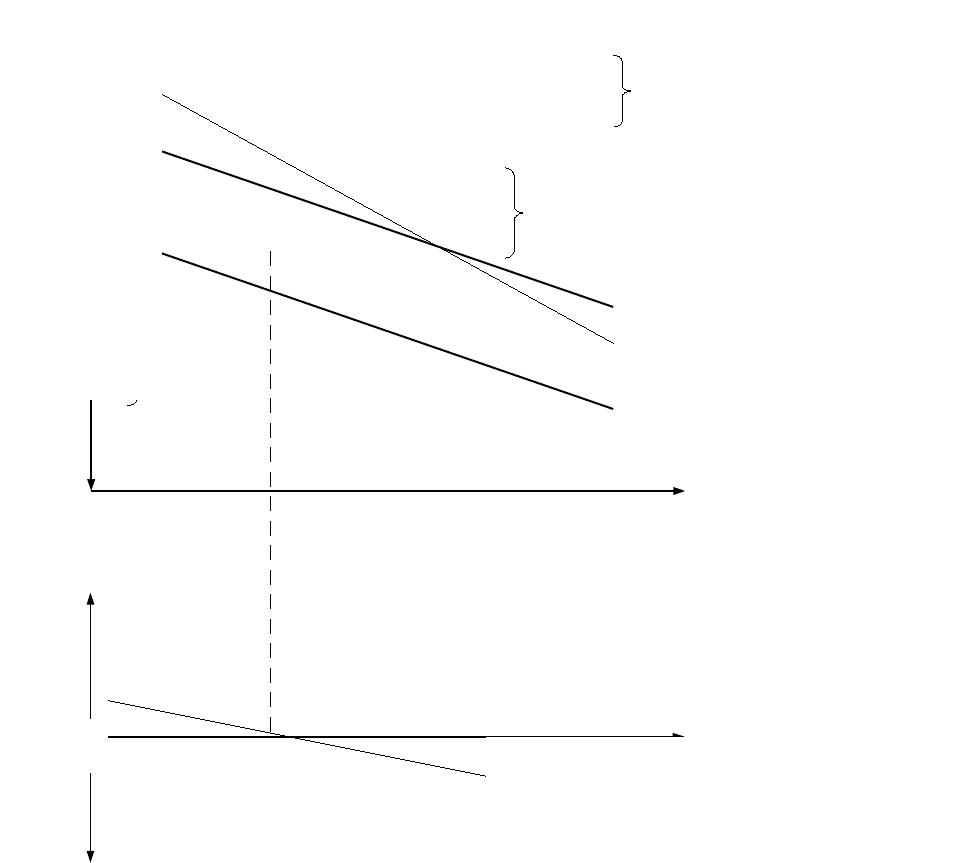
Figure 18-1c and d: The Demand for Domestic Goods and the Trade Balance (NX)
2. Equilibrium Output and the Trade Balance
Equilibrium in the goods market requires that the demand for domestic goods equals the production of
domestic goods, namely that Y=Z. Substituting equations (18.2) and (13.3) into the demand for domestic
goods results in a new IS relation:
Y=C(Y-T)+I(Y,r)+G-IM(Y,)/ +X(Y*,).
(18.4)
Note that real imports, which have units of foreign goods, are multiplied by the real exchange rate to
convert them into units of domestic goods.
©2017 Pearson Education, Inc. Publishing as Prentice Hall
I
Trade Balance, NX
0Income, Y
Domestic Demand (DD)
Demand for Domestic Goods (ZZ)
Income, Y
ZZ
NX
X
NX
18-85
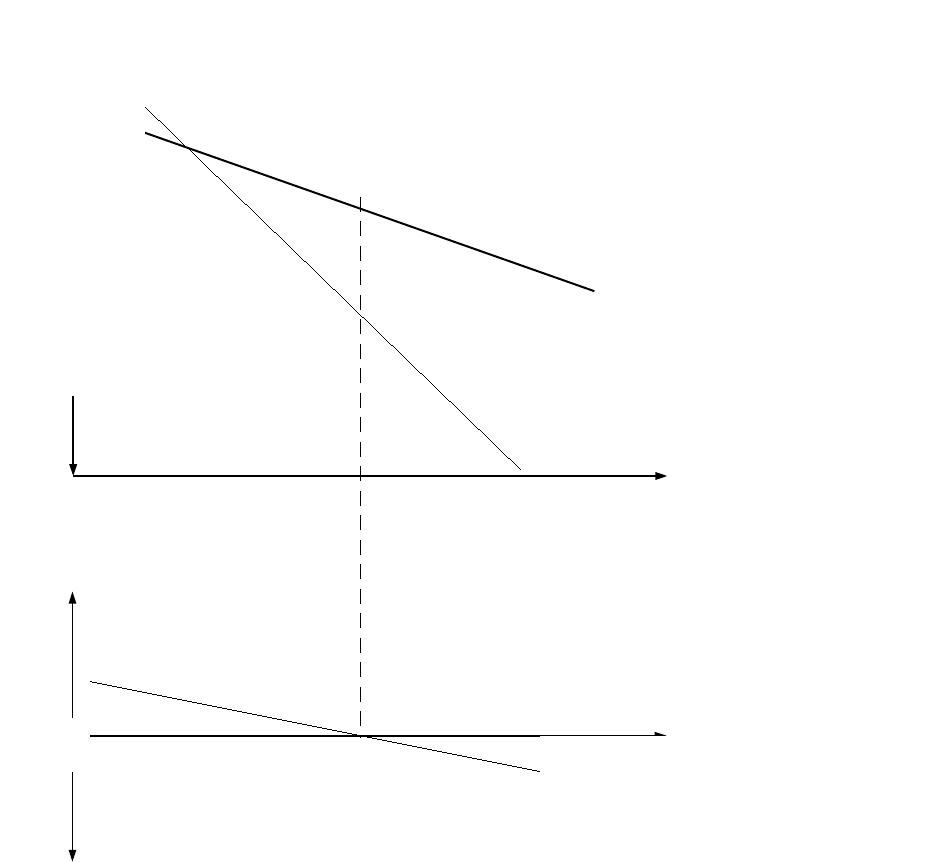
Since this chapter concentrates on the short run, it assumes that production responds one-for-one to
changes in demand (without changes in price). Graphically, equilibrium is determined by the intersection
of the ZZ curve and the 45°- line (Figure 18.2). In general, equilibrium does not require balanced trade.
Figure 18-2 depicts an equilibrium condition with a trade deficit.
Figure 18-2: Equilibrium Output and the Trade Balance (NX)
©2017 Pearson Education, Inc. Publishing as Prentice Hall
Trade Balance, NX
0Income, Y
45º
Demand for Domestic Goods (ZZ)
Income, Y
ZZ
NX
18-86
3. Increases in Demand – Domestic or Foreign
When domestic demand increases (e.g., G increases, T decreases, or consumer confidence increases), the
ZZ curve shifts up, so output increases and the trade balance falls. When foreign demand (Y*) increases,
the ZZ and NX curves shift up by the same amount. Output and the trade balance increase. The increase
in imports that arises from the increase in home output does not entirely offset the positive effect on
exports from the increase in foreign demand.
Note that increases in domestic demand have a smaller effect on output in the open economy than in the
closed economy, because some of the increased income “leaks” out of the domestic economy through
spending on imports. In other words, the multiplier is smaller in an open economy. A box in the text
carries this analysis further and notes that smaller countries are likely to have larger marginal propensities
to import out of income. As a result, fiscal policy will have a smaller effect on output in a smaller
economy, but a greater effect on the trade balance.
The relationship between foreign and domestic output suggests that policy coordination can be important
when industrial countries as a group are operating below normal levels of output. Governments typically
do not like to run trade deficits, because deficits require borrowing from the rest of the world. In the
absence of coordinated action, an expansionary policy by an individual country in the midst of a
worldwide recession will likely generate a trade deficit (or at least worsen the trade balance), because the
increase in income will increase imports. Coordinated expansions will tend to have less effect on trade
balances in individual countries, because imports will increase substantially throughout the world. On the
other hand, coordinated expansions may be difficult to arrange. Countries that have budget deficits may
be unwilling to consider expansionary fiscal policy. In addition, once an agreement has been negotiated,
each country has an incentive to renege, thereby hoping to benefit from expansions abroad and to improve
its trade balance.
4. Depreciation, the Trade Balance, and Output
The trade balance (NX) is given by
NX=X(Y*,) – IM(Y,)/.
A real depreciation has two effects: a quantity effect (an increase in exports and a reduction in imports),
which tends to increase the trade balance, and a price effect (an increase in the relative price of imports),
which tends to reduce the trade balance. The net effect will be positive if the quantity effect is greater
than the price effect, a condition known as the Marshall-Lerner condition (derived in an appendix). If so,
a real depreciation will improve the trade balance and increase output. With some qualifications, the
Marshall-Lerner condition is usually satisfied in practice, and the text assumes that a real depreciation
will improve the trade balance.
If the government can affect the real exchange rate through policy, then it can use two policy instruments
(fiscal policy and the real exchange rate) to achieve two policy targets (output and the trade balance). For
©2017 Pearson Education, Inc. Publishing as Prentice Hall
18-87
example, suppose a country in recession has a trade deficit, and policymakers want to achieve the natural
level of output and balanced trade. Expansionary fiscal policy will increase output, but will also worsen
the trade deficit. A real depreciation will increase output and improve the trade deficit, but there is no
guarantee that it can achieve the output target under balanced trade. To achieve both targets,
policymakers need a policy mix: in this case, a real depreciation sufficient to balance trade at the target
output level and the fiscal policy required to ensure that the economy achieves the target output level. If
output is higher than desired after the real depreciation, policymakers should use contractionary fiscal
policy; if output is lower than desired, policymakers should use expansionary fiscal policy. The text
includes a table that summarizes other policy mixes under alternative initial conditions for output and the
trade balance.
5. Looking at Dynamics: the J-Curve
The effects of a real depreciation have a dynamic dimension. The price effect happens immediately, but
the quantity effect takes time. As a result, the trade balance tends to worsen immediately after a real
depreciation, but to improve over time. In other words, it takes some time for the Marshall-Lerner
condition to be satisfied. This adjustment process of the trade balance—a temporary fall followed by a
gradual improvement—is called the J-curve. Econometric evidence suggests that in rich countries, the
trade balance improves between six months and a year after a real depreciation.
6. Saving, Investment, and the Current Account Balance
The national income identity (equation (18.1)) can be expressed as
NX = Y–C–I–G = (S–I) + (T–G),
where private saving (S) is given by S = Y–C–T. The first equality in equation says that the trade balance
equals income minus spending. The second equality of equation says that the trade balance is the excess
of private saving over investment plus the government budget surplus. Ignoring the distinction between
the current account and the trade balance, a trade surplus implies that a country is lending to the rest of
the world. The funds for this lending are derived from the two sources on the RHS of equation.
Since saving and investment are endogenous, this formulation can be a misleading guide for policy
analysis. For example, since the real exchange rate does not appear in this equation one might conclude
that a real depreciation has no effect on the trade balance. In fact, a real depreciation affects output, and
therefore affects saving and investment. If the Marshall-Lerner condition is satisfied, a real depreciation
will increase saving more than it increases investment, and improve the trade balance.
A box in the text examines the increase in the current account deficits of Euro periphery countries such as
Spain and Portugal. These current account deficits increased to high levels by 2008, the year the financial
crisis emerged. The higher borrowing costs for these nations forced them to reduce their current account
deficits as foreign borrowing proved too costly. However, given that exchanges could not adjust the
impact was to decrease output and imports. This adjustment is known as import compression and resulted
in an approximate 25% decline in both categories since 2008.
©2017 Pearson Education, Inc. Publishing as Prentice Hall
18-88
V. PEDAGOGY
The relationship between saving and investment in an open economy is presented at the end of the
chapter. There are two arguments for placing it at the beginning. First, the derivation of equation
presented in section 6 illustrates that the trade balance is the difference between income and spending.
Second, by discussing this equation before the policy experiments, instructors can include the effects on
saving and investment in the discussion of fiscal and exchange rate policy. This approach will reinforce
the notion that saving and investment are endogenous and that the government surplus is not the only
determinant of the trade balance. To illustrate the latter point, note that the U.S. federal budget deficit
declined over the 1990s, but the trade deficit reached record levels.
©2017 Pearson Education, Inc. Publishing as Prentice Hall
18-89