Archives
Appendix A Reference Correctness Communication Part Correctness Communication Lecture Notes Amp Exercises Reference
A-1 Reference Chapter A: Correctness of Communication Part IV: Correctness of Communication Lecture Notes & Exercises Reference Chapter A: Correctness of Communication Teaching Suggestions Appendix A covers some of the most common grammar mistakes made by undergraduate college students. Consider […]
Business Communication Chapter 1 Communicating The Workplace Employees Are Supposed Participate And Expected Perform Would
1-12 Chapter 1: Communicating in the Workplace employees are supposed to participate and expected to perform, would this be an issue for them? Or would they enjoy this type of culture? Invite students to share their experiences of the organizational […]
Business Communication Chapter 1 Communicating The Workplace Part By Lecture Notes Amp Exercises Communicating
1-1 Chapter 1: Communicating in the Workplace Part II: Chapter-by-Chapter Lecture Notes & Exercises Chapter 1: Communicating in the Workplace Teaching Suggestions Much of the information you will cover in the first meeting is routine—introduction of yourself, office hours, course […]
Business Communication Chapter 10 Writing Persuasive Messages And Proposals Part By Lecture Notes Amp Exercises
10-1 Chapter 10: Writing Persuasive Messages and Proposals Part II: Chapter-by-Chapter Lecture Notes & Exercises Chapter 10: Writing Persuasive Messages and Proposals Teaching Suggestions The teaching techniques for this chapter are the same as for the preceding two chapters. Connect […]
Business Communication Chapter 10 Writing Persuasive Messages And Proposals Power Charge Your Professionalism Make Logical
10–17 Chapter 10: Writing Persuasive Messages and Proposals Power Charge Your Professionalism: Make Logical Comparisons When making comparisons in your writing, be sure they are logically worded. Keep these points in mind: Be sure your comparison is complete. If you […]

Business Communication Chapter 11 Researching And Writing Reports For Further Instruction And Practice The Parallelism
11–16 Copyright © 2018 McGraw-Hill Education. All rights reserved. No reproduction or distribution without the prior written consent of McGraw-Hill Education. For further instruction and practice, go to the “Parallelism” activities under “Style and Word Choice” in LearnSmart Achieve. Chapter […]
Business Communication Chapter 11 Researching And Writing Reports Part By Lecture Notes Amp Exercises
11-1 Chapter 11: Researching and Writing Reports Part II: Chapter-by-Chapter Lecture Notes & Exercises Chapter 11: Researching and Writing Reports Teaching Suggestions In teaching this chapter we suggest that you use a combination of techniques. Lecture is good to review […]
Business Communication Chapter 12 Creating The Right Type Report Criticalthinking Questions Discuss The Effects Formality
12–13 Chapter 12: Creating the Right Type of Report Critical-Thinking Questions 1. Discuss the effects of formality and likely length on report makeup as described in the chapter. (LO1) As a general rule, the more formal the report situation, the […]
Business Communication Chapter 12 Creating The Right Type Report Part By Lecture Notes Amp Exercises
12-1 Chapter 12: Creating the Right Type of Report Part II: Chapter-by-Chapter Lecture Notes & Exercises Chapter 12: Creating the Right Type of Report Teaching Suggestions Lecture, discussion, and illustration are all good for teaching types of reports. You can […]
Business Communication Chapter 13 Delivering Business Presentations And Speeches Nobody Says Anything When You Ask
13–13 Chapter 13: Delivering Business Presentations and Speeches Nobody says anything when you ask a question. Be ready to rephrase your question in a more provocative way. Review the basics of oral presentations as needed. They are shown in Exhibit […]
Business Communication Chapter 13 Delivering Business Presentations And Speeches Part By Lecture Notes Amp Exercises
13-1 Chapter 13: Delivering Business Presentations and Speeches Part II: Chapter-by-Chapter Lecture Notes & Exercises Chapter 13: Delivering Business Presentations and Speeches Teaching Suggestions Teaching oral communication is best done through application exercises and problems. Even so, you will probably […]
Business Communication Chapter 14 Putting Interpersonal Skills Work Conversations And Meetings Part By Lecture Notes
14-1 Chapter 14: Putting Interpersonal Skills to Work in Conversations and Meetings Part II: Chapter-by-Chapter Lecture Notes & Exercises Chapter 14: Putting Interpersonal Skills to Work in Conversations and Meetings Teaching Suggestions Teaching interpersonal skills is best done through application […]
Business Communication Chapter 14 Putting Interpersonal Skills Work Conversations And Meetings You Need Additional Practice
14–13 Chapter 14: Putting Interpersonal Skills to Work in Conversations and Meetings If you need additional practice, be sure to visit the grammar, mechanics, and punctuation exercises in LearnSmart Achieve. Suggested revision of the letter body follows: Subject: BOM routing […]
Business Communication Chapter 15 Communicating The Job Search Message Can Sent Over Email Sent Via
15–14 Chapter 15: Communicating in the Job Search message can be sent over email or sent via regular mail. If the interviewee knows a hiring decision will be made before a thank-you note could arrive via regular mail, an email […]
Business Communication Chapter 15 Communicating The Job Search Part By Lecture Notes Amp Exercises
15-1 Chapter 15: Communicating in the Job Search Part II: Chapter-by-Chapter Lecture Notes & Exercises Chapter 15: Communicating in the Job Search Teaching Suggestions The teaching techniques for this chapter are the same as the preceding chapters. Some instructors will […]
Business Communication Chapter 2 Writing Effectively For Your Audience Purpose And Medium Part By Lecture
2-1 Chapter 2: Writing Effectively for Your Audience, Purpose, and Medium Part II: Chapter-by-Chapter Lecture Notes & Exercises Chapter 2: Writing Effectively for Your Audience, Purpose, and Medium Teaching Suggestions This material will mostly be covered best by lecture and […]
Business Communication Chapter 3 Designing Documents With Visual Appeal Part By Lecture Notes Amp Exercises
3-1 Chapter 3: Designing Documents with Visual Appeal Part II: Chapter-by-Chapter Lecture Notes & Exercises Chapter 3: Designing Documents with Visual Appeal Teaching Suggestions This chapter lays the foundation for good basic document design skills that will help any person […]
Business Communication Chapter 4 Communicating With Visuals Part By Lecture Notes Amp Exercises Communicating
4-1 Chapter 4: Communicating with Visuals Part II: Chapter-by-Chapter Lecture Notes & Exercises Chapter 4: Communicating with Visuals Teaching Suggestions As we look at teaching visuals, the emphasis in a business communication class should be on their proper use and […]
Business Communication Chapter 4 Communicating With Visuals Point Out Your Students The Discussion Concerning Chartjunk
4-13 Chapter 4: Communicating with Visuals Point out to your students the discussion concerning chartjunk in the Communication Matters box titled “Avoiding Chartjunk.” Charley Kyd from the ExcelUsers blog said the visual on the left contains chartjunk. The visual on […]
Business Communication Chapter 5 Crafting Effective Sentences And Paragraphs Communication Also Just Because Word Short
5-16 Chapter 5: Crafting Effective Sentences and Paragraphs Copyright © 2018 McGraw-Hill Education. All rights reserved. No reproduction or distribution without the prior written consent of McGraw-Hill Education. communication. Also, just because a word is short doesn’t mean it’s “unprofessional.” […]
Business Communication Chapter 5 Crafting Effective Sentences And Paragraphs Part By Lecture Notes Amp Exercises
5-1 Chapter 5: Crafting Effective Sentences and Paragraphs Part II: Chapter-by-Chapter Lecture Notes & Exercises Chapter 5: Crafting Effective Sentences and Paragraphs Teaching Suggestions This chapter contains a great deal of advice about writing and crafting effective communication. One foundational […]
Business Communication Chapter 6 Building Positive Relationships Through Communication Part By Lecture Notes Amp Exercises
6-1 Chapter 6: Building Positive Relationships through Communication Part II: Chapter-by-Chapter Lecture Notes & Exercises Chapter 6: Building Positive Relationships through Communication Teaching Suggestions This chapter builds on what students learned in Chapter 5. They have been learning how to […]
Business Communication Chapter 7 Communicating Across Cultures Part By Lecture Notes Amp Exercises Communicating
7-1 Chapter 7: Communicating across Cultures Part II: Chapter-by-Chapter Lecture Notes & Exercises Chapter 7: Communicating across Cultures Teaching Suggestions In today’s global marketplace, it’s more important than ever to be aware of cultural differences and be able to navigate […]
Business Communication Chapter 8 Writing Goodnews And Neutral Messages Part By Lecture Notes Amp Exercises
8-1 Chapter 8: Writing Good-News and Neutral Messages Part II: Chapter-by-Chapter Lecture Notes & Exercises Chapter 8: Writing Good-News and Neutral Messages Teaching Suggestions This chapter introduces students to one of the standard organizational approaches in business writing: the direct […]
Business Communication Chapter 8 Writing Goodnews And Neutral Messages The Next Two Paragraphs Provide Details
8-14 Chapter 8: Writing Good-News and Neutral Messages The next two paragraphs provide details of the issues, including specifically stating what was expected and how the experience did not meet expectations. Throughout the explanation, the writer sticks to the facts, […]
Business Communication Chapter 9 Writing Badnews Messages Part By Lecture Notes Amp Exercises Writing
9-1 Chapter 9: Writing Bad-News Messages Part II: Chapter-by-Chapter Lecture Notes & Exercises Chapter 9: Writing Bad-News Messages Teaching Suggestions The teaching techniques for this chapter are the same as for the preceding chapter. Connect provides instructors with a variety […]
Communications Chapter 1 Describe The Business Communication Process topic The Communication
1-1 Chapter 01 Communicating in the Workplace Answer Key True / False Questions 1. Communication ranks at or near the top of the business skills needed for success. TRUE Communication is a major and essential part of the work of […]
Communications Chapter 1 The Ability Meaningfully Accurately And Efficiently
30. A. It has had little effect on communication in the workplace. B. Communication in businesses decreases as diversity increases. C. The requirement for cultural agility in workplace communication has increased significantly. D. All people within a business share standardized […]
Communications Chapter 1 The Grapevine Organization Best Defined Network
50. A. The formal network does not include the upward and lateral movement of information in an organization. B. The formal communication network never includes external audiences. C. The formal network is the only important communication network in an organization. […]
Communications Chapter 1 The Process Communication Once The Primary
65. In the process of communication, once the primary sender of a message has defined the situation, the next step is to A. consider possible communication strategies. B. interpret the message. C. compose the message. D. send the message. E. […]
Communications Chapter 10 The best organizational pattern for a persuasive
10-1 Chapter 10 Writing Persuasive Messages and Proposals Answer Key True / False Questions 1. The best organizational pattern for a persuasive message is to say what you want your readers to do right away and then use the rest […]
Communications Chapter 10 The First Step Writing Sales Message
Accessibility: Keyboard Navigation Blooms: Understand Difficulty: 2 Medium Learning Objective: 10-03 Show awareness of common ethical concerns regarding sales messages. Topic: Avoiding Unethical Communication Practices 35. The first step in writing a sales message is A. choosing the appropriate medium […]
Communications Chapter 10 Which The Following Best Illustrates Proposal
56. Which of the following best illustrates a proposal? A. a company’s written defense for the use of hazardous material B. an email to the employees in a company detailing the changes in company policy C. a routine letter to […]
Communications Chapter 11 Examine The Following Sentence Taken From
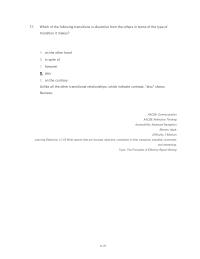
77. Which of the following transitions is dissimilar from the others in terms of the type of transition it makes? A. on the other hand B. in spite of C. however D. also E. on the contrary Unlike all the […]
Communications Chapter 11 Garrett Conducts Study Company That Shows
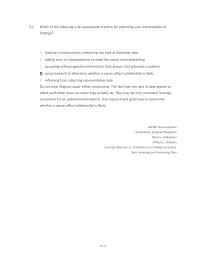
61. A. drawing a conclusion by comparing two sets of dissimilar data B. adding color to interpretations to make the report more interesting C. accepting without question information from groups that advocate a position D. using research to determine whether […]
Communications Chapter 11 Primary Research Produces New Information Through
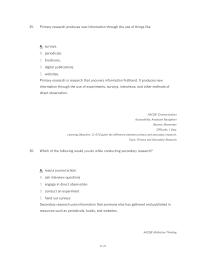
35. Primary research produces new information through the use of things like A. surveys. B. periodicals. C. brochures. D. digital publications. E. websites. Primary research is research that uncovers information firsthand. It produces new information through the use of experiments, […]
Communications Chapter 11 The objective quality of a report is its unbiased approach
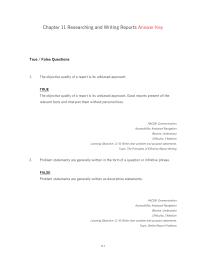
11-1 Chapter 11 Researching and Writing Reports Answer Key True / False Questions 1. The objective quality of a report is its unbiased approach. 2. FALSE Problem statements are generally written as descriptive statements. AACSB: Communication Accessibility: Keyboard Navigation Blooms: […]
Communications Chapter 12 Shabri’s Work Involves Creating And Submitting
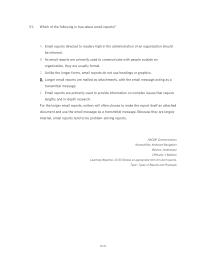
51. A. Email reports directed to readers high in the administration of an organization should be informal. B. As email reports are primarily used to communicate with people outside an organization, they are usually formal. C. Unlike the longer forms, […]
Communications Chapter 12 The more informal the situation, the more elaborate
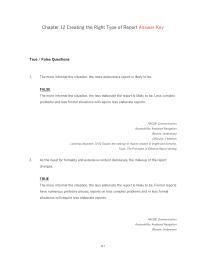
Chapter 12 Creating the Right Type of Report Answer Key True / False Questions 1. FALSE The more informal the situation, the less elaborate the report is likely to be. Less complex problems and less formal situations will require less […]
Communications Chapter 12 Which The Following Provide Written Record
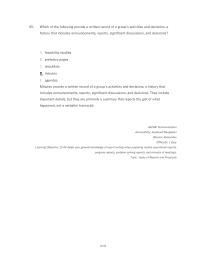
65. Which of the following provide a written record of a group’s activities and decisions, a history that includes announcements, reports, significant discussions, and decisions? A. feasibility studies B. prefatory pages C. checklists D. minutes E. agendas Minutes provide a […]
Communications Chapter 12 Which The Following The Most Appropriate
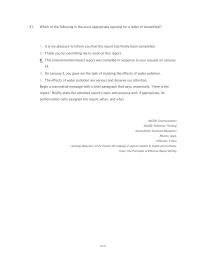
31. Which of the following is the most appropriate opening for a letter of transmittal? A. It is my pleasure to inform you that the report has finally been completed. B. Thank you for permitting me to work on this […]
Communications Chapter 13 Oliver Plans Give Informative Presentation How
Chapter 13 Delivering Business Presentations and Speeches Answer Key True / False Questions 1. FALSE Persuasive presentations are primarily intended to sell. Persuasive presentations are primarily intended to engage and reward the audience’s attention. AACSB: Reflective Thinking Accessibility: Keyboard Navigation […]
Communications Chapter 13 When Organizing The Body Presentation Important
32. When organizing the body of a presentation, it is important to A. use at least three levels of hierarchy in the structure. B. avoid dividing the body into comparable parts. C. choose an opening that steers away from the […]
Communications Chapter 13 Willa Human Resources Manager Giving Presentation
55. Willa, a human resources manager, is giving a presentation about discrimination to the employees at her office. She has used presentation software to create slides with images, statistics, and some key points. When should she look at her slides? […]
Communications Chapter 14 However You Have Put Caller on Hold Sure
14-1 Chapter 14 Putting Interpersonal Communication Skills to Work in Conversations and Meetings Answer Key True / False Questions 1. Written and oral communication play a very important role in both reinforcing and changing an organization’s culture. TRUE Written and […]
Communications Chapter 14 The Process Discussion That Leads Agreement
50. The process of discussion that leads to an agreement and is frequently used to solve a conflict is A. negotiation. B. constructive feedback. C. back-channeling. D. paralanguage. E. heuristics. Negotiation is the process of discussion that leads to an […]
Communications Chapter 14 When Screening Phone Call Assistant Busy
61. When screening a phone call, an assistant to a busy executive must A. courteously ask the purpose of the call. B. put the caller on hold for however long it takes the executive to be ready. C. promise to […]
Communications Chapter 14 Which The Following Involves Focusing What
30. A. filtering. B. sensing. C. remembering. D. receiving. E. acknowledging. This is an example of filtering, which is the process by which your personal context affects how you filter sounds and give meaning to incoming messages. Your filter is […]
Communications Chapter 15 Gina Has Learned Job Opening For
50. Gina has learned of a job opening for which she is qualified through an acquaintance who works at the hiring company. Which of the following is the best way for Gina to begin her cover letter? A. At the […]
Communications Chapter 15 Only paid internships offer interns the opportunity to gain
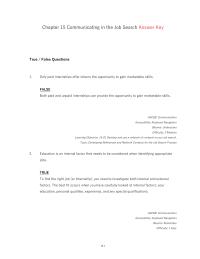
15-1 Chapter 15 Communicating in the Job Search Answer Key True / False Questions 1. Only paid internships offer interns the opportunity to gain marketable skills. 2. TRUE To find the right job (or internship), you need to investigate both […]
Communications Chapter 15 The Context Finding Employers Are
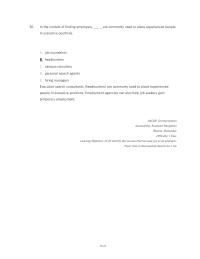
30. In the context of finding employers, _____ are commonly used to place experienced people in executive positions. A. job counselors B. headhunters C. campus recruiters D. personal search agents E. hiring managers Executive search consultants (headhunters) are commonly used […]
Communications Chapter 15 Which The Following Should You Avoid
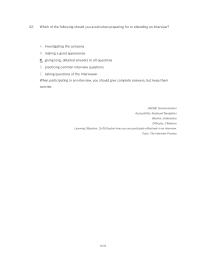
62. Which of the following should you avoid when preparing for or attending an interview? A. investigating the company B. making a good appearance C. giving long, detailed answers to all questions D. practicing common interview questions E. asking questions […]
Communications Chapter 2 The Direct Order Plan Organizing Information
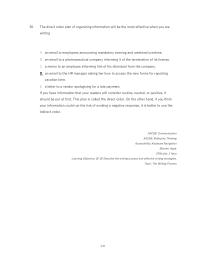
30. The direct order plan of organizing information will be the most effective when you are writing A. an email to employees announcing mandatory evening and weekend overtime. B. an email to a pharmaceutical company informing it of the termination […]
Communications Chapter 2 Whether And When These Abbreviations Are Used
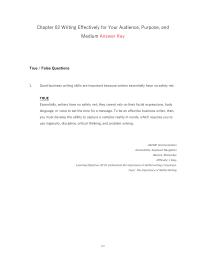
Chapter 02 Writing Effectively for Your Audience, Purpose, and Medium Answer Key True / False Questions 1. Good business writing skills are important because writers essentially have no safety net. 2-1 TRUE Essentially, writers have no safety net; they cannot […]
Communications Chapter 2 Which The Following Factors Common All
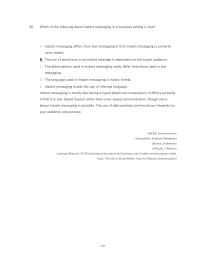
66. A. Instant messaging differs from text messaging in that instant messaging is primarily voice-based. B. The use of emoticons in an instant message is dependent on the target audience. C. The abbreviations used in instant messaging vastly differ from […]
Communications Chapter 2 Which The Following Lists The Four
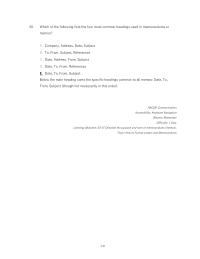
50. Which of the following lists the four most common headings used in memorandums or memos? A. Company, Address, Date, Subject B. To, From, Subject, References C. Date, Address, From, Subject D. Date, To, From, References E. Date, To, From, […]
Communications Chapter 3 Business documents must be created by graphic designers
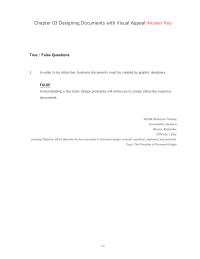
Chapter 03 Designing Documents with Visual Appeal Answer Key True / False Questions 1. In order to be attractive, business documents must be created by graphic designers. 3-1 FALSE Understanding a few basic design principles will allow you to create […]
Communications Chapter 3 Carlos Would Like Use Multiple Fonts
30. A. a script font B. a sans serif font C. a serif font D. a proximity font Serenity would be best served by a serif font. Serifs can help connect letters and make text more readable, particularly when it […]
Communications Chapter 3 What Four Elements Are Typically Contained
62. What four elements are typically contained on the title page of a formal report? A. the publication date, the report title, the report’s conclusion, the report website B. the name of the person for whom the report has been […]
Communications Chapter 3 Which The Following Rarely Used Business
50. A. The page number should appear at the bottom of every page. B. Pages two and onward should feature the page number but not the date. C. Every page should be numbered. D. The heading on pages two and […]
Communications Chapter 4 The Use Charts And Tables Display Data18scale
4-1 Chapter 04 Communicating with Visuals Answer Key True / False Questions 1. Visuals are constructed to help the intended reader understand the information more quickly, easily, and completely. TRUE You should plan your visuals with your reader in mind […]
Communications Chapter 4 When Constructing Visuals Document You Should
30. When constructing visuals in a document, you should A. always place borders around visuals that occupy less than a full page. B. use a quarter page to display visuals presenting complex or detailed information. C. determine the size of […]
Communications Chapter 4 Which The Following Category Common Errors
63. A. a pie chart B. a bilateral bar chart C. a scatter diagram D. a statistical map E. a line chart Statistical maps are useful when quantitative information, such as population, is to be compared by geographic areas, such […]
Communications Chapter 4 Which Type Chart Shows The Hierarchy
50. Which type of chart shows the hierarchy of levels and positions within a business or group? A. a decision tree B. a flowchart C. an organizational chart D. a pull quote chart E. a text tabulation An organizational chart […]
Communications Chapter 5 Lack Unity Sentences Usually Caused
51. Which of the following is an example of a sentence in which one idea is subordinated to the other? A. The company saw a huge increase in quarterly profits, and it invested large amounts of money in research and […]
Communications Chapter 5 Which The Following Pieces Advice Will
63. A. The most common paragraph arrangement is to begin with the topic sentence. B. The most common paragraph arrangement is to end with the topic sentence. C. The most common paragraph arrangement has the topic sentence in the middle […]
Communications Chapter 5 Which The Following Sentences Provides The
30. Which of the following sentences provides the best example of the use of abstract words? A. His office is on the fifth floor. B. A significant portion of the time, she is able to close the deal without a […]
Communications Chapter 5 You must use words that your readers are familiar
5-1 Chapter 05 Crafting Effective Sentences and Paragraphs Answer Key True / False Questions 1. To communicate clearly, you must use words that your readers are familiar with. 2. FALSE Although you should use familiar words, it is still okay […]
Communications Chapter 6 Standard Expressions Politeness Such Please Thank
32. Standard expressions of politeness, such as “please,” “thank you,” and “I’m sorry,” A. automatically make a message courteous. B. do not always make the recipient feel understood and appreciated. C. are necessary to make the recipient feel comfortable and […]
Communications Chapter 6 While a conversational language style is preferable in internal
Chapter 06 Building Positive Relationships through Communication Answer Key True / False Questions 1. FALSE Using the you-viewpoint means moving beyond your own goals and thinking about the communication situation from the recipients’ perspective. AACSB: Reflective Thinking Accessibility: Keyboard Navigation […]
Communications Chapter 6 Words That Refer Negatively Groups People
51. A. discrimination. B. ethical communication. C. a lie of commission. D. a lie of omission. E. exaggerated emphasis. A lie of omission is when you leave out information. If your boss depends on you to have a project done […]
Communications Chapter 7 Colette Business Executive From France And
52. A. first-language translation B. back translation C. equivalency translation D. high-context translation E. low-context translation This is an example of back translation. Elisa grew up speaking Spanish, but learned to speak English as an adult, and she now works […]
Communications Chapter 7 Culture Where People Tend Express Themselves
31. A. polychronic B. monochronic C. long-term oriented D. short-term oriented E. collectivist Polychronic cultures view time in a relaxed way and do not see anything wrong with showing up late to a scheduled meeting. Rosita has a meeting scheduled […]
Communications Chapter 7 English Speaker Best Err The Side Of simplicity
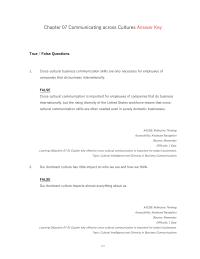
Chapter 07 Communicating across Cultures Answer Key True / False Questions 1. FALSE Cross-cultural communication is important for employees of companies that do business internationally, but the rising diversity of the United States workforce means that cross- cultural communication skills […]
Communications Chapter 8 Messages That Stay Within Business And
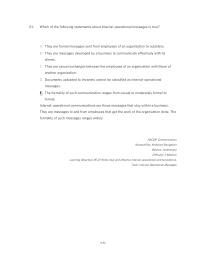
61. A. They are formal messages sent from employees of an organization to outsiders. B. They are messages developed by a business to communicate effectively with its clients. C. They are casual exchanges between the employees of an organization with […]
Communications Chapter 8 What The Advantage Closing Message With
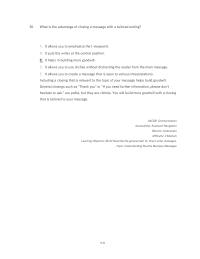
30. What is the advantage of closing a message with a tailored ending? A. It allows you to emphasize the I-viewpoint. B. It puts the writer at the central position. C. It helps in building more goodwill. D. It allows […]
Communications Chapter 8 When a message is likely to elicit a positive
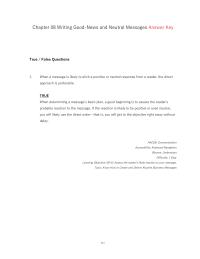
8-1 Chapter 08 Writing Good-News and Neutral Messages Answer Key True / False Questions 1. When a message is likely to elicit a positive or neutral response from a reader, the direct approach is preferable. TRUE When determining a message’s […]
Communications Chapter 8 When Including Bad News Favorable Response
50. When including bad news in a favorable response, you should A. place the bad news in secondary positions. B. avoid using space emphasis. C. present the bad news at the end of the message. D. present the bad news […]
Communications Chapter 9 Adjustment Refusal Message The Best Place
50. In an adjustment refusal message, the best place to state the refusal is A. in the subject line of the message. B. after the explanation since it is the logical result of the explanation. C. at the end of […]
Communications Chapter 9 The Closing Negative Announcement Should Recall
61. The closing in a negative announcement should A. recall the main message of the announcement. B. justify why it is not your fault. C. express your grievances surrounding the negative situation. D. focus on your emotions. E. cement your […]
Communications Chapter 9 When Presenting Bad News You Should
30. When presenting bad news, you should avoid using A. second person. B. first person. C. third person. D. the we-viewpoint. E. the you-viewpoint. When presenting bad news, you should avoid using second person. Instead, present your reasoning in first […]
Communications Chapter 9 You Could Reinforce The Message That You
9-1 Chapter 09 Writing Bad-News Messages Answer Key True / False Questions 1. Research indicates that negative news is received positively when it is not preceded by an explanation. FALSE The indirect order is especially effective when one must say […]