8-14
Chapter 8: Writing Good-News and Neutral Messages
The next two paragraphs provide details of the issues, including specifically stating what was expected
and how the experience did not meet expectations. Throughout the explanation, the writer sticks to the
facts, without using emotional language. Instead of being negative, the writer actually offers compliments
to the company and indicates that he considers them to have good service normally.
Internal-Operational Messages
Slides 8-36, 8-37, 8-38
These are the internal communications necessary in conducting the company’s business—those needed to
get work done on a regular basis.
The suggestions for writing these messages are much the same as for those types previously discussed.
The need for clarity, correctness, and courtesy should guide these efforts.
Take a quick poll of your students. How many say that most of the internal-operational messages they
receive from their employers come via email? How many say that most of these messages come via a
printed, written note? Which do they think is more effective?
To write a formal internal-operational message, writers should follow a plan that is similar to the routine
Ask students: When constructing an internal-operational message of a formal nature, it may be the case
that you are very familiar with much of your audience (your coworkers). What kinds of problems or
mistakes might you need to look out for in such a situation?
Ask students to refer to the bad and good examples of internal-operational messages in their textbook.
What in particular makes the good example work well?
Students will have a chance to correct an internal message on the next slide.
Slide 8-39
In this chapter, we’ve covered the most common direct message situations. Using the strategies outlined
here will help you to be successful in crafting direct messages for any routine business situation.

8-15
Chapter 8: Writing Good-News and Neutral Messages
8-16
Chapter 8: Writing Good-News and Neutral Messages
Power Charge Your Professionalism: Commas with a Series,
Phrases, and Clauses
Insert commas as needed in the sentences provided. Indicate which comma guide you used from
Reference Chapter A to determine the punctuation for each sentence. If the sentence is correct, leave it as
is. (Correct answers are shown in bold and comma guides are given in parentheses.)
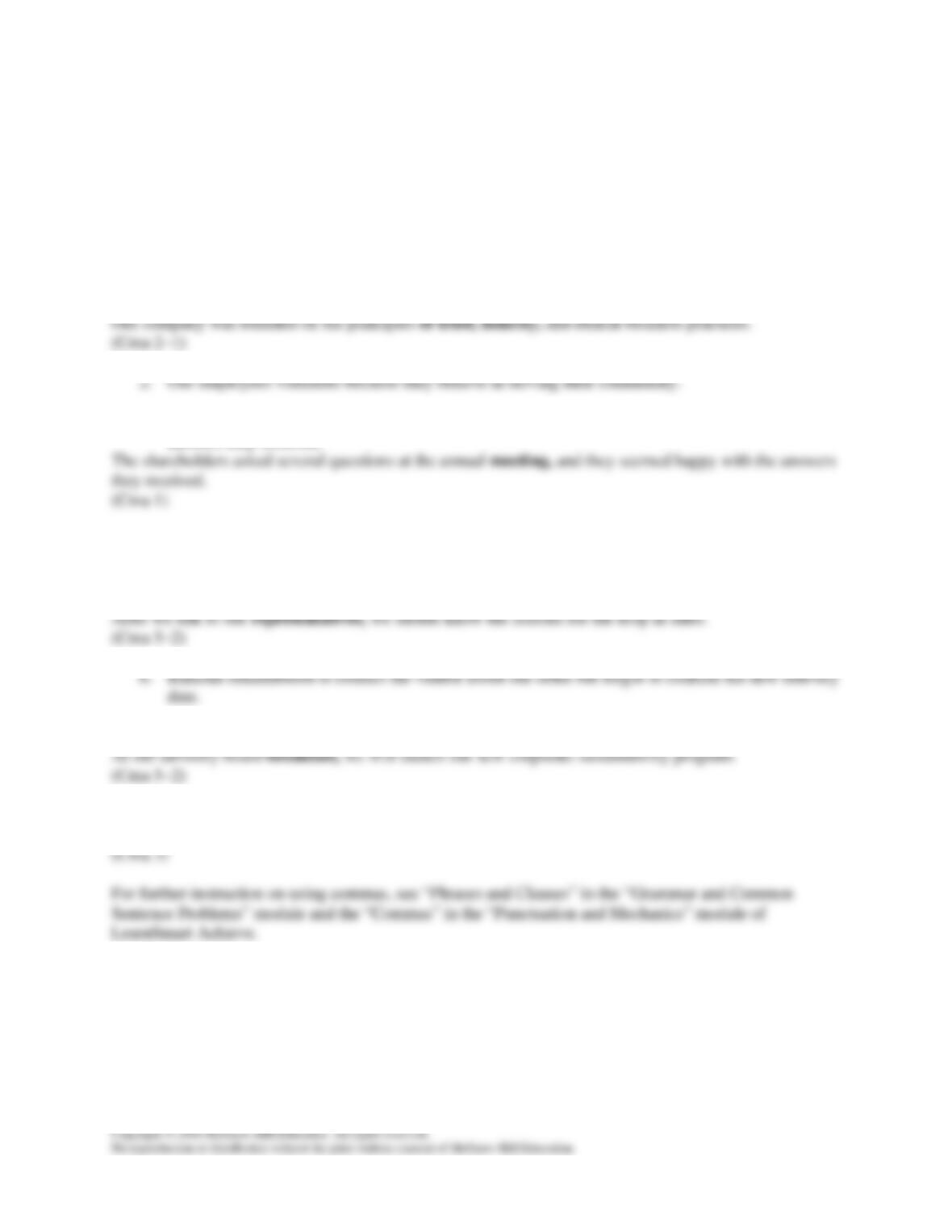
1. Our company was founded on the principles of trust honesty and ethical business practices.
3. The shareholders asked several questions at the annual meeting and they seemed happy with the
answers they received.
4. All employees who are interested in health savings accounts should attend the information
session at 3:00.
5. After we talk to our representatives we should know the reasons for the drop in sales.
7. At our advisory board breakfast we will launch our new corporate sustainability program.
8. The new printers which were purchased last May are much faster than our old printers.
The new printers, which were purchased last May, are much faster than our old printers.
8-17
Chapter 8: Writing Good-News and Neutral Messages
Critical-Thinking Questions
1. When is the direct order appropriate in inquiries? When would you use the indirect order?
Give examples. (LO1)
2. “Explanations in inquiries merely add length and should be eliminated.” Discuss. (LO3)
3. Discuss why just reporting truthfully may not be a sufficient strategy for handling negative
information in messages answering inquiries. (LO4)
4. Defend a policy of doing more than asked in answering routine inquiries. Can the policy be
carried too far? (LO4)
5. What can acknowledgment messages do to build goodwill? (LO5)
6. Discuss situations where the following email forms of an order acknowledgment would be
preferred: form message and a special message. (LO5)
7. Discuss how problems (vague orders, back orders) should be handled in messages
acknowledging orders. (LO5)

8-18
Chapter 8: Writing Good-News and Neutral Messages
8. When would you use the direct approach to write a claim? When would you use the indirect
approach to write a claim? (LO6)
9. Discuss the use of directness in internal-operational communications. Why is it desirable?
Can it be overdone? When might indirectness be appropriate? (LO7)
8-19
Chapter 8: Writing Good-News and Neutral Messages
Skills-Building Exercises
1. Point out the shortcomings in this email response to an inquiry about a short course in business
communication that Casey Webster’s company offered to its employees. The course was taught
by a local college professor. Mr. Braden’s initial inquiry included five questions: (1) How did
the professor perform? (2) What was the course format (length, meeting structure)? (3) What
was the employee evaluation of the instruction? (4) Was the course adapted to the company and
its technical employees? (5) Was homework assigned? (LO1, LO2, LO4)
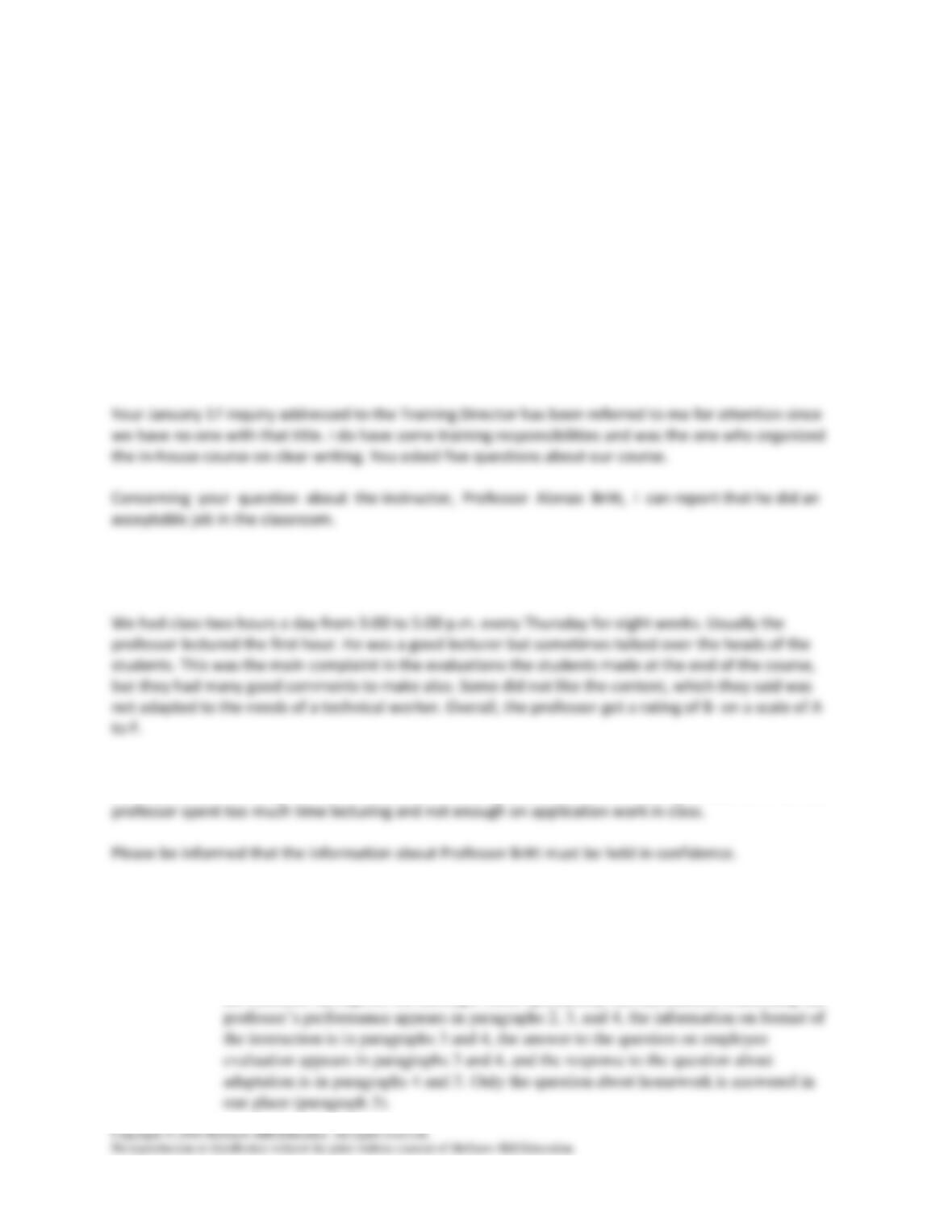
Subject: Course evaluation
Mr. Braden:
Some of the students, including this writer, felt that the emphasis was too much on grammar and
punctuation, however. He did assign homework, but it was not excessive.
We think the course was good, but it could have been better adapted to our needs and our people. I
also think it was too long—about 10 hours (five meetings) would have been enough. Also, we think the
Casey Webster
The shortcomings are as follows:
a. The opening is indirect. It is slow—a full paragraph of obvious and unnecessary
explanation. The organization throughout is bad. The answers to most of the questions
are scattered throughout the message. More specifically, the information concerning the
8-20
Chapter 8: Writing Good-News and Neutral Messages
2. List your criticisms of this email message inquiring about a convenience store advertised for
sale. (LO1, LO3)
Subject: Store details needed
Mr. Meeks:
This is in response to your advertisement in the May 17 Daily Bulletin in which you describe a
convenience store in Clark City that you want to sell. I am very much interested since I would like to
relocate in that area. Before I drive down to see the property, I need some preliminary information.
Hoping that you can get these answers to me soon so we can do business.
Criticisms of the message to Mr. Meeks are as follows:
a. “This is in response to…” —a slow, indirect opening, obvious
b. “I am very much interested…” —obvious
c. “…I need some preliminary information.”—hints that information is needed but doesn’t
ask for it
3. Criticize the following thank-you message from a college student to a professor who has sent
her a job lead. (LO1, LO5)
Subject: Thanks
Criticisms of the message to Professor Smith are as follows:
8-21
Chapter 8: Writing Good-News and Neutral Messages
4. Point out the shortcomings in this message granting a claim for a scanner received in damaged
condition. The box was damaged when it arrived in Ms. Nelson’s office, but she has no proof
that Mr. Hicks’s company is at fault. Think about whether the direct or indirect approach
would be appropriate (LO1, LO6).
Dear Mr. Hicks:
The Rigo Scanner Model 391 was in damaged condition when I received it on November 2. I doubt
Shortcomings of the message to Mr. Hicks are as follows:
a. The opening is confusing because it doesn’t reference the original order.
b. “…I doubt that the damage…” —This language is negative and the comparison to “our
5. Critique the following direct claim message: (LO1, LO6)
I wonder if you would consider reducing the bill I recently received for repair work that Tom, one of
your men, performed last week. I did not realize that he would charge me for the time he spent
going to Home Depot to get the parts he needed because the charge did not appear on the itemized
estimate along with the other charges for his time. If I’d known this, I probably wouldn’t have
chosen your company to do the work.
Please let me know your reply as soon as possible.
Kim Keeley
A critique of the direct claim message from Kim Keeley is as follows:

8-22
8-23
Chapter 8: Writing Good-News and Neutral Messages
Sample Solutions to Problem-Solving Cases
Routine Inquiries, Case #4
This case is a good exercise in critical thinking and writer analysis. Aside from basic information
regarding costs and legal issues, students should consider the types of needs, fears, goals, and questions
that a manager in this situation is likely to have. These will help form the basis of the writer’s questions.
Example
Have you had success using personality testing as a hiring/promotion tool? Could you provide
some examples of this?
Do you have experience working with the manufacturing industry? In what areas?
What, if any, legal issues are involved in personality testing?
What are the upfront and long-term costs of contracting your services?
What types of personality testing are available? Which would you recommend for our industry?
Are there other services that would be better than personality testing for assessing our
employees?
Favorable Responses, Case #15
As with most favorable responses, this is a fairly easy, straightforward message. It should begin by
8-24
Chapter 8: Writing Good-News and Neutral Messages
toward alleviating her supervisor’s fears and pre-presentation stress.
The close might be a friendly offer of additional help on the presentation if Kaya needs it. You might
want to have the class brainstorm other possible closes.
Example
Effective Communication:
News on Relevant Science: 10 TED Talks That Will Change the Way You Communicate
I’ve reviewed all of these and the one to lead with seems to be Nancy Duarte’s “The Secret Structure of
Great Talks.” The first five minutes would be sufficient to capture the message. The next is Laura Trice’s
Ineffective Communication:
The first video is Julian Treasure’s TED Talk on “How to Speak So That People Want to Listen,” in which
he talks about the seven deadly sins of speaking. The second is a brief, humorous look at several
mistakes in making a cold call:
Claims, Case #32
In this problem the restaurant staff is clearly at fault. Although you cannot repeat the retirement dinner at
this point, a clearly written letter could help the restaurant’s management be aware of some problems and
can also gain back for your company some of the funds spent on the event.
Example
You may recall that the Becker Plumbing staff celebrated the retirement of one of our employees at
your restaurant on December 12. Celebrating 35 years with our company is a special achievement; I
chose Walt’s as the location because I have always had good experiences there and the food is some of
the finest in our area. However, this lunch did not live up to Walt’s good reputation.
8-25
Chapter 8: Writing Good-News and Neutral Messages
First, though I made the reservation two weeks prior to the event and we arrived on time, we still had to
Internal Operational Messages, Case #43
It’s important for company leadership to maintain employee confidence and trust. One of the ways to do
that is through the use of clear, accurate information presented directly and in a timely manner, especially
when rumors may be traveling around the company grapevine. The example below illustrates how this
can be done.
Example
It has come to my attention that some questions have arisen recently regarding the handling of
information kept in our company’s personnel files.
If any of you have further questions regarding the personnel files, please contact Janet Bloom, our
Human Resources Director, who will be happy to meet with you.