
14-1
Chapter 14 Putting Interpersonal Communication Skills to Work in
Conversations and Meetings Answer Key
True / False Questions
1.
Written and oral communication play a very important role in both reinforcing and
changing an organization’s culture.
14-2
2.
In face-to-face communication, a larger part of the message is sent through nonverbal
communication than through verbal communication.
3.
The four common types of nonverbal communication are body language, facial expression,
verbal fillers, and paralanguage.
14-3
4.
By emphasizing the words do
not
in a sentence to convey how serious you are, you are
using paralanguage.
5.
After listening to formal oral communication, such as a speech, we quickly forget most of
the message.
14-4
6.
According to the ten commandments of listening, by frequently asking questions, you
interfere with the talker’s ability to develop his or her message.
7.
Most people do a reasonably good job of talking informally and do
not
need to work on
improving their conversational abilities.
14-5
8.
Unless you have an emergency, your conversation is never so important that you should
interrupt another conversation.
9.
When engaging in small talk, some good topics to discuss include sports, politics, current
events, movies, and the cost of things.
14-6
10.
If you have to engage in a difficult conversation, you should be subjective in how you
interpret and use the facts.
11.
Constructive feedback is used only to soften negative messages.
14-7
12.
People who prioritize relationships and others’ feelings over their own wishes typically
choose to use the conflict avoidance strategy.
13.
The competitive strategy of conflict management is frequently referred to as the “win-win”
strategy because everyone works toward a resolution that meets everyone’s needs.
14-8
14.
When engaging in negotiation, it is important to understand that the audience is judging
everything about you, and if you fall short in some area, you may lose your credibility.
15.
It is preferable if only a few people do most of the talking during a meeting because this
ensures that similar problems are dealt with in a similar manner.
14-9
16.
Meetings of such groups as formal committees, boards of directors, and professional
organizations usually follow generally accepted rules of conduct called parliamentary
procedure.
17.
One of the disadvantages of recording the minutes of a meeting is that it does
not
make a
note of the absentees.
14–10
18.
Putting the person you called on hold while you wait for an executive to be free to talk is
not
courteous.
19.
When leaving a voicemail message, it is a good idea to skip the message overview and
leave only a phone number where the call can be returned.
14–11
Multiple Choice Questions
20.
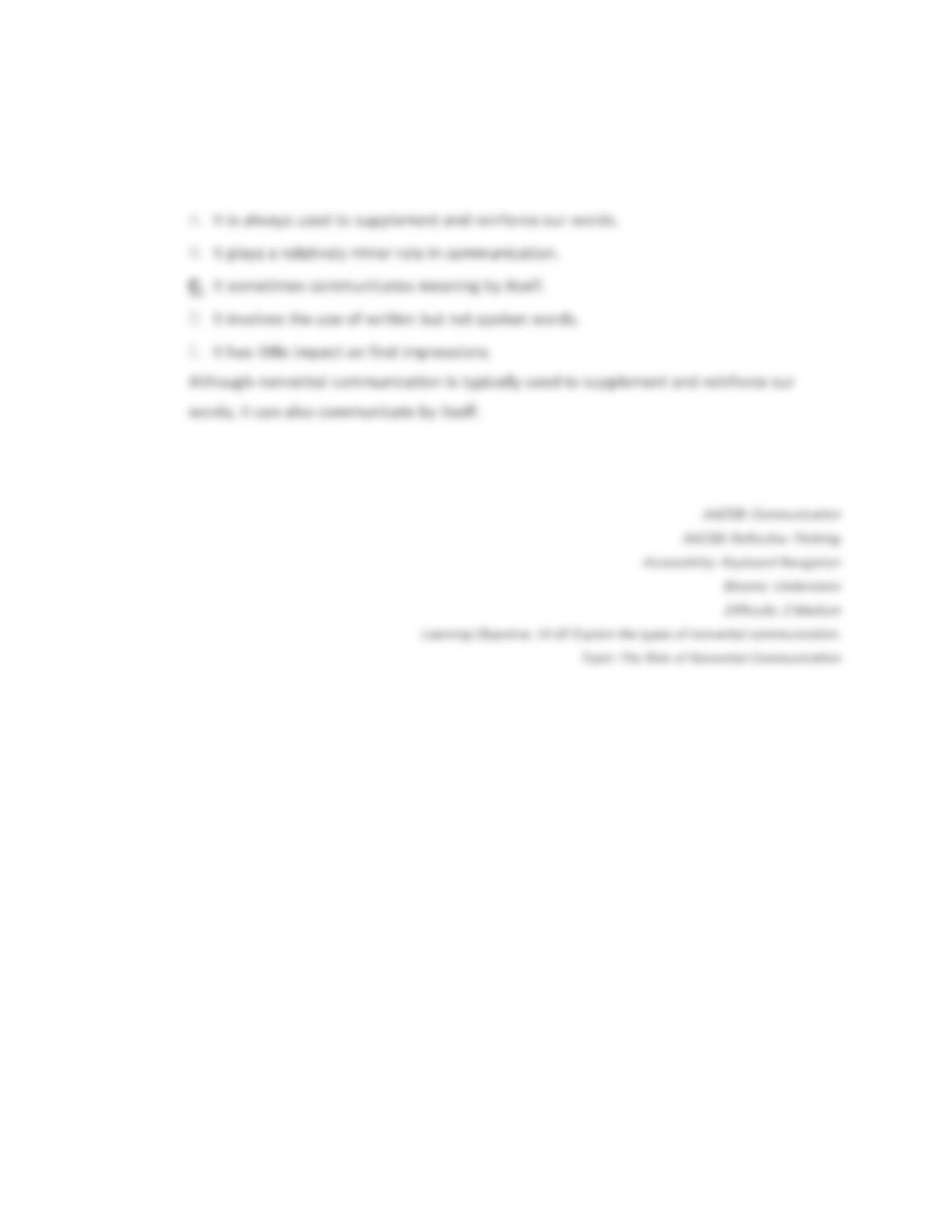
Which of the following statements about organizational culture is true?
14–12
21.
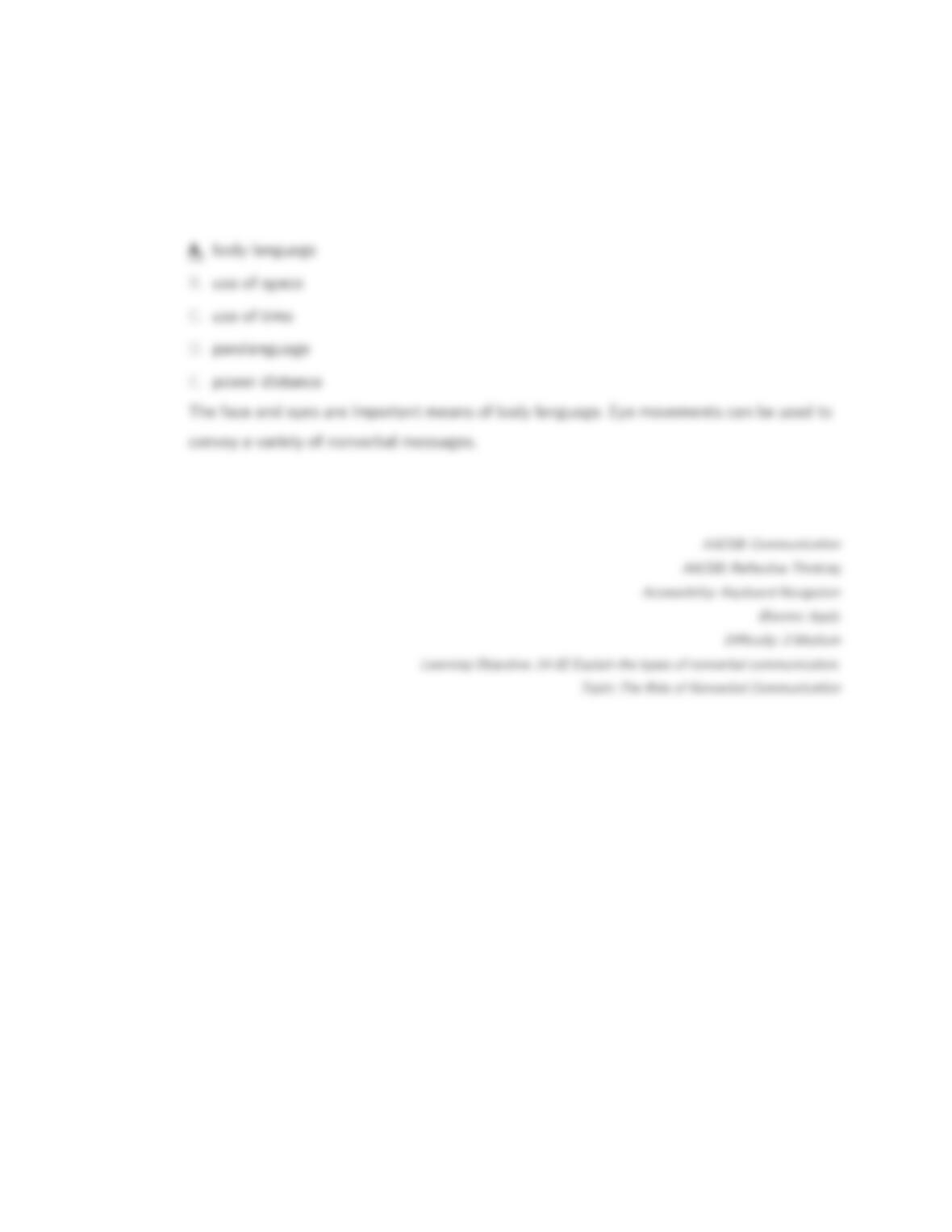
Which of the following statements about nonverbal communication is true?
14–13
22.
Sandra looks Jorge in the eyes to show him how sincere she is about her topic. What type
of nonverbal communication does this demonstrate?
14–14
23.
Dayson wears a suit, tie, and polished dress shoes to a meeting with clients to convey the
message that he respects them and takes their business relationship seriously. What type
of nonverbal communication is Dayson using?

14–15
24.
Teata is speaking with her co-worker Dan. She does not like or trust him, so she stands a
little farther away from him than she would with most of her co-workers. What type of
nonverbal communication is Teata using?

14–16
25.
Lukas, a manager, makes sure to show up ten minutes early for a meeting with Roberto,
an important client, to convey respect. What type of nonverbal communication does this
demonstrate?
14–17
26.
Agnetha, a CEO, is very angry with one of her managers for lying to a client about the
progress of a project. As she talks to the manager about this, she speaks forcefully and
emphasizes certain words and phrases to convey her feelings. What type of nonverbal
communication does this represent?
14–18
27.
Paralanguage refers to the
14–19
28.
In terms of the nature of listening, a person’s ability to sense words is dependent on
14–20
29.
In terms of the nature of listening, which of the following is true of the ability to sense
words?