6-1
Chapter 6: Building Positive Relationships through Communication
Part II: Chapter-by-Chapter Lecture Notes & Exercises
Chapter 6: Building Positive Relationships through
Communication
Teaching Suggestions
This chapter builds on what students learned in Chapter 5. They have been learning how to construct
effective messages with appropriate wording. Appropriate wording can refer to more than just being
correct, however. Being appropriate can also mean using language that is respectful of your audience’s
viewpoints and that seeks to be inclusive of all readers or listeners.
The exercises at the end of the chapter enable students to learn by doing.
Connect provides instructors with a variety of ways to customize courses, create assignments,
determine grading policies, and receive student work. One of the tools Connect offers is the ability to
select and add interactive assignments to your course. Explanations of these assignments and how they
support the learning objectives are integrated into the instructor’s manual with the relevant subject
areas.
Another useful tool in Connect is “Writing Assignment,” which students can use to submit their
Learning Objectives
LO 6-1 Use the you-viewpoint to build goodwill.
LO 6-2 Use a conversational style that has the appropriate level of formality and eliminates “rubber
stamps.”
LO 6-3 Describe ways to be courteous beyond using polite expressions.
LO 6-4 Employ positive language to achieve goodwill and other desired effects.
6-2
Chapter 6: Building Positive Relationships through Communication
LO 6-8 Use professional codes of conduct and established approaches to ethical reasoning to help
you make ethical decisions.
Key Terms
goodwill
you-viewpoint
you-attitude
conversational language
level of formality
rubber stamps
courtesy
positive words
emphasis
ethics
lie of commission
lie of omission
discriminatory words
credibility
integrity
restraint
code of conduct
Aristotelian ethics
Kantian ethics
utilitarian ethics
Text Summary, Lecture Outline
Showing Consideration
Slides 6-1, 6-2, 6-3, 6-4
Conveying information is not the only goal of good business communication. In today’s digital age,
when messages fly back and forth at lightning speed, it’s important to make sure that the “people”
content of your messages gets as much attention as the informational content. This chapter will help
Problem-Solving Challenge
Have students consider the message to Mr. Morley that was written by Jason, a new hire at a large
office-supply company. What in particular is wrong with the way Jason worded the message? How
could you help Jason rewrite the message? After the class has gone through the chapter, have them go
back and see how they would rewrite the message, and how they would explain the new version to
Jason.
6-3
Chapter 6: Building Positive Relationships through Communication
Slide 6-5
Slide 6-6
You-Viewpoint
Writing from the you-viewpoint is a powerful technique for building goodwill.
Slide 6-7
Using the you-viewpoint to create the right effect is demonstrated in these contrasting sentences.
Some claim that using the you-viewpoint is (1) insincere and (2) manipulative. The arguments have
merit, for it can be used to the point of being insincere. And it can be manipulative.
Slide 6-8
Ask students to read the message on the slide and then respond to these questions:
• How would you have felt if you’d gotten this message? Why?
• What wording is the most problematic in this message?
• How would you revise this message to consider the you-viewpoint?
Slide 6-9
Use Conversational Style
Another technique that helps build goodwill is to write in conversational language.
6-4
Chapter 6: Building Positive Relationships through Communication
In today’s ever-shifting business environment, where people often need to establish friendly relations
quickly, it is a better strategy to use language that is warm, natural, and personable.
But choosing the right level of formality for your audience is important. A more formal style is
appropriate in these situations:
Ask students to suggest revisions for the sentences and phrases on this slide. After gathering some
answers, challenge them to provide examples of what would be too informal or casual.
For a homework assignment or class exercise, consider asking the students to develop a WhoPrint of
their “writer’s persona.” A WhoPrint is an advertising term for the consumer that advertising copy
Slide 6-10
Cut Out Rubber Stamps
Also called clichés, rubber stamps are words we use without thought every time a certain situation
occurs. That is, we use them like “rubber stamps.”
Because they are used routinely, they communicate the effect of routine treatment.
Slide 6-11
Courteous Language
Being courteous includes more than just using polite words. By courtesy we mean respectful and
considerate treatment of others. What is considered appropriate will vary among situations, industries,
and countries (direct students to check out the Communication Matters feature on “Business
Etiquette—It Depends on Where You Are”).
6-5
Chapter 6: Building Positive Relationships through Communication
write an angry message, but then don’t send it. Sometimes getting the words out will help you realize
that a calmer approach will be more helpful.
Slide 6-12
Another way of being courteous in messages is to avoid wording that could insult your readers’
intelligence. Remember to always consider the message from their point of view. Ask yourself these
questions:
• Would they already know this?
• Would they want to hear this?
• How would I feel if I got this message?
For an in-class exercise, ask students to get a partner. Each pair will need one sheet of notebook or
blank paper (the size doesn’t really matter). One student will be the instruction giver. The other
student will be the instruction receiver. Before the exercise begins, take a quick poll of the room: How
many of you have a positive impression of your instruction giver? How many of you have a negative
impression?
You can write examples of directions on a board or tell online students: fold it in half, fold the lower
left corner over the upper right corner, turn the paper 90 degrees, fold it in half again, tear a circular
shape into the middle of the left side of the paper, fold it into thirds.
Use this exercise as an illustration of how the tone of communication and the types of words used can
make a significant difference in the impression the audience has. (Online students can perform the
exercise with a friend or neighbor at home and report on the results.)
Slide 6-13
Respectfulness—Go the Extra Mile
In the hurry of today’s business world, it’s tempting to communicate as quickly and abruptly as
possible. And while getting to the point is also a way of being respectful, being thoughtful about
6-6
Chapter 6: Building Positive Relationships through Communication
giving your audience the time, attention, and resources they need will go a long way toward creating
goodwill.
Accentuating the Positive
Slide 6-14
In most cases, positive or neutral wording will succeed better than negative wording.
Positive words tend to put readers in a good frame of mind; they build goodwill. Negative words—
such as damage, error, mistake, problem, loss, and failure—produce the opposite effect.
Connect Assignment 6-1 (a-e): Asking for Better Work from Your Boss
Summary: Students will answer multiple-choice questions to demonstrate their ability to apply the
following principles: using you-viewpoint, using conversational style, employing positive language to
achieve goodwill, using positive emphasis.
6-1a, 6-1b
Learning Objectives: 6-01, 6-04, 6-05
Difficulty: Medium
AACSB: Communication
Blooms: Evaluate
6-1c
Learning Objectives: 6-01, 6-02, 6-04
Difficulty: Medium
AACSB: Communication
Blooms: Evaluate
6-1d, 6-1e
Learning Objectives: 6-01, 6-02, 6-03, 6-04
Difficulty: Medium
AACSB: Communication
Blooms: Evaluate
6-7
Chapter 6: Building Positive Relationships through Communication
Follow-Up Activity: Students can create the email that will be sent to the boss to request more
information, using the principles that will be more likely to achieve positive results.
Slide 6-15
Make It Positive
Ask students to offer ideas for how to make these statements more positive by getting rid of negative
words and focusing on what can be done, instead of what cannot be done.
Slide 6-16
Positive Positioning
This slide provides an overview of three techniques for softening the blow of negative messages
through managing emphasis in the structure of messages.
Connect Assignment 6-2 (a-e): Striving for Positive Results
Summary: Students will view a video business conversation and then answer questions to demonstrate
their ability to apply the following principles: using you-viewpoint, using conversational style, and
employing positive language to achieve goodwill.
6-2a, 6-2b, 6-2c
Learning Objectives: 6-01, 6-02, 6-04
Difficulty: Easy
AACSB: Communication
Blooms: Analyze
6-2d
Learning Objectives: 6-02, 6-04
Difficulty: Medium
AACSB: Communication
Blooms: Evaluate
6-2e
Learning Objectives: 6-01, 6-02, 6-04
Difficulty: Medium
AACSB: Communication
Blooms: Evaluate
6-8
Chapter 6: Building Positive Relationships through Communication
Follow-Up Activity: Students can suggest alternative language for Juan and Rita to use in their
conversation with Carlos. Students should offer a suggestion for each of the statements addressed in
the questions.
Communicating Ethically
Slide 6-17
This slide provides an overview of some of the concepts that are presented in the discussion of ethical
communication practices.
6-3a, 6-3b
Learning Objective: 6-06
Difficulty: Medium
AACSB: Ethics
Blooms: Analyze
6-3c, 6-3e
Learning Objective: 6-06
Difficulty: Easy
AACSB: Communication
Blooms: Analyze
6-3d
Learning Objective: 6-06
Difficulty: Medium
AACSB: Communication
Blooms: Analyze
Follow-Up Activity: Students can role-play the conversation between Gina and Jason, suggesting a
better way for Gina to approach her conversation with Jason and a possibility for handling the
investment proposal in an ethical manner.
Slide 6-18
Don’t Discriminate
We should strive to use nondiscriminatory wording—wording that treats all people equally and with
respect.
6-9
Chapter 6: Building Positive Relationships through Communication
Copyright © 2018 McGraw-Hill Education. All rights reserved.
No reproduction or distribution without the prior written consent of McGraw-Hill Education.
This means avoiding words that either deliberately or unintentionally make assumptions about or
create impressions of groups of people based on race, gender, nationality, sexual orientation, age, or
disability.
Slide 6-19
Use Gender–Neutral Language
One of the more common types of discriminatory wording is sexist wording.
There are several strategies you can use to avoid using gender-specific language.
• Avoid use of masculine (or feminine) pronouns to refer to a group of people that includes both
genders.
• Avoid words derived from masculine words (for example: fireman, chairman, man-made).
• Avoid wording that calls undue attention to a person’s gender (for example: waitress,
stewardess, male nurse).
Direct students to check out the Communication Matters feature “Three Ways to Avoid Sexist
Pronouns.”
Slide 6-20
Qualities to Cultivate
Slide 6-21
Ethical Challenge—You Make the Call
For an interesting exercise, break the class into groups and let them role-play this situation. Some
groups can be the ones who speak up and others can be the ones who are talking unfairly and then
respond to the ones who are speaking out.
6-10
Chapter 6: Building Positive Relationships through Communication
Slide 6-22
These are good words to consider: “Write as though you were addressing intelligent people you
understand and respect.” Even when writing to someone with a low level of education or someone
who has made an angry complaint, you will almost always get the best result if you bring out the best
in them.
Power Charge Your Professionalism: Make Your Pronouns and
Antecedents Agree in Number
First identify the antecedent. Then select the pronoun that agrees with its antecedent. Identify which
pronoun-antecedent agreement guide from Reference Chapter A you used in making your choice.
(Correct answers are marked in bold.)
(singular antecedent)
(collective antecedent acting as individuals)
(plural antecedent)
(plural antecedent)
(singular antecedent)
(singular antecedent)
(plural antecedent)
(collective antecedent acting as one)
(singular antecedent)
(singular antecedent)
Critical-Thinking Questions
1. Discuss this comment: “Using the you-viewpoint is ethically shady since the real purpose
of business communication is to advance the writer or speaker’s goals. Your
communication should be honest about that.” (LO1)
6-11
Chapter 6: Building Positive Relationships through Communication
Copyright © 2018 McGraw-Hill Education. All rights reserved.
No reproduction or distribution without the prior written consent of McGraw-Hill Education.
If it is used insincerely, the you-viewpoint can be dishonest. But it can and should be used
sincerely. There is nothing dishonest about one person having a genuine interest in another
person, which is what the you-viewpoint is all about.
2. In what way, if any, could using the you-viewpoint when writing to someone you don’t
like (for example, someone who has complained unreasonably about something) be
justified? (LO1)
3. “A message can’t sound official unless it has an impersonal style and uses business
jargon.” Discuss. (LO2)
4. “If common business phrases apply to a situation, why not use them? Rubber stamps
save time, and in business time is money. Plus, people are used to these expressions.”
(LO2)
5. “Please submit your payment at your earliest convenience.” Is this a courteous sentence?
Why or why not? (LO3)
(LO3)
1. You work at the paint desk of a home-improvements store. A customer asks you what
kind of paint she should use to paint her bathroom.
6-12
Chapter 6: Building Positive Relationships through Communication
2. You have invited someone to give a talk at your company, and he has just sent you an
email in which he said yes. You email him back to say thank you.
3. You’ve just finished doing a team project, for which you were the leader, and you
were really impressed with the members’ work.
7. “I’m nervous about deliberately employing positive wording. I think people like writers
who shoot straight, and I worry that they’d think I was being deceptive.” Discuss. (LO4)
8. You work for a mail-order business, and you’re writing to tell the customer that the item
he wants is not only out of stock but also discontinued. How might you use the three
ways of de-emphasizing negative news in your message? (LO5)
9. Imagine that a customer has written to complain about the lack of attention that she
received when visiting a paint store. The manager’s responding letter explains why the
sales staff was so busy, offers to make a special appointment with the customer to discuss
her decorating needs, and then ends with the following paragraph:
We do apologize again for any inconvenience that this situation caused you. We thank you
for your understanding. Please do not hesitate to contact us again if we ever fall short of
the superior service that you have come to expect from us.
If the manager asked for your feedback on this letter, what would you say? It’s full of
polite expressions. Is it a good concluding paragraph? (LO1-LO5)
10. Consider each of the following communication-related behaviors and decide whether or
not you think it is ethically defensible. Could any of the established approaches to ethical
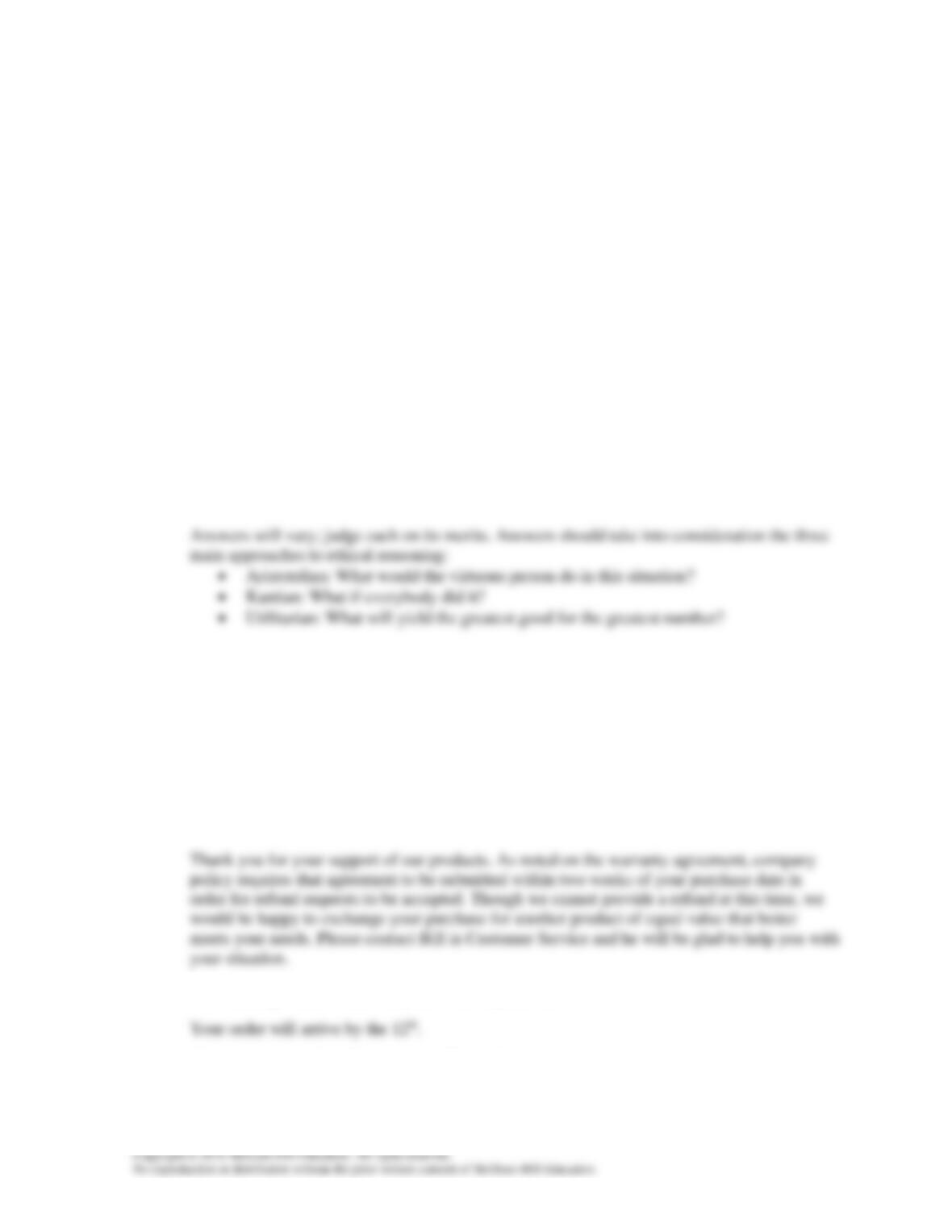
6-13
Chapter 6: Building Positive Relationships through Communication
reasoning help you make your decision? Would the circumstances influence your
answer? (LO6–LO8)
1. Referring to a female staff person by her first name (e.g., “See Joan at the front desk”)
but to the higher-ranking employees by their first and last names (e.g., “Jim Smith in
Tech Support can answer your question”).
2. Sending a male member of the sales team (or an Anglo-American) to give an
important presentation because you know the client is gender (or racially) biased.
3. Using your company email account to plan a family reunion.
4. Using your company’s instant messaging platform to comment on a coworker.
5. Boning up on hockey (even though you have no interest in it) before meeting with a
potential client (or having a job interview with a potential boss) who loves the sport.
6. Waiting to see how everyone else weighs in on a dicey issue (e.g., whether someone
should be fired) before giving your opinion.
7. Telling your boss that your coworker held up her end on a team project when she
really didn’t.
8. Complaining about the boss to your coworkers rather than discussing the issues
directly with him or her.
9. Criticizing your current or past workplace on Facebook, Twitter, or an Internet site.
10. Letting others do more than their share on a group project (but still getting full
credit) because you had unavoidable family issues to deal with.
Skills-Building Exercises
Using the You-Viewpoint (LO1)
Rewrite the following using the you-viewpoint. You may need to add additional material.
(Answers will vary, but should demonstrate understanding of and effective use of the you-viewpoint.)
1. As required by company policy, I am denying your refund request because you needed
to have submitted the warranty agreement within two weeks of your purchase.
2. We will be pleased to deliver your order by the 12th.
3. We have worked for 37 years to build the best lawn mowers on the market.
6-14
Chapter 6: Building Positive Relationships through Communication
Copyright © 2018 McGraw-Hill Education. All rights reserved.
No reproduction or distribution without the prior written consent of McGraw-Hill Education.
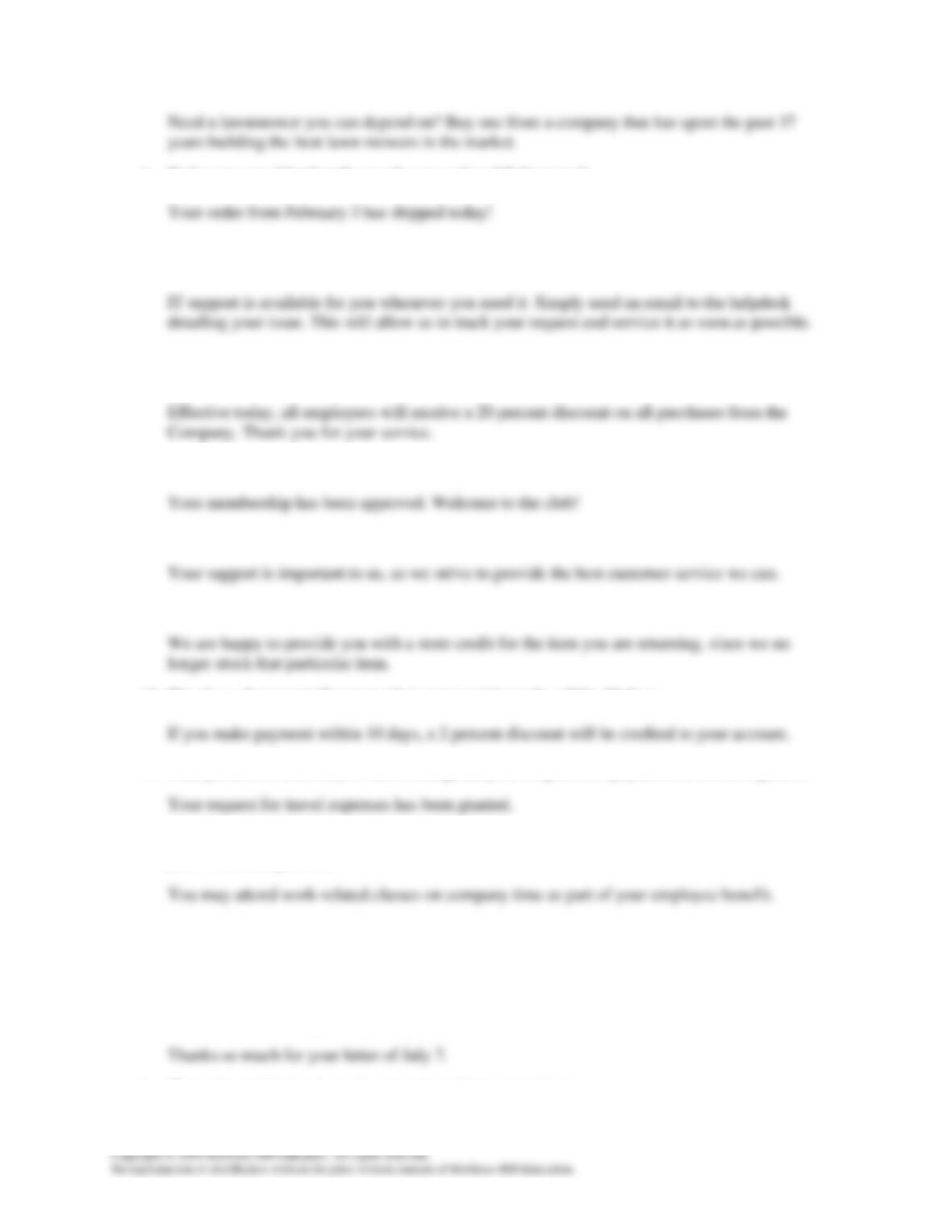
Need a lawnmower you can depend on? Buy one from a company that has spent the past 37
years building the best lawn mowers in the market.
4. Today we are shipping the goods you ordered February 3.
5. Instead of stopping us in the hallway to ask for IT support, send us an email, or else we
will have trouble keeping track of your service request.
6. (From an email to employees) We take pleasure in announcing that, effective today, the
Company will give a 20 percent discount on all purchases made by employees.
7. We are happy to report approval of your application for membership in our club.
8. We do our best to provide the best customer service possible.
9. Since we no longer stock this item, we must give you store credit instead of a refund.
10. We give a 2 percent discount when payment is made within 10 days.
11. I am pleased to inform you that I can grant your request for payment of travel expenses.
12. We cannot permit you to attend classes on company time unless the course is related to
your work assignment.
Using a Conversational Style (LO2)
Rewrite the following in a conversational style. (Answers will vary, but should demonstrate
effective use of conversational style wording.)
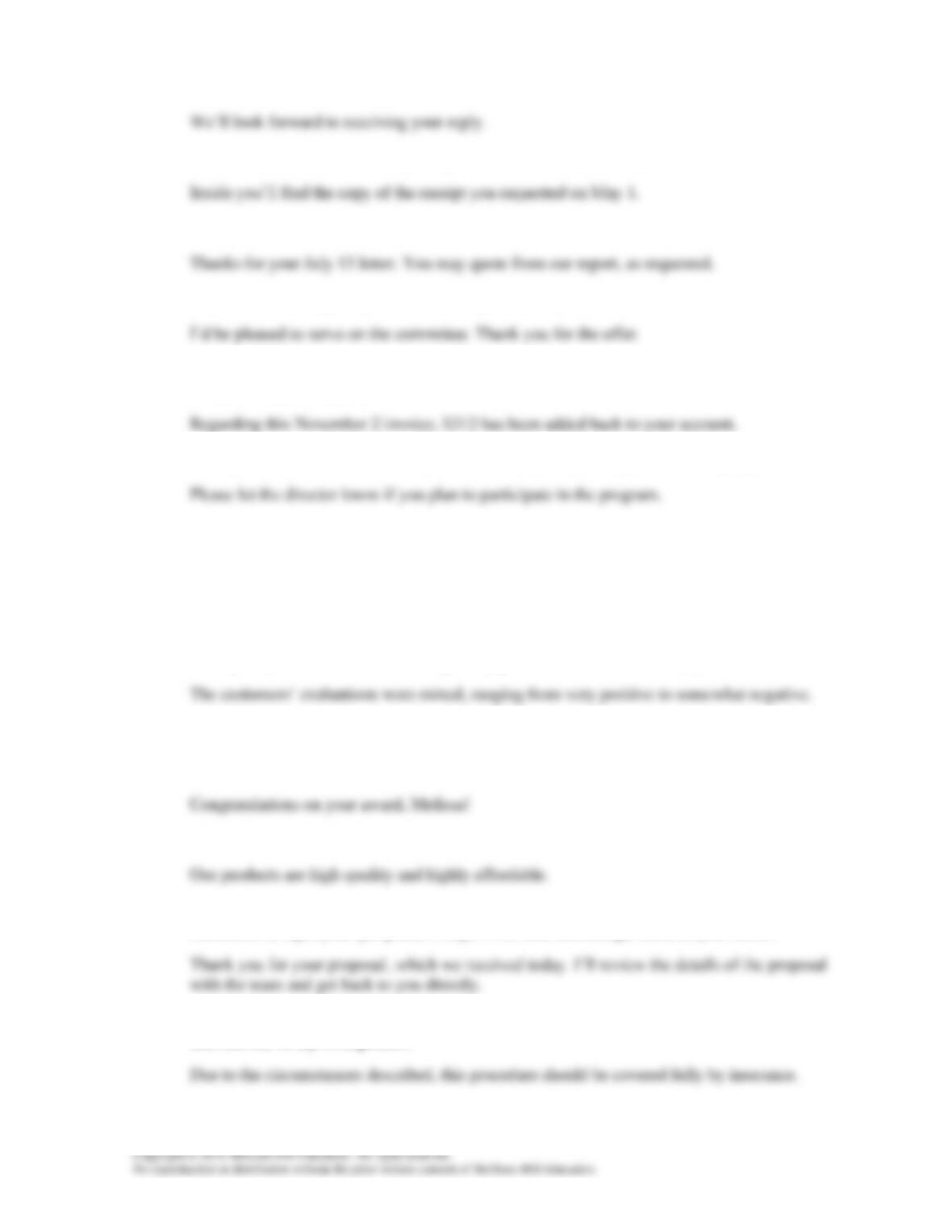
1. I hereby acknowledge receipt of your July 7 letter.
2. Please be so kind as to reply at your earliest convenience.
6-15
Chapter 6: Building Positive Relationships through Communication
Copyright © 2018 McGraw-Hill Education. All rights reserved.
No reproduction or distribution without the prior written consent of McGraw-Hill Education.
We’ll look forward to receiving your reply.
3. Attached please find the receipt requested in your May 1st inquiry.
4. In reply to your letter of July 13, permission to quote from our report is hereby granted.
5. I would deem it a great pleasure to accept your kind offer to serve on the committee.
6. Please be advised that, with regard to above invoice, a payment of $312 has been
credited to your account.
7. Kindly advise the director as to your availability for participation in the program.
Using the Right Level of Formality (LO2)
Reword the following sentences to achieve a more appropriate level of formality. (You may need
to recast the whole sentence.) (Answers will vary, but should reflect an understanding of the proper
tone.)
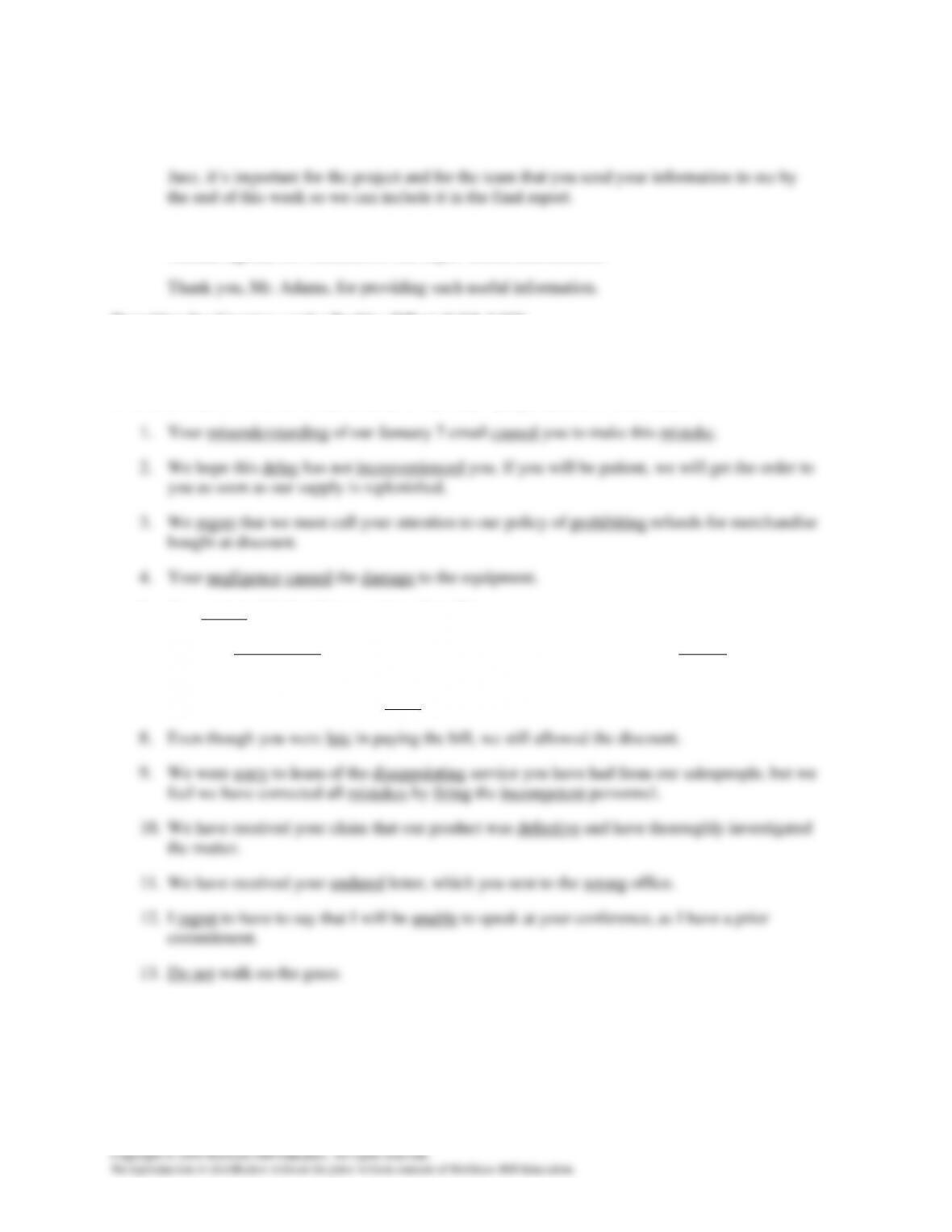
1. (In a report that several managers will read:) The customers’ evaluations of our service
were pretty mixed, with some being really positive and others not so positive.
2. (In an email message to your division head—whom you do not know well—to
congratulate her on receiving a prestigious award from a professional society:) Way to
go, Melissa! You do us all proud!
3. (In a sales message:) Our products are awesome, and they don’t cost a lot of money.
4. (In a response to a proposal from a vendor who wants to be your company’s HR
contractor:) I got your proposal. I’ll give it a look-see and get back to you ASAP.
5. (In a complaint letter to your health-insurance provider:) No way should I have to pay
this bill out of my own pocket!
6-16
Chapter 6: Building Positive Relationships through Communication
6. (In an email to an employee about missing a deadline:) I need your information, Jane!
Our project is gonna be a fail if we can’t pull it together by the end of the month.
7. (In a thank-you message to a CEO for letting you interview him for a class project:)
Thanks again, Mr. Adams, for the super-useful information.
Rewriting for Courtesy and a Positive Effect (LO3–LO5)
Underscore all negative words in these sentences. Then rewrite the sentences for a more positive
effect. Use your imagination to supply situation information when necessary. (Negative words
have been underscored. Rewritten sentences will vary—judge answers on their merits.)
5. You cannot visit the plant except on Saturdays.
6. We were disappointed to learn from your July 7 email that you are having trouble with our
Model 7 motor.
7. Our Stone-Skin material is less weak than the fabric used by other brands.
Avoiding Unethical Communication Practices (LO6–LO8)
Prepare a short report for your instructor on a company or other type of organization that was
recently involved in an ethical scandal. What behavior caused the scandal? What pressures, if
any, were on the organization to behave this way? How easy/desirable would it have been for
6-17
Chapter 6: Building Positive Relationships through Communication
them to have avoided this behavior? Was this a cut-and-dried case of bad ethics, or do you think
it was more complex than that? Be sure to cite your sources in the report.
Judge answers based on merit.
Avoiding Discriminatory Language (LO6)
Change these sentences to avoid discriminatory language. (Suggested changes are marked below.)
2. A successful writer adapts his communication style to different audiences.
5. If Ms. Adams is not in, Joe at the front desk can help you.
6. Any worker in violation of this rule will have a letter of reprimand put in his personnel
file.
Workers in violation of this rule will have letters of reprimand placed in their personnel files.
Using Resources for Ethical Reasoning (LO8)
Find the code of conduct for professionals who work in the area you hope to work in or the code
of conduct for a company you’d like to work for. Read it carefully, and then write a short report
for your instructor in which you summarize and comment on its contents. Did anything about it
particularly impress or surprise you? Was anything left out that you thought should be
included? Do you think it would actually help people in the field or the company behave in the
right way? Attach a copy of the code of conduct to your report.
Judge each report on its merits.