9-1
Chapter 9: Writing Bad-News Messages
Part II: Chapter-by-Chapter Lecture Notes & Exercises
Chapter 9: Writing Bad-News Messages
Teaching Suggestions
The teaching techniques for this chapter are the same as for the preceding chapter.
Connect provides instructors with a variety of ways to customize courses, create assignments,
determine grading policies, and receive student work. One of the tools Connect offers is the ability to
select and add interactive assignments to your course. Explanations of these assignments and how they
support the learning objectives are integrated into the instructor’s manual with the relevant subject
areas.
Another useful tool in Connect is “Writing Assignment,” which students can use to submit their
Learning Objectives
LO 9-1 Determine which situations require using the indirect approach.
LO 9-2 Write messages following the general plan for an indirect approach.
LO 9-3 Use tact and courtesy when refusing a request.
LO 9-4 Write adjustment refusals that minimize the bad news and overcome negative impressions.
LO 9-5 Write negative announcements that maintain goodwill.
Key Terms
adjustment refusals
buffer
indirect approach
negative announcements
refused request
9-2
Chapter 9: Writing Bad-News Messages
Text Summary, Lecture Outline
Approaches to Writing Bad-News Messages
Slides 9-1, 9-2, 9-3
When introducing this chapter, you can ask your students to give examples of times when they
received some bad news. How was that message delivered? Did the method or tone of delivery make
the situation worse or better? How?
The goal of this chapter will be to prepare students to, as Joan McCarthy put it, “communicate bad
news in a way that preserves your company’s credibility and keeps employee trust and morale intact.”
Slides 9-4, 9-5
Here is an explanation of why indirect order is usually right for bad-news messages. See if students
can come up with these on their own before revealing them.
Then develop the strategy—continue what the beginning set up. Make your case in such a way that the
reader will see your point and consider it reasonable—perhaps even in his or her best interest.
Then present the negative. It should be the logical outcome of the preceding strategy, and it should be
worded as positively as the situation permits.
End on a positive note, shifting the focus to happier things—just as you would do at the end of a face-
to-face meeting.
Exceptions to indirect order for bad news are listed on slide 9-5. Here, too, you might see if the
students can generate these on their own before revealing this slide.
Let your students brainstorm bad-news messages that might best be delivered through a direct
approach.
9-3
Chapter 9: Writing Bad-News Messages
The General Indirect Plan
Slide 9-6
This slide presents the general plan for bad-news messages. Note that this plan will be adapted to
specific situations in following slides.
Set up the news. Continue what the beginning set up. Present your reasons for saying “no” before you
deliver the news. Make your case in such a way that the reader will see your point and consider it
reasonable—perhaps even in his or her best interest.
Offer an alternative. When you say “no” or announce negative news, you’ve left your reader with a
problem. Help him/her solve it to the best of your ability.
Slide 9-7
Buffers
This slide outlines important elements of the strategic buffer in bad-news messages. Ask students to
think of opening lines that have helped them or could help them to receive bad news.
Slide 9-8
Apologizing
When delivering bad news, the first thought is often to apologize. This slide outlines when apologies
are useful and when they may not be.
9-4
Chapter 9: Writing Bad-News Messages
Refused Requests
Slide 9-9
This slide summarizes the thought process for writing a refused request.
This is a very common business situation. Such messages are almost always negative, although they
vary in degree of negativity. The goals of the message are to 1) refuse clearly and 2) maintain
goodwill.
Perhaps you must refuse because of company policy. In this case, it is advisable to justify the policy
rather than to just say it is company policy to refuse. Probably you will refuse because the facts of the
Students can compare two versions of a refused request in the following slides.
Connect Assignment 9-1 (a-e): Denying a Request for a Reduced Rate
Summary: The goal of this activity is to apply the indirect pattern to refuse a request while retaining
the customer’s goodwill and business. Students will review the case and then answer the questions that
follow.
9-1a
Learning Objective: 9-03
Difficulty: Medium
AACSB: Analytical Thinking
Blooms: Analyze
9-1b
Learning Objective: 9-03
Difficulty: Medium
AACSB: Analytical Thinking
Blooms: Evaluate
9-1c
Learning Objective: 9-03
Difficulty: Hard
AACSB: Analytical Thinking
Blooms: Evaluate
9-1d
Learning Objective: 9-03
Difficulty: Medium
AACSB: Analytical Thinking
Blooms: Evaluate
9-5
Chapter 9: Writing Bad-News Messages
9-1e
Learning Objective: 9-03
Difficulty: Medium
AACSB: Analytical Thinking
Blooms: Analyze
Follow-Up Activity: Students can write a reply from Milo, delivering the bad news that he has opted
to go with a different supplier for his office supplies.
Slide 9-10
You Make the Call
Slides 9-11, 9-12
Ask students to critique this message. What language should be avoided? What kind of approach is
being used here? Does it work or not? Why?
The problem: In this case, the writer must refuse a request made by Ms. Cangelosi for a donation.
• Harsh and blunt treatment has a negative impact on the reader. The reader may be less
likely to accept the explanation that follows.
• The explanation is clear, but there is an unnecessary use of negative words (exhausted,
regret, cannot consider).
Have the students assess this message in light of the guidelines for refusals.
• How does a compliment help buffer the news?
• How does the writer “sell” the reader on White Label, saying something positive about the
Slide 9-13
Who Did It Well?
For an in-class or at-home assignment, challenge students to look for stories in the news that display
Adjustment Refusals
Slide 9-14, 9-15
Slides 9-14 and 9-15 summarize the considerations and procedure for writing an adjustment refusal.
9-6
Chapter 9: Writing Bad-News Messages
In this case, it’s likely the reader believes he or she is right and that you are wrong, although some
readers know their claims are weak. Your goal is to present the bad news in a way that will allow for
continuing a positive relationship with the reader.
A good beginning step in working on the letter is to decide how to explain your decision. Your
So you review the facts, and you determine the explanation that will be most likely to convince the
reader that right is on your side.
Note that slides 9-16, 9-17, and 9-18 present bad and good examples of adjustment refusals.
Beginning. Acknowledge the request to which you are responding. You can do this by a date
reference early in the message or just by referring to the situation. After that, there are two useful
Making your case and refusing. Call the reader’s attention to the facts or policies that pertain to the
End with goodwill. Close with an appropriate, positive comment that shows you care about the
reader’s business and the quality of your products or service. Avoid recalling the problem.
Connect Assignment 9-3 (a-g): When the Customer Isn’t Always Right
Summary: This exercise will help students practice their ability to deny a customer’s request while
communicating respectfully and in a way to promote goodwill.
9-3a
Learning Objective: 9-04
Difficulty: Medium
AACSB: Analytical Thinking
Blooms: Understand
9-3b
Learning Objective: 9-04
Difficulty: Medium
AACSB: Analytical Thinking
Blooms: Evaluate
9-3c
Learning Objective: 9-04
Difficulty: Hard
AACSB: Analytical Thinking
Blooms: Apply
9-3d, e
9-7
Chapter 9: Writing Bad-News Messages
Learning Objective: 9-04
Difficulty: Hard
AACSB: Analytical Thinking
Blooms: Analyze
9-3f
Learning Objective: 9-04
Difficulty: Medium
AACSB: Analytical Thinking
Blooms: Analyze
9-3g
Learning Objective: 9-04
Difficulty: Medium
AACSB: Analytical Thinking
Blooms: Analyze
Slides 9-16, 9-17, 9-18
The problem: In this case, the writer is refusing to reimburse a customer for fabric that faded.
• How effective is the opening?
• How effective is the body of the message? How sound is the reasoning behind the refusal?
• Tone?
Get the students to describe the good strategies that the writer uses at each point of the message in
slide 9-17. Are any strategies the students discussed in the previous brainstorm included in this
improved version?
Students can also look at the Case Illustration for another example of a skillful refusal.
Negative Announcements
Slide 9-19
Sometimes a company may need to announce bad news internally and externally. Much of the time it
is handled indirectly, especially when you expect your readers to be surprised, disappointed, or even
angered by a direct presentation.
9-8
Chapter 9: Writing Bad-News Messages
Beginning. Begin the explanation that justifies the announcement. You could start simply with a
complimentary or cordial statement focusing on the relationship you have with the reader or present
justifying information.
Next steps. Many times change comes with negative announcements. Call attention to any new
benefits that may result from these changes, positive expectations, or the good aspects that have not
changed. When possible, help resolve any problems the bad news creates.
End with goodwill. Close with positive, forward-looking words that emphasize your concern for the
readers.
Slide 9-20
You Make the Call
Let students consider reasons that could call for an in-person delivery. For example, letting a specific
group of employees know their jobs are being cut. Or maybe, due to federal regulations, you would
The following slides show bad and good examples of negative news announcements for your students
to examine.
Slides 9-21, 9-22, 9-23
The following slides show good and bad examples of negative news announcements.
Get the students to describe the good strategies that the writer uses at each point of the “good”
message on slide 9-22
Get the students to describe the good strategies that the writer uses in the last paragraph on slide 9-23.
Slide 9-24
Slide 9-25
Negative announcements follow the general construction of other bad-news messages. Due to the
nature of the content that such announcements commonly carry, the main goals of the negative
9-9
Chapter 9: Writing Bad-News Messages
In these instances, the writer begins by thinking, “What can be said that will cushion the shock of the
bad news?”
The beginning should set up the justification of the announcement and ease the reader into the
discovery of the bad news. This can be done with a cordial statement that focuses on the relationship
of the writer to the reader(s) or a set-up of the justifying information to follow.
The negative news should be presented as positively as the situation justifies. But it must be crystal
clear. As in the other negative messages, the words must be carefully chosen.
End on a note that affirms the good relationship between you and your readers and perhaps looks
ahead to something positive.
Ask the students to put themselves in the place of Ms. Cato and describe how they feel after reading
this message. Were there any negative points? Was the message too negative? Was it clear? Could it
have been presented in a negative way? How?
Ask them to describe the setup of the message and the strategy behind it.
Connect Assignment 9-2 (a–e): A Policy Change at Affinity Software Solutions
Summary: Students will use their understanding of crafting negative announcements to analyze and
offer suggestions to improve the human resources director’s message.
9-2a
Learning Objective: 9-05
Difficulty: Medium
AACSB: Analytical Thinking
Blooms: Analyze
9-2b
Learning Objective: 9-05
Difficulty: Hard
AACSB: Analytical Thinking
Blooms: Analyze
9-2c
Learning Objective: 9-05
Difficulty: Medium
AACSB: Analytical Thinking
Blooms: Apply
9-2d, e
9-10
Chapter 9: Writing Bad-News Messages
Learning Objective: 9-05
Difficulty: Medium
AACSB: Analytical Thinking
Blooms: Analyze
Slide 9-26
This slide can serve as an end to your lecture.
The point of this quote, of course, is that one should never write business messages in anger. When
tackling a negative situation, writers need to let their initial feelings settle.
9-11
Chapter 9: Writing Bad-News Messages
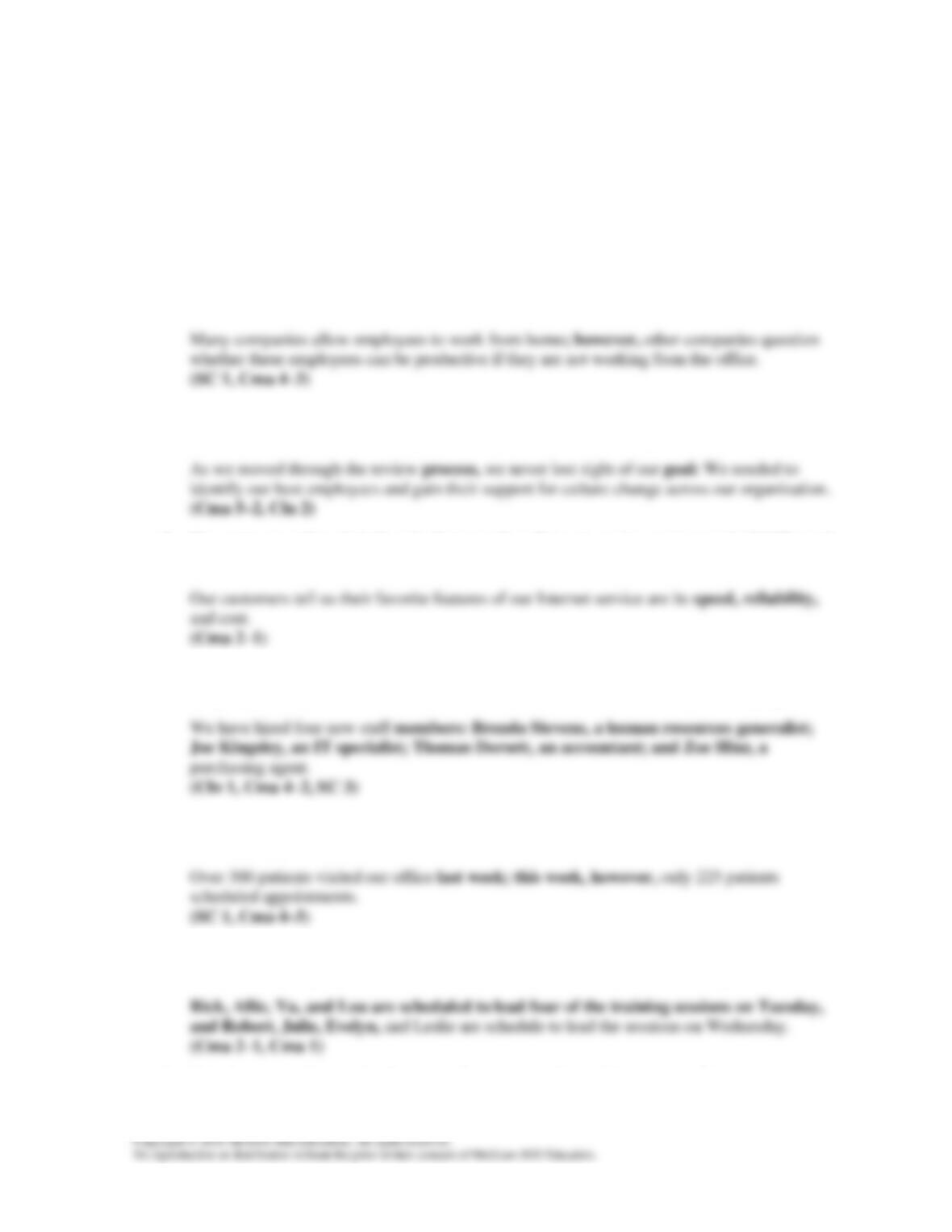
Power Charge Your Professionalism: Colons and Semicolons
Insert colons, semicolons, and commas as needed in the following sentences. Indicate which
punctuation guide you used from Reference Chapter A to determine the punctuation for each sentence.
If the sentence is correct, leave it as is. (Corrected portions are marked in bold and references are
included in parentheses.)
1. Many companies allow employees to work from home however other companies question
whether these employees can be productive if they are not working from the office.
2. As we moved through the review process we never lost sight of our goal We needed to
identify our best employees and gain their support for culture change across our organization.
3. Our customers tell us their favorite features of our Internet service are its speed reliability and
cost.
4. We have hired four new staff members Brenda Stevens a human resources generalist Joe
Kingsley an IT specialist Thomas Dorsett an accountant and Zoe Hinz a purchasing agent.
5. Over 300 patients visited our office last week this this week however only 225 patients
scheduled appointments.
6. Rick Allie Yu and Lou are scheduled to lead four of the training sessions on Tuesday and
Robert Julie Evelyn and Leslie are schedule to lead the sessions on Wednesday.
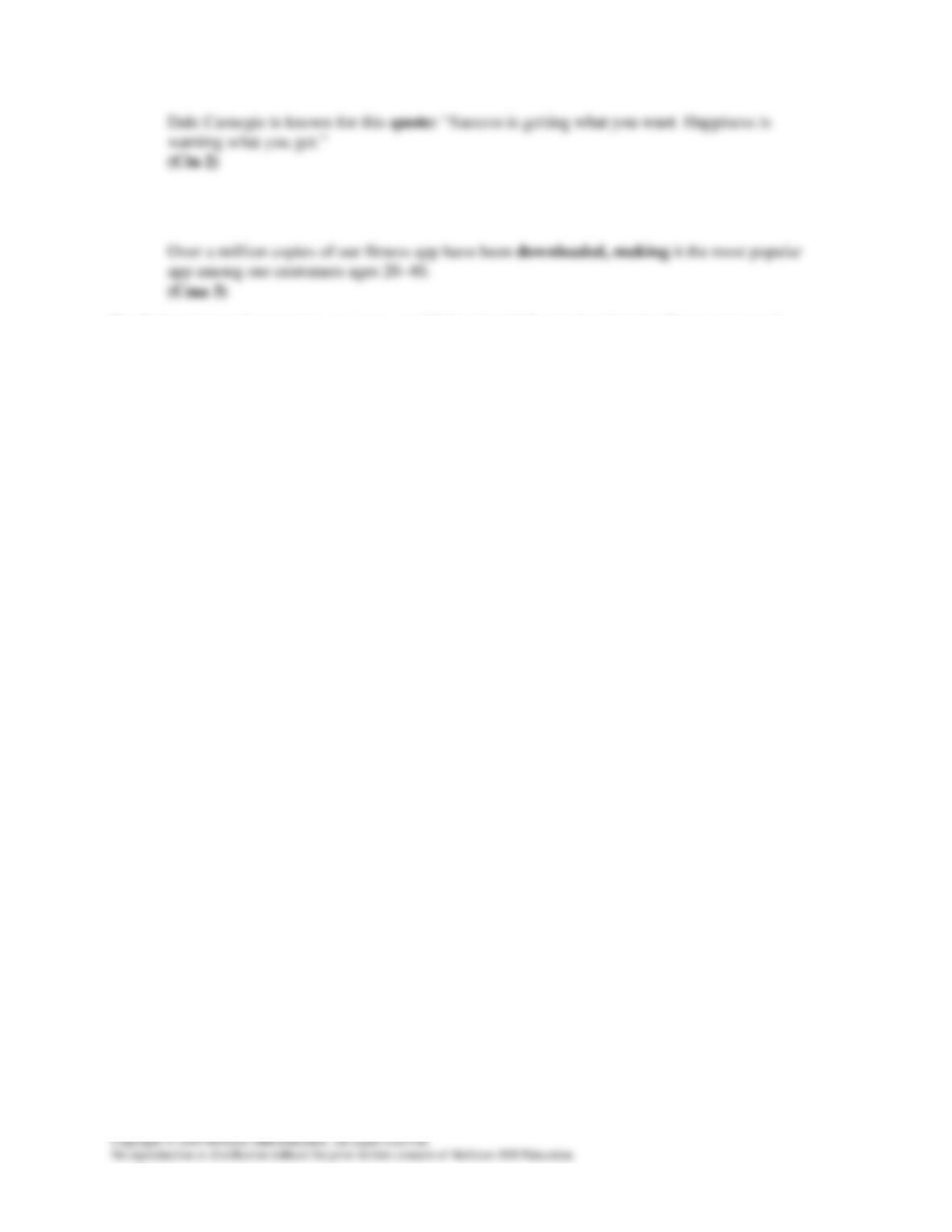
7. Dale Carnegie is known for this quote “Success is getting what you want. Happiness is
wanting what you get.”
9-12
Chapter 9: Writing Bad-News Messages
8. Over a million copies of our fitness app have been downloaded making it the most popular
app among our customers ages 20–40.
For further instruction on using commas, see “Colons” and “Semicolons” in the “Punctuation and
Mechanics” module of LearnSmart Achieve.
9-13
Chapter 9: Writing Bad-News Messages
Critical-Thinking Questions
1. Give examples of times (or situations) when indirectness or directness would be
appropriate for responses giving negative information. (LO1)
2. Writing in the indirect order usually requires a buffer, making indirect messages longer
than direct messages. Since conciseness is a virtue in business writing, how can the
indirect order be justified? (LO2)
3. What strategy is best in a message refusing a request when the reasons for the refusal
are in the writer’s best interests and not in the reader’s? (LO3)
4. “Apologies in refusals are negative because they call attention to what you are refusing.
You should avoid using them.” Discuss. (LO3)
5. Some business writers explain an adjustment refusal simply by saying that company
policy did not permit granting claims in such cases. Is citing company policy adequate?
Discuss. (LO4)
6. Negative announcements usually need to include much more than the announcement.
Explain. (LO5)
The announcement needs to be explained and justified. Also, the announcement may raise
9-14
Chapter 9: Writing Bad-News Messages
7. Give examples of negative announcements that would be appropriately written in the
direct order. (LO5)
9-15
Chapter 9: Writing Bad-News Messages
Skills-Building Exercises
1. Point out the shortcomings in the following email message from a sports celebrity
declining an invitation to speak at the kickoff meeting for workers in a fundraising
campaign for a charity. (LO3)
Subject: Your Request for Free Lecture
Ms. Chung:
2. Criticize the following message refusing the claim for a defective riding lawn mower. The
mower was purchased 15 months earlier. The purchaser has had difficulties with it for
some time and submitted with the claim a statement from a local repair service verifying
the difficulties. The writer’s reason for refusing is stated in the email. (LO4)
Subject: Your May 12 Claim
Mr. Skinner:
3. You work for an online mail-order company, Nonsensicals, which sells such novelty
items as T-shirts with clever sayings, unique toys and games, and such household
9-16
Chapter 9: Writing Bad-News Messages
accessories as framed posters and retro table lamps. Most of the employees are young,
somewhat quirky, and very Internet savvy. Now consider the following email sent to
everyone from the company president. (LO5)
Subject: No More Social Networking during Work Hours
Considering the advice in this chapter, what would be the main ways to improve this
negative announcement?
4. You own a small new- and used-book store and café with free wireless Internet access.
You enjoy the calm, quiet atmosphere of your store and like that your customers choose
your store to conduct business, socialize with friends, or just enjoy a good book and a
cup of coffee. Increasingly, many customers are talking on their cell phones—very loudly
and in places where they shouldn’t be. They hold up the order line by talking on the
phone when they should be talking to the cashier. They disrupt others who are enjoying
the quiet atmosphere to work or read. Sure, customers who are working on the
computer may need to talk on the phone, but must these customers be so loud and
disruptive that those across the room who are trying to read can hear their
conversations? Many customers have actually complained. You want to make these
customers happy but not at the expense of making your cell phone users unhappy. Write
a cell phone use policy to post in your store. (LO5)
9-17
Chapter 9: Writing Bad-News Messages
Sample Solutions to Problem-Solving Cases
Refused Requests, Case #2
The purpose of the message is to turn down an employee’s request for an organization’s inclusion in a
company volunteering program. Due to the organization’s politically charged stances, you need to take
care in the wording of your message to explain the reason for your refusal while supporting the
employee’s participation in the volunteer program.
As the message moves into explanation and presentation of the refusal, students could discuss the need
for the HR director to not just rely on the excuse of “it’s against company policy,” but to explain the
reasoning behind the policy requirements. The refusal needs to be written in such a way that the reader
clearly understands the reasoning before the refusal is even explicitly stated. Wording such as “As you
are probably aware” could be used to introduce the discussion of the company policy. The writer could
Related discussion or assignments: Have students bring in or recall various denials that they have
received for jobs, schools, credit cards, etc. and discuss what they liked or did not like about them.
Have students recall and discuss times when they have felt insulted or upset in a business dealing.
Share some of your own experiences with them.
Adjustment Refusals, Case #12
Like most messages that refuse to make a requested adjustment, this one needs both to say “no” and to
somehow re-sell the reader on the value of the company’s products or services. More specifically, the
purpose of the message is to courteously but clearly refuse Ms. Hornung’s request for a refund while
also maintaining her goodwill.
The first paragraph should begin with a buffer that gets the conversation started. This may include an
acknowledgement of the request, appreciation for Ms. Hornung’s business, or a statement about the
company’s willingness to be of assistance. It should not, however, mislead the reader into thinking the
9-18
Chapter 9: Writing Bad-News Messages
request will be granted and should not reveal yet that the adjustment request is being denied. It may
open with something like “As always, we are willing to do as much as we reasonably can to make
give a good reason for the policy. Perhaps it can start with “This policy has become standard in our
industry because . . .,” or perhaps it can be linked to keeping the prices of your fine products as low as
possible for your customers. Be careful not to imply any bad motives on the part of the customer for
returning the item.
done, it may convey the message that the company’s products are of high quality, thus restoring Ms.
Hornung’s confidence in this fact. Or it might thank Ms. Hornung for her business. Or students may
think of, and evaluate, other closing strategies.
Negative Announcements, Case #25
Students may be familiar with the situation outlined in this case—when coworkers are not all keeping
up with their responsibilities to each other and may be taking advantage of company policies. Before
addressing the case, talk with students about experiences they may have had similar to this one at
returning equipment to the appropriate places. Though this can be seen as a trivial problem, the state
of the common meeting areas could have a detrimental effect on outsiders’ perceptions of the
company and also is wasting employees’ time by making people go search for chairs and other
equipment needed to conduct meetings.
example, say, “The management team has been made aware that the equipment for the conference
rooms is sometimes being borrowed for use in other areas, but then is not returned immediately after
9-19
Chapter 9: Writing Bad-News Messages
use,” instead of saying “The conference rooms are a mess and people are constantly taking equipment
and not bringing it back.”
Example
In order to maintain the usefulness of our meeting rooms and support our coworkers, here are simple
ways we can all do our part:
1. If you need to borrow equipment for a meeting, first check the room reservation calendar in
Outlook to see if anyone is using the room where the equipment resides.
3. Any time you remove equipment from a room, please use the signout sheet available in each
conference room.
4. When you are finished with the equipment, please return it immediately to the room from
which it was taken and sign it back in on the sheet.
Close the message by looking forward to more productive meetings and less delays and encourage