Archives: Solution Manual
978-1305501393 Chapter 2 Solution Manual
DISCUSSION QUESTIONS 1. Which do you think is more important to team performance, surface-level or deep-level diversity? Why? Surface-level diversity refers to observable differences in people, including race, age, ethnicity, 2. How can diversity create a competitive advantage for a […]
978-1305501393 Chapter 2 Lecture Note Part 2
IV. TECHNOLOGY AND BUSINESS Technology refers to the methods used to create products, including both physical goods and intangible services. Three specific areas of technology worth noting here are: (1) the shift toward a service-based economy, (2) the growing use […]

978-1305501393 Chapter 2 Lecture Note Part 1
PART ONE – INTRODUCTION TO ORGANIZATIONAL BEHAVIOR Chapter Two – The Changing Environment of Organizations Overview The environment of all organizations is changing at an unprecedented rate. People work in different ways and places than in the past, the workplace […]
978-1305501393 Chapter 16 Solution Manual
DISCUSSION QUESTIONS 1. Is most organization change forced on the organization by external factors or fostered from within? Explain. Organization change is caused by both external and internal factors. However, most organization 2. What broad category of pressures for organization […]
978-1305501393 Chapter 16 Lecture Note Part 2
III. ORGANIZATION DEVELOPMENT On one level, organization development is simply the way organizations change and evolve. Thus, in the broadest sense, organization development means organization change. The term as used here, however, means something more specific. Our definition of organization […]
978-1305501393 Chapter 16 Lecture Note Part 1
PART FIVE – ORGANIZATIONAL PROCESSES AND CHARACTERISTICS Chapter Sixteen – Organization Change and Change Management Chapter Overview Companies that change appropriately can continue as viable businesses. Those that do not make the right changes, like Kodak, lose their ability to […]
978-1305501393 Chapter 15 Solution Manual
DISCUSSION QUESTIONS 1. Describe three different types of organizational cultures. When would each be most and least effective for a research and development company dependent on employee innovation? Dominating conflict cultures have open confrontations are accepted as well as heated […]
978-1305501393 Chapter 15 Lecture Note
PART FIVE – ORGANIZATIONAL PROCESSES AND CHARACTERISTICS Chapter Fifteen – Organizational Culture Chapter Overview Organizational culture is essential to organizational performance. Not only does it influence the decisions and behaviors of employees, but it also explains what is happening in […]
978-1305501393 Chapter 14 Solution Manual
DISCUSSION QUESTIONS 1. How do you think your career path might differ in a hierarchical versus a flat organization? In a hierarchical organization with formal authority, chain of command, and rules, an employee’s 2. Why do you think companies are […]
978-1305501393 Chapter 14 Lecture Note Part 2
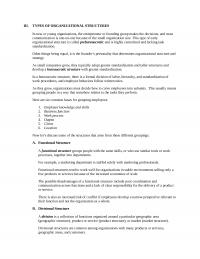
III. TYPES OF ORGANIZATIONAL STRUCTURES In new or young organizations, the entrepreneur or founding group makes the decisions, and most communication is one-on-one because of the small organization size. This type of early organizational structure is called prebureaucratic and is […]
978-1305501393 Chapter 14 Lecture Note Part 1
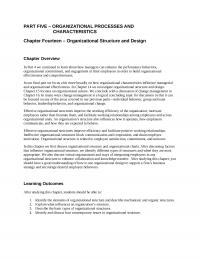
PART FIVE – ORGANIZATIONAL PROCESSES AND CHARACTERISTICS Chapter Fourteen – Organizational Structure and Design Chapter Overview In Part 4 we continued to learn about how managers can enhance the performance behaviors, organizational commitment, and engagement of their employees in order […]
978-1305501393 Chapter 13 Solution Manual
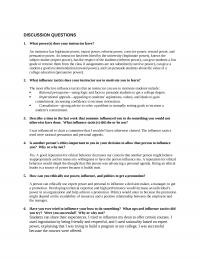
DISCUSSION QUESTIONS 1. What power(s) does your instructor have? An instructor has legitimate power, expert power, referent power, coercive power, reward power, and persuasive power. An instructor has been hired by the university (legitimate power), knows the 2. What influence […]
978-1305501393 Chapter 13 Lecture Note
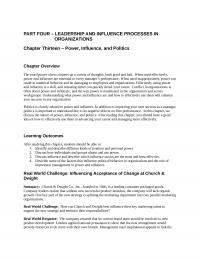
PART FOUR – LEADERSHIP AND INFLUENCE PROCESSES IN ORGANIZATIONS Chapter Thirteen – Power, Influence, and Politics Chapter Overview The word power often conjures up a variety of thoughts, both good and bad. When used effectively, power and influence are essential […]
978-1305501393 Chapter 12 Solution Manual
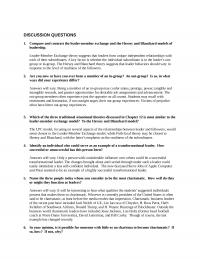
DISCUSSION QUESTIONS 1. Compare and contrast the leader-member exchange and the Hersey and Blanchard models of leadership. Leader-Member Exchange theory suggests that leaders form unique independent relationships with 2. Are you now or have you ever been a member of […]
978-1305501393 Chapter 12 Lecture Note
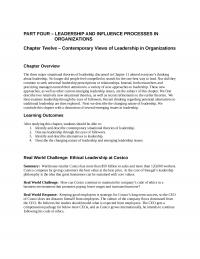
PART FOUR – LEADERSHIP AND INFLUENCE PROCESSES IN ORGANIZATIONS Chapter Twelve – Contemporary Views of Leadership in Organizations Chapter Overview The three major situational theories of leadership discussed in Chapter 11 altered everyone’s thinking about leadership. No longer did people […]
978-1305501393 Chapter 11 Solution Manual
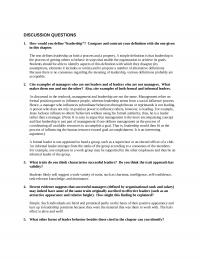
DISCUSSION QUESTIONS 1. How would you define “leadership”? Compare and contrast your definition with the one given in this chapter. The text defines leadership as both a process and a property. A simple definition is that leadership is the process […]
978-1305501393 Chapter 11 Lecture Note
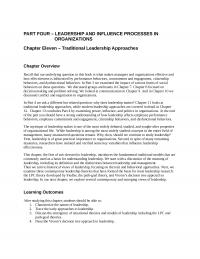
PART FOUR – LEADERSHIP AND INFLUENCE PROCESSES IN ORGANIZATIONS Chapter Eleven – Traditional Leadership Approaches Chapter Overview Recall that our underlying question in this book is what makes managers and organizations effective and how effectiveness is influenced by performance behaviors, […]
978-1305501393 Chapter 10 Solution Manual
DISCUSSION QUESTIONS 1. Have you ever experienced a constructive conflict? What happened? How was the disagreement resolved? Students can share their experiences. I serve on the organizing committee for a chorale. We were to perform Beethoven’s Ninth Symphony in partnership […]
978-1305501393 Chapter 10 Lecture Note
PART THREE – SOCIAL AND GROUP PROCESSES IN ORGANIZATIONS Chapter Ten – Managing Conflict and Negotiating Chapter Overview Conflict is an inevitable result of interdependencies among people, workgroups, and organizations. Given that all organizations are interdependent systems, organizations without conflict […]
978-1305501393 Chapter 1 Solution Manual
DISCUSSION QUESTIONS 1. What do you think are the most important things a manager does? Is how a manager does these things also important? Why or why not? The ability to understand what people think and feel, knowing how to […]
978-1305501393 Chapter 1 Lecture Note
PART ONE – INTRODUCTION TO ORGANIZATIONAL BEHAVIOR Chapter One – An Overview of Organizational Behavior Overview Managers strive to make their organizations as effective and successful as possible. To do this they rely on assets such as financial reserves and […]
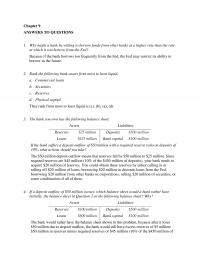
978-0133836790 Chapter 9
Chapter 9 ANSWERS TO QUESTIONS 1. Why might a bank be willing to borrow funds from other banks at a higher rate than the rate at which it can borrow from the Fed? 2. Rank the following bank assets from […]
978-0133836790 Chapter 8
Chapter 8 ANSWERS TO QUESTIONS 1. For each of the following countries, identify the single most important (largest) and least important (smallest) source of external funding: United States; Germany; Japan; Canada. Comment on the similarities and differences among the countries’ […]
978-0133836790 Chapter 7
Chapter 7 ANSWERS TO QUESTIONS 1. What basic principle of finance can be applied to the valuation of any investment asset? investment will generate over its life. 2. What are the two main sources of cash flows for a stockholder? […]
978-0133836790 Chapter 6
Chapter 6 ANSWERS TO QUESTIONS 1. If junk bonds are “junk,” then why do investors buy them? 2. Which should have the higher risk premium on its interest rates, a corporate bond with a Moody’s Baa rating or a corporate […]
978-0133836790 Chapter 5 Part 2
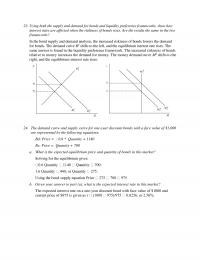
23. Using both the supply and demand for bonds and liquidity preference frameworks, show how interest rates are affected when the riskiness of bonds rises. Are the results the same in the two frameworks? 24. The demand curve and supply […]
978-0133836790 Chapter 5 Part 1
Chapter 5 ANSWERS TO QUESTIONS 1. Explain why you would be more or less willing to buy a share of Microsoft stock in the following situations: a. Your wealth falls. Less, because your wealth has declined 2. Explain why you […]
978-0133836790 Chapter 4
Chapter 4 ANSWERS TO QUESTIONS 1. Would a dollar tomorrow be worth more to you today when the interest rate is 20% or when it is 10%? higher interest rate today. 2. Write down the formula that is used to […]
978-0133836790 Chapter 3
Chapter 3 ANSWERS TO QUESTIONS 1. Why is simply counting currency an inadequate measure of money? 2. In prison, cigarettes are sometimes used among inmates as a form of payment. How is it possible for cigarettes to solve the “double […]
978-0133836790 Chapter 25
Chapter 25 ANSWERS TO QUESTIONS 1. In 2009, in the wake of the global financial crisis and when interest rates were at their lowest, the U.S. government instituted a “cash for clunkers” program and later a “cash for durables were […]
978-0133836790 Chapter 24 Part 2
21. What traits characterize a “conservative” central banker? A conservative central banker is one who has a strong and notable dislike for inflation. In other words, a conservative central banker would be appointed to project a strong aversion to inflation […]
978-0133836790 Chapter 24 Part 1
Chapter 24 ANSWERS TO QUESTIONS 1. What does the Lucas critique state about the limitations of our current understanding of the way in which the economy works? 2. “The Lucas critique by itself casts doubt on the ability of discretionary […]
978-0133836790 Chapter 23 Part 2
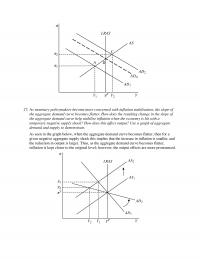
27. As monetary policymakers become more concerned with inflation stabilization, the slope of the aggregate demand curve becomes flatter. How does the resulting change in the slope of the aggregate demand curve help stabilize inflation when the economy is hit […]
978-0133836790 Chapter 23 Part 1
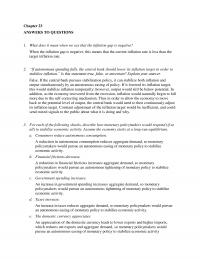
Chapter 23 ANSWERS TO QUESTIONS 1. What does it mean when we say that the inflation gap is negative? 2. “If autonomous spending falls, the central bank should lower its inflation target in order to stabilize inflation.” Is this statement […]
978-0133836790 Chapter 22 Part 2
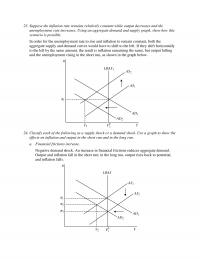
23. Suppose the inflation rate remains relatively constant while output decreases and the unemployment rate increases. Using an aggregate demand and supply graph, show how this scenario is possible. 24. Classify each of the following as a supply shock or […]
978-0133836790 Chapter 22 Part 1
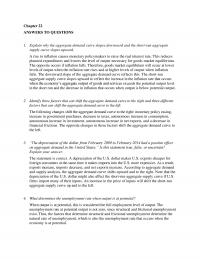
Chapter 22 ANSWERS TO QUESTIONS 1. Explain why the aggregate demand curve slopes downward and the short-run aggregate supply curve slopes upward. 2. Identify three factors that can shift the aggregate demand curve to the right and three different factors […]
978-0133836790 Chapter 21 Part 2
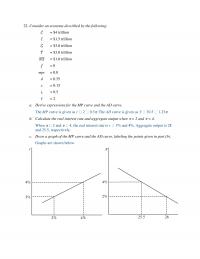
22. Consider an economy described by the following: 𝐶 = $4 trillion 𝐼 = $1.5 trillion 𝐺 = $3.0 trillion 𝑇 = $3.0 trillion 𝑁𝑋 = $1.0 trillion 𝑓 = 0 mpc = 0.8 d […]
978-0133836790 Chapter 21 Part 1
Chapter 21 ANSWERS TO QUESTIONS 1. When the inflation rate increases, what happens to the federal funds rate? Operationally, how does the Fed adjust the federal funds rate? 2. What is the key assumption underlying the Fed’s ability to control […]
978-0133836790 Chapter 20 Part 2
20. Suppose that Dell Corporation has 20,000 computers in its warehouses on December 31, 2016, ready to be shipped to merchants (each computer is valued at $500). By December 31, 2017, Dell Corporation has 25,000 computers ready to be shipped, […]
978-0133836790 Chapter 20 Part 1
Chapter 20 ANSWERS TO QUESTIONS 1. “When the stock market rises, investment spending is increasing.” Is this statement true, false, or uncertain? Explain your answer. 2. Why is inventory investment counted as part of aggregate spending if it isn’t actually […]
978-0133836790 Chapter 2
Chapter 2 ANSWERS TO QUESTIONS 1. If I can buy a car today for $5,000 and it is worth $10,000 in extra income to me next year because it enables me to get a job as a traveling salesman, should […]
978-0133836790 Chapter 19
Chapter 19 ANSWERS TO QUESTIONS 1. How would you expect velocity to typically behave over the course of the business cycle? 2. If velocity and aggregate output are reasonably constant (as the classical economists believed), what will happen to the […]
978-0133836790 Chapter 18
Chapter 18 ANSWERS TO QUESTIONS 1. If the Federal Reserve buys dollars in the foreign exchange market but conducts an offsetting open market operation to sterilize the intervention, what will be the impact on international reserves, the money supply, and […]
978-0133836790 Chapter 17
Chapter 17 ANSWERS TO QUESTIONS 1. When the euro appreciates, are you more likely to drink California wine or French wine? 2. “A country is always worse off when its currency is weak (falls in value).” Is this statement true, […]
978-0133836790 Chapter 16 Part 2
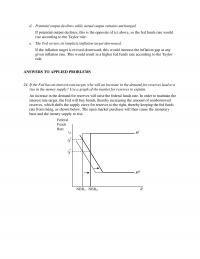
d. Potential output declines while actual output remains unchanged. e. The Fed revises its (implicit) inflation target downward. If the inflation target is revised downward, this would increase the inflation gap at any given inflation rate. This would result in […]
978-0133836790 Chapter 16 Part 1
Chapter 16 ANSWERS TO QUESTIONS 1. What are the benefits of using a nominal anchor for the conduct of monetary policy? 2. What incentives arise for a central bank to fall into the time-inconsistency trap of pursuing overly expansionary monetary […]
978-0133836790 Chapter 15 Part 2
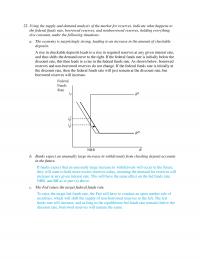
22. Using the supply and demand analysis of the market for reserves, indicate what happens to the federal funds rate, borrowed reserves, and nonborrowed reserves, holding everything else constant, under the following situations. a. The economy is surprisingly strong, leading […]
978-0133836790 Chapter 15 Part 1
Chapter 15 ANSWERS TO QUESTIONS 1. If the manager of the open market desk hears that a snowstorm is about to strike New York City, making it difficult to present checks for payment there and so raising the float, what […]
978-0133836790 Chapter 14 Part 2
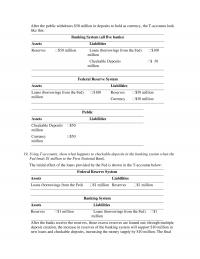
After the public withdraws $50 million in deposits to hold as currency, the T-accounts look like this: Banking System (all five banks) Assets Liabilities Reserves Loans (borrowings from the Fed) million million Federal Reserve System Assets Liabilities Loans (borrowings from […]
978-0133836790 Chapter 14 Part 1
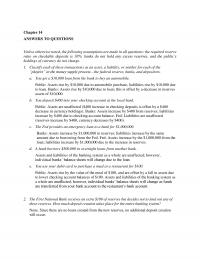
Chapter 14 ANSWERS TO QUESTIONS holdings of currency do not change. 1. Classify each of these transactions as an asset, a liability, or neither for each of the “players” in the money supply process—the federal reserve, banks, and depositors. a. […]