Chapter 5
ANSWERS TO QUESTIONS
1. Explain why you would be more or less willing to buy a share of Microsoft stock in the
following situations:
a. Your wealth falls.
Less, because your wealth has declined
2. Explain why you would be more or less willing to buy a house under the following
circumstances:
a. You just inherited $100,000.
More, because your wealth has increased
d. Prices in the stock market become more volatile.
e. You expect housing prices to fall.
3. Explain why you would be more or less willing to buy gold under the following
circumstances:
b. Prices in the gold market become more volatile.
4. Explain why you would be more or less willing to buy long-term AT&T bonds under the
following circumstances:
c. Brokerage commissions on stocks fall.
d. You expect interest rates to rise.
e. Brokerage commissions on bonds fall.
5. What will happen to the demand for Rembrandt paintings if the stock market undergoes a
boom? Why?
Rembrandts would rise.
6. “The more risk–averse people are, the more likely they are to diversify.” Is this statement
true, false, or uncertain? Explain your answer.
7. “No one who is risk-averse will ever buy a security that has a lower expected return, more
risk, and less liquidity than another security.” Is this statement true, false, or uncertain?
Explain your answer.
8. What effect will a sudden increase in the volatility of gold prices have on interest rates?
9. How might a sudden increase in people’s expectations of future real estate prices affect
interest rates?
10. Explain what effect a large federal deficit should have on interest rates.
11. In the aftermath of the global economic crisis that started to take hold in 2008, U.S.
government budget deficits increased dramatically, yet interest rates on U.S. Treasury debt fell
sharply and stayed low for quite some time. Does this make sense? Why or why not?
12. Will there be an effect on interest rates if brokerage commissions on stocks fall? Explain
your answer.
13. The president of the United States announces in a press conference that he will fight the higher
inflation rate with a new anti-inflation program. Predict what will happen to interest rates if
the public believes him.
14. Predict what will happen to interest rates if the public suddenly expects a large increase in
stock prices.
15. Predict what will happen to interest rates if prices in the bond market become more volatile.
16. Would fiscal policymakers ever have reason to worry about potentially inflationary
conditions? Why or why not?
17. Why should a rise in the price level (but not in expected inflation) cause interest rates to rise
when the nominal money supply is fixed?
18. If the next chair of the Federal Reserve Board has a reputation for advocating an even
slower rate of money growth than the current chair, what will happen to interest rates?
Discuss the possible resulting situations.
19. M1 money growth in the U.S. was about 15% in 2011 and 2012, and 10% in 2013. Over the
same time period, the yield on 3-month Treasury bills was close to 0%. Given these high
rates of money growth, why did interest rates stay so low, rather than increase? What does
this say about the income, price-level, and expected-inflation effects?
ANSWERS TO APPLIED PROBLEMS
20. Suppose you visit with a financial adviser, and you are considering investing some of your
wealth in one of three investment portfolios: stocks, bonds, or commodities. Your financial
adviser provides you with the following table, which gives the probabilities of possible
returns from each investment:
Stocks
Bonds
Commodities
Probability
Return
Probability
Return
Probability
Return
0.25
12%
0.6
10%
0.2
20%
0.25
10%
0.4
7.50%
0.25
12%
0.25
8%
0.25
6%
0.25
6%
0.25
4%
0.05
0%
a. Which investment should you choose to maximize your expected return: stocks, bonds, or
commodities?
9%. The expected return on the
b. If you are risk-averse and have to choose between the stock and the bond investments,
which should you choose? Why?
21. An important way in which the Federal Reserve decreases the money supply is by selling
bonds to the public. Using a supply and demand analysis for bonds, show what effect this
action has on interest rates. Is your answer consistent with what you would expect to find
with the liquidity preference framework?
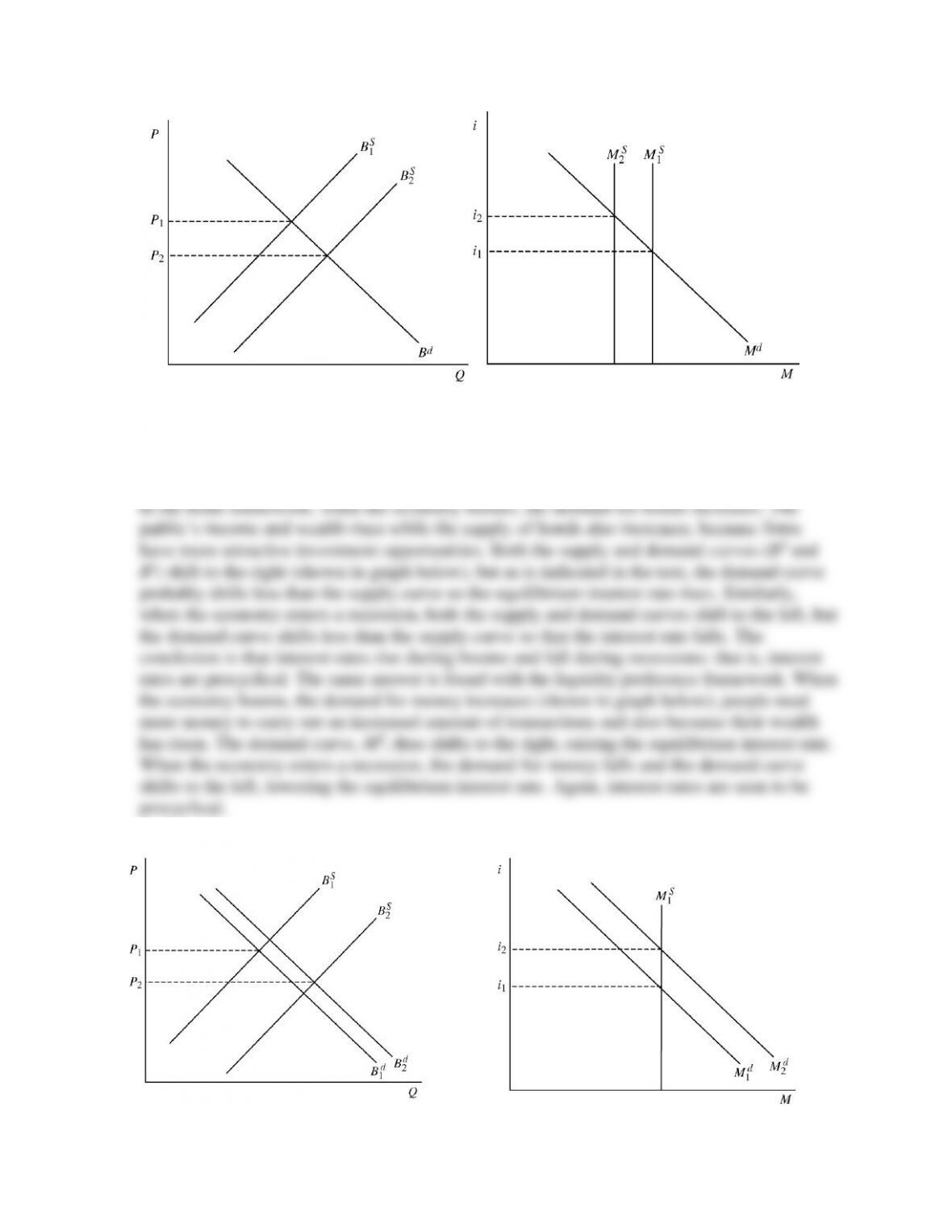
22. Using both the liquidity preference framework and the supply and demand for bonds
framework, show why interest rates are procyclical (rising when the economy is expanding
and falling during recessions).